
Your Guide to Adaptive Fitness Programs That Actually Work
Ever feel like you're just going through the motions with a generic workout video? You know the one—the impossibly fit instructor is either crushing a pace you can't match or moving so slowly you start checking your email mid-lunge. That's the problem with one-size-fits-all fitness. It has no idea who you are, what you're capable of, or what you're trying to achieve.
This is where adaptive fitness programs come in to save the day. They're the complete opposite of that static, pre-recorded routine. Forget the video that plays the same way every time. Instead, picture your workout as a responsive video game. When you master a level, the next one gets tougher. If you're struggling, it dials back the difficulty to help you build up your skills.
These programs use technology to turn your workout into a two-way conversation. It's a smart system built to keep you in that perfect zone—the sweet spot right between "I'm so bored" and "I'm about to collapse." That’s where real, consistent progress happens.
At its heart, the idea is refreshingly simple: your fitness plan should evolve with you. A workout that was challenging last month should be a warm-up today. That’s the magic of adaptation.
Here’s what really makes these programs different from your standard workout app:
This intelligent approach is a huge reason why the global fitness app market, valued between USD 8.5–12.1 billion in 2024, is set to skyrocket. People are tired of passive video libraries; they want smart, responsive coaching that actually gets them results. You can find out more about the fitness app market forecast and see what's driving this massive shift.
To really see the difference, let's break down how these two approaches stack up side-by-side.
This table quickly shows you why adaptive programs are changing the game.
Essentially, traditional fitness gives you a map and wishes you luck. An adaptive program acts as your personal GPS, recalculating the route whenever you hit traffic or find a shortcut.
So, what's the secret sauce behind a fitness program that just gets you? It's not magic. It’s a smart, systematic approach built on three core pillars that work together like a well-oiled machine. Think of it like a personal tailor: they take your measurements, draft a unique pattern, and make adjustments as you go.
This intelligent design makes sure your workout is always just right for you, keeping you hooked and helping you get better without getting hurt. Let's pull back the curtain on each of these essential parts.
Before a smart program can cook up your perfect workout, it needs to get to know you. This is the assessment phase. Forget stressful tests; think of this as your fitness origin story. It’s like creating a character in a video game—you have to set your starting stats before you can head out on your quest.
This initial get-to-know-you session might include:
All this data creates a clear picture of where you are right now, giving the system everything it needs to move on to the fun part.
Once the program has your stats, the personalization pillar kicks into gear. This is where the real magic happens. The AI takes everything it learned about you and builds a workout that fits you like a glove. It’s like having a master chef design a meal just for your taste buds.
Forget generic, cookie-cutter routines. The system designs a session specifically for your abilities. If the assessment showed you’ve got legs of steel but your shoulders are a bit tight, your workout will reflect that. It won’t throw you into movements you’re not ready for, which is key for dodging injuries and building a solid foundation.
The final, and arguably most important, pillar is progression. A workout plan that stays the same is a plan that’s destined to fail. Your body is incredibly clever and adapts to whatever you throw at it. To keep getting stronger and fitter, you have to constantly dial up the challenge just enough.
This is where adaptive fitness programs truly leave the old-school methods in the dust.
The system is always watching, learning from your performance. Did you nail that set of squats? Hold that yoga pose without a wobble? The program sees that and makes a note to nudge the difficulty up just a bit for next time.
This smart, gradual advancement keeps you in that perfect growth zone—challenged enough to improve, but never so much that you feel overwhelmed. Of course, to make this all work, you need to know how to track fitness progress, since that data is the fuel that powers the whole adaptive engine. It’s what keeps you moving forward, one workout at a time.
So, what's the magic behind adaptive fitness programs? Let's pull back the curtain. It’s not about fiddling with a bunch of complicated gadgets; it's about smart, simple tools doing the heavy lifting in the background.
Think of the AI as a GPS for your body. It uses your data to map out the quickest, safest, and most effective route to your fitness destination.
The real star of the show is computer vision. This is just a fancy way of saying the AI can "see" and understand your movements using your device's camera.
Let's say you're flowing through a yoga session and move into Warrior II. The AI is watching, analyzing your form with mind-boggling precision. It'll notice if your front knee is inching past your ankle or if your shoulders are tensing up by your ears, then offer a gentle voice cue to guide you back into alignment. Just like that, your phone transforms from a passive screen into a personal, eagle-eyed coach.
But it’s not just about what you look like; it’s about what you feel like. The best programs also tap into your body’s signals through biometric data.
That heart rate data from your smartwatch? It's gold. If your heart is pounding out of your chest during a high-intensity interval, the AI might suggest taking a longer breather. If your heart rate is lagging, it could give you a little nudge to kick it up a gear. This constant conversation between your body and the app ensures you’re always in that sweet spot for maximum results.
This concept map breaks down how these smart elements—Assessment, Personalization, and Progression—flow into one another to create a workout that’s always just for you.
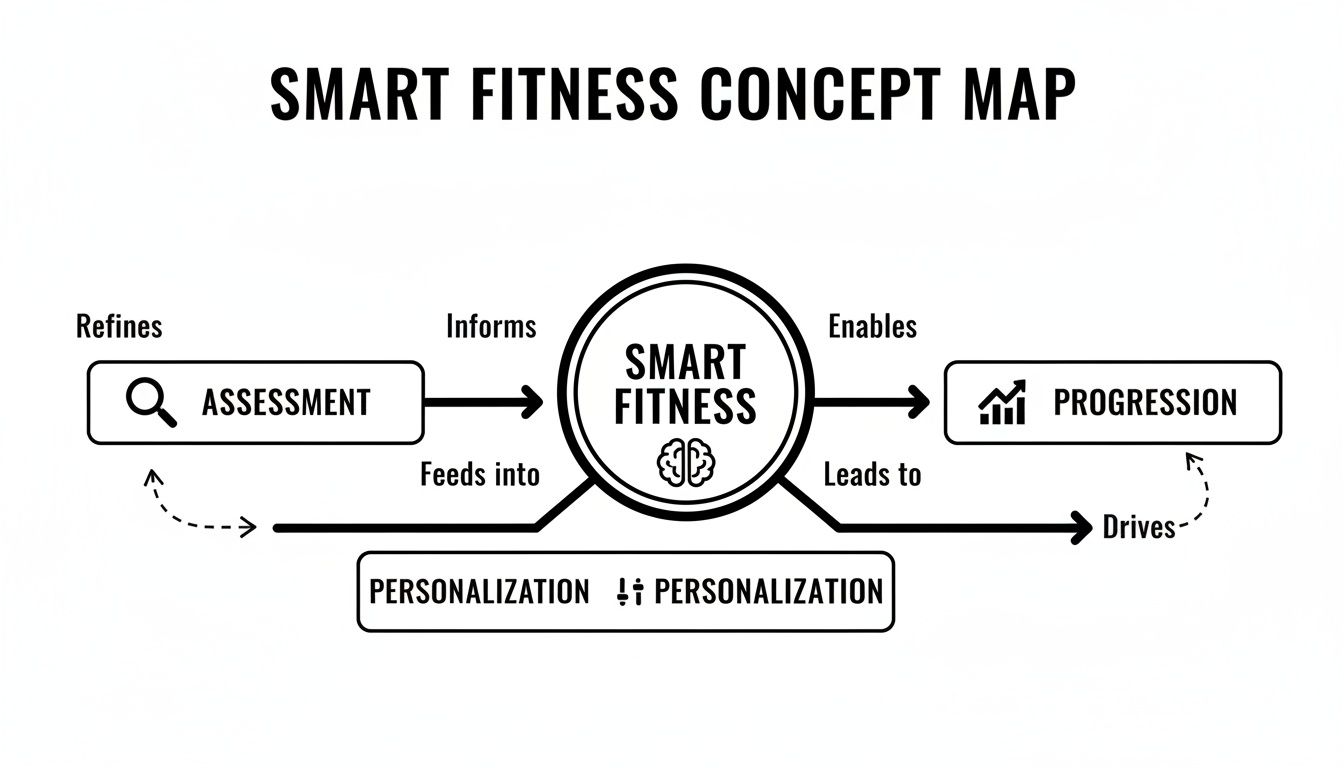
As you can see, your initial performance feeds the plan, and as you get stronger, the plan evolves right along with you. It’s a beautiful, continuous cycle of improvement.
So, who's processing all this information? That would be the machine learning algorithms. These are the digital brains of the operation, constantly learning your patterns and preferences.
They remember you struggled with lunges last week and use that intel to tweak today’s session. This clever system blends real-time feedback with your workout history to make smart predictions, turning your fitness routine into a dynamic, two-way conversation.
The results speak for themselves. When a program actually responds to you, you're far more likely to stick with it. One app saw a whopping 35% boost in sales just by tailoring workouts to individual needs. It's clear that personalization isn't just a feature; it's a massive motivator. You can dig into more stats on the growth of the fitness app market on Technavio.com.
By combining visual analysis with biometric feedback, these systems deliver a level of personalized coaching that used to be reserved for pro athletes. Many of these same principles are popping up in the world of smart home gym equipment, too, where connected machines work in concert to build a responsive workout environment.
Ultimately, it’s all designed to help you move better, safer, and more effectively, turning those big fitness goals into something you can actually achieve.
The real magic of adaptive fitness isn’t hidden in lines of code or complex algorithms—it’s in the tangible results it delivers for everyday people. Enough with the theory. Let's look at how this plays out for three different individuals, each with their own unique goals and hurdles.
First up is Sarah, a project manager whose schedule is, to put it mildly, chaotic. One week she’s glued to her desk hitting deadlines, and the next she’s hopping on a plane for a client meeting. Trying to shoehorn a rigid, one-hour workout into that kind of life was a recipe for failure.
Her adaptive program, on the other hand, actually learns her rhythm.
When she manages to squeeze in a 20-minute session on a crazy Tuesday, the system takes note. The next day, it might suggest a slightly longer, more intense workout to keep her moving toward her goals, but it never demands time she simply doesn't have. It’s fitness that finally bends to her life, not the other way around.
Next, meet David, a competitive cyclist who had hit a wall. He was training like a beast but his race times just wouldn't budge. He felt strong, but the stopwatch was telling him a different story.
David started using an adaptive app synced with his heart rate monitor and quickly found the culprit: his recovery time between high-intensity sprints was lagging. The program immediately got to work, automatically adjusting his training to include targeted recovery drills and tweaking the length of his intervals.
Within a few weeks, he was shaving precious seconds off his personal bests. The program saw a weakness he was completely blind to and served up the exact fix he needed to break through.
Finally, let’s talk about Alex. They’d always wanted to get into yoga but felt completely out of their depth in fast-paced studio classes. Enter an AI-powered platform like Dalm, which gave Alex a virtual instructor who is endlessly patient, incredibly precise, and always on call.
During a session, Alex moves into the Warrior II pose. The camera-based AI instantly analyzes their form.
"Gently lower your hips," a calm voice suggests. "And extend your arms parallel to the floor."
The AI isn't just passively watching; it's seeing Alex's alignment with medical-grade precision. It picks up on a slight forward lean and offers a subtle cue to correct it. At the end of the session, the app flags this as an area to work on. The very next workout it builds for Alex includes specific hip-opening exercises to develop the strength and flexibility needed to perfect that pose.
This immediate, data-driven feedback is a game-changer. Alex isn't just mimicking movements on a screen; they're actively learning and getting better with every single session. It’s how adaptive yoga builds real confidence and skill, one pose at a time. The tech is essentially building a live model of your body's abilities, a concept we dive into in our post on AI digital twins. This deeply personal approach guarantees that everyone gets the exact guidance they need, right when they need it.
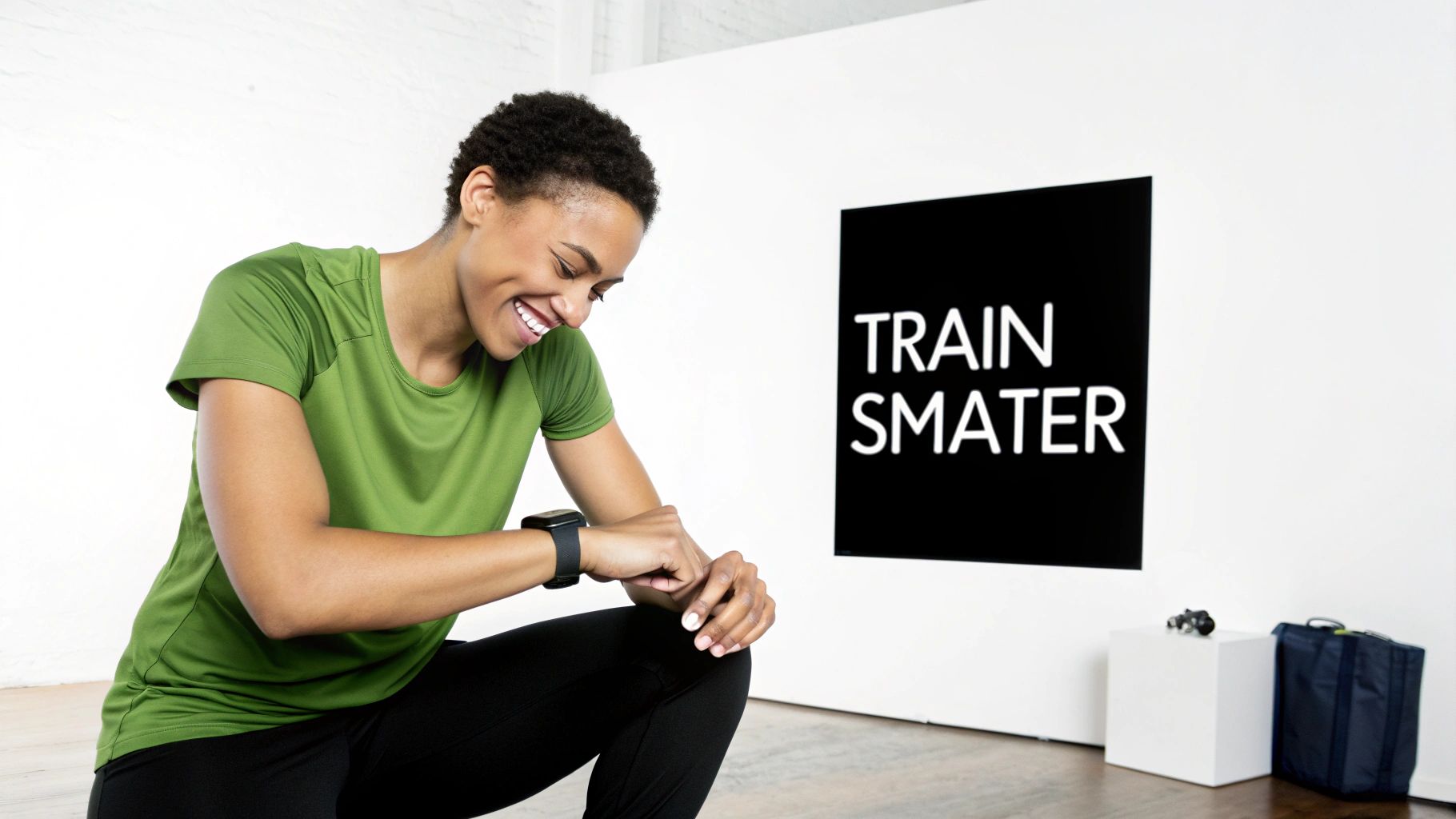
So, what's the big deal with adaptive fitness? The payoff goes way beyond just a smarter workout. It completely reframes how you think about and do exercise, making it safer, way more engaging, and incredibly effective—no matter where you're starting from.
One of the biggest wins is a massive drop in injury risk. Let’s be real, a generic workout video has no clue if your left glute is tired or if your squat form is a little wonky. An adaptive system, on the other hand, acts like a personal spotter. It makes sure every move is solid and stops you from pushing past your limits into the injury zone.
This personal touch is also a secret weapon against boredom, the silent killer of just about every fitness goal. When a workout is always perfectly calibrated to your current ability, it never gets stale. You’re constantly being pushed just enough to feel challenged, but never so much that you feel defeated. That’s the sweet spot that keeps motivation burning bright.
Adaptive fitness isn't some elite tool reserved for pro athletes. It's for everyone. By zeroing in on exactly what your body needs on any given day, these programs get you better results in less time. No more spinning your wheels on exercises that aren't actually moving the needle.
The whole idea is simple but profound: Fitness should work for every single body. It’s about creating a space where your goals feel reachable, your progress is obvious, and the process is something you actually look forward to.
This focus on making fitness truly personal is fueling a massive global trend. While North America is currently the biggest player, pulling in about 39-40% of all fitness app revenue, the Asia-Pacific region is catching up at lightning speed. This boom isn't just a fad; it points to a universal craving for fitness that finally gets the individual. You can dive into more stats on the global fitness app market from Grand View Research.
The benefits create a powerful domino effect, building momentum that makes it easier to stick with your routine. Here’s a taste of what to expect:
Bottom line? Adaptive fitness takes the guesswork and frustration out of getting healthy. It makes hitting your goals safer, faster, and a whole lot more fun.
Jumping into something new always sparks a bit of curiosity. When that "something new" is a fitness program that blends personal training with some seriously smart tech, the questions are bound to fly. You might be wondering how it all really works, if it can actually replace a human coach, or what happens to your data.
Let’s get right to it. This section tackles the most common questions head-on, giving you the clear, straightforward answers you're looking for. We'll pull back the curtain on the tech, talk through the practical stuff, and show you exactly how this new-school approach to fitness can work for you.
Not a chance. In fact, the best adaptive fitness platforms are designed to feel incredibly simple and intuitive. All the complex AI and number-crunching happens behind the scenes, leaving you with a clean, focused experience.
Think of it like driving a modern car. You don’t need to be a mechanic to get behind the wheel; you just drive. You trust that all the advanced engineering is humming along to give you a smooth, safe ride. It's the same idea here. If you can use your phone to order a coffee, you’ve got all the skills you need. The tech does the heavy lifting so you can focus on your workout.
That's the million-dollar question, isn't it? The honest answer is a bit of a "yes and no." While an app can't give you a high-five or offer the same in-person connection as a human coach, it brings some unique and powerful advantages to the table.
Let's break down the differences:
For many people, an adaptive program is the perfect standalone tool—it's consistent, accessible, and always pushing them just the right amount. Others use it to supplement their sessions with a human trainer, getting the best of both worlds.
This is where the magic really happens. The app acts like a super-perceptive coach, picking up on tiny cues to figure out when you're hitting your limit.
It starts with computer vision, which can spot subtle shifts in your form. As you get tired, maybe your movements get a little shaky, your posture starts to sag, or your pace slows down. The AI sees these visual clues and flags them as fatigue.
Another huge piece of the puzzle is biometric data. By connecting with a wearable like your smartwatch, the app keeps an eye on your heart rate. If it spikes way higher than usual or doesn't drop during a rest period, the system knows you're working hard and might suggest a modification or a longer break.
Finally, a lot of programs just ask you! A simple "How did that feel on a scale of 1 to 5?" at the end of a set provides the algorithm with direct feedback it uses to dial the intensity up or down for your next session.
Absolutely. Data privacy is, and should be, a massive priority for any reputable fitness company. Your health information is incredibly personal, and the leading platforms treat it with the seriousness it deserves. Before you sign up for anything, it's always smart to check out the privacy policy.
Here’s what you should expect from any platform you trust with your data:
At the end of the day, you're in the driver's seat. Stick with platforms that are transparent about their security and give you full control over your information.
Ready to experience a yoga practice that truly understands you? Dalm uses AI-powered pose analysis and real-time feedback to create sessions that are uniquely yours. Perfect your form, see your progress, and join a community dedicated to mindful movement. Start your personalized yoga journey today at Dalm.co.