
Discover what is mind body connection and how your thoughts shape your health. Learn science-backed practices to unlock harmony and well-being today.
Ever felt that flutter in your stomach before a big presentation? Or found yourself pacing around the room when you’re stressed out of your mind? That’s not just a coincidence. It’s the mind-body connection in action—a powerful two-way street where your thoughts, feelings, and beliefs directly influence your physical health, and vice versa.
Picture your brain as the high-tech command center of your entire body. Your thoughts and emotions are the operators, constantly sending out signals that ripple through your entire system. Every single thought, whether you realize it or not, triggers a physical response.
This isn’t some new-age philosophy; it’s hardwired biology. That knot in your stomach from anxiety? That's a real, physical reaction caused by stress hormones flooding your gut. On the flip side, feelings of joy and gratitude can actually give your immune system a helpful boost.
This internal communication system means your mental chatter isn’t just background noise—it's a series of commands. For a long time, this was understood mostly through experience, but now science is catching up and literally mapping it out.
A groundbreaking 2023 study found the mind-body connection physically built into our brain's architecture. Researchers discovered that parts of the brain controlling movement are directly plugged into networks that handle thinking and planning. This finally explains why just thinking about moving can fire up those muscles, and why anxiety gives you that antsy, can't-sit-still feeling.
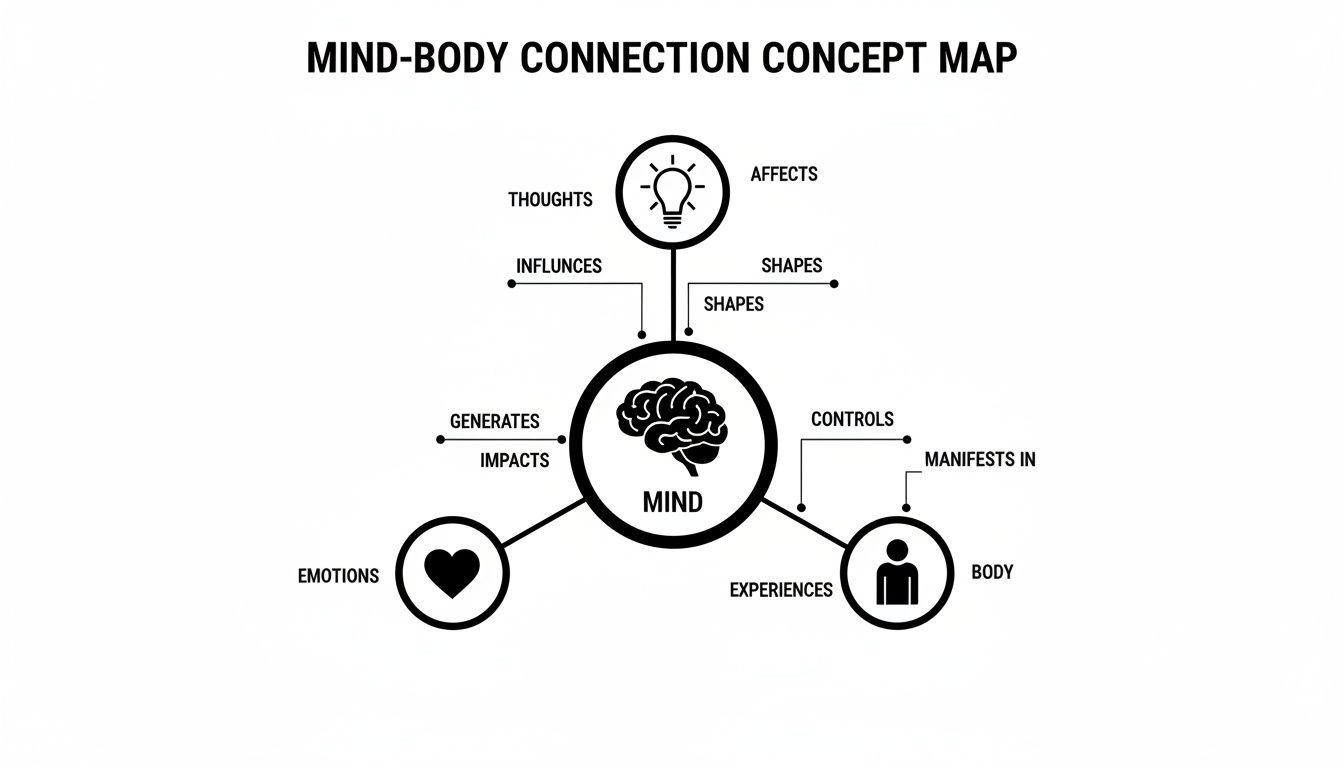
As you can see, it's a constant feedback loop. Your mental state creates physical sensations, which in turn influence your thoughts and emotions.
To help you grasp this, here's a quick breakdown of how these components interact in daily life.
By understanding this dynamic, you can start using it to your advantage instead of letting it run on autopilot.
Just knowing this connection exists is the first step. You can go from being a passenger on this wild ride to grabbing the steering wheel.
If you’re looking to sharpen your focus even further, you might find it helpful to explore tools and strategies like assistive technology for ADHD to boost focus. By getting a handle on your mind-body connection, you unlock the secret to guiding your own well-being.

Ever feel like your brain is stuck in a massive traffic jam? Some thoughts just loop endlessly, while stress and frustration create mental gridlock. It’s a familiar feeling. Now, imagine you could become the city planner for your own mind, building new, smoother highways and rerouting that congested traffic.
That’s exactly what practices like yoga and mindfulness empower you to do. This isn't just a feel-good metaphor; it’s a real phenomenon called neuroplasticity. Your brain has an incredible, built-in ability to reorganize itself by forging new neural connections. When you engage in these mind-body exercises, you are literally changing your brain's physical structure. You’re becoming the architect of your own mental landscape.
Think of your yoga mat or meditation cushion as a gym for your brain. With every session, you’re strengthening key regions. The prefrontal cortex, which you can think of as your brain's cool-headed CEO, gets a serious workout. This is the part of you that handles decision-making and keeps you from flying off the handle. A stronger prefrontal cortex helps you stay centered and calm instead of just reacting to whatever life throws at you.
At the same time, you're upgrading the communication lines between different parts of your brain. It's like giving your emotional brain (the limbic system) and your rational brain (the prefrontal cortex) a crystal-clear phone connection. When a stressful situation pops up, they can talk to each other, allowing you to respond thoughtfully instead of being emotionally hijacked.
A 2021 systematic review of MRI studies drove this point home, confirming that mind-body exercises literally reshape key brain areas. For example, a simple 8-week Tai Chi program was found to increase gray matter volume in regions tied to cognitive function.
This isn't some fringe science. It's proof that intentional movement and mindfulness strengthen the very fabric of your brain, boosting everything from cognition to stress management.
Every single time you choose to take a deep breath instead of snapping in frustration, you’re paving a new neural pathway. At first, it feels like carving a trail through a dense forest—it takes a lot of conscious effort. But the more you walk that path, the wider and clearer it becomes until, one day, it’s your new default.
Here’s a look under the hood at how this transformation happens:
And the best part? You don't have to be a seasoned yogi to see these changes. If you’re just starting your journey, check out our guide on 8 Simple Mindfulness Exercises for Beginners in 2025. By showing up consistently, you are actively rewiring your brain for a calmer, more focused, and resilient life.

Could you actually think yourself into better health? It sounds like a superpower from a comic book, but a mountain of scientific evidence says it’s absolutely possible. Your mindset isn’t just a random collection of thoughts; it's a powerful biological force that can either build you up or, unfortunately, break you down.
The most famous example of this is the placebo effect. This is where people experience real, physical healing just because they believe a treatment will work—even when it's just a sugar pill. On the flip side, there’s the nocebo effect, where negative expectations can create genuine physical harm. This isn't magic. It's your brain acting as its own internal pharmacy, dispensing potent chemicals based entirely on your beliefs.
When you hold a certain thought, your brain doesn't just ponder it. It gets to work, sending a cascade of biochemical messengers zipping through your nervous system. These signals can speed up or slow down your heart rate, rev up or calm down your immune response, and even change how you register pain.
Your mindset can spark measurable, physiological changes in your body, often without changing anything else in your life. It’s one of the most direct and powerful health tools you have.
A brilliant 2007 study brought this to life. Researchers worked with a group of hotel room attendants, who have a very physically demanding job. They told half of the attendants that their daily work was fantastic exercise, meeting doctors' recommendations and burning hundreds of calories. The other half, the control group, got no such information.
The results were stunning. After only four weeks, the group that reframed their work as exercise saw major health boosts. They lost weight, their blood pressure dropped, and their body fat percentage decreased. The control group? Nothing. Despite doing the exact same physical labor, they saw no changes at all. It’s a jaw-dropping look at how perception really can become reality.
And that wasn't just a fluke. Study after study has shown that our perception of our physical activity can be even more important than the activity itself. So, how does a simple belief trigger such a powerful physical reaction? It all comes down to the autonomic nervous system.
Positive thoughts and a proactive mindset send signals that soothe this system. This, in turn, can influence everything from gene expression and neural pathways to the strength of your immune defenses. In fact, a 2023 statement from the American Heart Association, which reviewed 16 different studies, found that mindfulness practices significantly lowered anxiety, depression, and systolic blood pressure—a huge win for heart health. You can dive deeper into the mindset research that backs up these incredible findings.
"A proactive, positive outlook isn’t just a nice-to-have. It’s one of the most effective health interventions out there. When you truly cultivate a belief in your own wellness, you turn your mind into your greatest ally, capable of producing tangible, physical results."
By understanding this deep connection, you can start using your beliefs to actively support your physical well-being. This is where the magic really happens for users of platforms like Dalm. AI-powered yoga with instant voice feedback helps you perfect your form, which builds confidence and creates a powerful positive feedback loop—turning your physical practice into profound mental and physical gains.
Alright, we’ve talked the talk. Now it’s time to walk the walk. Understanding the mind-body connection is one thing, but actually feeling it click into place? That’s where the real magic happens. This is your hands-on guide to forging that link, starting this very minute.
Forget abstract ideas and dense theory. We’re diving into three simple, ridiculously powerful exercises you can try today. Think of them less as a workout and more as fun little experiments to prove just how quickly you can shift your entire state of being.
Let's start with a technique used by everyone from Navy SEALs in high-stakes situations to executives about to walk into a big presentation: Box Breathing. It’s laughably simple but profoundly effective because it sends a direct memo to your nervous system: "Hey, everything's cool. You can relax now."
This is your emergency brake for stress and anxiety. Here’s how to pull it, right now:
Go through this "breathing in a box" pattern a few times. You'll be shocked at how quickly it can quiet a frantic mind and get your shoulders to drop an inch or two from your ears.
Next up: yoga. The classic Sun Salutation A is a beautiful moving meditation that perfectly demonstrates the mind-body connection by tethering your breath to every single movement. The goal isn’t a flawless pose; it’s about experiencing that incredible feeling of your body and breath flowing together as one.
Each movement is choreographed to an inhale or an exhale, creating a rhythm that pulls you right into the present moment. This is the heart of mindful movement, a practice built on deep, intentional awareness. You can explore this idea further in our guide to what is mindful movement and its awesome benefits.
Here’s a simple flow to get you started:
Hang out here in Downward-Facing Dog for five long, deep breaths. Feel the stretch, feel the ground beneath your hands, and feel the rhythm of your own breath. Then, walk your feet forward and reverse the sequence to come back to standing.
Finally, here’s a brilliant mindfulness trick you can pull out of your back pocket anytime, anywhere. If you’re feeling overwhelmed or disconnected, the "5 Senses" grounding technique is a lifesaver. It yanks your awareness out of a spiral of anxious thoughts and plants it firmly in the here and now.
It works by forcing your brain to stop worrying and start noticing. By systematically engaging each sense, you anchor yourself to your immediate surroundings, giving you a quick and effective escape from mental chaos.
The next time your mind starts spinning, just pause and run through this checklist:
These aren’t just exercises; they’re invitations. They’re your first steps toward opening up a better, clearer conversation with your own body. Practice them, play with them, and watch as you build a stronger foundation for calm, resilience, and a deeper sense of well-being.
Yoga, breathwork, and mindfulness are incredibly personal practices. But let's be honest, going it alone can be tough. What if you could have a top-tier instructor right there with you, whispering pointers to deepen your stretch or fix your form during every sun salutation? That’s not some far-off dream anymore—it’s what AI can bring to your living room floor. This is where you put all that mind-body knowledge into high-speed action.

Think of it this way: learning yoga by yourself is like trying to become a guitarist by just listening to the radio. You might figure out the basic tune, but all the little things that make the music beautiful—the way you hold the neck, the pressure on the frets—are easy to miss. An AI yoga coach is your personal music teacher, analyzing every move with a precision that’s almost impossible to achieve on your own.
Dalm is so much more than another fitness app. It’s a dedicated coach that uses your phone's camera to deliver the kind of analysis once reserved for pro athletes. It's built to take your practice from "pretty good" to truly exceptional by zeroing in on the tiny details that make a massive difference.
Picture yourself in Warrior II. You feel powerful, but without realizing it, your back arm is drooping, or your front knee is creeping past your ankle. Instead of finding out hours later from an achy joint, Dalm gives you real-time voice feedback to nudge you into perfect alignment on the spot. This gentle, instant correction is a complete game-changer. It helps you avoid those small, repeated mistakes that can lead to injury, making your practice safer and way more effective.
The real magic is in the precision. By providing medical-grade analysis of your poses, this technology turns every session into a private lesson. You're not just going through the motions; you're truly mastering the mechanics of each and every pose.
This constant feedback loop gives your mind-body connection a serious upgrade. As you tweak your body based on the AI's cues, you’re actively teaching your brain what correct alignment feels like. You're building powerful new neural pathways that make proper form feel like second nature.
One of the biggest frustrations on any wellness journey is hitting a plateau. Dalm is designed to keep you moving forward with a personalized path that adapts to your actual progress. This isn't some cookie-cutter program; it's your own unique yoga roadmap.
The app tracks your improvements, giving you a visual record of how far you've come. Here’s how it keeps you inspired:
This fusion of ancient yoga wisdom and modern tech makes the profound benefits of a strong mind-body connection more attainable than ever. It closes the gap between knowing what to do and knowing if you're doing it right. If you're curious about the technology that makes this possible, exploring dedicated AI courses can offer some fascinating insights. Likewise, learning how a smart yoga mat can work with a digital coach gives you a complete look at the future of home practice. This is how you take the wheel and truly level up your wellness journey.
So, after all this, what’s the big takeaway? Simply put, the mind-body connection isn’t some new-age fad or a strange, mystical force. It’s biology. It's the way you're wired, a fundamental part of your human operating system where every thought creates a very real, physical ripple.
Realizing this is a game-changer. It’s like finding a superpower you’ve had all along. You’re not just a passenger on this ride; you’re in the driver’s seat of your own well-being. Every mindful breath, every yoga pose, every bit of kindness you show yourself is a direct deposit into your long-term health and happiness account.
The real magic happens when you take these ideas and get them off the screen and into your life. It’s all about weaving these practices into your daily routine, because small, consistent actions are what create massive, lasting shifts.
Think of it less like a marathon and more like simply putting one foot in front of the other. You don't need a grand, sweeping gesture. You just need a little bit of attention each day—a moment of quiet, a conscious stretch—to help yourself thrive.
You are not a passive spectator in your own health. You are the one steering the ship. Every choice to tune in, breathe deep, or move with purpose builds your resilience, giving you a powerful buffer against whatever life throws your way.
This mental shift is everything. It takes you from feeling like you're at the mercy of your circumstances to becoming the creator of your own calm and vitality.
Here’s the best part: you don’t have to wait. The starting line is right here. You don’t need fancy gear or a free hour in your schedule. All it takes is a single, intentional moment.
Ready to take that first step? Here’s how you can start today:
Your path to a stronger, more connected life is built one small, mindful action at a time. The most important step you can take is always the next one. So, what’s it going to be?
Alright, let's clear the air. When people hear "mind-body connection," a whole lot of questions (and a few myths) tend to pop up. It's totally normal to be curious. We've gathered some of the most common questions we hear and are here to give you the straight scoop.
Hopefully, that clears a few things up! Now, let's dive a little deeper into some of those answers.
The awesome part is that some perks are almost immediate. Seriously. Just one session of deep breathing or a 5-minute mindfulness exercise can send a wave of calm over you. That instant "ahhh" feeling is your nervous system getting a quick and much-needed reset.
For the more profound, long-term changes—like measurably lower blood pressure or new neural pathways firing—consistency is the name of the game. Most studies point to significant, lasting improvements kicking in after about 4 to 8 weeks of regular practice.
Nope. Not even a little bit. Let's bust this myth right now: Yoga is for every single body, regardless of how far you can (or can't) bend or what your personal beliefs are.
The point isn't to force yourself into a pretzel or achieve some mystical state of enlightenment. It’s simply about showing up and connecting with your own body and breath. Modern tools can even help you start safely and find a rhythm that feels perfect for you, making the whole practice more approachable than ever.
Key Takeaway: The single most effective mind-body exercise to start with is controlled breathing, like the 'Box Breathing' technique. It’s the fastest, most accessible way to directly influence your autonomic nervous system, letting you dial down stress in just a few minutes, anytime and anywhere.
Yes, and it’s a game-changer. Don't think of an AI-powered tool as a replacement for the experience, but as a smart guide that makes it better. It’s like having a personal coach who gives you real-time feedback on your form—the kind of subtle adjustments you’d totally miss when practicing alone.
This has a few massive advantages:
AI simply enhances the traditional practice by making it safer, more effective, and perfectly suited to you.
Ready to stop guessing and start mastering your practice with personalized feedback? Dalm uses medical-grade AI analysis to guide your every move, helping you build a stronger mind-body connection faster than ever before. Start your journey with Dalm today.