
8 Essential Body Awareness Exercises to Master Your Practice in 2026
Ever feel like your mind and body are speaking different languages? You're not alone. It’s easy to live from the neck up, ignoring the constant stream of signals our bodies send us. But what if you could finally tune into that conversation, unlocking a deeper level of control, balance, and physical intelligence?
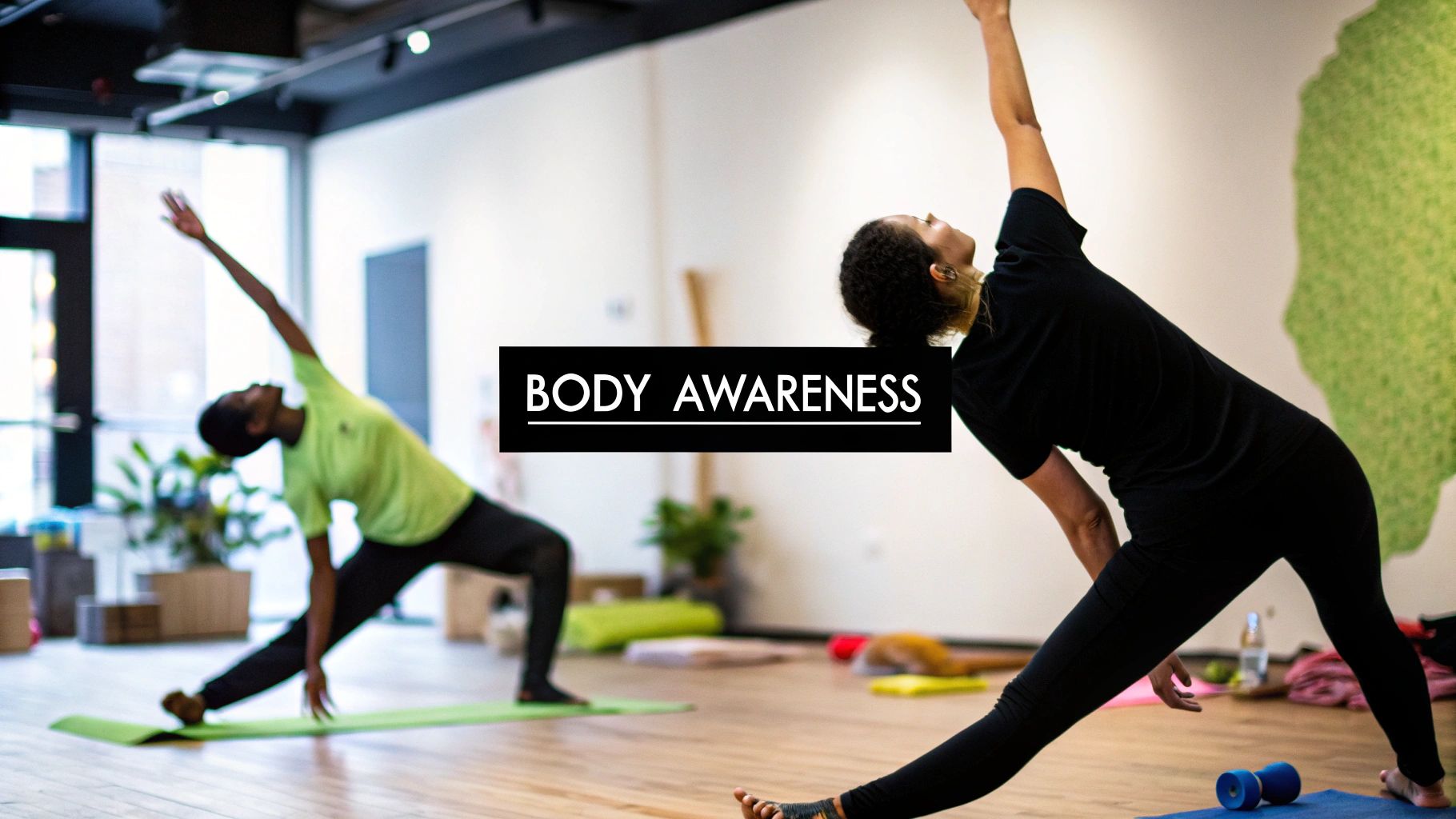
That's the power of body awareness. It’s the secret ingredient that transforms generic exercise into a mindful, powerful practice, helping you move with more efficiency and grace. This isn't just about knowing where your limbs are in space; it's about truly understanding your body’s unique patterns of tension, the rhythm of your breath, and the subtle internal sensations that guide your every move.
We've curated a list of eight potent body awareness exercises designed to bridge that mind-body gap. These practices will sharpen your internal senses, from proprioception (your "joint-position sense") to interoception (your perception of internal states). We'll dive into actionable drills with step-by-step instructions.
Plus, we’ll explore how innovative tools like Dalm’s AI-powered pose analysis can act as your personal translator, turning your body's whispers into clear, actionable feedback to enhance your practice in real-time. Let's get started.
Imagine you're a detective, but instead of a crime scene, your body is the mystery to solve. A Body Scan Meditation is your magnifying glass, one of the most fundamental body awareness exercises for tuning into the subtle clues your body sends you. This mindfulness technique involves methodically sweeping your attention from your toes all the way to the top of your head, noticing every sensation along the way without judgment. Think of it as a friendly, internal meet-and-greet with your own physical self.
You're not trying to change anything, just observe. Is your left big toe tingling? Is there a warmth in your calf? A tightness in your shoulder? This practice, a cornerstone of Jon Kabat-Zinn’s renowned Mindfulness-Based Stress Reduction (MBSR) program, trains your brain to notice the quiet whispers of your body before they become deafening shouts.
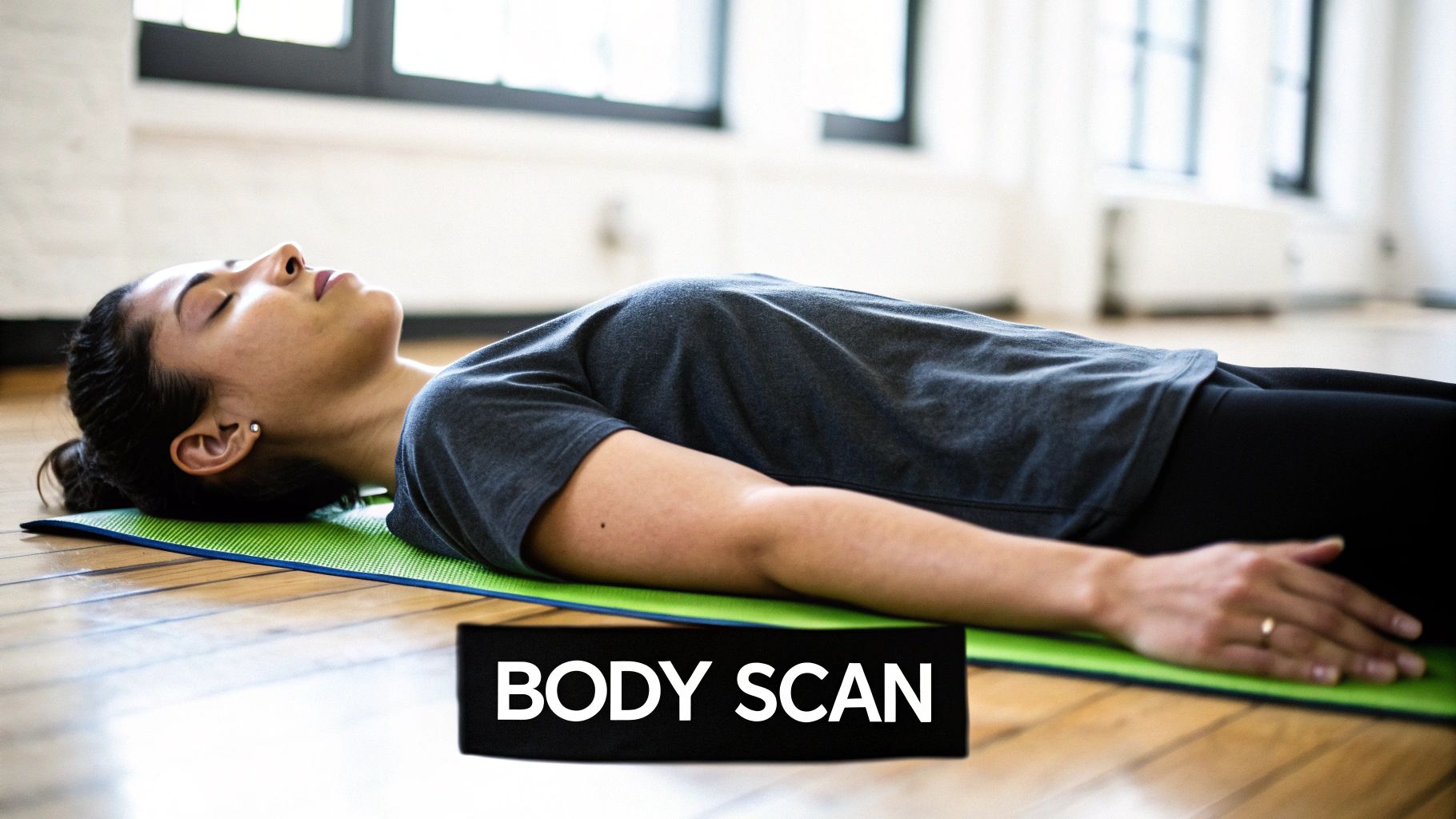
This isn't just about relaxation; it's about building a high-definition sensory map of your body. Athletes use it to pinpoint muscle tension for injury prevention, while healthcare facilities integrate it for chronic pain management. For your yoga practice, a body scan is like upgrading from standard definition to 4K. It sharpens your ability to feel subtle misalignments and understand how your body truly responds to each pose.
Key Insight: The goal isn't to feel "good" or "relaxed." The goal is simply to feel, whatever that feeling might be. This non-judgmental awareness is the secret sauce to profound body connection.
For those just starting, exploring different meditation techniques for beginners can provide a solid foundation. When you pair this heightened sensory acuity with a tool like Dalm’s AI pose feedback, you unlock a new level of practice. The body scan trains you to feel the imbalance, and Dalm’s feedback helps you see it, creating a powerful loop for mastering alignment.
Imagine trying to walk in a pitch-black room. How do you know where your feet are? That’s proprioception, your body's innate GPS. Proprioceptive training hones this "sixth sense," your ability to know where your body parts are in space without looking. It’s one of the most crucial body awareness exercises for building balance, coordination, and an intuitive understanding of your alignment. Think of it as upgrading your internal software to instantly process your body's position and movement.
This neurological skill is what allows a dancer to nail a complex spin or a physical therapy patient to regain stability after an injury. For your yoga practice, strong proprioception means you can feel the subtle shift of weight in Tree Pose or sense if your hips are squared in Warrior I, all without a glance in the mirror. It’s about building a connection so deep that your body’s alignment becomes second nature.
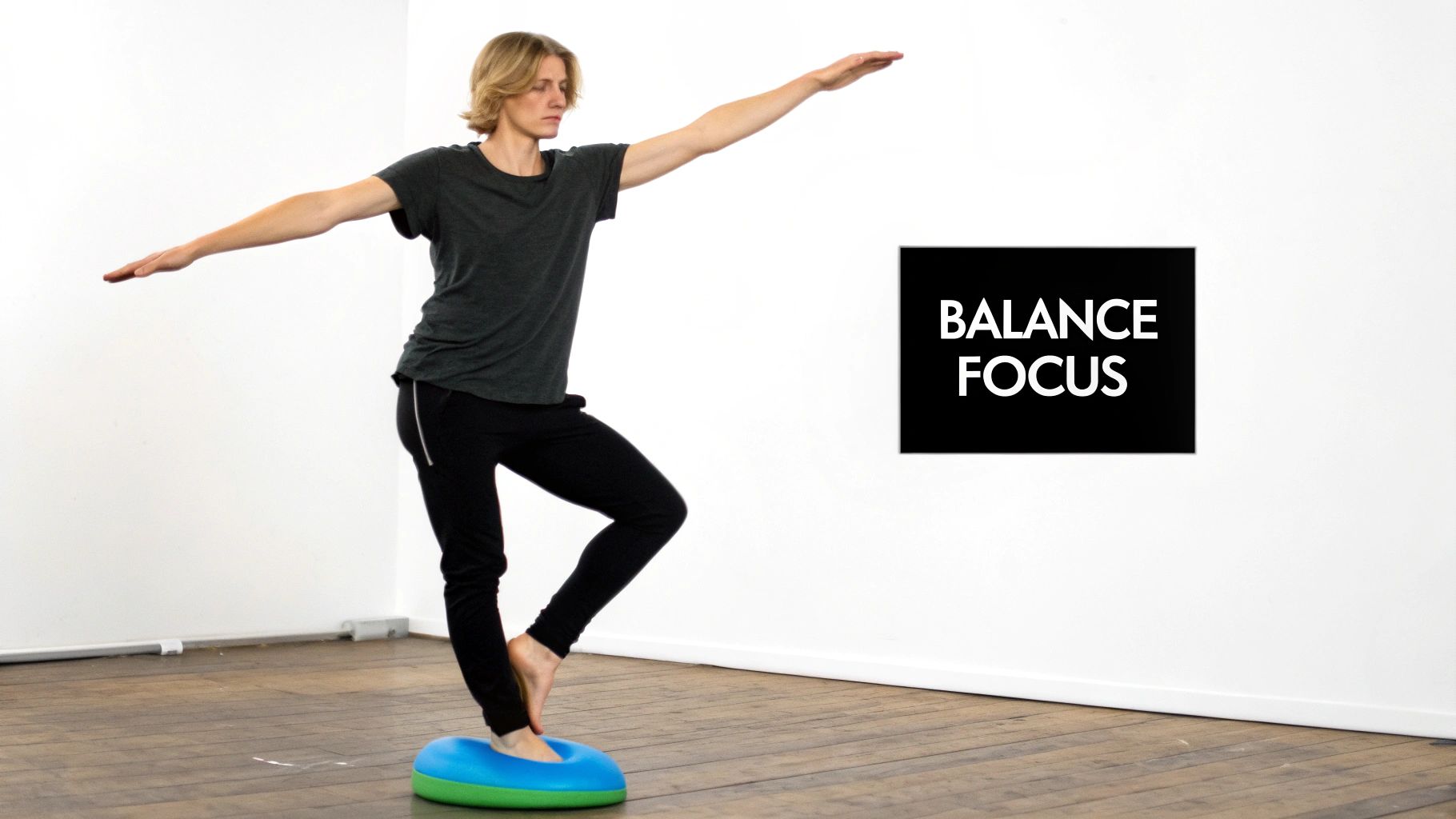
This isn't just about avoiding wobbles; it's about developing true motor control from the inside out. Physical therapists and sports medicine experts, building on the work of pioneers like Dr. Jean Ayres, use these drills to prevent injuries and rehabilitate athletes. For yogis, this training is the bridge between knowing what a pose should look like and truly feeling it in your own body. It transforms your practice from mimicking shapes to embodying them with intelligence and stability.
Key Insight: Proprioception is the conversation between your brain and your body's position sensors (proprioceptors) in your muscles and joints. The clearer the signal, the more precise and stable your movements become.
By actively challenging your balance and spatial awareness, you're not just improving poses; you're rewiring your brain for more masterful movement. To dive deeper into the science behind it, you can explore this guide on what is proprioception training.
Think of your muscles as tiny fists, clenched all day without you even realizing it. Progressive Muscle Relaxation (PMR) is the act of intentionally squeezing those fists even tighter, then letting them go completely. This classic technique, developed by physician Edmund Jacobson, is one of the most direct body awareness exercises for understanding the difference between tension and true relaxation. You systematically tense specific muscle groups, hold, and then release, creating a wave of relief that you consciously track through your body.
It’s a simple but profound process of exaggeration and release. By actively creating tension, you teach your brain what it feels like, making you hyper-aware of the unconscious tension you hold daily. For a yogi, this is like finding hidden brakes in your system; releasing them can unlock newfound depth in your stretches and stability in your poses.
This technique is a powerful tool used far beyond the yoga mat. Clinicians use PMR to treat anxiety disorders and PTSD, while athletes employ it to release pre-competition jitters and improve recovery. For your practice, PMR sharpens your ability to isolate and control individual muscles. It helps you understand why your shoulders creep toward your ears in Plank or why your jaw clenches in a deep hip opener, giving you the power to consciously release that tension on command.
Key Insight: Relaxation isn't a passive state you fall into; it's an active skill you can cultivate. PMR teaches you the physical "how-to" of letting go by first showing you what it feels like to hold on.
Before starting a yoga session with Dalm, a quick PMR sequence can highlight your personal tension hotspots. If you notice significant tightness in your shoulders during PMR, you'll be more prepared to receive and apply Dalm’s real-time feedback when it flags elevated shoulders in your Downward-Facing Dog, turning a frustrating habit into a breakthrough moment.
Think of your breath as the radio signal connecting your mind and body. Most of the time, it's just background noise, but with Breath Awareness and Pranayama, you learn to tune into the frequency. These ancient yogic breathing practices are powerful body awareness exercises that transform your breath from an automatic function into a conscious tool for influencing your physical and mental state. This isn't just about inhaling and exhaling; it's about controlling the rhythm, depth, and flow of your life force.
You're not just moving air; you're directing energy. Practices like the rhythmic Ujjayi breath in a Vinyasa flow generate internal heat and focus, while Nadi Shodhana (Alternate Nostril Breathing) can calm a frayed nervous system. Popularized in the West by masters like B.K.S. Iyengar, these techniques are the bridge between your inner world and your physical form, showing you in real-time how stress quickens your breath or how calm elongates it.
Mastering your breath is like finding the master remote control for your nervous system. For athletes, controlled breathing enhances stamina and focus. For public speakers, it quells performance anxiety. In your yoga practice, breath is everything. It’s the engine that powers your flow, the anchor that stabilizes you in a challenging balance, and the guide that tells you when you're pushing too hard. It turns a series of physical movements into a mindful, moving meditation.
Key Insight: Your breath is an honest mirror of your present state. You cannot be physically tense and have a relaxed, deep breath. Learning to control one directly gives you influence over the other.
Connecting your breath to movement is a core tenet of yoga. When you use a tool like Dalm’s AI feedback, conscious breathing keeps you present and engaged. Your breath becomes the soundtrack to your alignment, helping you find stability and ease as you adjust your form based on the real-time guidance.
Think of your yoga mat as a laboratory and each pose as an experiment in sensation. Practicing yoga asana with a mindful alignment focus transforms it from simple calisthenics into one of the most dynamic body awareness exercises available. Instead of chasing the "perfect" shape, this approach invites you to become a scientist of your own body, exploring how subtle shifts in alignment change your entire physical experience. It's about feeling the pose from the inside out, not just replicating an image.
This method, deeply rooted in traditions like B.K.S. Iyengar's teachings, prioritizes the internal sensations of muscular engagement and skeletal positioning over external aesthetics. You learn to feel the grounding through your feet in Tree Pose or the opening in your hips in Warrior II. It’s a practice of asking, "How does this feel?" rather than just, "How does this look?"
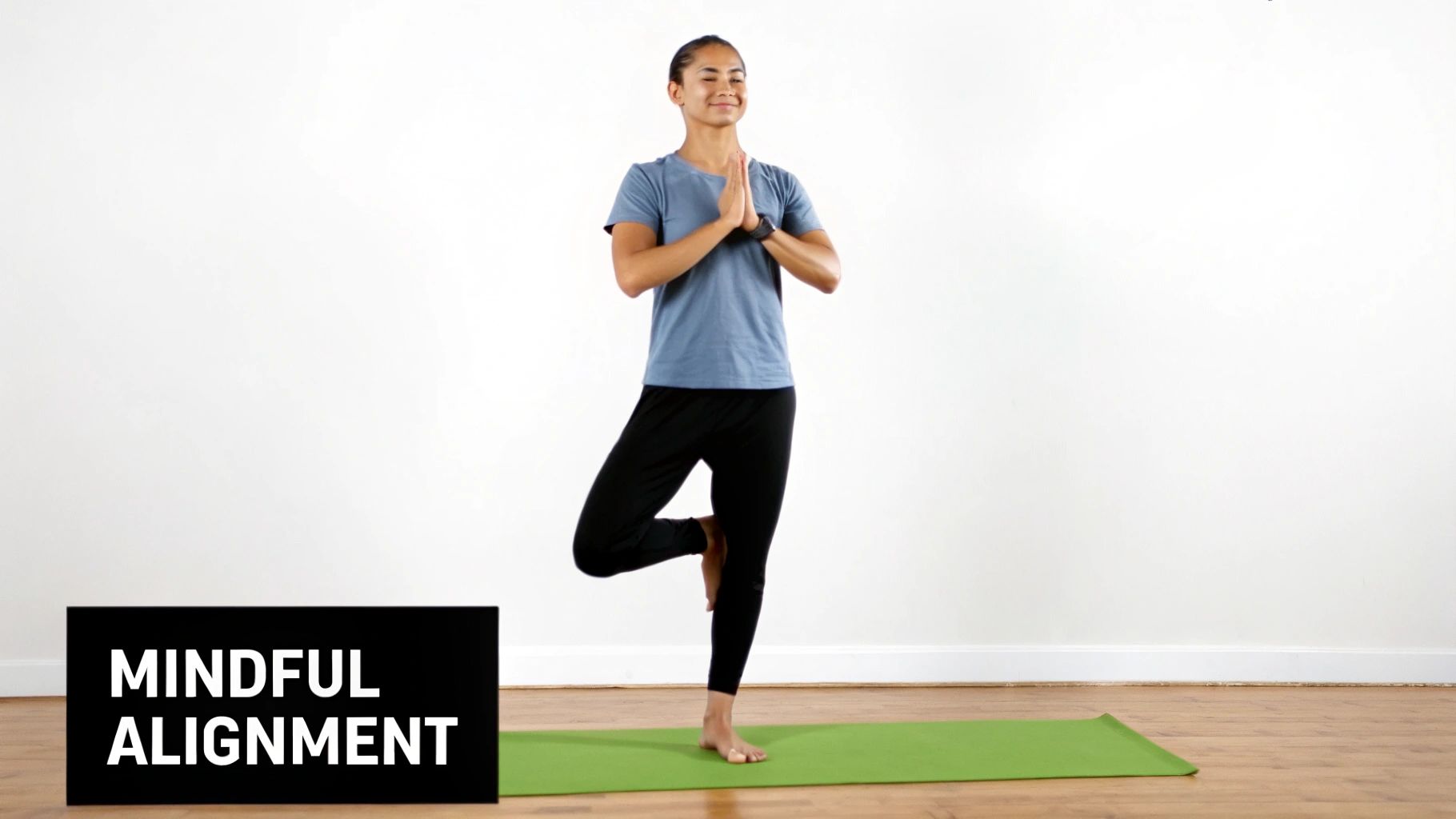
This isn't just about preventing injury; it's about unlocking a deeper conversation with your body. Physical therapists use specific asanas to rehabilitate injuries precisely because of this alignment-centric approach. For your own practice, it elevates movement from rote memorization to a rich, sensory dialogue. You begin to understand your unique anatomy and limitations, building strength and flexibility safely and intelligently.
Key Insight: The true alignment of a pose is found in the sensation of stability and ease within your own body, not in forcing your body to match a picture. It's a personalized, internal blueprint.
Think of your brain as a cartographer and your body as an uncharted continent. Somatic movement is the slow, deliberate exploration that creates a detailed map, connecting mind to muscle. These practices, such as the Feldenkrais Method or Alexander Technique, are foundational body awareness exercises that retrain your nervous system to move more intelligently and efficiently. It’s less about stretching or strengthening and more about re-learning how to move with ease.
You’re not forcing a pose; you're investigating a question. What happens if I lift my arm this way? How does my spine respond when I turn my head? Popularized by pioneers like Moshe Feldenkrais and F.M. Alexander, this approach helps undo inefficient neuromuscular habits we've developed from injury or daily life. It's about finding the path of least resistance in your own body.
This is the software update for your body's operating system. Dancers and musicians use these techniques to prevent repetitive strain injuries and refine their artistry, while others use it for postural re-education. In yoga, somatic exploration can dissolve chronic tension that holds you back in certain asanas. By creating a clearer mental "body map," you can initiate movement from the right places, making poses feel more integrated and less strained.
Key Insight: The quality of the movement is more important than the range of motion. Small, mindful explorations create more profound neurological change than large, forceful stretches.
Pairing this internal investigation with a tool like Dalm’s AI feedback is incredibly powerful. Somatic movement sharpens your internal sense of alignment, while Dalm’s real-time analysis provides the external validation, confirming if what you feel matches what is actually happening. This creates a closed-loop system for mastering your body's unique mechanics.
Think of interoception as your body's internal news channel, broadcasting updates on everything from your heart rate to your hunger levels. Interoception Training is the practice of tuning into this channel, developing a keen awareness of what’s happening inside your body. While other body awareness exercises like proprioception focus on where your limbs are in space, interoception is all about perceiving your internal physiological state.
This isn't just about knowing you're thirsty; it's about feeling the subtle signals your body sends long before that. This deep internal listening, championed by researchers like Dr. Bessel van der Kolk for its role in trauma recovery, is the bedrock of emotional regulation and mind-body integration. It’s the skill that lets you feel the physical flutter of anxiety in your stomach or the warmth of contentment spreading through your chest.
Developing interoceptive awareness is like gaining a superpower for self-regulation. Athletes use it to gauge exertion levels and find their optimal performance zone, while clinical psychology leverages it to help individuals manage anxiety and panic disorders by recognizing early physical triggers. For your yoga practice, it transforms movement from a purely physical act into a rich, internal dialogue, helping you understand how each pose truly makes you feel on the inside.
Key Insight: Your emotions have a physical signature. Interoception training teaches you to read these signatures, giving you the power to respond to your feelings instead of just reacting to them.
Imagine trying to navigate a dense forest blindfolded. That's what movement without awareness can feel like. Mindful movement practices are your guide, combining slow, intentional motion with a deep focus on bodily sensations. Think of it as a moving meditation, where the goal is to fully inhabit your body as it flows through space. Practices like Tai Chi, Qigong, and even conscious walking are cornerstone body awareness exercises that build your kinesthetic sense, which is your internal GPS for movement.
You're not just going through the motions; you're feeling every shift in weight, every muscle engagement, and every joint rotation. This isn't about athletic performance but about sensory richness. By deliberately slowing down, you give your nervous system time to process the flood of proprioceptive feedback, creating a more detailed and accurate map of your body in motion. It's the difference between hearing a symphony in mono and experiencing it in full surround sound.
This practice transforms movement from a subconscious habit into a conscious conversation with your body. Ancient traditions like Tai Chi have been used for centuries to improve balance and reduce stress, while modern movement therapies use these principles for emotional and physical integration. For your yoga or fitness routine, cultivating kinesthetic awareness means you can feel an imbalance before it causes an injury. It's the skill that allows you to internalize alignment cues, making corrections from the inside out.
Key Insight: The focus is on the feeling of the movement, not its external appearance. True kinesthetic mastery is about how a movement feels, not how it looks in the mirror.
For those looking to deepen this practice, understanding the fundamentals is key. You can explore a more comprehensive guide on what is mindful movement to build a solid foundation. When you use mindful movement as a warm-up for a Dalm session, you prime your body to be more receptive to feedback. You’ve already opened the lines of communication, making it easier to understand and apply Dalm’s real-time corrections.
So, you’ve made it through the grand tour of body awareness exercises, from the quiet stillness of the Body Scan to the dynamic exploration of Mindful Movement. If your brain feels a little buzzed and your body is itching to try something new, that's a fantastic sign. You're on the cusp of starting one of the most rewarding dialogues you'll ever have: the one with your own physical self.
This journey isn't about achieving a flawless yoga pose or perfectly executing a complex movement on the first try. It’s about tuning into the subtle, and sometimes not-so-subtle, signals your body sends every second. It’s the difference between mindlessly going through the motions and consciously inhabiting your own skin.
Think of each exercise we've covered as a unique tool in your sensory toolkit. You've now got a whole new set of instruments to work with:
The real magic happens when you stop seeing these as isolated drills and start weaving them into the fabric of your life. Body awareness isn't just for the yoga mat; it’s for how you sit at your desk, how you lift groceries, and how you hold yourself during a stressful conversation. It's about transforming unconscious patterns into conscious, powerful choices.
Feeling overwhelmed by all the options? Don't be. The goal is progress, not perfection. Pick just one exercise that felt intriguing or accessible and commit to practicing it for five minutes, three times this week. That’s it. See what happens.
Remember, your body has been whispering, and sometimes shouting, at you for your entire life. These body awareness exercises are simply you learning its language. By practicing them, you’re finally picking up the phone to answer its call. You're cultivating a partnership built on trust, respect, and a deep, intuitive understanding. This relationship is the foundation for improved physical performance, better mental health, and a more vibrant, connected existence. The conversation is just beginning, and your body has so much to tell you.
Ready to turn internal feelings into visible, actionable data? Supercharge your practice with Dalm, the AI-powered movement coach that provides medical-grade analysis and real-time feedback on your form. Stop guessing and start knowing by visiting Dalm to see how you can build a smarter, safer, and more connected body awareness practice today.