
functional movement assessment: Improve movement quality now
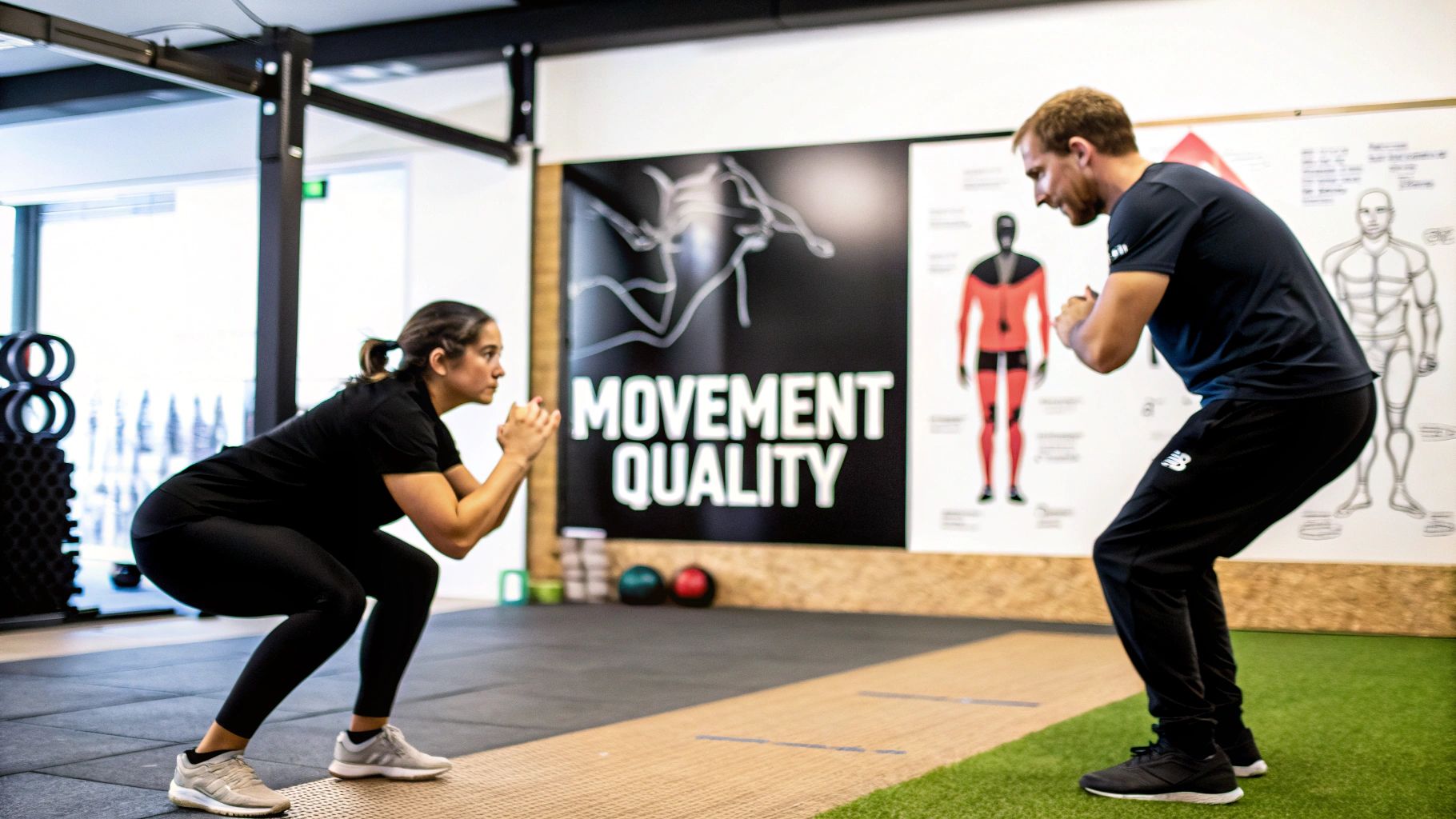
Ever wonder why that one shoulder always acts up, or why your lower back groans after a long walk? A functional movement assessment is like hiring a detective for your body to find out exactly why. It’s a methodical look at your basic movement patterns—think squats, lunges, and reaching—to spot the hidden weak spots and imbalances that could be causing trouble.
This isn't about how much you can lift or how fast you can run. It’s about the quality of your movement. It’s a check-up that gets to the root of problems before they sideline you with an injury.
Imagine your body is a high-performance car. A functional movement assessment is the diagnostic scan a master mechanic runs. It doesn't just check the horsepower (your strength); it checks the alignment, the timing, and ensures all the parts are communicating correctly to deliver a smooth, powerful ride.
Back in the day, fitness tests were all about numbers—body fat percentage, bench press max, mile time. And while those numbers have their place, they missed a giant piece of the puzzle: how well you actually move. We’ve since learned that piling strength on top of shoddy movement patterns is like building a skyscraper on a cracked foundation. It's just asking for trouble.
That's where the assessment comes in. It helps pinpoint the real culprit behind your aches. Your nagging knee pain? The assessment might reveal it has nothing to do with your knee and everything to do with weak hips or stiff ankles, forcing your knee to take a beating it was never designed for.
The big idea here is beautifully simple. Your body is built to perform a handful of fundamental movements: push, pull, squat, lunge, hinge, rotate, and carry. When you do any of these, your brain fires off a lightning-fast sequence of commands to your muscles and joints. A movement assessment watches this sequence in slow motion to see if there are any "glitches" in the system.
A functional movement assessment is a proactive strategy. It’s designed to identify the weak links in your kinetic chain before they break, transforming your approach from reactive (fixing pain) to preventive (building resilience).
And this isn't just for pro athletes. It's for anyone who wants to pick up their kids without wincing, enjoy a hike, or just get through the day feeling good. By watching how you do something as simple as standing up from a chair, a skilled coach can gather a goldmine of information about your body’s internal "software."
To really understand what we're looking for, let's break down the core principles.
This table gives you a quick snapshot of what a movement assessment is all about and why each part is so crucial for building a better, more resilient you.
Ultimately, a good assessment decodes your body's unique language, telling you exactly where to focus your efforts for the biggest impact.
An assessment gives you a clear snapshot of where you are right now, exposing the sneaky dysfunctions that might be holding you back. It’s all about answering a few key questions about your body:
Once you identify these weak spots, you can stop guessing and start training with purpose. The goal isn’t to chase a perfect score; it’s to get a personalized roadmap for building a stronger, more efficient, and pain-free body.
Every big idea has an origin story, and the functional movement assessment is no different. This wasn't some stuffy concept cooked up in a lab. It was born in the real world, forged in the trenches of athletic training to answer a maddeningly simple question: why do our strongest, fittest athletes keep getting sidelined by injuries?
Flashback to the late 1990s. Physical therapists Gray Cook and Lee Burton were scratching their heads over this exact problem. They were working with athletes who could lift incredible weights and run at blistering speeds, yet were constantly benched by non-contact injuries. Clearly, raw strength and speed weren't the whole picture. Something crucial was missing.
Their lightbulb moment was to shift the focus. Instead of isolating muscles, why not look at how the body actually moves? They decided to create a simple, repeatable system that any coach could use to spot the hidden cracks in an athlete's foundation before the whole thing came crashing down.
This practical, no-nonsense approach gave birth to the Functional Movement Screen (FMS). Rolled out in 1997, the FMS was designed as a standardized toolkit to spot asymmetries and imbalances across seven basic movement patterns. The tests are intentionally awkward, forcing the body into positions that reveal sneaky weaknesses in mobility and stability that you'd never see in the gym. Want the deep dive? You can uncover the full story of the FMS development on Symmio.com.
This wasn't just another fitness trend; it was a powerful diagnostic tool that quickly caught fire in the high-stakes world of professional sports.
This wasn't an overnight success. It was a system built on a decade of real-world data, refinement, and proof that it worked where it mattered most—on the field.
Knowing where the FMS came from gives us a huge piece of the puzzle. It reminds us that this whole practice is built on a proactive, preventive mindset. The point was never about getting a high score on a test; it was about getting intel on how a body operates.
The FMS was created to start a conversation between the client and the professional. It provides a common language to discuss movement quality, making it possible to design smarter, more effective training programs that build resilience from the ground up.
Think of it this way: Cook and Burton didn't invent movement. They just created a standardized lens to look through. They gave coaches and therapists a systematic way to find the "why" behind someone's dysfunctional patterns. This flipped the script, moving the industry from just chasing symptoms to actually fixing the root cause. That's what makes a functional movement assessment so incredibly valuable for everyone today, from professional athletes to you and me.
Once you start exploring functional movement assessments, you'll hear two acronyms pop up constantly: FMS and SFMA. They sound almost the same, but they’re built for completely different jobs. Picking the right one is like choosing the right tool—you wouldn’t use a sledgehammer to hang a picture frame, would you?
Let's break it down with an analogy. The Functional Movement Screen (FMS) is like your car's annual inspection. It’s a proactive check-up for people who are, for all intents and purposes, healthy and not in pain. The goal is to spot potential alignment issues, faulty wiring, or uneven tire wear before you end up stranded on the side of the road. It’s a screen, designed to catch red flags in your movement patterns before they blossom into full-blown injuries.
On the other hand, the Selective Functional Movement Assessment (SFMA) is the master mechanic you call when the "check engine" light is already flashing. This is a diagnostic tool used by clinicians and physical therapists specifically for people who are currently in pain. It’s not just about spotting a problem; it’s about popping the hood and digging deep to find the precise root cause of that flashing light.
This timeline shows how movement screening evolved from a novel idea to a trusted standard in sports and fitness.
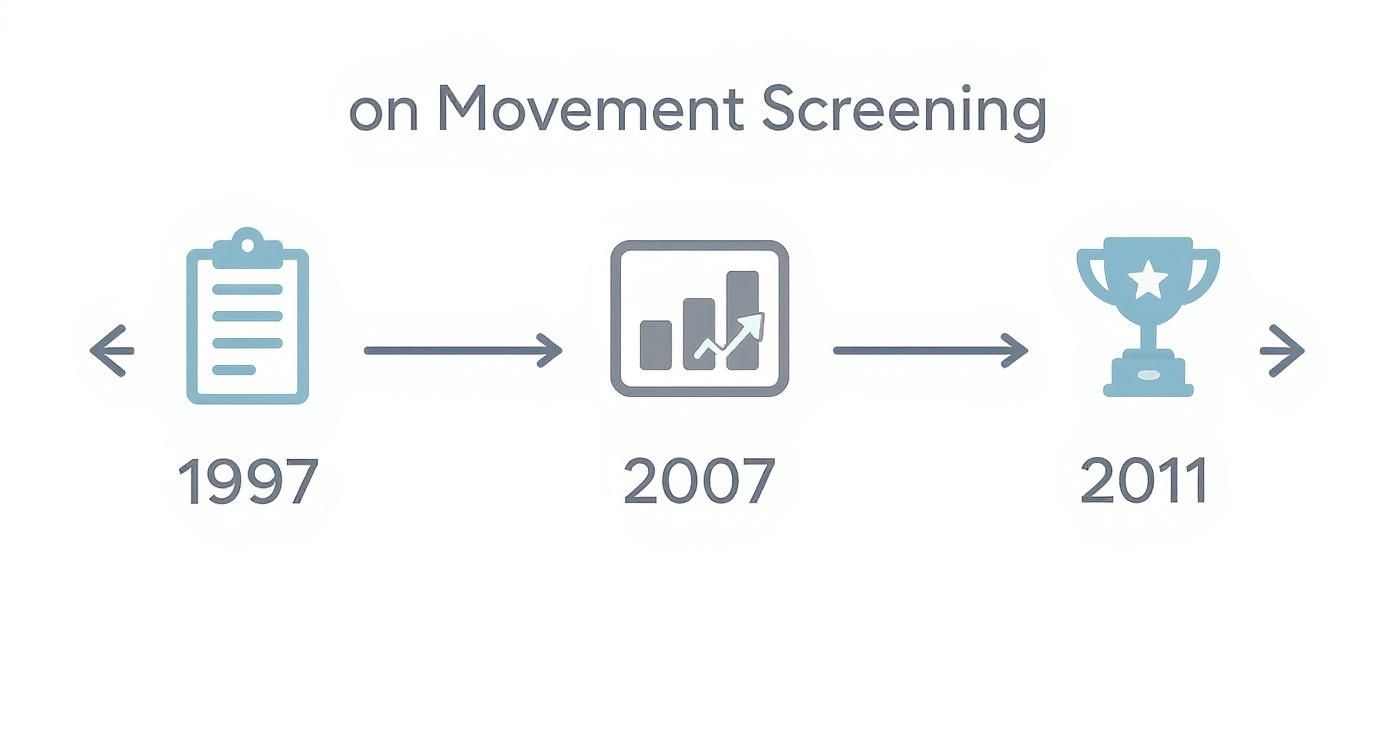
You can see the journey from the FMS's introduction in 1997 to its validation and adoption by major sports leagues over a 14-year period, proving it wasn't just a fad.
Let's dive into how these two protocols stack up head-to-head.
While they serve different purposes, both the FMS and SFMA share a common philosophy: looking at the body as an integrated system, not just a collection of parts.
The FMS is the more famous of the two, a common sight in gyms and training facilities everywhere. It’s a beautifully simple system built around seven movements that put your mobility and stability to the test.
Here are the seven challenges:
Scoring is dead simple. Each test gets a grade on a 0-3 scale. A score of 3 means you crushed it—perfect form. A 2 means you got it done but had to cheat a little. A 1 means you couldn't complete the move properly. Finally, a 0 is an immediate stop sign: you felt pain.
The whole point of the FMS is to catch big-picture problems like major limitations or glaring asymmetries. The rule is simple: if there's pain (a score of 0), the person gets referred to a medical pro. The FMS doesn't diagnose; it screens.
If the FMS flags pain, that’s the SFMA’s cue to enter the scene. Developed in 2004, it was designed to give clinicians a powerful system to investigate the "why" behind someone's pain. It’s a deep, comprehensive tool used by healthcare pros to untangle complex movement issues tied to an injury.
The SFMA involves ten whole-body movements and a sophisticated algorithm to break down faulty patterns and trace them back to their origin. Clinical studies have shown it helps therapists create incredibly effective treatment plans by finding sources of dysfunction that are often far away from the site of pain. For a more technical breakdown, you can read the full research on the SFMA's clinical value.
So, which one is for you? For most people wanting to get fitter, move better, and stay off the sidelines, the FMS is the perfect starting point. It’s the gatekeeper that tells you if your body is ready for more. But if pain is already part of your story, the SFMA is the high-powered diagnostic tool a professional can use to help you write the next chapter: a full recovery.
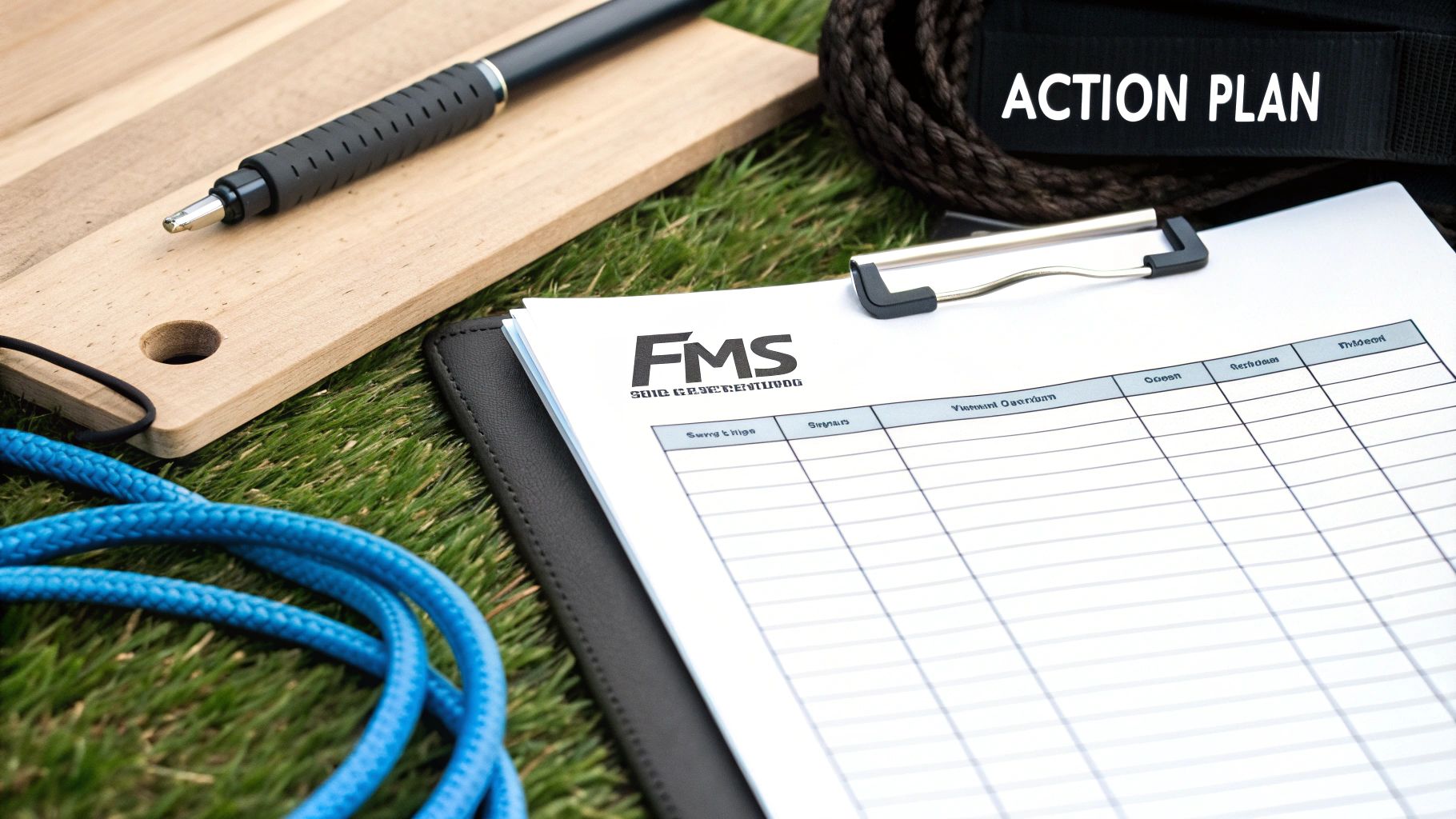
Alright, so you've got your score. Now what? Think of that number less like a report card and more like a treasure map. It’s not judging you; it’s showing you where the good stuff is buried.
The real magic isn’t in the score itself, but in what you do with it. This is where we stop guessing and start getting strategic, turning that raw data into an intelligent plan that goes after the real source of your movement quirks, not just the annoying symptoms.
Every part of your assessment result is a clue. A low score on a specific movement isn’t a sign of failure—it’s a giant, blinking neon arrow pointing you toward a massive opportunity for improvement. Let's crack the code on what these results are really telling you.
For instance, scoring a 1 on the Deep Squat almost never means you just have "bad knees" or "weak legs." It's way more interesting than that! It usually signals that something else is off, forcing your knees to take the blame. The real culprits are often hiding in plain sight:
Suddenly, the path forward is crystal clear. Instead of just gritting your teeth and doing more squats, your action plan will zero in on ankle mobility drills, hip openers, and core activation exercises.
A functional movement assessment score doesn’t judge your fitness; it guides your focus. It helps you stop guessing what’s wrong and start working on exactly what your body needs to move and feel better.
An asymmetrical score is another huge red flag. Let’s say you score a perfect 3 on the Hurdle Step with your right leg but can barely squeak out a 1 with your left. That’s a major imbalance. This lopsidedness creates a chain reaction, forcing one side of your body to constantly work overtime to cover for the slacker side. The fix? Prioritize single-leg exercises to bring that weaker side up to snuff.
Once you understand the "what" and the "why" behind your score, you can build a smart, targeted plan. This isn't about adding another brutal workout to your week. It's about weaving in small, precise movements that teach your body better habits.
A solid action plan follows a simple hierarchy: you have to earn the right to progress. That means tackling mobility first, then stability, and only then adding strength on top.
Here’s how that plays out in the real world:
This methodical approach is the secret sauce. It stops you from layering strength on top of dysfunction—a classic recipe for injury. By focusing on the quality of your movement, you build a foundation that makes everything else you do in the gym or in life safer, stronger, and more effective. Your functional movement assessment is the blueprint for that unshakeable foundation.
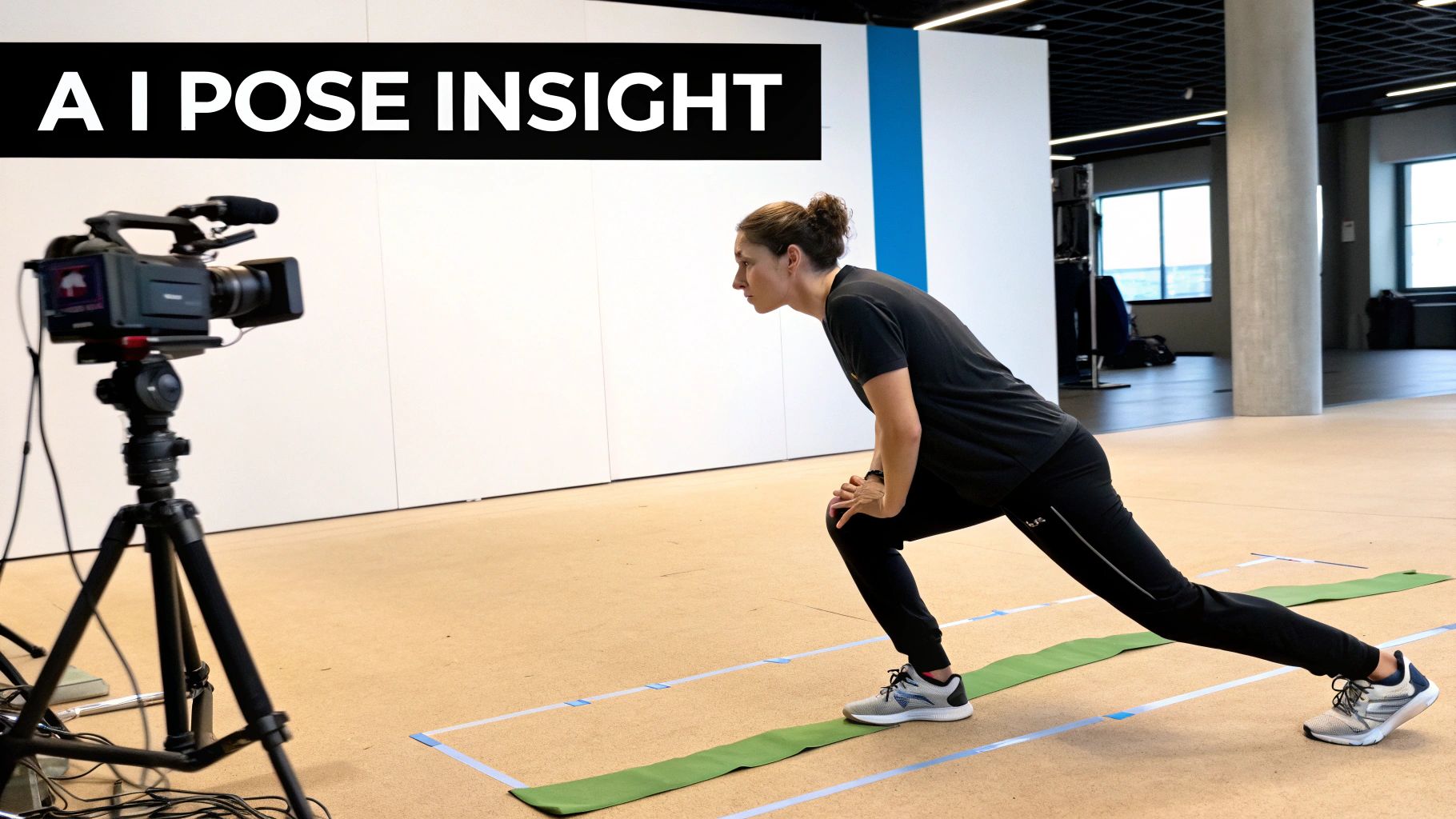
While traditional functional movement assessments have completely changed the game, the next big leap is already upon us. Artificial intelligence is taking the guesswork out of how we analyze movement, bringing a level of precision that used to be confined to high-tech sports science labs.
Think of it like this: your eyes are a fantastic digital camera, but AI is a high-speed, 4K slow-motion camera with built-in analytics software. A great coach can spot the obvious stuff, but AI sees the things we’re physically incapable of catching—the subtle tells that make all the difference.
AI-powered pose analysis is pretty clever. It uses complex algorithms to map out your key joints and track them in 3D space with ridiculous accuracy. This is how it can spot a pelvic tilt that’s off by a mere 2 degrees or a knee that wobbles for a split second during a lunge. Let’s be honest, those are the kinds of tiny compensations that are practically invisible in real-time.
By putting a number on these tiny deviations, AI gives you a purely objective look at how you move. No more subjective bias from the observer. No "good days" vs. "bad days" when it comes to scoring. The data is consistent, reliable, and perfectly repeatable every single time.
AI isn't here to replace the expert—it's here to supercharge them. By taking over the tedious, data-heavy lifting, it frees up coaches to do what humans do best: build relationships, offer encouragement, and design brilliant strategies for improvement.
This kind of detail takes you from a general screening to a microscopic examination, painting a crystal-clear picture of your body's unique movement signature. It's especially powerful when you combine it with tools that dig deep into your overall alignment. To really get into the weeds on this, check out our guide on posture analysis software and see how this tech is changing the wellness world.
Not too long ago, getting this kind of high-fidelity motion capture meant booking time in a facility with a truckload of expensive equipment and a team of specialists. It was the stuff of pro training centers and university research labs—totally out of reach for the rest of us.
AI flips that script completely. It puts the power of a biomechanics lab right onto your smartphone. This shift has massive implications for how we all approach our fitness and well-being.
At the end of the day, AI-driven pose analysis is the natural evolution of the functional movement assessment. It keeps the core principles of observing movement quality but enhances the entire process with unmatched accuracy and objectivity. This isn't just about finding your weak links anymore; it's about getting a precise, data-backed roadmap to build a stronger, more resilient body.
Alright, you've survived the screening and have your results. Now for the fun part: turning that data from a clipboard into a real-world game plan. A functional movement assessment isn't just about finding out what's "wrong"—it's about getting a personalized user manual for your body.
This is where the theory hits the road. Think of your results as a roadmap showing you exactly where to focus your energy to upgrade your performance and durability, whether you're on a yoga mat, under a barbell, or just chasing your kids around the park. It’s time to put that knowledge to work.
Ever been in a yoga class where the instructor cues a pose and your body just goes, "Nope, not happening"? Your assessment results are your permission slip to actually listen to that little voice and modify with confidence.
Let's say your screening flagged some gnarly shoulder mobility issues. Instead of wrestling your way into a deep bind that makes your shoulder scream for mercy, you can now use that self-awareness to make smarter choices.
This isn't about avoiding the hard stuff. It's about working with your body instead of fighting against it. When you respect your current limitations, you can build strength and mobility safely, paving the way for progress without risking an injury that sets you back for weeks.
For anyone lifting weights or playing a sport, a functional movement assessment is your secret weapon against injury. It lets a good trainer spot the bugs in your movement "software" before you start piling on heavy loads, which is usually a one-way ticket to Snap City.
Imagine your FMS results showed a big asymmetry in the Hurdle Step, meaning your left hip is way less stable than your right. A sharp trainer will take that intel and build a program that’s truly designed for you.
Your FMS score basically works like a "red light, yellow light, green light" system for your training. A poor score on a pattern like the Deep Squat doesn't mean you can never squat again. It just means you need to hit the brakes, fix what's causing the problem, and then reintroduce the movement safely.
Instead of jumping straight to heavy back squats (a definite "red light" activity), your plan would start with corrective exercises.
Once that imbalance starts to even out, you earn the right to progress. This whole approach ensures you're building strength on a solid, symmetrical foundation. Of course, consistently applying these insights is what really matters, which is why we put together a guide on how to track fitness progress to help you stay on course.
This is what separates mindless exercise from intelligent training. You get better results, feel stronger, and build a body that’s truly built to last.
Diving into something new always brings up a few questions. The world of functional movement can seem a little complicated from the outside, but once you get the hang of it, the core ideas are actually pretty simple. Let's tackle some of the most common things people ask so you can feel totally confident moving forward.
Think of this as your personal FAQ, designed to give you quick, clear answers.
For most active people, a good rhythm is to get a full functional movement assessment about once a year. This gives you a solid baseline and lets you see how your body is adapting over time.
But life happens, right? Sometimes you need to check in more often. I'd recommend bumping that up to every 3-6 months if you're:
Checking in more frequently helps you tweak your training on the fly, making sure your program grows and changes right along with you.
Look, I get the temptation. You see a video online and think, "I can do that." But honestly, for a real, accurate assessment, this is one of those times you want a pro. The true magic of a functional movement assessment isn't just doing the movement; it's having a trained eye watch how you do it.
A professional will catch the tiny, almost invisible ways your body cheats—like that slight hip hike in a squat or a little twist in your spine when you reach. Those are the details you'd miss on your own, and they're often where the most important clues are hiding.
They're trained to see the things you can only feel. Their expertise is what turns a simple movement test into a personalized, safe, and effective plan for you.
Not a chance! This is probably the biggest myth out there. While movement screens got their start in the world of pro sports, the tool itself is for everyone.
Movement is universal. It doesn't matter if you're chained to a desk all day fighting off back pain, a weekend hiker, or a retiree who just wants to stay balanced and mobile. The assessment finds the same fundamental glitches in movement patterns that can lead to pain or injury for anyone. It's for anybody who wants to move better and feel better in their own skin.
Ready to stop guessing and start seeing your movement with medical-grade precision? Dalm uses AI-powered pose analysis to give you real-time feedback and track your progress, turning your yoga practice into a personalized journey of improvement. Discover what your body is truly capable of at https://dalm.co.