
Easy Hamstring Stretches for Beginners
Ever get up from your desk and feel that familiar, unwelcome tightness tugging at the back of your legs? You’re definitely not alone. The secret to fixing it isn't some complex, pretzel-like yoga pose. For beginners, the best hamstring stretches are all about gentle, sustained holds that safely lengthen the muscle, helping you finally get some relief and move a little easier.
If your hamstrings could talk, they'd probably have a few choice words for your chair. These big, powerful muscles running down the back of your thighs do a ton of work, but our modern lives often put them in a tough spot.
The main offender? Sitting. Lots and lots of sitting. When you're parked in a chair all day, your hamstrings are stuck in a shortened, lazy position. Imagine bunching up a rubber band and leaving it like that for hours—when you finally try to stretch it out, it's not going to be very happy. That's exactly what's happening to your legs.
You might just write off tight hamstrings as the reason you can’t touch your toes. But the trouble they cause can travel all the way up your body. When those muscles are constantly tight, they pull down on your pelvis. This little tug-of-war can flatten the natural curve of your lower back, leading to stiffness and that nagging ache that so many of us know all too well.
It's a sneaky problem. People often try to fix their back pain directly, never realizing the real culprit is hiding in their legs. Getting your posture in check can be a huge help, and as you’ll see in our guide on postural awareness exercises, everything in your body is connected.
Don't just take my word for it. A massive meta-analysis looked at 14 studies with 735 participants and found a direct link. The research confirmed that consistent hamstring stretching significantly cut down pain and improved daily function for people dealing with low back pain. You can dive into the research linking hamstring flexibility to back pain relief if you want to see the data for yourself.
Making time for a few simple hamstring stretches pays off in more ways than just getting rid of aches. Sticking with a simple routine can unlock some seriously great benefits that make a real difference in your day-to-day life.
Here’s what you can look forward to:
Once you understand why your hamstrings are staging a protest, it’s much easier to get motivated to do something about it. The stretches we’re about to cover aren’t just random exercises; they’re your ticket to moving with more freedom and a lot less pain.
Let's get one thing straight: diving headfirst into a deep hamstring stretch without any prep is a recipe for disaster. It’s like trying to bend a cold rubber band—it’s just going to snap. Before you even think about reaching for those toes, we need to cover the absolute non-negotiables for keeping your body safe and happy.
Think of your muscles like a piece of taffy. Cold and stiff, it'll break. Warm it up a bit, and it becomes wonderfully pliable. Your hamstrings are no different. So, rule number one: never, ever stretch cold muscles.
Before you start, you absolutely must spend at least five minutes doing some light cardio. We're not talking about a full-on workout here. The goal is simply to get your blood pumping and warm up that muscle tissue, making it much more receptive to a good stretch.
A few easy ways to do this:
If you want a great, easy-to-follow routine, check out these simple yoga warm up exercises. They’re perfect for getting your whole body primed and ready to move. Think of this little warm-up as your insurance policy against strains and pulls.
This might be the single most important lesson you'll learn on your flexibility journey. You have to know the difference between the feeling of a productive stretch and a red flag from your body telling you to back off.
A good stretch feels like a mild, gentle pulling. It's a tension you can breathe through. On the other hand, "bad" pain is anything sharp, stabbing, burning, or tingling. That's your body slamming on the emergency brakes, and you need to listen. If you feel any of that, ease up immediately.
The old "no pain, no gain" saying is pure nonsense when it comes to stretching. Your goal is to gently coax your muscles into releasing, not wrestle them into submission. Real, lasting progress comes from being consistent and gentle, not from gritting your teeth in agony.
Your breath is your secret weapon here. If you catch yourself holding your breath or your breathing gets shallow, you're pushing way too hard. A deep, steady breath sends a signal to your nervous system that everything is okay, which allows the muscle to actually relax and lengthen. Always remember to exhale as you move deeper into a stretch—it’s a simple trick that changes everything.
Alright, enough of the textbook stuff—let's get to the good part. It's time to meet the five new best friends that will help you finally win the war against tight hamstrings. Don't worry, these aren't complex, pretzel-like yoga poses. They're simple, effective, and absolutely perfect for beginners.
We're going to break down each movement, one by one. But more importantly, I'll show you the common mistakes that trip everyone up and how to nail the form from day one.
This is the ultimate starting point because it puts you in complete control. If you can’t touch your toes (welcome to the club!), a simple bath towel or yoga strap becomes an extension of your arms. It's a brilliant way to gently nudge your muscles into a new range of motion without forcing anything.
Here's how you do it:
Now for the secret sauce: sit up tall and lead with your chest. The goal isn't to touch your head to your knees—that just rounds your back. Instead, imagine bringing your belly button toward your thighs. Gently pull on the towel until you feel mild tension. It should feel like a stretch, not a strain. Hold it for 30-45 seconds.
Taking it to the floor is a game-changer. When you lie on your back, your spine is fully supported, which makes it almost impossible to "cheat" by rounding your lower back. This position beautifully isolates the hamstring, ensuring you're actually stretching the muscle you intend to.
Lie flat on your back on a mat or carpet. Bend both knees and plant your feet flat on the ground.
Carefully extend one leg straight up toward the ceiling. Your other foot stays put. You can gently cradle the back of your raised thigh with both hands for a bit of support. From there, your only job is to work on straightening that raised leg until you feel that familiar hamstring pull. If it’s too much, just bend the knee a little. Easy. Hold for 30-45 seconds, then switch legs.
This one is my go-to for a quick stretch break at the office or while waiting for the kettle to boil. It uses a low, stable surface to give you a fantastic, isolated stretch without getting down on the floor.
Find something sturdy that’s lower than your hip—a solid chair, a park bench, or the bottom step of a staircase will do the trick.
Place the heel of one foot on your chosen surface, keeping that leg straight but not locking the knee. Your other foot should be flat on the floor, pointing forward. Now, put your hands on your hips to keep them from tilting, and hinge forward from your hips—not your waist. Keep that back straight! Once you feel the stretch, hold for 30 seconds per side.
I lovingly call this the laziest—and maybe most effective—stretch in the book. The wall does all the work, allowing you to completely relax and let gravity take over. It’s a passive stretch, meaning you aren’t actively pulling or fighting to get deeper into it.
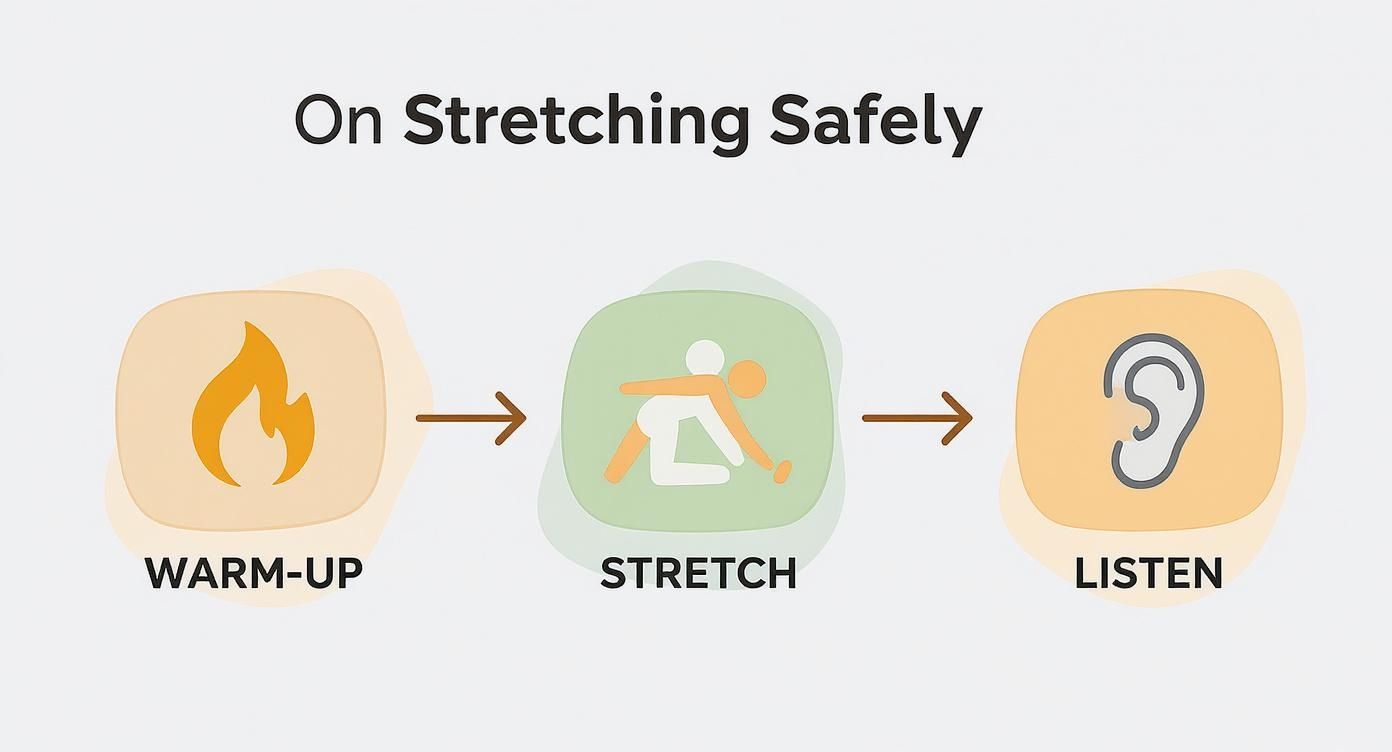
This simple visual is a great reminder of what matters: warm up first, then ease into the stretch, and always pay attention to what your body is telling you. Progress is about consistency and awareness, not brute force.
To get into the wall stretch, lie on your back next to a wall or doorframe. Scoot your hips as close to the wall as you can. Extend one leg up against the wall and keep your other leg bent with the foot on the floor. Now, just breathe and relax. Let the wall support your leg completely. Because it’s so gentle, you can hold this one for 60-90 seconds.
Borrowed from the world of yoga, this pose is an absolute powerhouse. It zeroes in on the hamstring of your front leg while also giving the calf a nice little stretch. It also adds a small balance challenge, which subtly engages your core and improves your overall stability.
Research has shown that passive stretching—where an external force like a wall or a towel helps you out—can lead to bigger, faster flexibility gains. One study found that this method improved hamstring flexibility by an average of 8.2 degrees instantly. It's solid proof that these gentle, supported stretches really do pack a punch. You can dive into the research on passive vs. active stretching if you're curious.
Start by standing with your feet together. Step one foot back about two to three feet. Imagine you're standing on railroad tracks, not a tightrope, so keep your feet about hip-width apart with all ten toes pointing forward.
With a nice flat back, hinge at your hips and gently lower your torso over your front leg. You can rest your hands on your front thigh, on a couple of yoga blocks, or on the floor for support. Feel that deep, satisfying stretch in your front hamstring and hold it for 30 seconds before you slowly come up and switch sides.
So, you've got a few basic hamstring stretches under your belt. That's great! But the real question is, how long do you actually need to hold these things, and how often do you have to do them to feel a real difference? Are we talking a quick 10-second pull, or do you need to hang out in a stretch until your eyes water?
Let’s cut through the noise and build a simple, effective plan that gets you flexible without eating up your entire day.
First things first, forget that old gym class advice about a quick, bouncy stretch. That's a one-way ticket to getting hurt. To actually encourage your muscles to lengthen, you need to give them time to relax into the stretch.
The magic number here is at least 30 seconds. Holding a stretch for this long gives your nervous system a chance to calm down and send the "all clear" signal to your muscles, allowing them to release and lengthen safely.
Anything less than 30 seconds is more of a temporary warm-up than a tool for creating lasting change. For anyone just starting out, the sweet spot is 30 to 60 seconds per stretch. This timeframe is the gold standard for gently coaxing your muscles into a new, more flexible state over time.
This isn't just a random number I pulled out of a hat. It's backed by solid research. One key study found that holding a hamstring stretch for 60 seconds led to the biggest gains in flexibility—more than double the improvement seen from a 30-second hold over a week. It’s no wonder this has become a cornerstone of modern physical therapy. If you're a science nerd, you can dig into the research on optimal stretch duration yourself.
Now for the "how often" part of the equation. This is where most people get tripped up, but the answer is simple: consistency trumps intensity every single time. A heroic, hour-long stretching session once a month will do virtually nothing for you. Short, regular sessions are where the real progress happens.
Here’s a simple way to think about your schedule:
The real secret is to make stretching something you just do, not another chore on your list. Piggyback the new habit onto something you already do every day. Maybe it's during your morning coffee, while you're waiting for dinner to cook, or as you wind down with your favorite show.
To help you visualize how this might fit into your life, here are a few sample schedules. Pick the one that feels most doable for you right now. You can always adjust it later.
Ultimately, the best routine is the one you’ll actually stick with. These principles of holding poses and practicing consistently are universal, whether you're working on your hamstrings or your shoulders. For a deeper dive, check out our guide on how long to hold yoga poses to better understand the why behind the what.
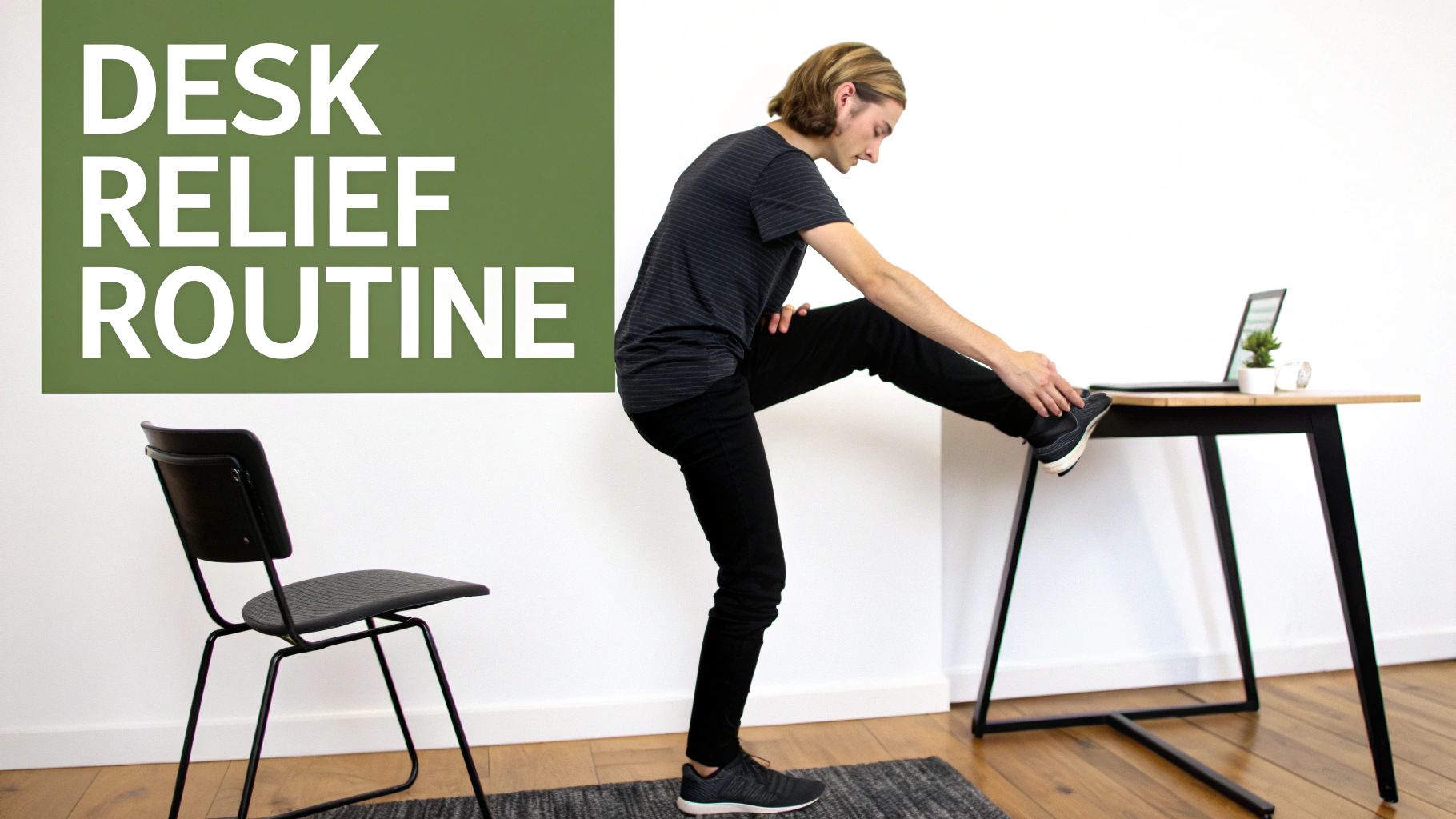
Alright, you know the individual stretches. But let's be honest, knowing is only half the battle. Turning that knowledge into a real, honest-to-goodness habit? That’s where the magic really happens.
Let’s build some simple, grab-and-go routines you can plug into your day without a second thought. Think of these less like a workout and more like a few quick recipes for happier hamstrings.
These aren't meant to be grueling, hour-long sessions. They’re quick, targeted sequences designed for the real world—perfect for breaking up a long workday or cooling down after a walk around the block.
Feel like you're slowly turning into the shape of your office chair? This quickie routine is your secret weapon. It’s designed to be done right at your workstation, no yoga mat or change of clothes needed.
This simple sequence is a fantastic way to counteract hours of sitting. It lengthens those crunched-up hamstrings and brings some much-needed movement back into your hips and lower back.
After a good walk or any light cardio, your muscles are warm and practically begging for a good stretch. This is the perfect time to gently nudge them into a new range of motion, which helps improve long-term flexibility and kickstarts your recovery.
Remember, the goal here isn’t to push to your absolute limit. You’re just gently guiding your warm muscles into a better place. Think of it as thanking your legs for carrying you.
At first, just holding these poses will feel like a challenge. But stick with it for a few weeks, and you’ll start to notice something amazing. The stretches that felt intense will start to feel… well, easy. That’s progress! It’s also your cue to level up.
But "leveling up" doesn't mean you need to start searching for some crazy new pretzel poses. The smartest way to progress with these hamstring stretches for beginners is to gently deepen what you’re already doing.
This gradual, patient approach is how you keep moving forward without getting hurt. You will be amazed at how these tiny, consistent adjustments add up to massive flexibility gains over time, ensuring you never hit that frustrating plateau.
Jumping into a stretching routine can feel like trying to interpret a new language your body is speaking. You're trying to listen, but what does that little shake mean? Is this good pain or bad pain? Let's clear up some of the most common questions that pop up when you start focusing on those hamstrings.
So you’re holding a stretch, feeling the tension, and suddenly your leg starts trembling like a leaf in the wind. Don't worry! A little bit of shaking is usually totally fine.
It's often just your nervous system adjusting to a new range of motion you're asking it to explore. Think of it as your body's software getting an update.
But—and this is a big but—that shaking should never be paired with sharp or intense pain. If the trembling is violent or hurts, that’s your body screaming "back off!" A good stretch feels like a satisfying, deep pull, not a struggle for survival.
The golden rule is simple: if you have to grimace and clench your jaw to hold a stretch, you've pushed way too far. Real progress comes from consistently coaxing your muscles, not wrestling them into submission.
Ah, the million-dollar question. Everyone wants to know when they'll finally be able to touch their toes without bending their knees. While every body is different, you'll probably feel a difference faster than you think.
With a consistent routine (hitting your hamstring stretches for beginners at least 3 to 5 times a week), most folks notice a real drop in day-to-day tightness within just 2 to 4 weeks.
Now, those big, impressive gains—like planting your palms flat on the floor—take a lot longer. We're talking months of dedicated practice. Be patient and celebrate the small victories along the way, like being able to tie your shoes without letting out a groan. That’s a win!
For a lot of people with that nagging, general lower back ache, the answer is a huge YES. In fact, gently stretching your hamstrings can be a game-changer. It helps release the constant downward tug on your pelvis, which can provide some sweet, sweet relief.
The keyword, of course, is gently. This advice isn’t universal, though. If you have a diagnosed condition like a herniated disc, sciatica, or a fresh back injury, you must talk to your doctor or a physical therapist first. They're the only ones who can give you the green light and guide you on movements that are safe for your specific situation.
Timing is everything. The absolute best time for those deep, static stretches—the kind where you hold a pose for a while—is after your workout. Your muscles are already warm and much more willing to lengthen. It's like trying to bend a cold piece of taffy versus a warm one.
Before a workout, you want to stick to dynamic movements. Think leg swings, high knees, or walking lunges. These active warm-ups get your body ready for action without temporarily weakening the muscles before you need them to perform. And remember, never jump into a stretching session cold; a quick five-minute walk or jog is essential to get the blood flowing first.
Ready to stop wondering if you're doing it right? The Dalm app uses AI to analyze your form with laser-like precision, giving you real-time voice feedback to stretch safely and make real progress. Ditch the guesswork and see what you're capable of by checking out Dalm today.