
Your Ultimate Guide to a Home Workout Without Equipment
Here’s the thing about a successful home workout without equipment: it all boils down to one powerful truth. Your body is the only gym you'll ever really need.
Forget the packed parking lots, the monthly fees, and the awkward wait for the squat rack. You have everything you need to build incredible strength, boost your health, and hit your fitness goals right there between your couch and your coffee table.

Let's get one major myth out of the way, right now. You do not need a mountain of iron to forge a strong, capable, and great-looking body. The real secret to fitness is consistency and challenging your muscles, and guess what? Your own bodyweight is more than enough resistance to get the job done. It’s about taking back control of your fitness, on your own terms.
This isn’t just some passing fad; it’s a genuine shift in how people view their health. The convenience alone is a game-changer. There's no traffic-filled commute, no waiting in line for a machine, and no need to sync your calendar with a rigid class schedule. Your workout starts the second you have a spare 20 minutes.
That one change demolishes the single biggest excuse most of us have for not exercising.
Working out at home also tears down a huge mental wall: gym-timidation. That feeling of being watched or judged is real, and it can keep people from ever starting. But in your own space? That pressure vanishes. You’re free to get sweaty, flub a move, and celebrate your wins without an audience.
This blend of comfort and access has sparked a worldwide movement. In the U.S., home workout participation shot up from 24% in 2019 to a high of 36% in 2021. By 2023, the numbers showed that over half of Americans who exercise preferred doing it at home, and their home sessions were outpacing gym visits by 10% for those who trained regularly.
To really see why this trend has taken hold, check out this quick breakdown.
It's a pretty compelling case. By eliminating the biggest barriers—cost, travel, and intimidation—a no-equipment routine becomes the easiest one to stick with long-term.
A smart bodyweight plan is a complete system for better living, not just a way to build muscle. It’s about upgrading how you move through your day-to-day life.
At the end of the day, turning your living room into your gym is an act of empowerment. It’s the moment you realize you already have everything you need to become a stronger, healthier you. This guide is here to show you exactly how to unleash that potential.
Alright, let's get down to business. This is your personal playbook for mastering bodyweight training. A killer home workout without equipment isn’t about just flailing around on the living room floor and hoping for the best. It's about owning a handful of fundamental movements with real precision and purpose.
And that's exactly what we're going to do here.
Forget simple lists of exercises. I’m going to break down the "why" and, more importantly, the "how" for each move. You'll get the little form cues and insider tips that make all the difference between just going through the motions and actually building strength. Think of this as your own private coaching session, designed to forge a rock-solid foundation from head to toe.
Let's dive in and turn your own body into the best piece of gym equipment you've ever owned.
Your legs and glutes are the engine for pretty much everything you do, from getting out of a chair to sprinting for the bus. Building strength here isn't just about how you look; it’s about creating stability, generating power, and having a body that's genuinely useful in the real world. These moves are the bedrock of any solid routine.
1. The Classic Bodyweight Squat
This is the undisputed king of lower-body exercises for a reason. It hits your quads, hamstrings, and glutes in one fell swoop, all while forcing your core to wake up and get to work.
2. The Forward Lunge
Lunges are phenomenal. They build single-leg strength and seriously challenge your balance in a way that two-footed exercises just can't.
The goal isn't just to move up and down. It's to control every inch of the movement. A slow, controlled lunge is ten times more effective than a dozen sloppy, rushed ones.
Think you can't build a strong upper body without weights? Think again. It's all about using leverage and angles to your advantage. These two movements will build your chest, shoulders, back, and arms with nothing but you and the ground.
3. The Perfect Push-Up
Ah, the push-up. It’s the ultimate upper-body press, hammering your chest, shoulders, and triceps while demanding a core of steel.
4. The Inverted Row (or Doorway Row)
Since most of us don't have a pull-up bar at home, the inverted row is our go-to pulling motion. It's absolutely crucial for balancing out all that pushing and is a fantastic way to build a strong back and biceps.
Let’s be clear: your core is way more than just a six-pack. It's the entire support system that connects your upper and lower body. A strong core means better posture, a happier back, and more power in every single thing you do.
5. The Plank
The humble plank is a masterclass in tension. It builds incredible endurance through your abs, obliques, and lower back without a single crunch.
6. The Glute Bridge
This is my secret weapon for waking up the posterior chain (glutes and hamstrings) and building a stable lower back.
Improving your mobility through gentle exercises can also significantly enhance your bodyweight practice. To learn more, check out our guide on gentle yoga for beginners, which offers movements that perfectly complement this strength work.
Okay, you know the moves. Awesome. But just knowing how to do a squat or a push-up isn't the whole game. The real magic happens when you weave them into a smart weekly plan that actually gets you results. This is where we go from just exercising to training.
A great plan isn't just a random list of exercises thrown together. It's a blueprint built for progress. The secret sauce? Strategic rest. We’ll hit different muscle groups on different days so your body has time to recover, repair, and come back stronger. This is how you avoid burnout and show up to every workout ready to crush it.
Below are three plug-and-play weekly blueprints, one for every stage of your fitness journey. Find the one that feels like a good challenge—tough but doable—and let’s get to work.
Just getting started? Fantastic. This plan is all about building a rock-solid foundation. We’re going to focus on mastering the basic movements and getting your body used to working as a single, powerful unit.
We’ll stick to full-body workouts three times a week on non-consecutive days. This gives you plenty of recovery time, which is crucial when you're starting out. Your goal here isn't to obliterate yourself; it's to build confidence and, most importantly, consistency.
Here’s how your week will look:
Workout A (Foundation Builder)
Workout B (Core & Control)
Give yourself a good 60-90 seconds of rest between sets. This setup ensures you’re building strength everywhere without hammering any single muscle group into the ground.
Ready to crank things up a notch? Good. The intermediate plan splits things up, letting you dedicate entire workouts to specific parts of your body. We’re moving to a four-day schedule, alternating between upper and lower body.
This approach means you can hit your muscles with more volume and intensity—the key ingredients for breaking through plateaus and seeing real change.
This is the stage where you truly start to own your fitness. You’ve laid the groundwork, and now you’re building the next level. The consistency you build here is what forges noticeable, lasting results.
Your weekly split will look like this:
Upper Body & Core Workout
Lower Body Workout
Shorten your rest to 45-60 seconds between sets. See how we're adding more challenging exercises and bumping up the sets? That's progressive overload in action, no weights required. And for all these moves, especially a classic like the squat, form is everything.
This quick diagram breaks down the three key phases of a perfect bodyweight squat.
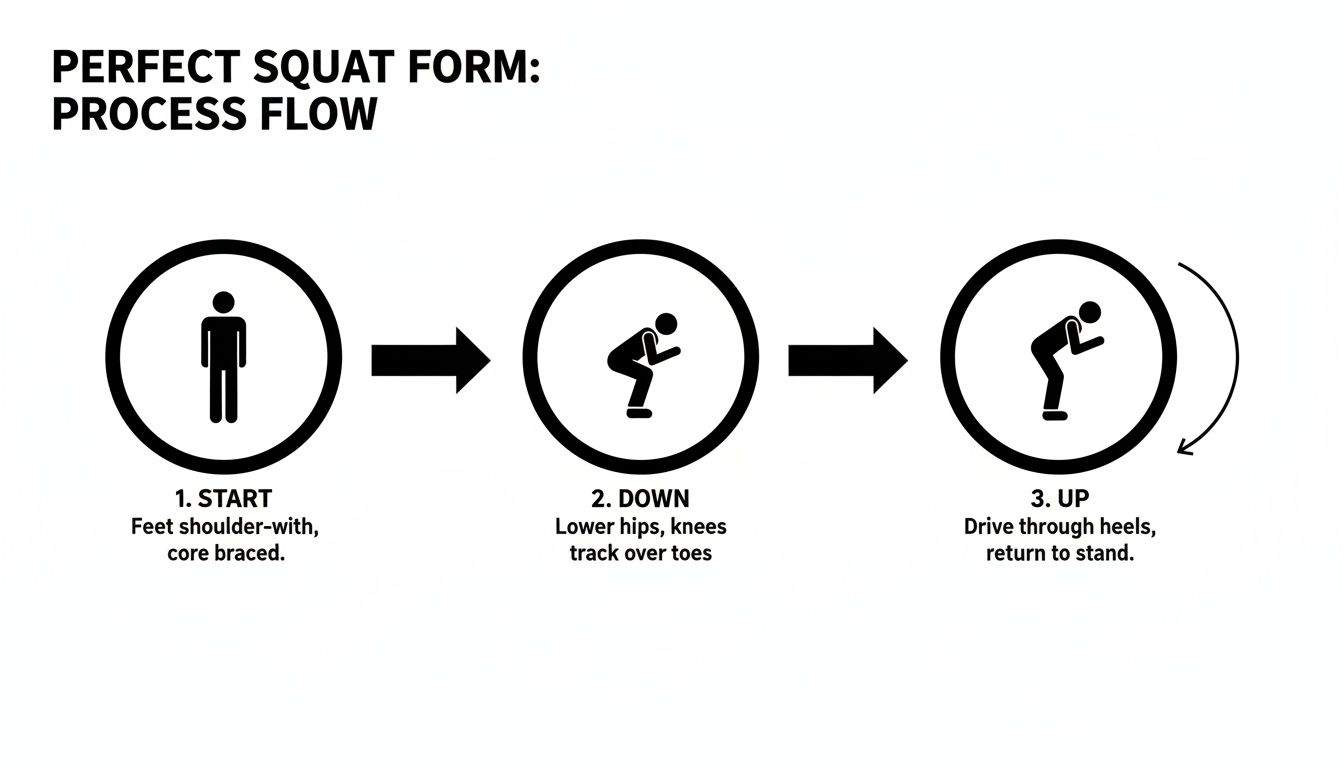
Burning this image into your brain helps lock in the movement pattern. Keep that chest up, drive your hips back, and push your knees out. That's the recipe for a safe and powerful squat.
To help you visualize how these different approaches structure a week, here’s a simple breakdown.
This table lays out the focus for each day, depending on your experience level. It's a great way to see how training evolves from full-body conditioning to more targeted, high-frequency work.
As you can see, the more advanced you get, the more specialized your training days become, allowing for greater intensity and volume while still building in crucial recovery time.
If you’ve absolutely nailed the fundamentals and are hungry for a challenge that will push your limits, this one’s for you. We’re graduating to a five-day "Push/Pull/Legs" split—a classic framework used by athletes to build serious strength and muscle.
Be warned: this plan is demanding. Your commitment to recovery, sleep, and nutrition needs to be as strong as your workouts.
The Advanced Weekly Breakdown:
Push Day Workout
Pull Day Workout
Leg Day Workout
Keep your rest periods tight—just 30-45 seconds—to maintain intensity. The addition of a dedicated HIIT day and a mobility day makes this a seriously well-rounded, athletic routine. For that mobility day, yoga can be a game-changer. This is where a tool like Dalm's AI-powered pose analysis can be incredibly useful, giving you precise feedback to deepen your stretches and perfect your alignment—a perfect complement to the high demands of this plan.
A great workout isn't just one thing. It's the whole performance.
Think of the main event—the squats, the push-ups, the sweat—as your headline act. But every headliner needs a killer opening act and a satisfying encore. For your no-equipment home workout, those are your warm-ups and cool-downs.
Skipping a warm-up is like trying to sprint the second you roll out of bed. It’s a classic rookie mistake and a recipe for disaster. Your muscles are cold, your joints are stiff, and you’re just not ready for action.
A good warm-up is your body’s ignition sequence. It gently coaxes your heart rate up, gets blood flowing to your muscles, and lubricates your joints. This isn't about exhausting yourself before you even start; it’s about priming the engine for peak performance and seriously cutting down your risk of injury.
Forget those old-school static stretches where you just hang out holding a hamstring stretch for 30 seconds. Before a workout, you need dynamic movement—stretching that takes your body through its full range of motion.
Here’s my go-to sequence. It's a simple but incredibly effective 5-minute routine that wakes up every major muscle group you’re about to put to work.
My Favorite 5-Minute Dynamic Warm-Up:
This quick routine is like sending your body a memo: "Hey, we're about to do something awesome."
Now for the encore. The cool-down is your body’s off-ramp. It allows your heart rate to come back down gradually and, most importantly, kickstarts the recovery process. This is where static stretching—holding a stretch for a set time—really shines.
A solid cool-down can make a world of difference in reducing post-workout soreness and improving your long-term flexibility, making your next workout even better.
My Essential 5-Minute Cool-Down Stretch Routine:
Spending just a few minutes here pays huge dividends in how you feel the next day. A great way to see the benefits is by tracking your flexibility and recovery over time. For more tips on this, check out our guide on how to track fitness progress.
Beyond the bookends of your workout, folding in mindful movement practices like yoga can seriously elevate your bodyweight training game. Yoga isn't just about becoming a human pretzel; it’s a masterclass in balance, core strength, and body awareness—three pillars for mastering any no-equipment exercise.
Learning to hold a warrior pose teaches you to engage your core and stabilize your hips in a way that directly translates to a stronger, deeper squat. It’s about building a smarter, more connected body.
This mind-body connection is exactly why yoga and Pilates are surging. A recent CivicScience.com report showed participation jumping 4 percentage points to 17%, with 58% of people preferring the privacy of home for their practice. It's a perfect fit for the no-equipment philosophy, building functional strength with mindful control.
By building this complete ecosystem—a smart warm-up, a powerful main workout, and a restorative cool-down—you’re not just exercising. You're building a truly resilient and capable body from the ground up.
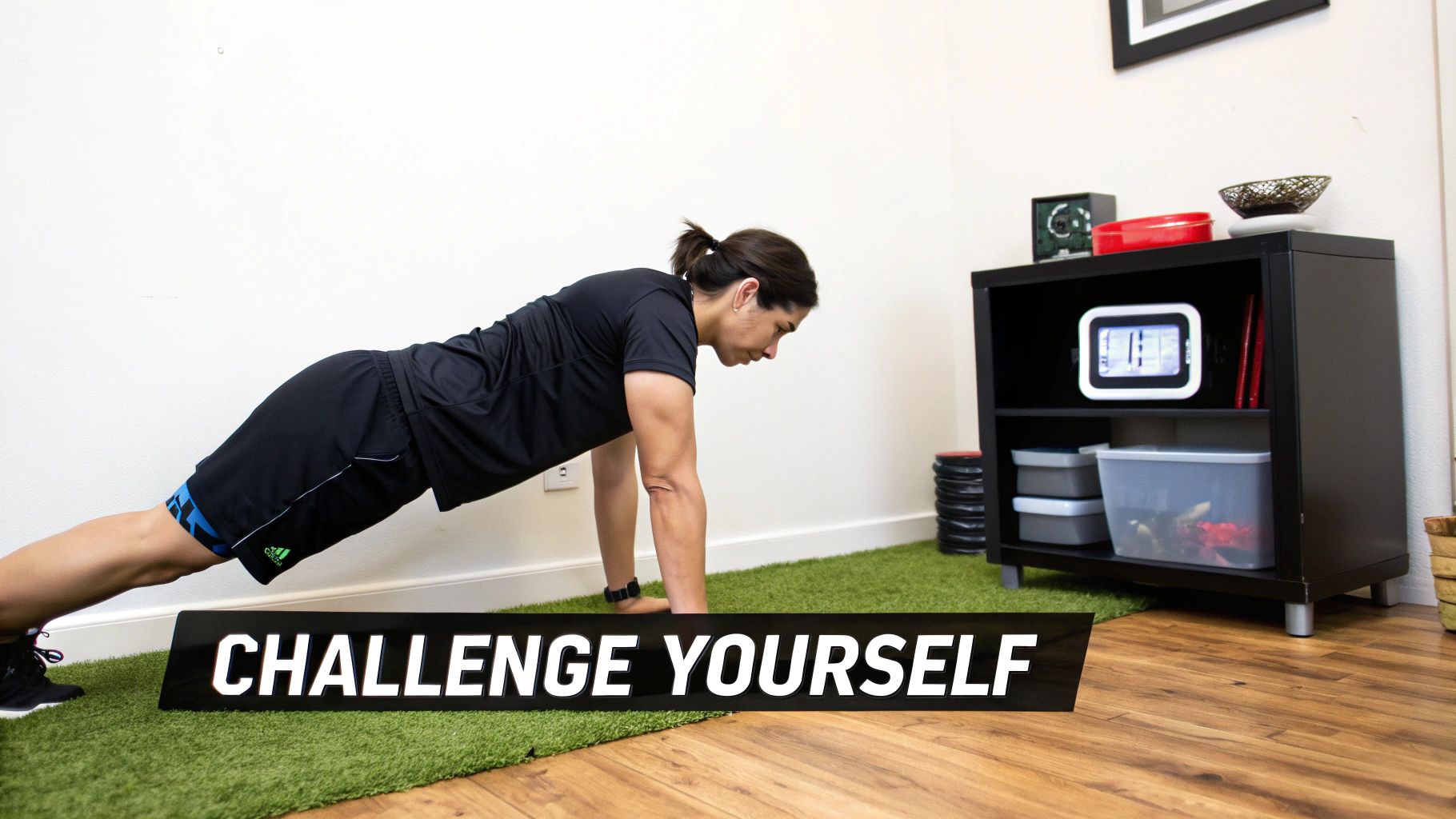
The human body is an amazing adaptation machine. The moment a workout starts feeling just a bit too comfortable, that’s your signal that your body has conquered the challenge. It’s a great feeling, but it’s also a warning sign: your progress is about to slam on the brakes.
To keep getting stronger and seeing results, you’ve got to keep your body guessing. This is where the principle of progressive overload comes into play. It sounds technical, but all it means is consistently making your workouts a little bit harder. When you're working out at home without equipment, you just have to get more creative than slapping another plate on a barbell.
You can crank up the intensity of any exercise without adding a single pound of weight. It’s all about playing with the variables to keep your muscles on their toes.
Here are my favorite ways to level up a routine:
Progress isn’t always about lifting more; it’s about demanding more from your body. A slower push-up or a shorter rest period is a clear signal to your muscles that they need to adapt and grow stronger.
Sometimes, you need to completely flip the script on how you train. This is where high-intensity formats come in to shock your system and obliterate boredom for good.
High-Intensity Interval Training (HIIT) is all about short, all-out bursts of effort followed by brief recovery periods. Think 30 seconds of burpees going full throttle, followed by 30 seconds of rest, repeated for 10-15 minutes. It's brutally effective and insanely time-efficient.
Another fantastic option is AMRAP, which stands for "As Many Rounds As Possible." You set a timer (say, 15 minutes) and power through a circuit of exercises as many times as you can before the clock runs out. It's a fun, competitive way to really push your limits.
Let's be real, life gets busy. Hour-long workouts aren't always in the cards, but that's never an excuse to do nothing. Having a few go-to express routines is a total lifesaver.
The 15-Minute AMRAP:
Just set a timer for 15 minutes and see how many rounds you can complete. It’s a full-body blast that absolutely gets the job done when you're short on time.
Digital fitness apps have been a huge part of making these quick, effective home workouts accessible to everyone. The industry is booming, with fitness apps projected to grow by an astounding $1.68 billion next year. With 345 million users downloading fitness apps 850 million times recently, it’s clear people are embracing bodyweight HIIT and yoga plans. You can find more cool fitness industry trends that show just how massive this movement is. This surge proves that a powerful workout is always just a few taps away.
Jumping into a home workout routine without any equipment can feel a bit like heading into uncharted territory. Your mind starts racing with questions. "Am I doing this right?" "Is this even working?" "Will I look silly?" Trust me, that's completely normal.
Let's clear the air. Think of this as your personal Q&A session where we bust some common myths and get you on the right track, feeling confident and ready to go.
You bet you can. Here’s a little secret: your muscles don't have eyes. They can’t tell the difference between a 50-pound dumbbell and your own bodyweight leveraged in a clever way. All they know is resistance.
The magic word here is progressive overload. Instead of slapping another plate on the bar, you just have to get a little more creative.
You can challenge your muscles and spark growth by:
The bottom line? You can absolutely build a lean, strong, and incredibly capable body using nothing more than gravity and the floor.
Ah, the eternal battle: you versus the comfy couch. Let's be real, the couch often has a strong case. Winning this isn't about having superhuman willpower; it's about building a smart routine that works for you.
First off, treat your workouts like a crucial meeting with your most important client: you. Schedule them in your calendar and make them non-negotiable. Next, carve out a dedicated space. It doesn't have to be a home gym—just a corner of your living room where you roll out your mat can become a powerful mental trigger that says, "It's time to move."
And for goodness' sake, do things you actually like! If you loathe burpees with every fiber of your being, find an alternative. The best motivation in the world comes from seeing progress, and nothing beats the feeling of realizing you just crushed a workout you couldn't finish last month.
The real trick to motivation isn't waiting for a lightning bolt of inspiration. It's about building a habit so ingrained that you get it done even on the days you'd rather not. Consistency is a skill you build, not something you find.
This is my favorite part, because the answer is so encouraging: consistency will always beat duration. You will get lightyears ahead with three focused, 20-minute workouts a week compared to one miserable, hour-long beast of a session that leaves you too wiped to function.
For most people starting out, 20-30 minutes, 3 to 4 times per week, is the sweet spot. You'll start feeling the good stuff—like more energy and better sleep—in just a week or two. As for the more visible changes in strength and body composition? Give it 4 to 8 weeks of sticking with it. Start with a goal so manageable you can't say no.
Yes! In fact, it's one of the safest ways to get into fitness. You're removing the variables that can often lead to injury, like fumbling with heavy weights or figuring out a confusing machine. Instead, you're focusing on mastering the fundamental ways your body is designed to move—pushing, pulling, squatting, and hinging.
The golden rule is simple: form over everything. Always prioritize moving well over moving fast or doing more reps. Start with the easiest version of an exercise and own it before you even think about making it harder. And listen to your body. That deep muscle burn is great. Sharp, stabbing pain? Not so much.
At Dalm, we're all about making mindful movement something everyone can access and benefit from. While you're building raw strength with these bodyweight exercises, our AI-powered yoga analysis can be an amazing tool for dialing in your mobility and form. It gives you real-time feedback to help you move better, prevent injury, and truly connect with your practice. Find out how personalized guidance can take your entire fitness journey to the next level at https://dalm.co.