
How to Alleviate Lower Back Pain and Finally Find Relief
When your lower back decides to throw a tantrum, your first instinct might be to freeze in place, hoping it just goes away. But taking a few simple, strategic actions right away can make all the difference between a minor blip and a week of misery.
Think of this initial response as first aid for your spine. It’s not about finding a magic cure, but about calming the storm so you can start addressing the real problem.
That first twinge. We’ve all been there. It’s that "uh-oh" moment when you realize you’ve tweaked something. What you do in the next 24-48 hours is critical for getting back on your feet quickly. Forget "no pain, no gain"—right now, it’s all about listening to your body and giving it a little TLC.
And if you feel like you're the only one dealing with this, you're not even close. In 2020 alone, an estimated 619 million people were dealing with lower back pain. It's the single leading cause of disability across the globe, so yeah, this is a pretty common battle. You can dig into the global back pain statistics to see just how widespread it is.
I know, I know. When your back is screaming, the last thing you want to do is move. But counterintuitively, a little bit of the right kind of movement can feel amazing. We're talking about tiny, gentle motions that release tension without causing any sharp pain.
So, should you grab an ice pack or a heating pad? This is probably the most common question I get, and the answer is simple: it depends on what your back is trying to tell you.
My Rule of Thumb: Ice is for injuries, heat is for achiness. Think of it this way: ice calms things down, heat loosens things up.
If you just strained your back lifting a heavy box (a new, acute injury), reach for the ice. For the first 48 hours, cold therapy is your best friend. It constricts blood vessels, which helps knock down swelling and numbs that sharp, angry pain.
On the other hand, if you're dealing with that chronic, dull, muscular ache that makes you feel stiff as a board, heat is the way to go. A warm bath or a heating pad gets the blood flowing, which helps relax those tight, grumpy muscles. Just don't ever put heat on a fresh injury—it'll just make the inflammation angrier.
When pain strikes, you don't want to have to think too hard. Here’s a quick-glance table to help you decide what to do in the moment.
Use this table as your go-to guide for those first critical hours. A little smart, immediate action goes a long way.
Let’s be honest: relying on temporary fixes for back pain is like putting a tiny band-aid on a gaping wound. It might feel better for a minute, but it’s not solving the real problem. If you want lasting relief, you have to build a strong, resilient back from the inside out—one that can handle everything from hauling groceries to surviving a marathon of Zoom meetings.
The secret isn't hammering out a thousand crunches. In fact, old-school sit-ups can often make your back pain worse. The real goal is to build a natural, muscular "corset" around your midsection that supports your spine like a built-in weightlifting belt. When your core is weak, your lower back is forced to do all the heavy lifting, leading to strain, fatigue, and that all-too-familiar ache.
Your core is so much more than the six-pack muscles. It's a whole crew of muscles that wrap around your torso—abdominals, obliques, hips, glutes, and even the muscles in your lower back. When they all work together, they create an incredibly stable platform for your spine.
Think of it this way: a strong core helps distribute weight and absorb shock, taking a massive amount of pressure off the delicate discs and vertebrae in your lower back. It’s the difference between a flimsy tent pole trying to survive a windstorm and a deeply rooted oak tree that barely even sways.
A stable core is the bedrock of a healthy spine. By strengthening the muscles that support your entire torso, you're effectively reducing the daily grind on your lower back, which is the key to preventing both current pain and future injuries.
To really get to the root of lower back pain, we need to focus on exercises that build stability, not just bend your spine. These foundational movements teach your core muscles how to fire up and protect you during all your daily activities.
Before you jump into strengthening, though, it’s always a good idea to calm down any immediate flare-ups. This simple three-step process is a great place to start.

Once the acute pain has subsided, you can start building the muscle that prevents it from coming back.
Here are three powerhouse exercises that will get you started on the right foot:
The Bird-Dog: This move is gold for teaching your body to keep a stable spine while your arms and legs are moving. Get on all fours, then slowly reach your right arm forward and your left leg straight back. The trick is to keep your hips and shoulders perfectly level with the floor. Don't let your lower back sag or arch! Hold for a breath, return to the start, and switch sides.
The Glute Bridge: Your glutes are a huge, and often lazy, part of your core. When they don't do their job, your lower back has to pick up the slack. Lie on your back with your knees bent and feet flat on the floor. Squeeze your glutes and lift your hips until your body forms a straight line from your shoulders to your knees. Pause at the top, give those glutes an extra squeeze, then slowly lower back down.
The Proper Plank: The plank is the undisputed champion of core stability, but only if you do it right. Your body should be a straight line from your head to your heels. To do this, you need to actively engage your abs (pull your belly button toward your spine) and squeeze your glutes. Avoid letting your hips dip toward the floor or rise up to the ceiling. A perfect plank for 20 seconds is infinitely better than a sloppy one for a minute. For more tips on building this foundational strength, check out our guide on yoga for core strength for beginners at https://blog.dalm.co/yoga-for-core-strength-beginners.
The magic isn’t in the exercises themselves, but in doing them consistently and with perfect form. Rushing through sloppy reps will only make things worse. Go slow, focus on the quality of each movement, and always listen to what your body is telling you.
For those looking to build strength after an injury or just be proactive, exploring how Pilates for rehabilitation can promote healing and functional strength is another fantastic option.
Try to weave these core exercises into your routine 3-4 times per week. Before you know it, you’ll have built a strong, supportive core that acts as your body’s own internal back brace, transforming your back from a source of chronic pain into a pillar of strength.
If your back feels like it’s made of concrete, you know exactly what I’m talking about. That stiff, locked-up sensation is a massive reason lower back pain decides to stick around for the long haul. While strength is key, it’s only half the battle. Without flexibility, your muscles stay wound up, constantly yanking on your spine and causing that all-too-familiar ache.
This is where we switch gears from building muscle to creating space.
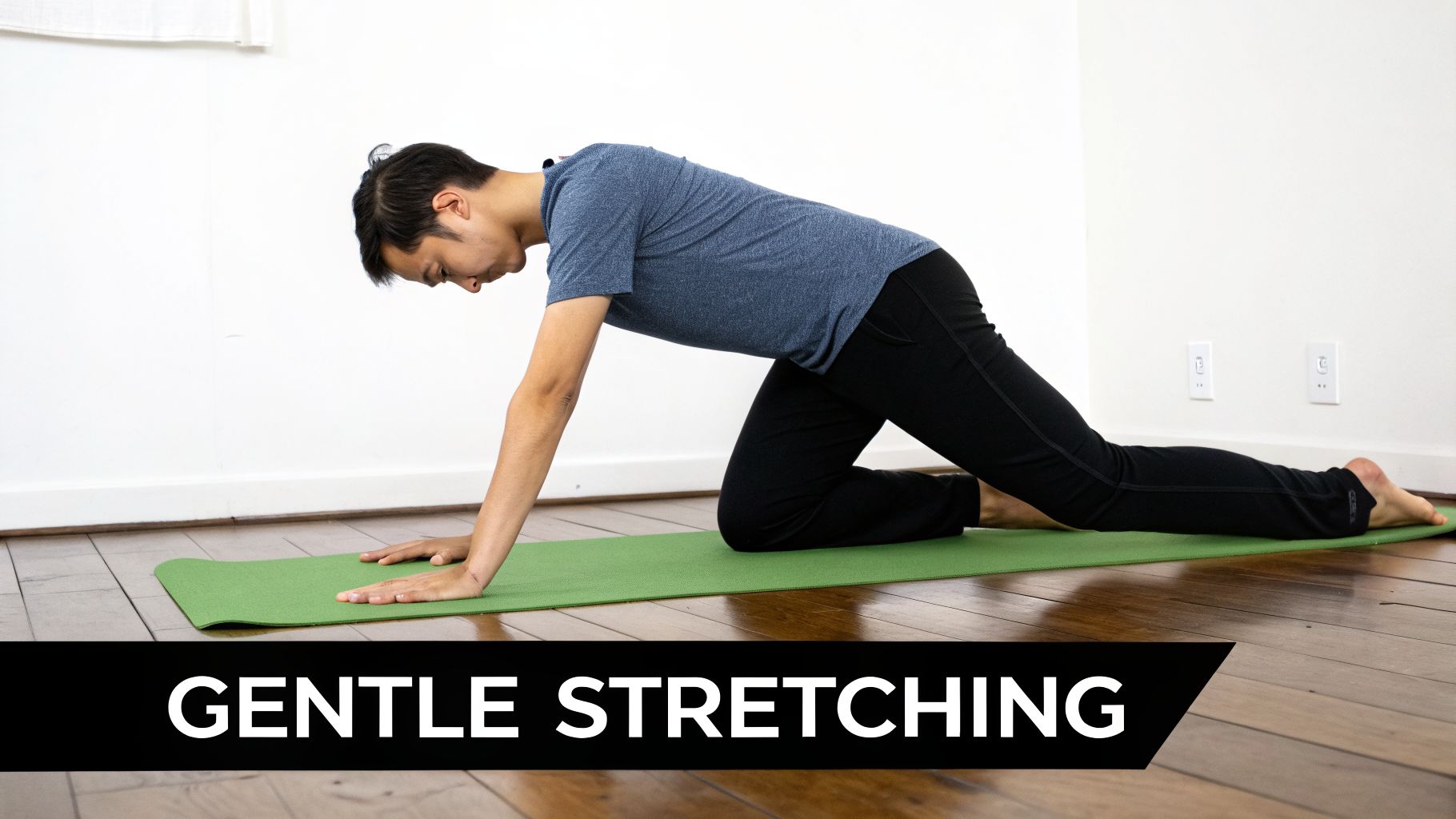
Forget about forcing yourself into a pretzel. We’re talking about mindful movement that gently coaxes your muscles into letting go. Think of it as a friendly conversation with your body, not a wrestling match. By focusing on the big players—your spine, hips, and hamstrings—you can seriously improve your mobility and start to melt away that chronic stiffness.
Your spine is built to move. It's designed to flex, extend, and twist. The problem? After hours slumped over a desk or phone, it kind of forgets how. Yoga-inspired movements are absolutely fantastic for reintroducing this natural motion in a safe, controlled way.
The undisputed champion of spinal mobility is the Cat-Cow stretch. It's simple, feels amazing, and is one of the safest ways to get your vertebrae moving again.
Just flow between these two for about a minute, letting your breath be the guide. This simple sequence is like a lube job for your spinal discs and works wonders on pent-up tension. It’s the perfect way to start your day.
Another incredible tension-buster is Child’s Pose. From all fours, just sit your hips back on your heels and fold forward, resting your forehead on the mat. You’ll feel a gentle stretch along the entire length of your back—it’s pure release. Think of it as your go-to reset button when your back feels fried.
Here’s a secret that many people miss: your tight hips and hamstrings could be the real villains behind your lower back pain. It’s true. When these massive muscle groups are tight, they pull your pelvis out of alignment, forcing your lower back into an unnatural curve and putting constant strain on your lumbar spine.
Releasing tension in your hips and hamstrings is non-negotiable for lasting back pain relief. It’s like untying the knots that are pulling your entire lower body out of whack, finally allowing your spine to rest in a neutral, pain-free position.
You don't need to get aggressive here. A simple seated forward bend or a gentle lunge can make a world of difference. To really dive into unlocking these tight spots, check out our in-depth guide on how to improve flexibility.
The biggest risk with any new exercise is doing it wrong. Bad form doesn't just cancel out the benefits; it can actually make your back pain worse. This is where a little tech can give you a huge leg up.
Using a platform like Dalm, you get AI-powered pose analysis that works like a personal yoga instructor in your pocket. It gives you real-time voice feedback on your alignment, making sure you’re doing each stretch safely and effectively. It helps you understand the little details of a pose so you’re hitting the right muscles without adding stress to your back. It's a fantastic way to build confidence and get the most out of every single stretch.
It's also worth remembering that other factors, like weight, can play a major role. Research shows that obesity and aging are significant drivers of lower back pain because excess weight puts a ton of pressure on the spine. Personalized exercise, guided by smart feedback, helps you build strength and improve alignment safely—a crucial part of managing these risk factors.
So, you’ve been stretching and strengthening like a champ, but that annoying ache in your lower back still shows up at the end of the day. What gives? It’s time to look at the other 23 hours of your day—how you sit, stand, and even sleep are probably undoing all your hard work.
Your posture is the foundation for a happy spine. If it’s out of whack, everything else will feel unstable.
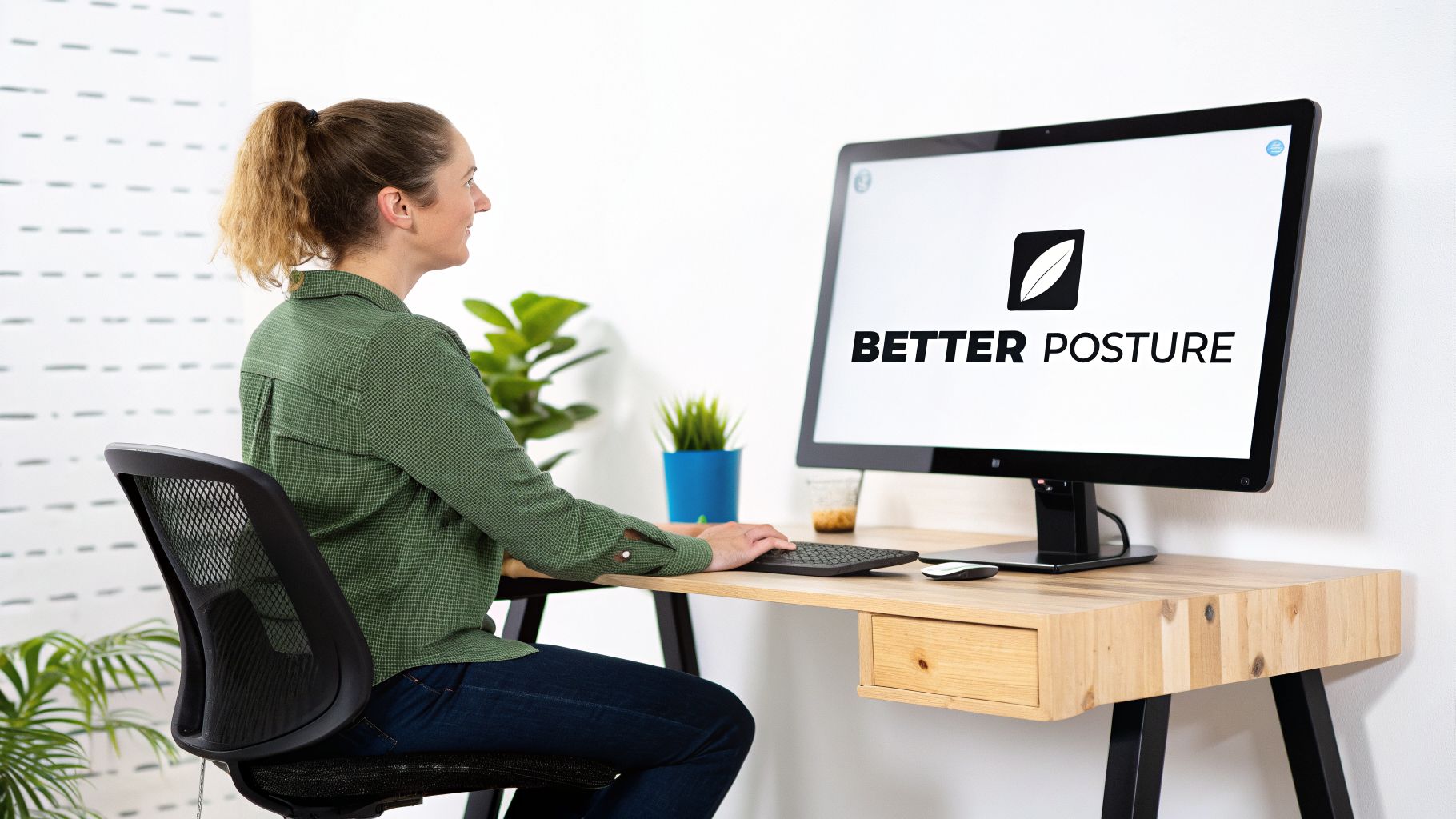
Let's take a hard look at your daily habits. Making small, consistent tweaks isn't just about finding temporary relief; it's about building a defense against future flare-ups. This is where you take back control, one simple adjustment at a time.
Your desk is often the scene of the crime when it comes to back pain. Whether you’re working from a fancy office or your kitchen counter, a bad setup is a bad setup. Slouching for hours puts a ton of strain on your lumbar spine, so let's sort it out.
You've probably heard of the 90-90-90 rule, and for good reason—it works. It's super simple:
This alignment helps your spine stay in a neutral, relaxed position, which drastically cuts down on stress. If your feet are dangling, don't just let them hang there! Grab a footrest, a yoga block, or even a stack of old textbooks to bring the floor to you.
Now, what about your screen? It needs to be straight ahead, with the top of the monitor at or just below eye level. If you're hunched over a laptop all day, you're cranking your neck and upper back forward, which inevitably pulls on your lower back. Do yourself a favor: prop that laptop on some books and get a separate keyboard and mouse. It’s a total game-changer.
"Lift with your legs, not your back!" We've all heard it a million times, but let's be honest, how often do we actually do it? One wrong move lifting a box of books or a bag of groceries can lead to a week of misery.
Your body is an amazing machine, but you have to use it correctly. Your powerful leg and glute muscles are built for heavy lifting; your lower back simply isn't.
Here’s the right way to do it:
And whatever you do, don't twist while holding something heavy. If you need to turn, move your feet. This tiny habit shift will save your back from a world of hurt.
Your spine doesn't get to clock out when you go to bed. Tossing and turning into a pretzel-like shape for eight hours is a surefire way to wake up feeling stiff and sore. The goal is a neutral spine, day and night.
If you sleep on your back, tucking a small pillow under your knees helps maintain your spine’s natural curve. Side sleepers, try putting a pillow between your knees. This stops your top leg from sliding forward and twisting your hips and lower back.
Your posture is a 24/7 job. Learning how to reduce back pain while sleeping is a critical piece of the puzzle, giving your spine the uninterrupted rest it needs to heal.
Stomach sleeping is the toughest on your back because it flattens your spine's natural curve and forces you to crank your neck to one side. If you just can't quit, at least slide a flat pillow under your pelvis and lower abdomen to help ease some of that strain.
Just becoming more mindful of how you move throughout the day is a huge step. If you want to dive deeper, exploring some dedicated https://blog.dalm.co/postural-awareness-exercises can give you the tools you need to build this crucial skill.
Let's be clear: being proactive with your back health is fantastic. Consistent stretching and thoughtful strengthening are your best long-term allies. But there are times when DIY care isn't just ineffective—it can be downright risky.
Knowing when to call in the professionals is just as important as doing your daily exercises. It's the difference between fixing a minor tweak and letting it spiral into something much bigger. You wouldn't try to rewire your house without an electrician, right? Same logic applies here.
Most of the time, that nagging ache in your lower back is mechanical. It's the result of strain on your muscles, ligaments, and joints from things like sitting too long or lifting something awkwardly. But sometimes, pain is your body's alarm system screaming about a bigger issue.
If you experience any of the following, hit pause on your home routine and get on the phone with a healthcare provider.
Don't ignore these signs:
Okay, so you've realized it's time to see someone. But who? The world of back care can feel like a confusing alphabet soup of specialists, and picking the right one can be daunting.
Let's break down who does what, so you can make an informed choice. Think of it as building your personal back-care dream team.
The goal isn't to play doctor and guess what's wrong. It's about getting an accurate diagnosis from someone who lives and breathes this stuff. A real expert can pinpoint the root cause, not just chase the symptoms.
Honestly, a great physical therapist is often the perfect starting point. They can do a deep dive into your movement patterns, figure out what’s causing the trouble, and get you on a safe, effective recovery program. Plus, they’ll be the first to tell you if you need to see a different kind of specialist.
Making that call for professional help isn't admitting defeat—it's taking control of your health. It’s the smartest, fastest, and safest way to get back to living your life without that nagging pain in your back.
When your back starts screaming, your mind floods with questions. It’s totally normal to want some straight answers when you’re trying to figure out what’s going on and how to fix it. We’ve heard them all, so we’ve rounded up the most common ones to give you the no-nonsense advice you need.
Let’s tackle that confusion head-on.
Ah, the million-dollar question. The honest answer is a classic: "it depends."
If you’re in the throes of an acute, can’t-get-off-the-floor flare-up where every tiny movement feels like a lightning strike, listen to your body. It's screaming for rest. For the first 24 to 48 hours of a brand-new, intense injury, gentle rest is your best friend.
But what about that nagging, chronic ache that’s become your unwelcome companion? Or after that initial, super-sharp pain has calmed down? That’s when movement becomes medicine. The trick is choosing the right kind of movement. We're talking gentle, feel-good stuff like the Cat-Cow or pelvic tilts we covered earlier. Pushing through a heavy workout is a definite no-go, but gentle motion gets blood flowing, eases stiffness, and keeps your muscles from locking up.
The old-school advice of complete bed rest has been totally debunked. Lying still for too long can actually make back pain worse by weakening your muscles and stiffening your joints. The real goal is to find that sweet spot between resting the injury and keeping the rest of your body moving safely.
Standing desks are everywhere these days, and for good reason—but they’re not a magic cure-all. The real win isn’t just standing; it's the simple act of changing your position throughout the day. Sitting for eight hours is a recipe for back disaster, but standing stock-still for eight hours can be just as punishing, leading to tired legs, sore feet, and—you guessed it—an aching back.
The ideal setup is an adjustable sit-stand desk. This lets you mix it up, which is where the real magic happens.
If you’re giving it a try, here’s a good rhythm to start with:
Think of a standing desk as a tool to fight against being stuck in one position. It encourages you to move and helps you break free from that static, slumped posture that’s a major cause of lower back pain.
Most of the time, lower back pain is "mechanical," which is just a fancy way of saying you've strained or sprained the muscles and ligaments. This kind of pain usually feels like a dull ache or a sharp twinge that gets worse when you move a certain way and feels better with a bit of rest, ice, or gentle stretching. It's incredibly annoying, but it's not usually dangerous.
However, as we talked about earlier, there are some serious red flags you should never ignore. If your back pain comes with numbness or weakness in your legs, you lose control of your bladder or bowels, or you spike a fever, you need to see a doctor right away.
Another clue is how the pain behaves. A muscle strain will often feel better once you find a comfortable position to rest in. Pain from something more serious, like a disc issue, can feel relentless, with no relief no matter how you sit, stand, or lie down. When in doubt, always get it checked out by a professional.
The short answer? A huge, unequivocal yes.
Your spine is the central pillar supporting your entire body. Carrying extra weight puts a constant, heavy strain on it, especially on the vertebrae in your lower back (the lumbar spine). Picture carrying a heavy backpack 24/7—eventually, the structures holding that load are going to get tired and start to complain.
Study after study shows a powerful link between a high body mass index (BMI) and lower back pain. The good news is that losing even 5-10% of your body weight can make a massive difference. It reduces the mechanical load on your spine and can seriously dial down your pain levels. It’s one of the single most effective long-term moves you can make for a happier back.
Ready to stop guessing and start healing? The Dalm app gives you AI-powered pose analysis and real-time voice feedback, guiding you through every stretch with precision. It’s like having a physical therapist in your pocket, making sure you build strength and flexibility the right way. Stop wondering if you're doing it right and start moving with confidence—check out Dalm today.