
How to Correct Forward Head Posture for Good
If you're serious about fixing that nagging neck pain, you've got to understand the root of the problem. It all boils down to a combination of targeted stretches, beefing up weak muscles, and being more mindful of how you carry yourself day-to-day. The goal is simple: release those tight chest muscles and strengthen the weak upper back and neck muscles to guide your head back where it belongs—right over your shoulders.

Let's be real for a second. There's a good chance you're reading this very sentence hunched over your phone or computer. That all-too-familiar forward head tilt has a name: Forward Head Posture (FHP). Some people even call it "text neck," and for good reason. It’s a postural nightmare where your head constantly juts forward, completely out of sync with your spine.
Think of your head as a bowling ball. It weighs a solid 10-12 pounds. When it's stacked neatly on top of your spine, your neck muscles handle the load just fine. But for every single inch your head drifts forward, it's like adding another 10 pounds of pressure on your cervical spine. This extra baggage forces the muscles in your upper back and neck to work overtime, leading to that gnawing fatigue, tightness, and pain you know so well.
This posture doesn't just sneak up on you. It's the slow, sneaky result of habits that basically train your body to slump. Our daily lives are a minefield of posture-destroying activities:
The link between our digital lives and forward head posture is undeniable. A major UK survey back in 2013 discovered that 18–24 year-olds were spending a whopping 8.8 hours a day glued to their devices. All that time spent with the neck bent forward is a recipe for the exact musculoskeletal misery you might be feeling. If you're curious, you can explore more data on the impact of device usage on posture.
Not sure if this is you? Try this quick reality check.
Use this simple 3-step test to quickly assess if you show signs of forward head posture.
If you struggled with that last step, don't sweat it. You're in the right place to start making a change.
Key Takeaway: Forward head posture isn't just about looking slumped; it's a biomechanical issue that places immense and sustained stress on your neck and upper back muscles, leading to a cascade of painful symptoms.
This constant forward pull creates a nasty imbalance. It overstretches and weakens the muscles in your upper back while shortening and tightening the ones in your chest and the front of your neck. It’s a vicious cycle that yanks you further out of alignment, making good posture feel awkward and almost impossible to hold.
The fallout? Everything from nagging neck pain and tension headaches to restricted breathing and even an increased risk of falls because your center of gravity is all out of whack. Getting a handle on this dynamic is the first, most crucial step toward fixing it.
Before you can even think about building strength, you’ve got to release the tension that's yanking you out of alignment. Seriously, think of this as hitting the reset button on a bunch of chronically tight muscles. When your head constantly juts forward, the muscles in your chest and the front of your neck get short and cranky, while the ones in your upper back become overstretched and weak.
Stretching is your secret weapon for that sweet, immediate relief. By focusing on lengthening these tight spots, you give the opposing weak muscles a fighting chance to finally pull your head back where it belongs—right over your shoulders.
Let’s talk about one of the biggest villains in the forward head posture saga: a tight chest. All those hours hunched over a keyboard or staring down at a phone are basically training your pectoral muscles to shorten. This pulls your shoulders forward and rounds your upper back.
This classic stretch is the perfect antidote. Here’s how to nail it:
I love this one because you can do it multiple times a day, especially when you take a break from your desk. It’s a fantastic way to quickly undo that dreaded "desk slump."
This isn't just about a fleeting good feeling. Consistently stretching your pecs helps them learn to stay longer, making it so much easier for your shoulder blades to pull back and support a taller you.
Next on our list are the muscles running up the side of your neck—the upper trapezius and the scalenes. When your head drifts forward, these guys work overtime to hold it up, which is why you get that classic stiff, achy neck.
This simple stretch hits them perfectly:
The real magic with this stretch is consistency. You have to make it a daily habit. If you're hungry for more ways to loosen up, you can discover how to improve flexibility throughout your whole body, which will only help your posture goals.
Remember, the point of these stretches is to create a sense of release and openness, not pain. Think of it as prepping the battlefield for the strengthening work ahead, which is where you’ll build the muscle endurance for real, lasting change.
Stretching feels incredible for that instant hit of relief, but let's be honest—it’s only half the story. If you want a real, lasting fix for forward head posture, you have to build a rock-solid foundation that holds you up without you even thinking about it. That means waking up and strengthening those chronically weak, overstretched muscles in your upper back and deep in your neck.
Think of these as the unsung heroes of good posture. They're the ones responsible for pulling your shoulders back and effortlessly holding your head high against the constant nagging pull of gravity.
Before you even think about grabbing a resistance band, the very first thing you need to do is re-establish a connection with these muscles. It’s like they've been asleep for years and have completely forgotten how to fire up properly. We need to wake them gently.
The absolute classic for this is the Chin Tuck. No, this isn't about giving yourself a double chin. It’s a precise movement designed to switch on the deep neck flexors at the front of your neck—the very muscles that stabilize your head.
This subtle little move is a total game-changer. It directly fights that forward-jutting head motion and kicks off the process of retraining your neck to sit where it belongs. To get even more in tune with your body, you can explore other foundational movements in these postural awareness exercises.
This simple exercise is just one part of a three-step process for immediate neck relief, which also includes key stretches to release tension.
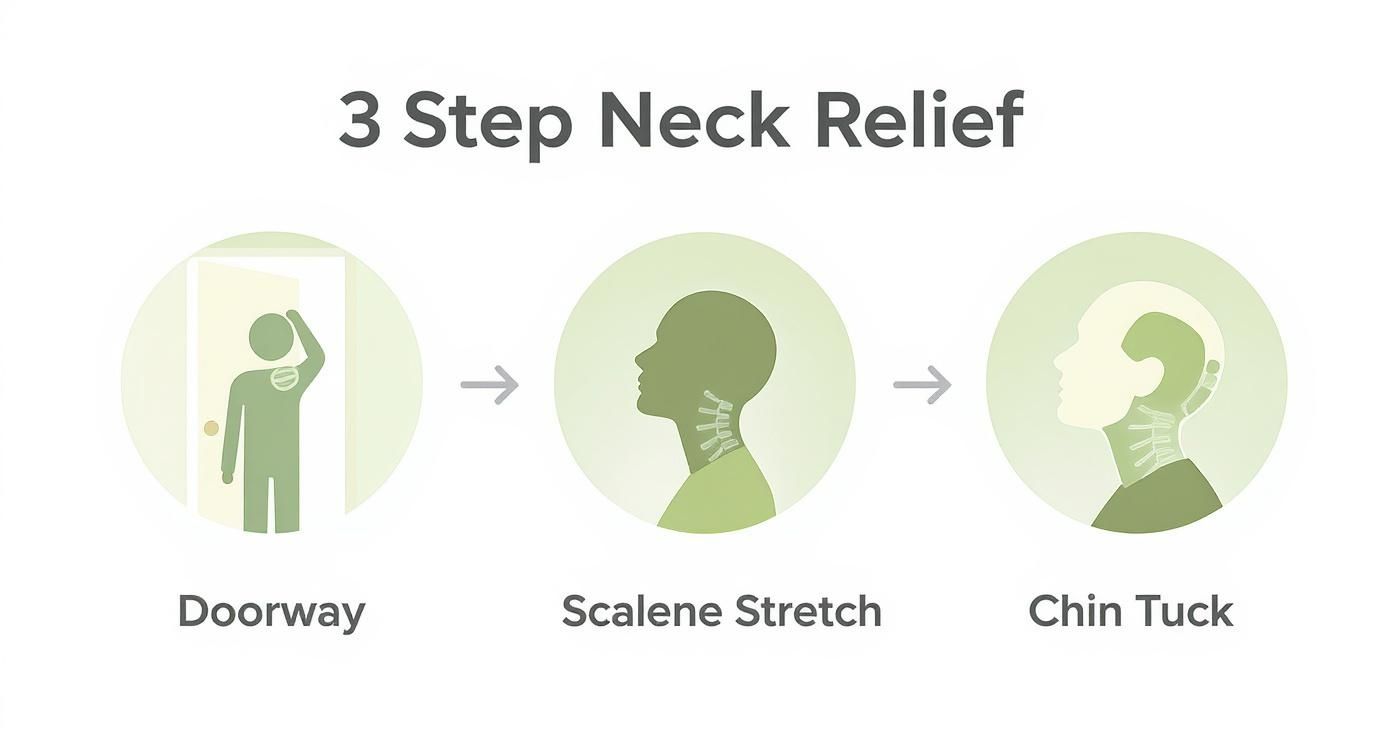
This fantastic visual guide really drives home how combining stretches (like the Doorway Stretch) with strengtheners (like our new friend, the Chin Tuck) creates a seriously powerful one-two punch for postural correction.
Alright, now that your deep neck flexors are awake and reporting for duty, it's time to call in the big guns: the muscles of your upper back. I'm talking specifically about the rhomboids and mid-traps. These are the muscles that pull your shoulder blades together, creating a strong, stable shelf for your head and neck to rest on.
Your new best friend for this job? Scapular Squeezes.
This focused squeeze is non-negotiable for anyone trying to figure out how to correct forward head posture, especially if you work at a desk. In fact, research shows that among people who spend their days in front of a computer, the prevalence of this issue can be a staggering 61.3%, almost always paired with rounded shoulders. If you're a data nerd, you can read the full research about these postural deviations.
Here's the real secret: This isn't about getting bulky. It's about building muscular endurance so that good posture becomes your natural, default state—not something you have to constantly force yourself into.
Once these exercises start to feel a bit too easy, you can level up by adding resistance bands for a greater challenge. The end goal is to build a strong, supportive muscular "corset" for your upper spine that makes slouching just feel... well, weird.

Let's be real. All the stretches in the world won't make a dent if your daily routine is constantly yanking you back into that familiar slump. You can do chin tucks until you’re blue in the face, but if you spend the next eight hours hunched over a laptop, it's a losing battle.
The real secret to lasting change? Rigging the game in your favor. It’s all about creating an environment where good posture is the easiest, most natural choice. We’re talking about smart, subtle adjustments that support your spine without you even having to think about it.
Your desk is ground zero for this postural revolution. If you’re a desk jockey like most of us, a bad setup is a one-way ticket to forward head posture. Time to stop sabotaging your own progress and conduct a quick ergonomic audit.
First things first, let's talk about your monitor. It needs to be positioned so the top third of the screen is directly at eye level. This tiny change is huge—it forces you to keep your head up and your neck long instead of craning forward to see what you're working on. And if you're on a laptop, a separate stand and an external keyboard aren't just nice to have; they're non-negotiable.
Now, look at your chair. Can you plant your feet flat on the floor with your knees bent at a comfy 90-degree angle? Your chair should have solid lumbar support to help maintain your lower back's natural curve, which is the foundation for a healthy upper spine. Your elbows should also be at a nice 90-degree angle when you type.
When you nail your screen setup, take regular breaks, and even look into effective digital eye strain treatments, you dramatically cut down on the subconscious urge to jut your head forward.
Key Insight: An ergonomic workspace isn't a luxury; it's a foundational tool for correcting forward head posture. It automates good habits, making it easier to maintain a neutral spine throughout your day.
But hey, your posture isn't just a 9-to-5 problem. How you hold yourself in your off-hours matters just as much.
These aren't massive life overhauls. They’re small, intentional tweaks that add up. By reshaping your environment, you're not just fixing a bad habit—you're building a lifestyle that actively promotes a taller, healthier, more confident you.
https://www.youtube.com/embed/VMbhM59K5FQ
Let's be real—the stretches, exercises, and habit changes we've covered are your front-line defense in this postural battle. For most people, they're more than enough to get things back on track.
But sometimes, you need to call in the cavalry.
Knowing when to wave the white flag and see a professional is a huge part of fixing your forward head posture safely and for good. It’s not about giving up; it’s about getting the right help when you need it.
Think of it like this: if you've got a leaky faucet, you might try tightening a few things yourself. But if the whole pipe bursts? You call a plumber. The same logic applies here.
So, what are the "burst pipe" symptoms for your neck?
A physical therapist or chiropractor can give you a precise diagnosis, often using awesome tools like posture analysis software to get exact measurements of your alignment. Seeing the hard data can be a real eye-opener.
Research has actually shown a direct link between the severity of forward head posture and how well conservative treatments work. One study found that for every bit your head juts forward, the odds of success with physical therapy drop by 13%. This just goes to show why getting a professional assessment is so important for tougher cases.
When the usual fixes aren't cutting it, professionals have other tools in their arsenal. They might suggest things like trigger point injections for pain relief to target those stubborn, painful knots.
Making that call isn’t a sign of failure. It’s a smart, proactive move toward feeling better for the long haul.
Here’s a quick guide to help you decide when to stick with your home routine and when it's time to book that appointment.
Ultimately, you know your body best. If something feels genuinely wrong or you're just not seeing the progress you'd hoped for, there is zero shame in getting an expert opinion.
Alright, so you’re ready to tackle that tech neck. It’s totally normal to have a few questions swirling around before you dive in. Let's clear the air on some of the most common ones so you can get started with confidence.
This is the million-dollar question, isn't it? The honest-to-goodness answer is... it depends. There's no magic switch, but most people start to feel a real difference—less pain, more flexibility—within a few weeks of consistent effort.
But making that change stick? That's more of a marathon than a sprint. For your body and brain to truly relearn what "normal" posture feels like, you're realistically looking at three to six months, sometimes longer. Think about it: you're unwinding years of habit. It takes time to build new muscle memory.
The Bottom Line: You'll feel better pretty quickly, but lasting change takes months of showing up for yourself. Patience is your best friend on this journey.
You've seen them online and in stores—straps and harnesses that promise to pull you into perfect alignment. While they can be a handy tool to give you a physical reminder of what better posture feels like, they are definitely not a permanent fix.
Think of them like training wheels on a bike. They provide support, but they do the work for your muscles. The whole point of this is to wake up and strengthen the lazy muscles in your back and neck so they can hold you up on their own. Relying on a brace too much can actually let those muscles get even weaker.
Let's get this one out of the way right now. Unless a doctor has told you otherwise for a specific medical reason, it is almost never too late to improve your posture. I don't care if you've been slouched over a desk for 20 years; you can still make a huge difference.
Your body is remarkably resilient. When you start strengthening your upper back and stretching out that tight chest, you’re actively retraining your muscles to hold you in a better position. This isn't just about aesthetics; it's about better balance, less pain, and even reducing your risk of falls later in life. You might not be able to change your bones, but you can absolutely change the muscles that support them. You haven't missed your chance.
Tired of wondering if you're doing the exercises correctly? Dalm takes the guesswork out of your practice. Using AI-powered analysis, it gives you real-time voice feedback on your yoga poses, making sure every move is a step toward better posture. It’s like having an expert guide you to perfect alignment. Discover your best posture with Dalm today.