
How to Develop Muscle Memory: Master Skills Faster with Proven Drills
Ever watched a guitarist rip through a solo, their fingers a blur on the fretboard? Or a tennis pro snap a perfect backhand down the line without a second thought? That’s muscle memory in action. But here's the secret: it has almost nothing to do with your muscles. It's your brain, running a brilliant, high-speed program it wrote itself.
Let’s get one thing straight right off the bat: your biceps don't have a better memory than you do. The term "muscle memory" is really just a catchy name for a fascinating brain process called motor skill learning. It’s how your brain turns clumsy, thought-intensive actions into fluid, automatic movements.
Imagine you're trying to find your way through a dense jungle for the first time. You’re hacking away at vines, carefully placing each step, and checking your compass every ten seconds. It’s a slow, mentally draining slog.
Now, imagine you walk that same path every single day. Soon, you've worn a clear trail. The vines are gone, the footing is certain, and you don't even need the compass anymore. Before you know it, that trail is a paved superhighway, and you can cruise down it at 80 mph while thinking about what to have for dinner. That's exactly what practice does to your brain.
This neurological highway construction isn't a one-man job. It's a finely tuned collaboration between a few all-star regions of your brain.
As you repeat a movement, these brain regions build and reinforce neural pathways. These pathways get wrapped in a fatty sheath called myelin, which acts like insulation on a high-speed cable. The more you practice, the thicker the myelin, and the faster the signal zips from brain to muscle. The result? A skill that feels effortless.
The true genius of muscle memory is that your brain is essentially outsourcing the grunt work. By automating the physical execution, it frees up your conscious mind to focus on strategy, creativity, and reading the situation—like a point guard analyzing the defense instead of thinking about how to dribble.
While your brain is the mastermind, your muscles are definitely more than just passive puppets. They adapt in a pretty cool way, too. As you train, particularly against resistance, your muscle cells create more myonuclei. These are like tiny little foremen inside each muscle fiber, managing protein production and helping the muscle repair and grow.
Here's where it gets interesting. One landmark study showed that even after a 16-week break from training—long enough for muscles to shrink—those extra myonuclei stuck around. When the participants started training again, the previously worked muscles regained size and strength way faster. The cellular "factory" was already built and just waiting to be switched back on. Men's Health has a great breakdown of these long-term muscular changes.
This whole beautiful process is a perfect example of kinesthetic learning, where you learn by doing. By understanding what's happening under the hood, you can stop just mindlessly grinding and start practicing with purpose. Every single repetition is another layer of pavement on your neural highway, getting you that much closer to mastery.
Alright, so we've peeked under the hood at the neuroscience. Cool stuff. But knowing how muscle memory works and actually building it are two very different beasts. This is where we get our hands dirty.
The most powerful tool you have for this is deliberate practice. I’m not talking about just going through the motions. Forget that. This is about practicing with laser-like focus, a crystal-clear goal for every single repetition, and a hungry desire for feedback.
Honestly, 20 minutes of this kind of sharp, focused work will demolish two hours of zoned-out, mindless repetition. Every time. We're turning practice from a chore into a high-intensity workout for your brain.
First things first: stop looking at a skill as one giant, scary mountain. A perfect golf swing, a complex yoga pose, that tricky guitar chord change—none of them are single movements. They're a chain of smaller, linked actions. The secret is to pull them apart.
This is a technique we call chunking. You find each tiny piece of the skill, you master it on its own, and then you start snapping the pieces back together.
Let’s get real with an example. A new guitarist is trying to nail a clean G to C chord transition. It’s a classic struggle.
By breaking it down, you're not just practicing—you're methodically programming a flawless sequence into your brain, one chunk at a time. This works for anything, from a tennis serve to a powerlifting deadlift.
The whole game is about this: find your weak spot, isolate it, drill it into a strength, and then plug it back into the main skill.
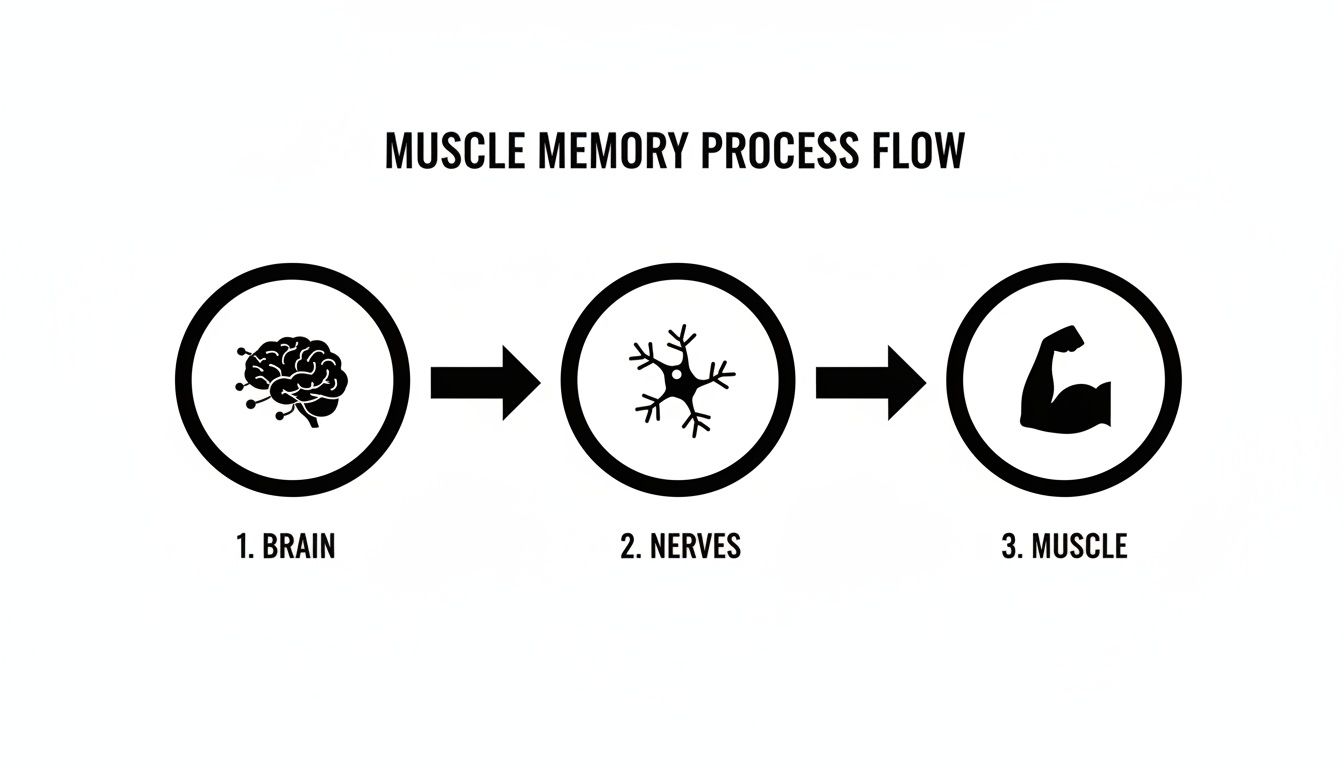
This entire process is about building and reinforcing that pathway from your brain, down your nerves, and into your muscles. It's how conscious effort eventually becomes second nature.
To make this happen, you need a plan. A vague goal like "get better at yoga" is totally useless. Your goals need to be specific, measurable, and obsessed with the process, not just the final outcome.
It’s all about structure. Let's look at how to build a practice session that actually works, comparing the usual mindless grind with a focused, deliberate approach.
This table breaks down the difference between just showing up and actually getting better.
This framework forces you to stop being a passenger and start being the pilot of your own skill development. You're constantly analyzing, tweaking, and refining. That, right there, is the secret sauce.
Alright, if deliberate practice is the engine driving your skill development, then the techniques we're about to cover are the high-octane fuel. Ready to hit the fast-forward button? These are the advanced drills that elite performers and neuroscientists alike swear by to lock in muscle memory at lightning speed.
First up is a powerful concept called Spaced Repetition. Your brain is wired with a natural "forgetting curve"—it's constantly trying to ditch information it deems unimportant. Spaced repetition is the art of strategically interrupting that process right when it matters most.
Instead of cramming all your practice into one marathon session, you space it out. This simple tweak forces your brain to work a little harder to recall the skill, and it's that extra effort that forges a much deeper, more permanent neural connection. Think of it like letting a muscle almost fully recover before you hit the next set in the gym; the stimulus is way more effective.
Now for a technique that feels counterintuitive at first but pays off big time. Most of us practice in neat, tidy blocks: 30 minutes of serves, then 30 minutes of forehands, then 30 minutes of backhands. This is what's known as blocked practice.
While it feels super productive in the moment, you're actually creating a very rigid and fragile muscle memory. The better way is interleaving, or what I just call varied practice.
This means you intentionally—and randomly—mix up your drills. For a tennis player, that practice session now looks more like this: serve, forehand, backhand, volley, serve, backhand... all in an unpredictable sequence. It feels chaotic and is definitely more challenging because your brain can't just slip into autopilot.
Interleaving forces your brain to constantly load and reload different motor programs. This builds an incredibly flexible and adaptable skill set that mirrors the chaos of real-world performance, whether you're on a court, in a boardroom, or on a stage.
This approach is a fantastic way to strengthen your proprioception—your body's internal GPS for knowing where it is and how it's moving in space. By constantly adjusting to different demands, you're not just learning one motion; you're learning the art of movement itself. To really get a handle on this, check out our guide on what proprioception training is and how it sharpens your physical intelligence.
So, how does this play out in practice? Let’s step off the tennis court.
For the Martial Artist: Stop drilling the same three-punch combo for 10 minutes straight. Instead, throw that combo, immediately flow into a defensive block, follow up with a leg kick, and then switch to a different combo. This chaos mimics the unpredictability of a real sparring match, building reflexes that actually work under pressure.
For the Coder: Don't just grind away on one type of programming problem for an hour. Interleave different challenges. Tackle an array problem, then switch to a string manipulation task, and then jump to a recursion problem. You’ll become a much more agile thinker, able to switch contexts on the fly.
For the Yogi: Instead of just holding Warrior II for five breaths on each side before moving on, try flowing through a more dynamic sequence. Move from Warrior II to Triangle Pose, then to Extended Side Angle, and back again. This teaches your body the crucial transitions between the poses, which are just as important as the poses themselves.
This kind of smart, varied practice doesn’t just rewire your brain; it actually leaves a physical mark on your muscles. Wild, right?
Research from the University of Jyväskylä discovered that muscles have their own form of protein-level memory. A study involving mass spectrometry scans of over 3,000 proteins found that after a 10-week resistance training program, "memory traces" lingered in the muscle proteins even after a 10-week break.
Even though muscle fibers shrank during the break, these epigenetic tweaks explained why re-gains happened so much faster. It completely debunks the old idea that all your progress vanishes if you take time off. This protein memory can last for about 2.5 months, so a break of less than 10 weeks barely makes a dent. You can dive into the full study on these incredible muscle protein memory findings.
By putting these advanced drills into action, you're not just practicing harder; you're practicing smarter. You're aligning your training with the fundamental ways your brain and body actually learn, adapt, and remember for the long haul.
Not too long ago, the only way to get a world-class critique of your form was to have a seasoned coach breathing down your neck, pointing out every tiny flaw you couldn't see or feel. That kind of eagle-eyed attention was a luxury. Today, that luxury fits in your pocket.
We now have virtual coaches that never get tired, never blink, and can break down our movements with scary precision. This is an absolute game-changer for building muscle memory because it completely kills the guesswork. You’ll never have to wonder, "Is this right?" again.
The magic behind this is a technology called pose estimation. It sounds like something out of a sci-fi movie, but the idea is simple. You set up your phone, record yourself doing a movement—a deadlift, a yoga pose, a golf swing—and an AI model analyzes the video, frame by agonizing frame.
This isn't just you watching a replay. The AI pinpoints your key joints (shoulders, hips, knees, you name it) and tracks their angles and positions in real time. It then stacks your form up against a massive database of ideal models, spitting out instant, actionable corrections.
This immediate feedback loop is pure gold. You mess up, you get a correction, you adjust on the very next rep, and you start carving the correct pattern into your brain from the get-go. No more practicing your mistakes.
This tech isn't some far-off concept; it’s in apps you can download right now. A platform like Dalm, for example, uses your phone's camera to deliver this exact kind of detailed analysis for yoga. It gives you real-time voice feedback, guiding you into better alignment and helping you perfect poses with medical-grade precision. You can see a full breakdown in our deep dive into posture analysis software.
Imagine you're in a Warrior II pose and a calm voice chimes in, "Lower your hips a bit more to get your front thigh parallel to the floor." That's the kind of hyper-specific cue that slashes your learning curve.
Here’s a quick look at how an AI-powered tool can track your movements and give you the data you need.
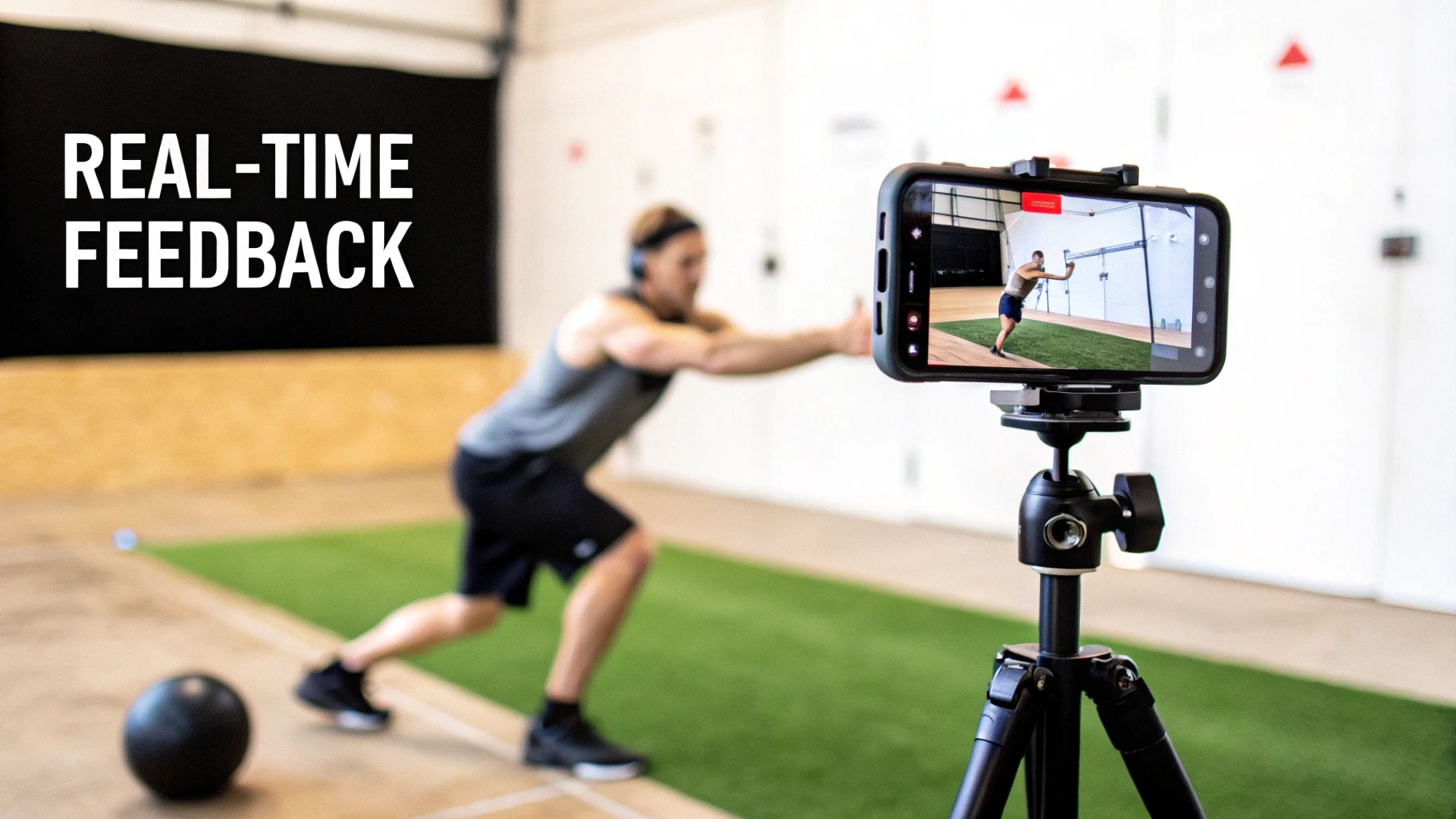
The image shows how simple the setup is—just you, a phone, and a tripod. That's all it takes to turn your living room into a high-tech training ground and get a sophisticated biomechanical analysis.
Let's be real: one of the toughest parts of mastering a new skill is staying motivated when progress feels invisible. This is where tech steps in again, making your tiny improvements tangible.
AI tools don't just correct you in the moment; they track your journey. Over time, you get visual proof of how your joint angles have improved, how much more stable you've become, or how consistent your form is now.
Seeing a chart that shows your squat depth has improved by 15% in a month is a huge shot of adrenaline. It turns a "feeling" into a hard fact, proving your deliberate practice is working. This data also ruthlessly points out any lingering weak spots, giving you a clear mission for your next session.
This isn't about replacing human coaches—a great one is invaluable. It’s about arming yourself with powerful, accessible data you can use anytime, anywhere. It helps ensure that every single rep is a step in the right direction, building a rock-solid foundation of flawless muscle memory.
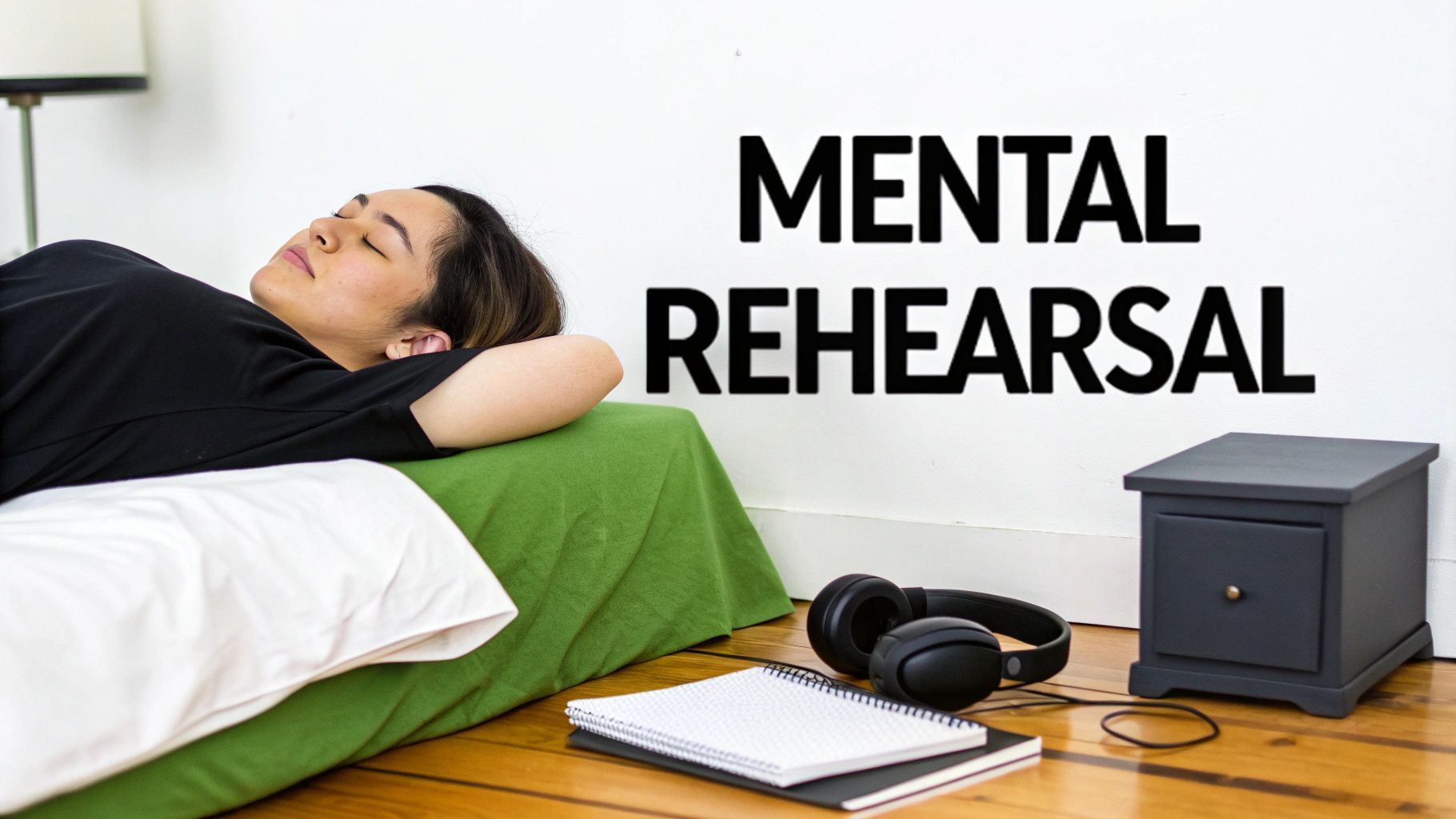
The reps you put in during practice? That's only half the story. The real magic, the place where your brain cements all that hard work into actual skill, happens long after you've put the gear away. It happens when you’re resting, recovering, and most importantly, sleeping.
Your brain isn't just powering down for the night; it's running a sophisticated software update. This process is called sleep-dependent memory consolidation, and it’s where the flimsy neural connections you just built get reinforced, refined, and locked in for good.
During the deep, non-REM stages of sleep, your brain literally replays the motor patterns you practiced. This mental "instant replay" prunes away the sloppy signals and strengthens the correct ones, making the movement smoother and more automatic the next day. Skimping on sleep is like doing a killer workout and then skipping the protein shake—you’re just throwing away the gains.
Getting good sleep isn't just about feeling less cranky. It’s a non-negotiable strategy for learning faster. The good news is that a few small tweaks to your nightly routine can make a massive difference in how well your brain consolidates your practice.
Here are a few high-impact tips that actually work:
Think of quality sleep as the final, mandatory step of every single practice session. It’s where fragile, short-term memories get converted into permanent, automatic skills.
Now for the secret weapon used by pretty much every elite athlete, surgeon, and concert pianist out there: mental rehearsal. Also known as visualization. It might sound a bit woo-woo, but the neuroscience behind it is rock-solid. When you vividly imagine yourself executing a skill, you fire up the exact same neural circuits in your brain as you do when you're physically performing it.
It's a free, zero-impact way to squeeze in extra reps. You’re literally strengthening your muscle memory without moving a muscle. This is a game-changer for learning complex sequences, fine-tuning your form, or practicing when you’re injured or away from your equipment.
Here's the kicker: your brain can't always tell the difference between a vividly imagined experience and a real one. By repeatedly running a mental movie of a perfect performance, you're paving those neural highways just as effectively as you would on the court or in the gym.
But to make this work, you can't just daydream. You need a framework. The gold standard for this is the PETTLEP model, which turns passive thinking into an active, brain-training workout.
Alright, so you're bought into the science and you have a game plan. But let's be real, the road to mastering a new skill is never a straight line. Questions always pop up.
Think of this as your personal troubleshooting guide. I've heard these questions countless times from people I've coached, so let's get you the straight answers you need to keep moving forward.
This is the million-dollar question, isn't it? Everyone wants to know the magic number, but the honest answer is: it depends. The time it takes is all about the complexity of the skill and, even more importantly, the quality of your practice.
Learning a solid kettlebell swing might start feeling second nature after a few hundred really focused reps. But mastering something wildly complex, like a Chopin nocturne on the piano or a difficult martial arts kata? That's a different beast entirely, often demanding thousands of hours of painstaking, deliberate work.
The real secret isn't about hitting a certain number of hours. It’s about showing up consistently. Fifteen minutes of focused, daily practice will build better, stronger pathways than a frantic three-hour session once a week. Your brain craves that consistency.
Yes and no. It’s not like the memory just vanishes. But those super-efficient neural highways you built will definitely get rusty with disuse. If you hang up your guitar for five years, you’re not going to pick it up and shred your favorite solos with the same fluid grace. The signal just won't be as clean.
But here's the cool part: the underlying blueprint never really goes away. It’s why re-learning an old skill feels so much faster than starting from scratch. The path through the jungle might be overgrown with weeds, but it's still there, waiting for you to clear it out again.
Oh, absolutely. This is the dark side of muscle memory. Your brain is an incredible automation engine, but it doesn't judge. It will automate whatever you consistently do, whether it's right or wrong.
If you drill sloppy form over and over, your brain will dutifully lock in that sloppy movement pattern. This is precisely why it’s so critical to get it right from the very beginning.
Practicing with perfect form at a snail's pace is infinitely more valuable than practicing with bad form at full speed. Trying to undo a deeply ingrained, incorrect movement is a nightmare. You're literally fighting your own brain's hardwiring.
Look, it's true that younger brains are often more "plastic," meaning they form new connections a bit more readily. But you can absolutely build new skills and solid muscle memory at any age. The core principles—deliberate practice, focused reps, and proper rest—are the same for everyone.
It might take a little more conscious effort and patience as you get older, but your brain never loses its ability to learn, adapt, and automate. Don't let your age become a mental roadblock. Just be extra diligent about the quality of your practice.
Ready to stop guessing and get real, objective feedback on your form? Dalm uses AI-powered pose analysis to give you instant voice cues, making sure you build perfect muscle memory from day one. Perfect your practice with medical-grade precision at https://dalm.co.