
How to Do Yoga at Home for Beginners A Simple Guide

Alright, let's roll out the mat and get started. Doing yoga at home isn't some complicated, mystical ritual—it's actually way easier than you think. All you really need are three things: a dedicated little spot to call your own, a few key pieces of gear (starting with a good mat), and a simple routine to follow.
Forget the idea that you need a fancy studio membership or expensive leggings to get going. Your living room corner is about to become your new favorite yoga shala.
Welcome to your very own personal yoga studio! No, you don't need to knock down any walls. We're talking about that quiet corner in your bedroom or the space behind the couch. The thought of starting yoga at home can feel a bit daunting, but my goal is to cut through the noise and show you just how simple—and exciting—it can be.
Let go of any pressure to create an Instagram-worthy, minimalist zen paradise. The only thing that matters is creating a space that feels calm and inviting to you.
You're not just picking up a new hobby, either. You're joining a massive global movement. In a huge shift for the wellness world, 67% of practitioners now say they prefer practicing at home over going to in-person classes. And with resources like YouTube hosting well over 250 million yoga-related videos, it's never been easier to find guidance.

First things first: claim your spot. This doesn't need to be a permanent shrine to yoga. It just has to be a little patch of floor where you have enough room to stretch your arms out wide and your legs back long without kicking the cat or knocking over a lamp.
Think of this space as your personal escape hatch from the daily grind. Try to keep it as clutter-free as possible. A tidy space really does help create a tidy mind, which is exactly the vibe we're going for.
The real magic happens with consistency. By returning to the same spot every time you practice, you’re creating a powerful mental cue. Your brain will start to connect this little corner of your home with peace, focus, and movement, making it so much easier to get on the mat each day.
While you can do yoga with nothing but your own body, a few key items will make the experience way safer, more comfortable, and a whole lot more fun. Don't feel like you need to rush out and buy a cartful of gear. Just start with the basics.
To make it super simple, here’s a quick checklist of what’s what.
This table breaks down the essential and optional gear to create the perfect yoga space at home without breaking the bank.
Honestly, just a mat and some comfy clothes are all you truly need to begin. You can find more detailed recommendations in our complete guide on essential yoga equipment for beginners when you're ready to expand your toolkit.
Your yoga mat is more than just a piece of equipment; it's your personal island. It defines your space and becomes the foundation for your entire practice. Investing in a good one is investing in your comfort and safety from day one.
Last but not least, let's talk vibes. How do you want to feel during your practice? Energized and awake? Calm and centered?
A few simple tweaks can transform your corner from just a space on the floor into a genuine sanctuary.
Consider the lighting. Natural light is amazing if you have it, but a soft lamp works wonders for an evening session. Some people love practicing in total silence to focus on their breath. Others, like me, prefer a chill playlist with some ambient tunes or nature sounds.
There are zero rules here. Play around with it. Find what helps you disconnect from the noise of the world and connect with yourself. This little bit of effort is what turns a home yoga session from just a workout into a truly mindful experience.
I get it. You've finally carved out 20 precious minutes for yoga, and you're itching to jump right into those cool-looking poses. It’s so tempting to just skip ahead. But trust me on this one: launching into a Downward Dog with cold muscles is like trying to stretch a frozen rubber band. It’s a fast track to frustration and, worse, injury.
Honestly, skipping the warm-up is the most common mistake I see beginners make. Your body needs a gentle "good morning" before you ask it to bend and stretch. Think of it as a friendly handshake with your muscles, letting them know what's about to go down.
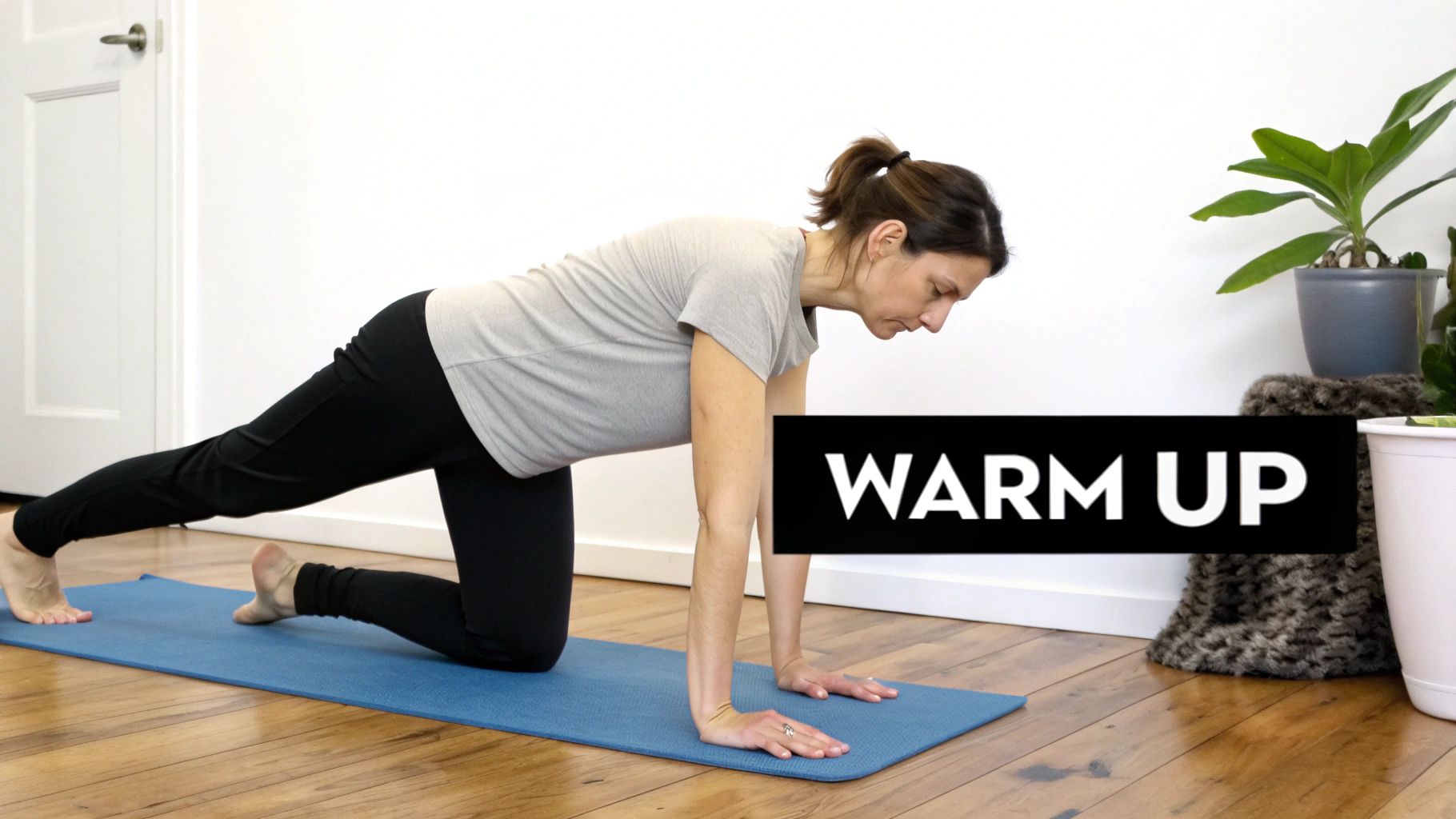
A good yoga warm-up isn't about holding deep, painful stretches. Quite the opposite, actually. It's all about dynamic movement—gentle, flowing motions. The real goal here is to get your blood flowing, lubricate your joints, and simply wake up the connection between your brain and your body. This little bit of prep work makes every pose that follows feel better and a whole lot safer.
Here's a super simple sequence I use all the time to get the body ready. It targets the spine, hips, and wrists—all crucial areas for a solid practice. The key is to move slowly and really sync up your breath with each movement.
That’s it! This quick routine is all you need to get your body prepped for a fantastic, safe practice. If you want to mix things up, we've got a whole list of other great yoga warm-up exercises you can try.
A warm-up does more than just get you ready physically; it’s a mental reset. It’s your signal to the brain that it's time to ditch the to-do list, tune out the noise, and turn your focus inward.
By spending just these 5 minutes, you're doing more than warming up muscles. You're showing your body respect and building a smart, sustainable yoga habit that will keep you injury-free for the long haul.
Alright, this is where the real fun begins. You’ve set up your space, warmed up your body, and now it’s time to actually do some yoga. Forget trying to memorize dozens of complicated Sanskrit names. We're going to focus on a handful of foundational postures that are the true building blocks of any solid practice.
Think of these poses as the ABCs of yoga. Once you get the hang of them, you can start stringing them together into flowing sequences. The goal here isn't perfection; it's about learning what each pose feels like in your unique body.
It might look like you're just standing there, but don't be fooled. Mountain Pose is the secret sauce to good alignment in almost every other standing pose you'll ever do. It's an incredibly active posture that teaches you how to ground down and lengthen up at the same time.
Stand with your feet about hip-width apart and really feel your weight distributing evenly across all four corners of each foot. Fire up your thigh muscles, give your tailbone a slight tuck, and draw your shoulders down and back. Let your fingertips reach toward the floor, imagining a line of energy shooting from your feet all the way to the crown of your head.
If there's one pose that just screams "yoga," this is it. Downward Dog is a glorious, full-body stretch that strengthens your arms and shoulders while lengthening your entire backside, from your calves all the way up to your hamstrings.
Start on your hands and knees. Tuck your toes under, and then lift your hips up and back until your body forms an inverted 'V' shape. Your first instinct might be to force your legs straight, but for beginners, it’s far more important to keep a flat back. So, go ahead and bend your knees generously!
Press firmly through your hands, rotate your upper arms outward to create some breathing room for your shoulders, and just let your head hang heavy. You can even "pedal" your feet—bending one knee and then the other—to gently wake up those sleepy hamstrings.
Time to unleash your inner warrior! This powerful standing pose is a beast for building strength and stamina in your legs and core. It also feels fantastic for opening up the hips and chest, helping you cultivate focus and stability.
From a standing position, step your feet wide apart, maybe 3.5 to 4 feet. Turn your right foot out 90 degrees and pivot your left foot in just slightly. Bend your right knee until it's directly over your ankle, keeping that back leg straight and strong.
Now, float your arms up parallel to the floor and gaze over your front fingertips. A big rookie move is to lean forward; try to keep your torso stacked right over your hips. Feel the strength radiating from the ground up.
Beginner Tip: Watch that front knee! It loves to collapse inward in Warrior II. Actively press it toward the pinky-toe side of your foot. This little adjustment protects your knee joint and makes sure your hip muscles are doing their job.
Triangle Pose is a fantastic stretch for tight hamstrings, hips, and your spine. It teaches you how to create length and find stability at the same time, making it a cornerstone of many yoga sequences. It's pure bliss after a long day of sitting.
Start in the same wide-legged stance as Warrior II. Straighten your front leg (but don't lock the knee!), and then start reaching forward as far as you can. When you've run out of room, hinge at your hip and bring your bottom hand down to rest on your shin, ankle, or a yoga block.
Reach your top arm straight up to the sky, creating a single, clean line from your bottom hand to your top. Remember, the goal isn't to touch the floor; it's to keep both sides of your torso long and open.
We touched on this in the warm-up, but it’s so good it deserves its own spotlight. Cat-Cow is less of a static pose and more of a gentle flow. It’s perfect for improving spinal flexibility and melting away tension in your back and neck.
Get on your hands and knees, with your wrists stacked under your shoulders and knees under your hips.
Flow between these two movements, letting your breath be the guide. It’s a simple, rhythmic motion that feels like a mini-massage for your entire spine.
This is your home base. Your reset button. Your "I need a minute" pose. Child's Pose is a gentle resting posture that calms the mind and provides a lovely stretch for the back, hips, and ankles. Never, ever feel ashamed to take Child's Pose whenever you need it.
From your hands and knees, bring your big toes to touch, spread your knees wide, and sink your hips back toward your heels. Fold your torso forward and rest your forehead on the mat. You can stretch your arms out long in front of you or rest them alongside your body—whatever feels better. Just breathe deeply into your back.
Cobra is a gentle backbend that helps strengthen your spinal muscles and improve posture. It’s the perfect antidote to all the forward-hunching we do over desks and phones.
Lie on your stomach and place your hands under your shoulders, tucking your elbows in close to your ribs. Press the tops of your feet and your pubic bone firmly into the floor. On an inhale, gently peel your head and chest off the floor, using your back muscles more than the strength of your arms. Keep your gaze slightly forward to keep your neck long.
Here’s another accessible backbend that strengthens your glutes and hamstrings while opening up your chest and shoulders. Bridge Pose is a fantastic way to energize the body and can even help soothe a mild backache.
Lie on your back with your knees bent and feet flat on the floor, hip-width apart. You should be able to just graze your heels with your fingertips. On an exhale, press through your feet to lift your hips off the floor. Keep your thighs parallel. For a little extra oomph, clasp your hands together underneath you and roll your shoulders under for support.
For a deeper dive into these and other essential postures, check out our illustrated guide to the best yoga poses for beginners, which includes even more modifications and tips. Learning these fundamentals is the key to building a confident and safe home yoga practice.
Alright, you’ve got a handle on some of the core poses—that’s a huge step! Now for the fun part: weaving them together into a routine that actually flows.
Think of it like learning chords on a guitar. First, you practice each one individually. Then, you learn to move between them to create a song. The real magic in yoga happens in those transitions, that fluid movement from one pose to the next. It’s where you build heat, challenge your balance, and get your breath and body working in perfect sync.
Don't worry, you don't need to be a yoga choreographer just yet. I've put together three simple routines you can start using today. The goal is to get you comfortable enough to practice on your own, without feeling glued to a YouTube video every single time.
Forget hitting snooze for the tenth time. This quick little sequence is designed to gently nudge your body awake, shake off that morning stiffness, and get you started on the right foot. Honestly, it’s better than a shot of espresso.
We’ll focus on opening up the spine and chest, getting the blood moving, and clearing out the mental cobwebs.
This sequence is short, sweet, and surprisingly effective. It’s the perfect way to tell your body, "Okay, we're awake, we're moving, let's do this!"
This is your bread-and-butter routine. It pulls together the essential poses we’ve already covered into a well-rounded practice that builds a little strength and a little flexibility. It's perfect for when you have a bit more time to spare.
When you're starting out, consistency beats intensity every time. Experts suggest that practicing two to three times per week for 20 to 30 minutes is a fantastic sweet spot. It helps your body adapt safely and makes it way easier to build a habit that actually sticks. You can read more about building a solid practice over at aurawellnesscenter.com.
The point of a foundational flow isn’t perfection. It’s about building confidence and getting familiar with how your body moves. You’re creating a solid base you can build on for years.
Here’s a simple way to structure your 20 minutes:
This little graphic shows how some key poses in this routine—Downward Dog, Warrior II, and Child's Pose—can link together.

You can see the flow from an all-body stretch into a strong standing pose, and finally into a posture of rest and recovery.
Long day? Stressed out? This routine is your antidote. The whole vibe here is slow, deep stretching and calming poses that help you release physical tension and quiet your racing mind. It’s all about prepping for a great night’s sleep.
For this one, we'll hold the poses a bit longer. Use every exhale as an opportunity to release and soften just a little bit more.
This gentle sequence is the perfect way to tell your nervous system that it's officially time to shift from "go mode" into "rest mode."
Practicing smart is every bit as important as practicing often. As you figure out this whole at-home yoga thing, it's super easy to stumble into a few classic traps. Let's make sure you sidestep them so your practice feels incredible from the get-go.
One of the biggest blunders I see? Holding your breath! When a pose gets challenging, our gut reaction is to clench up and just... stop breathing. But that’s the exact opposite of what your body needs. Your breath is your fuel and your anchor. It’s the very thing that helps you sink deeper into a stretch and stay centered when you start to wobble.
Another classic is pushing way too hard, way too soon. We’ve all done it. You see a jaw-dropping pose on Instagram and think, "I can do that!" This "no pain, no gain" mindset is a one-way ticket to getting hurt and has absolutely no place in yoga. Remember, this is a practice, not a performance.
It’s tempting to just copy the general shape of a pose you see without really getting the mechanics behind it. But rushing through movements with sloppy alignment doesn't just cheat you out of the benefits—it can seriously strain your joints. A perfect example is letting your front knee cave inward during Warrior II. That puts a ton of funky pressure on the knee joint that you just don't want.
To avoid this, think quality over quantity. It's far better to do three poses with mindful, strong alignment than to race through ten with wonky form.
This one is the golden rule. Your body is giving you constant feedback, and your job is simply to listen. There's a world of difference between the satisfying discomfort of a muscle getting a good stretch and the sharp, screaming pain that signals an injury.
Here's how to tell the difference:
Your body speaks a language without words. Learning to listen to its whispers—the subtle aches, the feelings of openness—is one of the greatest skills you'll develop in your yoga practice. If you feel any "bad pain," back off immediately.
When you’re learning yoga at home, you are your own best teacher. So, don't you dare compare your Day 1 to someone else's Day 1,000. Your journey is yours alone. Stay curious, be patient with yourself, and always prioritize how a pose feels over how it looks. This is the secret to staying safe, happy, and rolling out your mat for years to come.
Stepping onto the mat for the first time is exciting, but it definitely sparks a few questions. When you're learning yoga at home, you're wearing all the hats—student, teacher, and motivator—so it's totally normal to wonder if you're doing things "right."
Let's tackle some of the most common things that trip up beginners. Think of this as the kind of friendly chat you'd have with a teacher after class. The answers are usually way simpler and more encouraging than you'd expect.
Forget about intensity for now. The real secret sauce is consistency.
Aiming for 2-3 sessions a week is a brilliant place to start. This gives your body a chance to rest and repair, which is exactly how you build strength without burning out.
And no, you don't need to block out an hour every time. A solid 20-30 minutes is more than enough to get the benefits and start building a real habit. Honestly, a quick 10-minute flow on a chaotic day is a million times better than doing nothing at all.
The point isn't to nail a headstand in a week. It's to create a practice that sticks around because it makes you feel good. Show up, even for a short while, and you're building something that will support you for years.
If I had a dollar for every time I've heard this, I'd have a lot more yoga mats. Saying you're not flexible enough for yoga is like saying you're too hungry to eat dinner. Flexibility isn't the ticket to get in; it's the prize you get for showing up.
Your starting point is exactly where you're supposed to be.
Real progress is slow and steady. It’s about celebrating that you can reach an inch further today than you could last week, not about contorting yourself into a human pretzel.
Ah, the classic question. The best answer? A little bit of both. They each bring something different to the table, and using them together is a fantastic way to learn.
Video routines, like the ones from Yoga with Adriene, are incredible when you're just starting out. They give you the visual cues you need for good alignment and help you sync your breath with your movement. It’s the next best thing to having an instructor in the room.
Written routines, like the ones in this guide, are your ticket to independence. They help you commit the flows to memory and learn to listen to your own body instead of constantly looking at a screen. Start with videos to get the hang of things, then switch to a written guide to really make the practice your own.
Want to stop guessing about your form and see progress faster? Dalm uses AI to give you real-time feedback on your poses, like having a personal yoga teacher on call 24/7. Build a rock-solid home practice with confidence by checking it out at https://dalm.co.