
How to Get Better at Yoga A Practical Guide for Real Progress
If you really want to get better at yoga, you can't just unroll your mat and hope for the best. You need a plan. Think of it as your personal roadmap—a simple, three-part process that turns aimless stretching into a focused journey. It all starts with assessing your baseline, then setting specific goals, and finally, practicing with intention.
Before you can even think about leaping forward in your practice, you have to know exactly where you’re standing right now. This means taking an honest, judgment-free look at your current strengths and, more importantly, where you want to grow. This is the bedrock of real improvement.
Forget about perfection for a second. Let's get real.
Maybe you're rock-solid in Warrior II, but your hamstrings scream bloody murder in a simple Forward Fold. Perhaps your balance is steady as a rock, but your mind is off planning dinner the second you lie down for Savasana. Pinpointing these details isn't about beating yourself up; it's about gathering intel.
Taking a quick snapshot of your current practice gives you an incredibly powerful baseline. Without it, you're just guessing. You could waste weeks trying to deepen your backbends when, in reality, your tight shoulders are the thing holding you back. A quick, honest check-in reveals the real areas that need your attention.
It’s like trying to use a map without knowing your "you are here" location. It’s useless. Your baseline is that little blinking dot. It lets you set achievable goals, celebrate the small victories, and turn your yoga practice into a genuinely rewarding journey.
"True progress isn't measured by how flexible you are, but by how well you understand your own body. The simple act of noticing—'my left hip is tighter than my right'—is where real growth begins."
This simple three-step cycle of assessing, goal-setting, and practicing is what creates continuous, noticeable improvement.

As you can see, every effective yoga journey starts with knowing yourself. That self-assessment directly informs your goals and gives your practice a clear purpose.
You don't need any fancy equipment for this. Just grab a notebook and spend 15 minutes moving through a few key poses you know. As you move, pay close attention to the four main pillars of any yoga practice:
Jotting down these quick observations creates a personal inventory. This isn't a one-and-done deal, either. It’s a powerful ritual you can come back to every month to see how far you've come.
To help you get started, here's a simple table to capture your thoughts.
This quick self-assessment helps you identify your current strengths and areas for improvement across the key yoga pillars. Just fill in the last column for yourself!
Once you have this snapshot, you've got clarity. For a deeper dive into logging your improvements over time, check out our guide on how to track fitness progress. This kind of focused approach keeps you motivated and ensures your effort is always aimed at what matters most for your body and your mind.
Let’s get one thing straight: you don’t need to chain yourself to your mat for an hour every single day to see results. That’s a one-way ticket to burnout. Real, lasting progress comes from a routine that actually fits into your messy, unpredictable, and wonderful life.
This is your blueprint for a practice that sticks. The secret isn't just more yoga; it's smarter yoga. By mixing different styles throughout the week, you give your body a much richer experience than just repeating the same flow on autopilot. This is how you level up without wearing yourself down.
There’s a reason structured classes are booming. Back in 2022, a whopping 38.4 million Americans were hitting the studio, a 4.6% jump from 2016. That growth seriously outpaced the rest of the population, which tells you something: people are craving intentional, guided practice. You can dive deeper into these trends in the Yoga Alliance's global report.
A truly effective practice is a beautiful dance between effort and ease. Think of your week as a blend of two distinct but complementary energies.
This dynamic duo ensures you're building resilience without constantly redlining your system. One isn't "better"—they're two halves of a whole, and you need both to keep improving for the long haul.
The point isn't to cram your body into a pose. It’s to use the pose to get to know your body. Consistency with a balanced approach will always, always trump sporadic intensity.
Your schedule should be a direct reflection of what you're trying to achieve. Feel free to steal one of these templates and tweak it until it feels like your own.
Goal: Build Strength for Arm Balances (Hello, Crow Pose!)
Goal: Increase Flexibility and Feel Less Like a Tin Man
See how even the strength-focused plan has restorative work? That’s non-negotiable. It’s your insurance policy against injury and key for keeping your joints happy.
Every time you step on the mat, even for a quickie, have a game plan. A solid session always has a clear beginning, middle, and end.
Treating each practice with this simple framework turns random movement into a powerful ritual that will fuel your growth.
Let's get one thing straight right now: perfect yoga alignment isn't about twisting yourself into some pretzel shape you saw on Instagram. It’s the secret ingredient that makes a pose feel solid and powerful, not like you're about to topple over.
Think of it this way: good alignment is what lets the pose work for your body, not the other way around. It's the difference between just getting through a pose and actually feeling it click. This is where you build real strength, dodge annoying injuries, and find a whole new level of flexibility.
Sometimes, the biggest “aha!” moments in yoga come from the tiniest little tweaks. I’m talking about the small, intentional shifts—the micro-adjustments—that can completely change how a pose feels from the inside out.
It’s less about huge, dramatic movements and more about a subtle press of a finger or a tiny rotation in your hip. Like tuning a guitar, that small turn makes all the difference. In yoga, that little shift is what makes the pose suddenly make sense.
These adjustments are also your ticket to building better proprioception, which is just a fancy word for your body's awareness of where it is in space. The better you get at this, the more intuitive your practice becomes. You can find some great ways to build this skill with our guide on postural awareness exercises, which has tips you can use on and off the mat.
Let's get down to brass tacks. Here are a few classic poses where things tend to go wrong, and the simple fixes that make all the difference. Don't try to fix everything at once—just pick one thing and focus on that.
Downward-Facing Dog (Adho Mukha Svanasana)
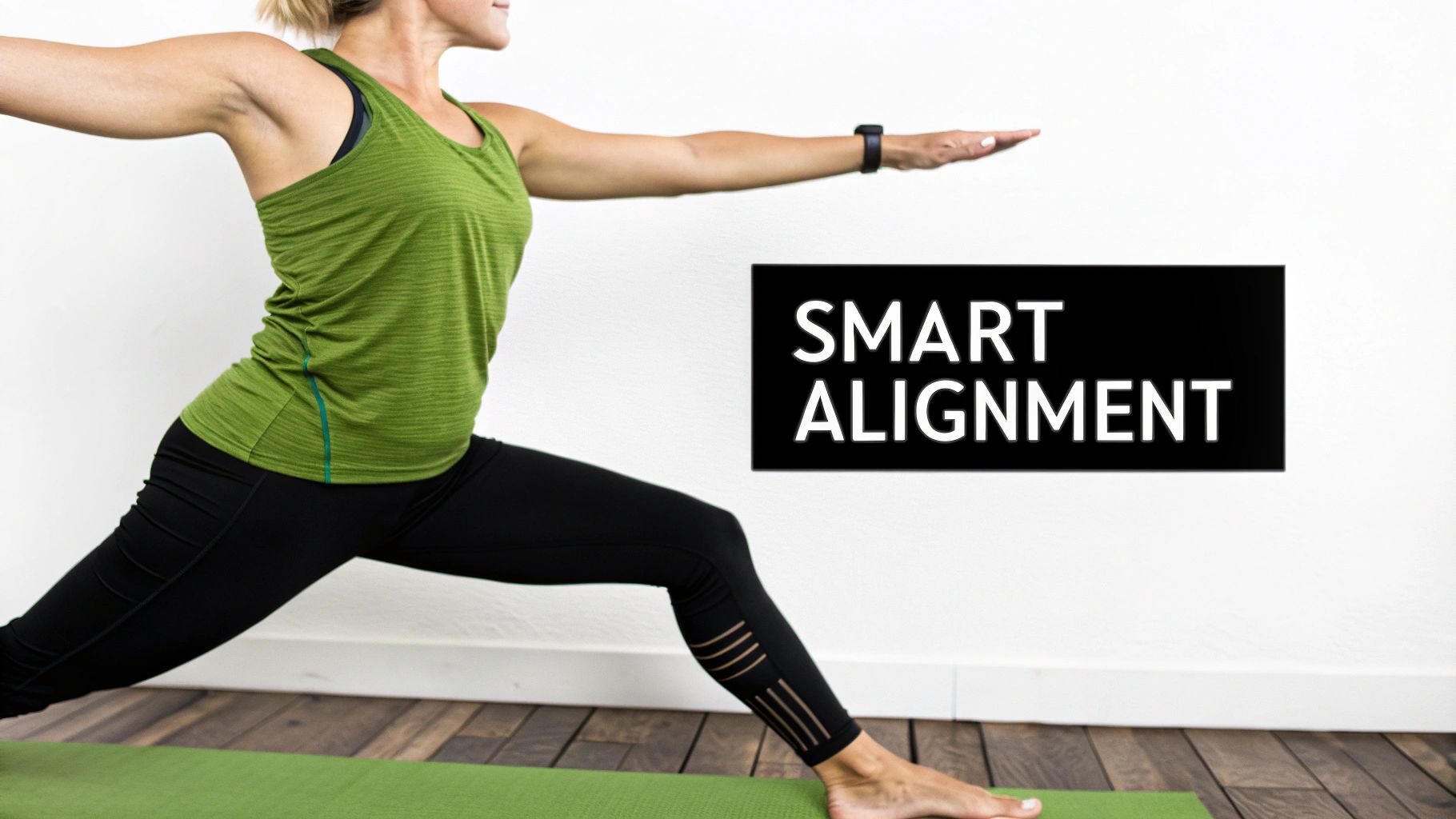
Warrior II (Virabhadrasana II)
Your body isn't a geometry problem to be solved; it's an experience to be felt. Alignment is your tool for feeling poses with more intelligence, stability, and ease.
Chaturanga Dandasana (Four-Limbed Staff Pose)
Nailing these fundamentals in common poses doesn't just make them feel better; it builds a foundation of awareness you'll carry into every other pose. It's how you build a smarter, safer, and way more enjoyable practice for the long haul.
What if you could have a world-class yoga instructor whispering alignment cues in your ear every time you practiced at home? It sounds a bit like science fiction, but that’s exactly what’s happening right now. AI-powered tools are completely changing the game for at-home yoga, offering personalized feedback that used to be reserved for expensive private lessons.
Let’s be clear: this isn't about replacing your favorite teacher or the incredible energy of a group class. Think of it as a powerful new training partner—an objective, data-driven sidekick that helps you fine-tune your practice when you’re on your own. For anyone serious about improving, it's a game-changer.
The biggest struggle with practicing solo? You often don't know what you don't know. You might feel like your hips are square in Warrior I, but a tiny, unnoticed tilt could be throwing the whole pose off. This is where AI really shines.
Using just your phone or tablet's camera, platforms like Dalm analyze your poses with uncanny precision. This creates an immediate feedback loop: you get into a pose, the AI sees what you’re doing, and you get a real-time verbal cue to adjust. It's like having a spotter for your alignment.
This process helps you:
This is a huge part of the shift we're seeing in yoga. As more of us practice at home, digital tools are making yoga more accessible and personalized than ever. It's a trend that's reshaping personal wellness in a big way, as noted by researchers at Fortune Business Insights.
The secret to getting better at anything is consistency. Technology removes the guesswork that so often grinds a home practice to a halt. When you get clear, actionable feedback every time you step on the mat, you build momentum like crazy.
Beyond those in-the-moment corrections, these tools offer something incredibly motivating: cold, hard data. That vague feeling of "I think I'm getting more flexible" is replaced with real, tangible metrics.
Apps can track your improvement in specific poses over time. You can literally pull up a chart and see how your balance in Tree Pose has improved or watch your forward fold deepen by measurable degrees. That kind of objective proof is a massive motivator, especially on days when you feel stuck in a plateau.
To really see what's possible, it's worth exploring how a dedicated daily yoga application can give you this level of detailed insight.
This kind of visual data shows exactly how your alignment is stacking up in a pose like Warrior II. Seeing the specific angles and joint positions laid out so clearly helps you finally connect the feeling of a pose with its actual mechanics. That connection is what speeds up the learning curve—dramatically.
Let’s be honest, to really level up your yoga, you have to realize that the magic happens when you step off the mat. The physical poses, or asanas, are just the beginning of a much bigger, richer world.
Think of it this way: the poses are the body of your practice, but the other limbs of yoga are its soul. Diving into them is what turns a good workout into a life-changing moving meditation. These aren't some mystical, far-out concepts; they are practical tools you can start using right now.
Your most powerful tool is one you already have: your breath. In the yoga world, we call this pranayama, or breath regulation. It's the engine that powers your movement and the anchor that keeps you steady when your muscles start screaming in a tough pose.
When you deliberately sync your breath to your movement—inhaling as you lengthen, exhaling as you fold deeper—you tap into an incredible flow state. This isn't just fluffy talk. Focused breathing actually calms your nervous system, pumps more oxygen to your muscles, and builds some serious mental grit.
Ready to try? Here are a couple of my go-to techniques:
Once you have a handle on the breath, the next step is bringing in mindfulness and meditation. All mindfulness really means is paying attention to what's happening right now, without judging it.
The goal isn't to silence your thoughts—good luck with that! It's about learning to watch them float by without jumping on the train. That skill, practiced in stillness, becomes your superpower in a wobbly balancing pose.
This trained focus pays huge dividends on the mat. You start noticing the tiniest sensations in your body, which helps you fine-tune your alignment and sidestep injuries. You learn to sit with discomfort instead of immediately bailing out of a pose that challenges you.
This shift toward deeper practice is a massive trend. The global yoga tourism market is expected to balloon to USD 72 billion by 2025, growing at about 10% a year. People aren't just flying to Bali for the poses; they're seeking that deeper connection. You can read more about the yoga travel boom on wellyx.com.
When you start weaving breath and mindfulness into your routine, the shapes you make with your body become something more. Your practice evolves into a richer, more joyful experience that truly connects mind and body.
As you get more serious about your yoga practice, you're going to have questions. That’s a good thing! It means you're paying attention. Think of these questions not as problems, but as little guideposts showing you where to go next.
Let's break down some of the most common things people wonder about when they decide to level up their yoga game.
I’ll give you the honest, and maybe slightly frustrating, answer: there’s no finish line. Yoga isn't a race you win; it's a path you walk. The real magic is in the journey itself, not some imaginary destination.
But that doesn't mean you won't see and feel real changes. If you’re practicing consistently—let’s say 3-5 times a week—most people start to notice a major difference in their strength, how flexible they feel, and their balance in about 8-12 weeks.
The secret? Keep your eyes on your own mat. Seriously. Stop worrying about the person next to you doing a perfect handstand.
Celebrate your own small wins. Did you hold Warrior II for just one more breath today? Did your Tree Pose feel a little less wobbly? Those are the gold medals. Focusing on your own tiny improvements is what keeps the practice fun and motivating.
Feeling stuck? It’s usually not some giant, glaring error. More often, it's a few small, sneaky habits that are holding you back from that next level. If you've hit a wall, see if one of these usual suspects sounds familiar.
Here are three common tripwires for yogis:
Here's a little secret: Progress isn't about jamming your body into a pretzel. It’s about creating the right conditions—with good alignment and a steady breath—and then letting the pose happen. Your body is smarter than you think; you just have to get out of its way and listen.
Ah, the classic chicken-or-the-egg question of yoga. The answer is ridiculously simple: you need both. They aren't in competition; they're partners. Focusing on one while ignoring the other is a recipe for imbalance.
Think about it. All the flexibility in the world without the strength to control it leads to floppy, unstable joints and a higher risk of getting hurt. On the flip side, building tons of strength without maintaining flexibility gives you a restricted range of motion and that stiff, "muscle-bound" feeling.
A smart, well-rounded practice, like a good Vinyasa class, is designed to build both at the same time. Try to mix it up during the week. Do some dynamic, sweaty flows to build heat and strength, but also make time for slower, deeper stretching sessions like Yin or a gentle Hatha class. This balanced approach is what builds a body that’s both strong and supple.
Ready to stop guessing and start seeing real, measurable progress in your alignment? Dalm uses AI to give you real-time feedback on every single pose, turning your living room into a private yoga studio. See how it works and start your journey at https://dalm.co.