
How to Improve Posture While Sitting A Practical Guide
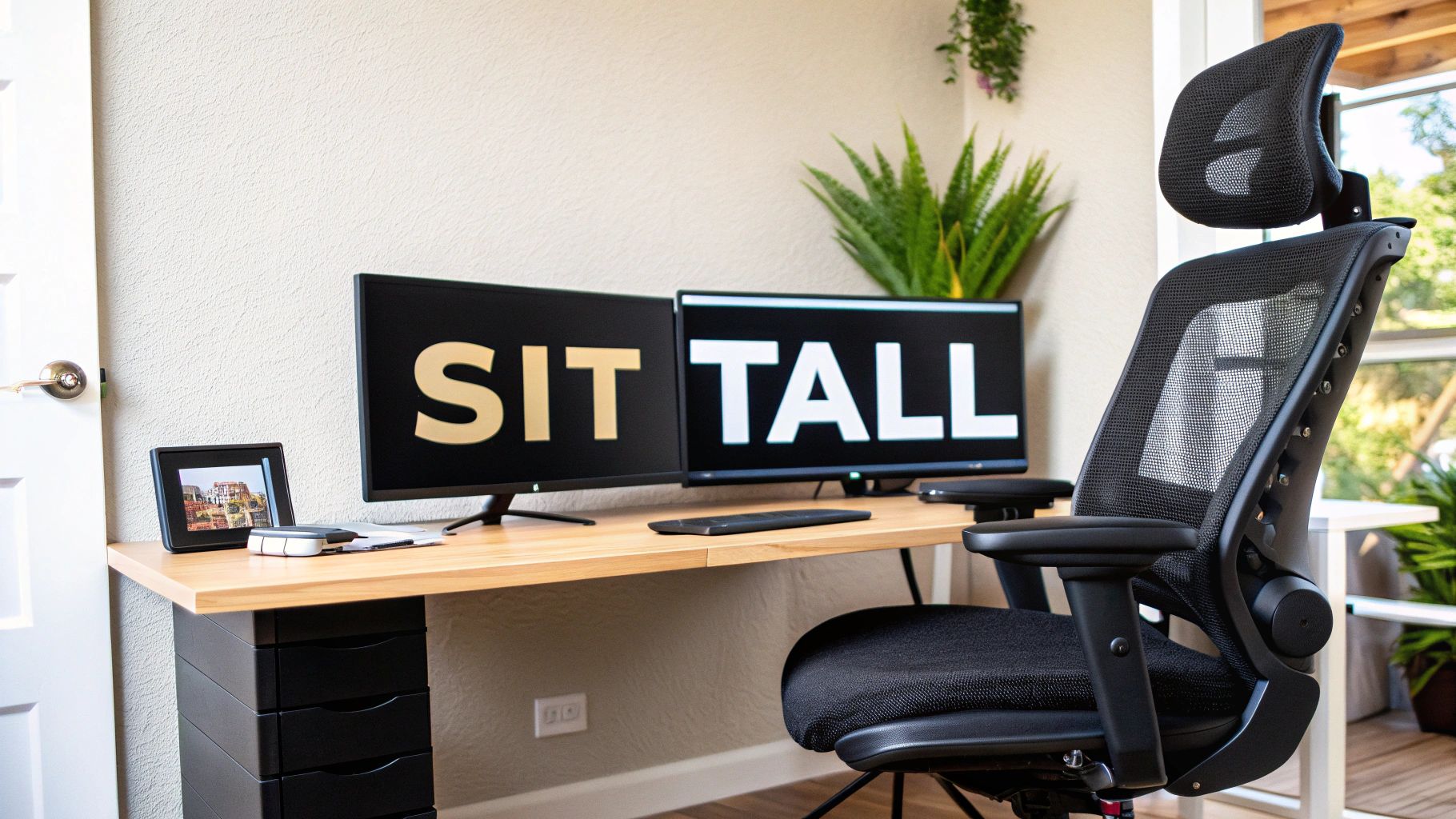
Fixing your posture while sitting all day isn't about willpower or constantly reminding yourself to "sit up straight." It's about engineering an environment where good posture is the default. The secret sauce? Creating natural alignment where your monitor is at eye level, your elbows are at a 90-degree angle, and your feet are flat on the floor.
This trifecta is your foundation. It stops the slow, creeping muscle strain that inevitably leads to slouching, that nagging neck pain, and bigger spinal problems down the road.
Let's be real for a second. Your workstation is probably a pain factory in disguise. That monitor that’s tilted just a little too low? That chair you sank into this morning? The keyboard that’s just a bit too far away? They all seem minor, but they add up.
Hour after hour, these tiny misalignments force your body into a constant, low-grade war with gravity. It's a battle your muscles are destined to lose, leaving you in that all-too-familiar C-shaped slump by 3 PM.
But turning things around doesn't require a fancy, four-figure ergonomic shopping spree. It's about understanding the geometry of your body and making your environment fit you—not the other way around. Think of it less like a chore and more like a high-return investment in your daily comfort and focus.
If there’s one golden rule for an ergonomic setup, it’s the 90-90-90 rule. This simple principle is all about creating right angles at your key joints to take the pressure off.
Here’s the breakdown:
This little diagram is a fantastic cheat sheet for getting your eyes, elbows, and knees in the right spot.
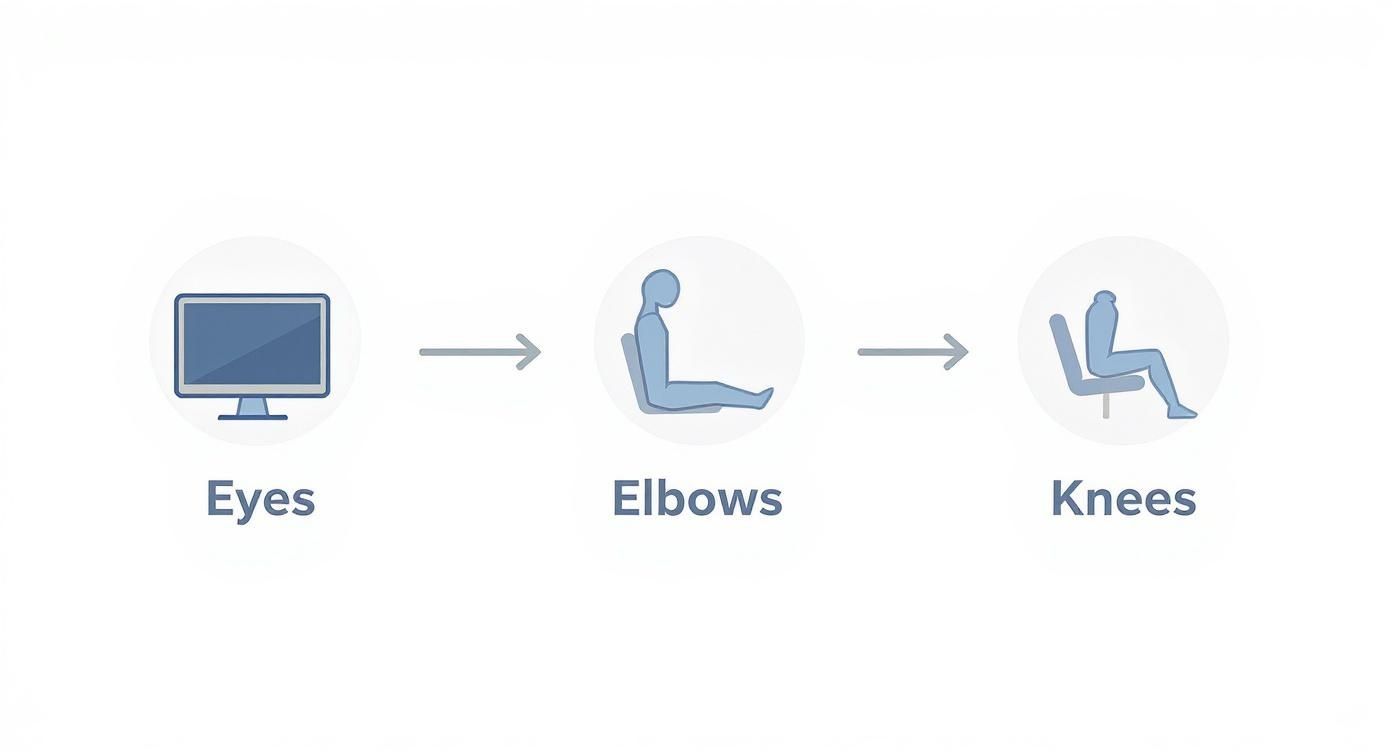
Nailing these three alignment points is hands-down the fastest way to support your spine’s natural curves and tell your body, "Hey, you can relax now."
For a quick reference, here's a checklist you can run through in just a few minutes to get your setup dialed in.
This isn't just about a one-time fix; it's about creating a new baseline for your workday comfort.
Once you've got the 90-90-90 rule down, a few more tweaks can elevate your setup from good to great.
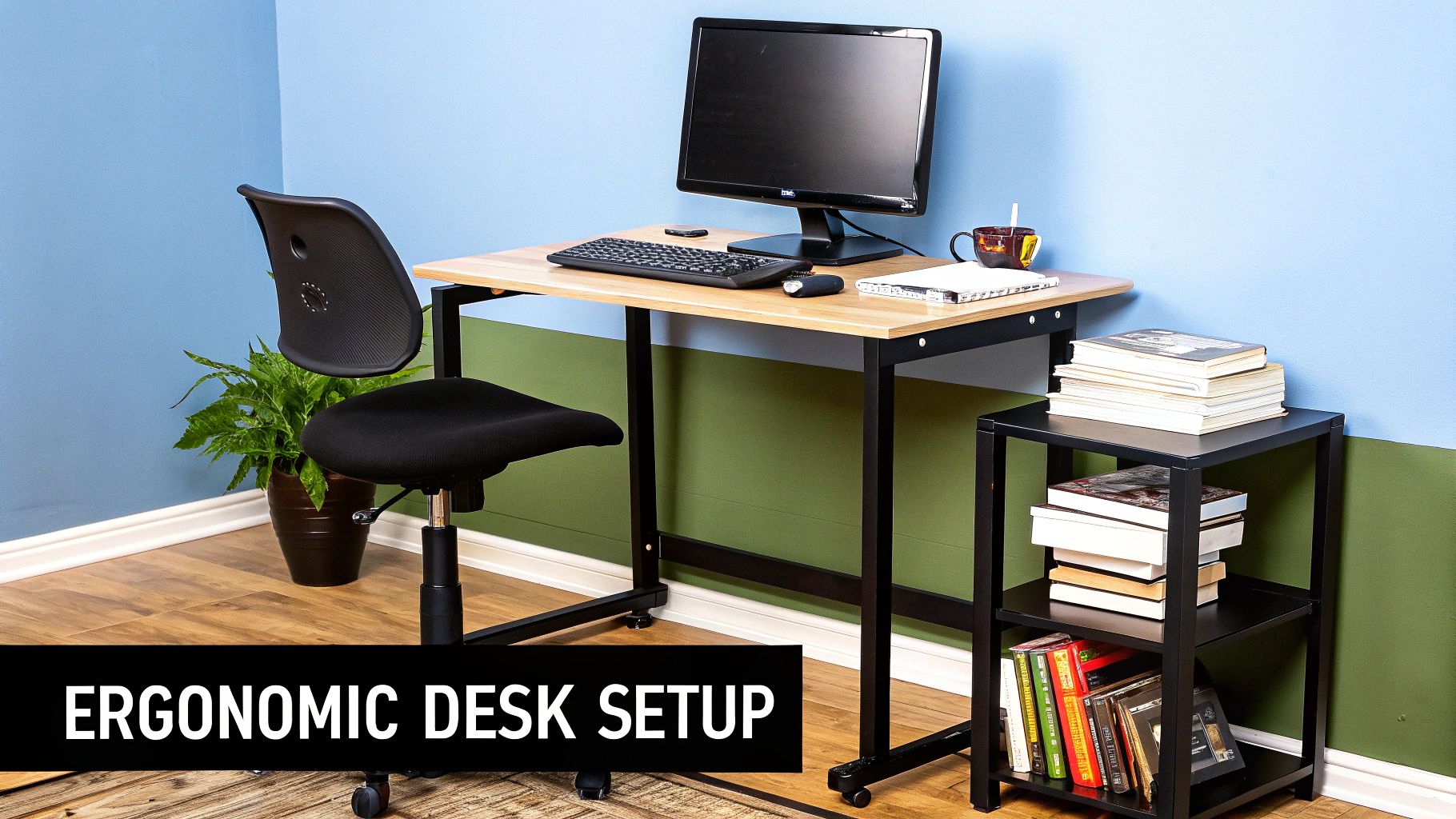
Is your screen too low? Don't just live with it—grab a stack of textbooks, a ream of paper, or a proper monitor stand to get it up to eye level. This tiny adjustment is a game-changer for preventing that forward head posture that’s the root cause of so much neck and shoulder pain.
And don't forget your armrests! They play a surprisingly critical role. They should be just high enough to lightly support your elbows, letting your shoulders completely relax. If they’re too low, you'll still end up slouching to reach them. Too high, and you’ll just trade one kind of shoulder tension for another. The goal is that "just right" feeling of neutral, effortless support.
These aren't just feel-good suggestions. Research repeatedly shows that making these kinds of workplace interventions leads to significant, measurable improvements in sitting posture and a reduction in musculoskeletal complaints for desk workers.
Look, an ergonomic setup is a fantastic starting point, but it's just the launchpad. You can have the fanciest chair in the world, but if you aren't paying attention to your body, you’ll still manage to melt into a slump. The real magic happens when you build a mindful connection between your brain and your body.
It's not about constantly yelling at yourself to "sit up straight!" That's exhausting. Instead, it’s about creating gentle, effective mental cues that work in the background, kind of like a subtle app running on your phone. This is the shift from just fixing your posture to truly feeling it.
So, how do you do it? Instead of those harsh commands, try painting a few pictures in your mind. These simple mental images can completely recalibrate your alignment without you having to consciously force it.
These cues are so effective because they work with your body’s natural tendencies, not against them. They create a sense of length and space, which is exactly what a happy, supported spine needs. If you want to go even deeper, exploring some postural awareness exercises can really supercharge this mind-body connection.
Your core is the built-in corset that supports your entire torso. When it's switched off (which it usually is when we sit), your poor lower back takes all the strain, leading to that familiar ache and slouch. The good news? Engaging your core at your desk doesn't mean you have to start doing sit-ups. It's all about gentle, sustained activation.
Think of it as turning your core muscles on at about 20% of their maximum power. It’s a subtle tightening, almost like you’re about to get a playful poke in the stomach.
This low-level hum of activity provides constant stability for your lower back. To find this feeling, sit tall and place your fingertips on the soft area just inside your hip bones. Now, gently draw your belly button in toward your spine, as if you're zipping up a tight pair of jeans. You should feel those muscles under your fingers firm up just a bit. The trick is to hold that gentle contraction while you continue to breathe normally.
Combine this with some deep, mindful breathing, and you've got a powerhouse combo. Slow, deep breaths expand your rib cage, which naturally helps you sit up taller, all while reinforcing your core's supportive role. Master this, and good posture will start to feel less like a chore and more like your natural state of being.
Let’s get one thing straight right off the bat: there’s no such thing as a “perfect” posture you can hold for eight hours straight. Honestly, trying to do that is a one-way ticket to a stiff back and aching shoulders.
The best posture is always your next posture.
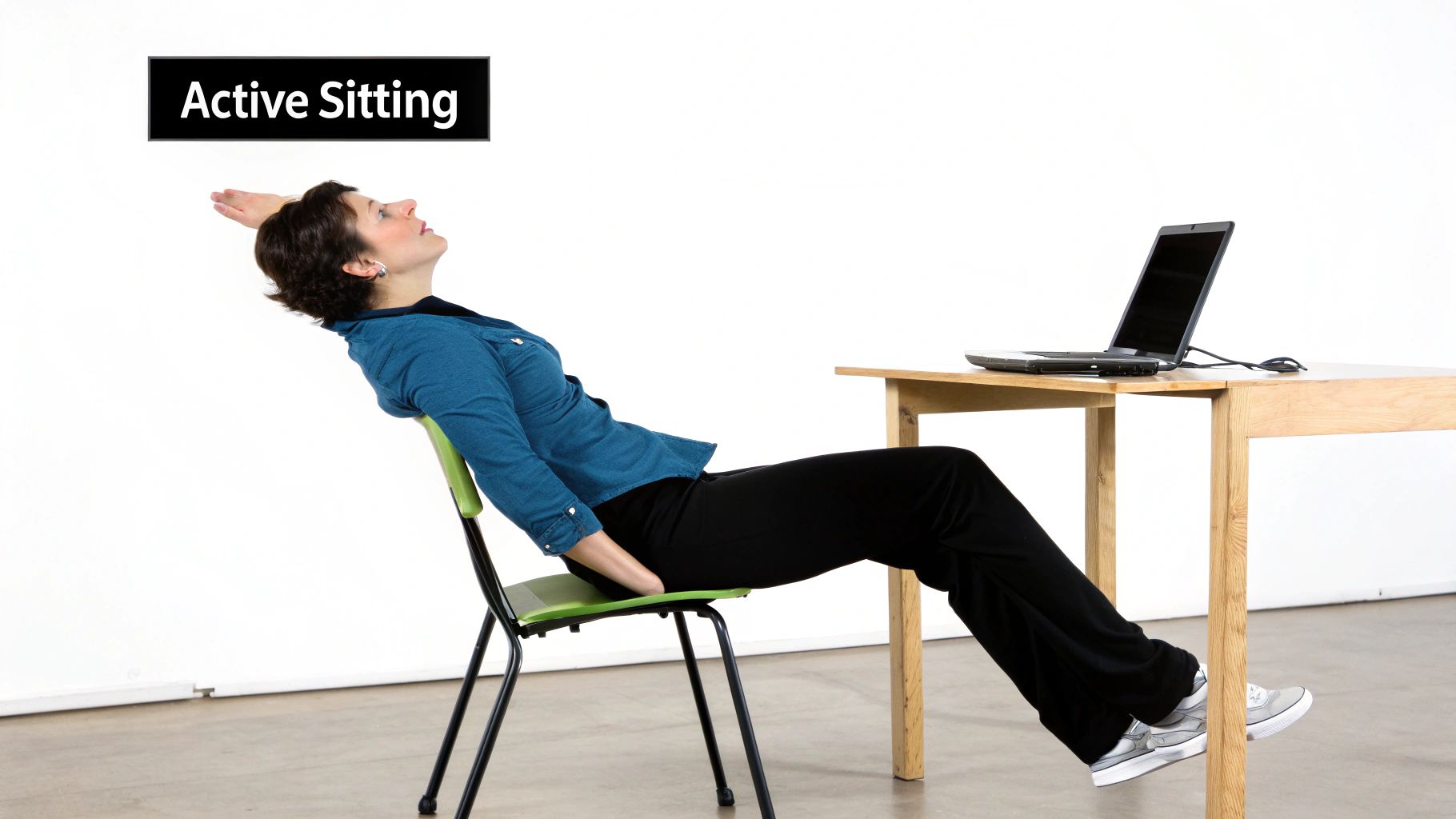
Our bodies were built to move, not to be locked into one position. When we force ourselves to sit like statues, our muscles and joints start screaming in protest. The answer isn't to stop sitting altogether—that’s just not realistic for most of us. The secret is to start sitting actively.
Active sitting is all about sprinkling tiny movements and stretches throughout your day. It’s not another task for your to-do list; it's about making movement a natural part of your workflow, like hitting a refresh button for your body without ever leaving your desk.
You don’t need to roll out a yoga mat to get some relief. These micro-stretches can be done in seconds, right where you are, and they work wonders on a tight neck, hunched shoulders, and a cranky back.
Here are a few of my personal favorites:
The whole point here is to be gentle. These aren't supposed to feel like a workout. Think of them as little moments of mindful release that break the monotony of sitting still.
You can even steal a few moves from yoga without anyone in the office noticing. My absolute go-to is a seated Cat-Cow. It’s a game-changer for waking up a stiff, grumpy spine.
Here’s how you do it:
Flow between these two for five to ten breaths whenever your back starts to complain or your afternoon slump hits.
The real magic of active sitting is simply interrupting the pattern. Every little shift, stretch, or wiggle is a signal to your body to wake up, re-engage, and find its natural alignment again.
Don't underestimate the power of these tiny breaks. One eye-opening study, the Take-a-Stand Project, found that cutting down sitting time by just 66 minutes a day resulted in a whopping 54% reduction in upper back and neck pain. People also reported feeling more energized and focused. It’s proof that a little movement makes a huge difference. You can dive into the full findings from the CDC to see just how beneficial it is to break up your day.
You can have the most tricked-out ergonomic setup on the planet, but a few sneaky, unconscious habits can still completely derail your efforts. We're not just talking about obvious, full-on slouching. These are the little things, the micro-habits you don't even realize you're doing, that add up to major aches and pains.
Let's shine a spotlight on these common culprits.
It’s time to play detective. The first step to correcting these posture pitfalls is simply catching yourself in the act.
Ever caught your reflection and noticed you look a bit like a turtle peeking out of its shell? That’s the "chin jut"—a classic posture blunder where you push your head forward to get closer to your screen. This move might seem harmless, but it forces the tiny muscles in your neck and upper back to hold up your entire head, which, by the way, is surprisingly heavy.
Do this long enough, and you’re basically signing up for a strained cervical spine, chronic neck pain, and a nasty collection of tension headaches. The fix is simple: bring the screen to you, not your head to the screen. Prop up your monitor so the top is at eye level, and get reacquainted with that gentle chin tuck we mentioned earlier.
Ah, the classic leg cross. It feels so natural, so comfortable, so… destructive to your posture. When you throw one leg over the other, you’re tilting your pelvis and throwing your entire spinal column out of whack.
Make this your go-to sitting position, and you'll eventually shorten the muscles on one side of your body while lengthening them on the other. This creates weird imbalances that are a one-way ticket to lower back and hip pain. Instead, make a conscious effort to plant both feet flat on the floor, about hip-width apart. It creates a solid, balanced foundation for your entire upper body. It'll feel strange at first, but your back will send you a thank-you note.
Uncrossing your legs does more than just align your hips. It immediately distributes your weight more evenly, reducing the lopsided pressure on your lumbar spine that builds up throughout a long workday.
We’ve all been there: phone rings, hands are full, so you jam it between your ear and shoulder. This move aggressively hikes up one shoulder and cranks your neck into a gnarly side bend. Even a quick call in this position can cause immediate muscle strain.
Let's be real, prolonged sitting is the root of many of these problems. In fact, recent data shows that people working from home sit for an average of 569 minutes a day—that's a lot more than their office-based colleagues. All that extra chair time often leads to worse hip posture and those compensatory habits we just talked about, which can seriously increase the risk of back pain.
Kicking these common mistakes to the curb is a massive step forward in learning how to improve posture while sitting.
Alright, so you know the theory. You've got the stretches, the ergonomic tips, the whole nine yards. But here's the real talk: none of that matters if you don't actually do it. Lasting change doesn't come from a one-off stretch session; it comes from building tiny, positive habits into the very fabric of your day.
The goal isn't to add another chore to your to-do list. It's about making good posture as second nature as grabbing your morning coffee. We're talking about creating a simple, repeatable routine that turns conscious effort into an unconscious, healthy default. Think of it as making small, consistent deposits into your body's "comfort account."

Your daily routine doesn't need to be some complex, hour-long ordeal. The simpler, the better. Seriously. The trick is to sprinkle these posture-positive moments throughout your day, piggybacking them onto things you already do.
Feel free to steal and tweak this simple template:
Here's the secret sauce: It’s not about how long you do these things, but how often. Three one-minute breaks scattered throughout the day will do infinitely more for you than one three-minute break at 5 PM.
To really lock in those good habits, it helps to add a slightly more focused session either before or after work. This is where you build the core strength that makes sitting up straight feel easy and natural, not like a constant battle.
You'd be amazed what a short, dedicated session can do. Building up that muscular endurance is what supports your spine all day long. If you're looking for a simple yet powerful way to build that stability, a beginner's guide to yoga for core strength offers some fantastic exercises you can easily tack onto your post-work wind-down routine.
So, how do you track your progress? Forget the apps and mirrors for a second and just pay attention to how you feel. Are you finishing the workday with less ache in your neck and shoulders? Do you catch yourself slouching and instinctively pull yourself upright?
These are the real signs you're on the right track:
Celebrate these little wins! They're proof that your daily routine is paying off, and that's the best motivation there is to stick with it for the long haul.
Alright, you've absorbed a ton of information, and you’re ready to stop slouching for good. But I know what happens next. A few little questions start to creep in, the ones that can derail your progress if you let them.
Let’s get those sorted out right now.
Ah, the million-dollar question. I wish I could give you a simple "six weeks!" answer, but the truth is, it's a "how long is a piece of string?" situation. It really depends.
What I can tell you is that you’ll probably start to feel better in just a few weeks. But seeing a real, lasting change? That takes a few months of consistent work. The key word there is consistency, not intensity.
Think about it: your body has spent years, maybe even decades, learning to slump. You’re not just breaking a habit; you’re reprogramming your muscles and brain. At first, sitting straight will feel like work. With time, it just becomes... how you sit.
A top-of-the-line ergonomic chair can be incredible, but it's not a magic fix. I've seen plenty of people in $1,500 chairs hunched over like gargoyles because their monitor is at belly-button level. The chair can't fix that.
An expensive chair is a powerful tool, not a posture cure. It offers fantastic adjustability and support, but it can't force you to use it correctly or fix bad habits.
Before you drop a ton of cash, nail the fundamentals first. Get your screen at eye level, master the 90-90-90 rule, and get in the habit of active sitting. You can get 80% of the way there by cleverly modifying a basic office chair with a good lumbar pillow and a simple footrest. Once you've got the basics down, then you can decide if a premium chair is a smart investment for you.
Let's talk tech. Those strap-on posture corrector braces can be a decent starting point. They give you a physical nudge to stop rounding your shoulders, which is helpful when you're just building awareness. But here's the catch: wear one for too long, and your muscles get lazy. The brace ends up doing the work your back muscles are supposed to be doing.
On the digital front, apps are fantastic for reminding you to take breaks and do a few stretches. Some of the more advanced tools can even offer detailed posture analysis software, giving you real-time feedback on your alignment as you work.
The bottom line is that these gadgets are supporting actors, not the main star. Your own body awareness is the real hero here. Use the tech to support your efforts, but don't rely on it to do the work for you. True, lasting posture comes from building strength and mindful habits.
Ready to take the guesswork out of your alignment? The Dalm app uses AI to provide real-time feedback on your poses, giving you the precision of a personal instructor anytime, anywhere. Perfect your form and track your progress by visiting https://dalm.co to start your journey today.