
How to Improve Proprioception and Master Your Balance
Want to boost your proprioception? It all comes down to a consistent routine that challenges your sense of balance, your joint awareness, and how you react to wobbly, unpredictable surfaces. You'll need a good mix of static balance drills, dynamic movements, and mindful practices like yoga. This combo is the secret sauce for retraining the neural highways between your brain and your body.
Ever wondered how you can navigate a dark room without stubbing your toe on everything? Or how you can tie your shoes while carrying on a conversation? You can thank your proprioception for that. It’s often called our "sixth sense," and frankly, it's the unsung hero working tirelessly behind the scenes of every move you make.
Think of it as your body's own internal GPS. It's a constant, lightning-fast chat between your brain and tiny sensory receptors tucked away in your muscles, tendons, and joints. These little messengers are always sending real-time updates on where your limbs are, how fast they’re moving, and how much effort they're putting in.
To make this a bit clearer, let's break down exactly what proprioception does for you in your daily life and on the yoga mat.
This table gives a quick rundown of the key parts of proprioception and how they translate into real-world benefits.
These components work together seamlessly, giving you a fluid and intuitive sense of your body in space.
That internal GPS is what lets a point guard nail a no-look pass or a dancer land a jump with effortless grace. It’s the reason you can bring a cup of hot coffee to your lips without a single spill. Your brain doesn't need to see your hand; it just knows where it is in relation to your face.
This incredible system runs on autopilot, allowing us to perform ridiculously complex movements without a second thought. But here’s the catch: just like any skill, this brain-body connection can get a bit fuzzy. Injury, a sedentary lifestyle, or even just the natural process of aging can weaken the signal.
When that happens, you might start feeling:
Proprioception is the body’s ability to sense its position, movement, and balance in space. It’s what allows you to walk without looking at your feet, maintain posture without conscious effort, and coordinate complex movements smoothly.
Improving your proprioception isn't just about preventing ankle sprains or holding a tricky yoga pose for an extra ten seconds. It’s about building a body that’s more resilient, confident, and deeply connected.
When your proprioception is sharp, you get faster reaction times, smoother and more efficient movements, and a dramatically lower risk of injury. By learning how to improve proprioception, you’re doing more than just training your muscles—you’re upgrading your body's entire operating system for a more stable and powerful practice.
Before you start training your "sixth sense," you need a baseline. Think of it like this: you wouldn't start a road trip without knowing where you are on the map, right? This quick, no-judgment self-check is your "you are here" marker.
All you need is a little floor space and your own body. This isn't about passing or failing; it’s about discovery. By getting a clear picture of your body's internal GPS signal right now, you'll be able to truly appreciate how far you've come in a few weeks.
Let's dive into three simple drills to see where you stand.
This classic test is pure gold for assessing your static balance. It’s deceptively simple but tells you a ton about how your body communicates with itself when you're standing still.
Okay, let's get you moving. This little drill tests your dynamic balance—how well you stay in control while in motion.
Let's talk results. A massive review of 70 different studies found that proprioceptive training delivers an average 53% boost in sensory performance. Even better, programs focused specifically on balance saw proprioceptive gains skyrocket to 58%. Dalm’s AI-powered pose analysis essentially brings the lab to your living room, giving you instant feedback on your alignment. This mirrors the joint position sense error (JPSE) tests that 70% of those studies used as the gold standard for measuring proprioception. Dig into the proprioceptive research here.
Ready to trade those wobbly moments for rock-solid stability? Let's get to work. This isn't just a list of exercises; it's a four-week roadmap designed to systematically rewire your body’s internal GPS. Think of it as upgrading the connection between your brain and your body, one week at a time.
We've mixed in a little bit of everything—balance drills, joint awareness exercises, and dynamic movements—to keep your nervous system on its toes. Each week layers on a new challenge, pushing you just enough to improve without ever feeling overwhelmed. You're about to become the master of your own movement.
This simple flow is your daily mantra: stand, walk, and consciously sense where your body is.
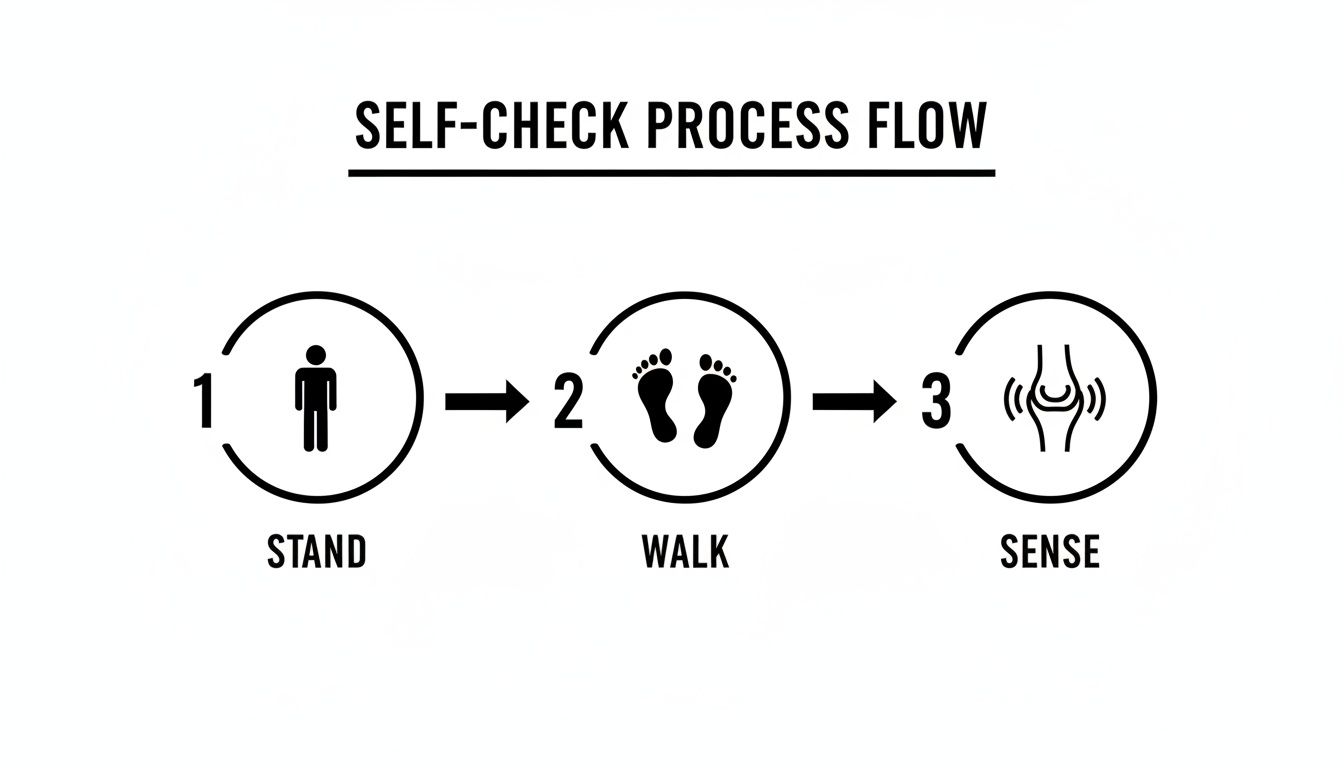
Keep this in mind. True progress comes from making these fundamental actions a daily, mindful practice.
First things first, let's wake up those sleepy sensory receptors in your muscles and joints. This week is all about building a solid base. The motto here? Consistency over intensity.
We'll begin with simple static holds that teach your body to find its center of gravity. Don't be shocked if one leg feels like a pro while the other is all over the place. That's totally normal, and it’s valuable feedback telling you exactly where to focus your attention.
Alright, your body is starting to get the memo. Now it's time to throw it a curveball. By introducing some controlled instability, we force your neuromuscular system to react quicker and smarter.
This is where you'll start to feel a real shift in your everyday balance. The big challenge this week is closing your eyes. When you take away your vision, your body has no choice but to rely on its internal sense of position. It's a game-changer.
So far, it's all been about standing still. But let's be real—life happens in motion. This week, we shift from static holds to dynamic control. True proprioception is about maintaining your balance and awareness while you're actually moving.
These drills train your brain to anticipate and react to constant shifts in your center of gravity. You’re essentially teaching it to make adjustments on the fly, which is what saves you from a rolled ankle on a rocky trail or a stumble on a busy sidewalk.
A massive review of 70 studies found that proprioceptive training boosts proprioceptive acuity by an average of 46% and motor performance by 45%. What's really cool? Over 50 of those studies used active movements—the kind you find in yoga—proving that flowing through poses is one of the most powerful ways to sharpen this sense.
Welcome to the final week! It's time to integrate everything you've learned into more complex, fluid movements. The exercises get a bit more demanding, combining balance, motion, and coordination all at once.
By now, that brain-body connection should feel significantly sharper. The goal is to make these proprioceptive skills second nature—so automatic that you don’t even have to think about them anymore. If you're feeling good and want more variety, you can always explore other great balance improvement exercises to keep things fresh.
Here’s how it all comes together. This table provides a bird's-eye view of your four-week journey, showing how you’ll progressively build on your skills.
Think of this as your blueprint. Stick with it, and you'll build a level of body awareness that feels less like a skill you learned and more like a superpower you've unlocked.
What if you had a personal yoga instructor with you for every single practice, giving you pinpoint feedback on every movement? It sounds like something out of a sci-fi movie, but this is exactly what smart tech like Dalm brings to the table, and it can absolutely fast-track your journey to better balance.
Using this kind of tool can slash the time it takes to get good at this stuff. It takes all the guesswork out of your alignment and gives you concrete, actionable feedback.
Think of Dalm’s AI pose analysis as a high-powered microscope for your body's alignment. It picks up on the tiniest imbalances that you’d never be able to spot on your own.
You might feel like you’re standing perfectly straight in Tree Pose, but the AI can see that your left hip is dipping by a mere 5 degrees. Or maybe it notices you’re dumping 70% of your weight onto the outside edge of your foot.
This is where the magic happens. This hyper-specific feedback pinpoints the exact weak links in your system, giving you a clear bullseye to aim for. Without it, you could practice for months, accidentally reinforcing the very habits you’re trying to break.
The secret sauce is the immediacy. You're not waiting for your weekly class to get an adjustment from a teacher. You get corrective cues the instant you wobble, creating a powerful feedback loop that rewires your brain and body on the fly.
One of the coolest features is the real-time voice feedback. As you’re settling into a pose, you might hear a calm voice say, “Ground through your left big toe,” or “Lengthen your spine.” These aren't just random tips; they’re specific instructions based on what the AI sees your body doing in that split second.
Let’s take Warrior III, a notoriously tricky pose. Say your hips always want to pop open, throwing your balance completely off. The AI might cue you to "roll your right hip down toward the floor." You make that tiny adjustment, the AI confirms your alignment is solid, and click—the pose suddenly feels stable and strong.
This immediate cause-and-effect is what teaches your proprioceptors what a solid, correctly aligned pose actually feels like from the inside. It’s the difference between reading a phrasebook and being dropped into a foreign country for total immersion. Every practice becomes a masterclass, making every minute you spend on the mat count.
Curious about the tech that makes this possible? You can get a deeper look into how posture analysis software delivers these kinds of detailed insights.
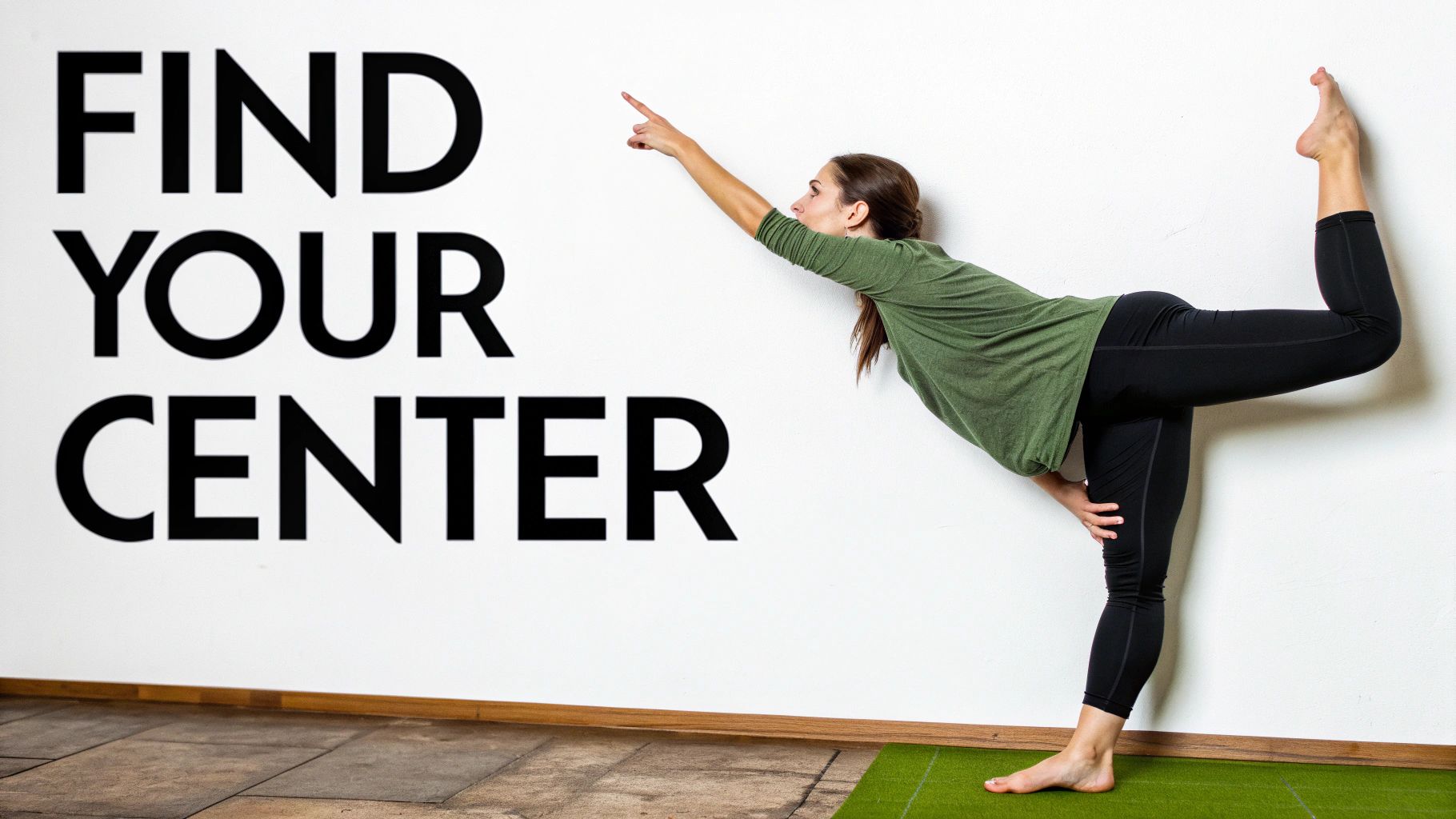
Sooner or later, everyone hits a wall in their balance training. It’s pretty much a rite of passage. One day you’re rock-solid, feeling like a statue, and the next, your Tree Pose is more like a sapling in a hurricane. Trust me, it’s a totally normal part of the process.
The biggest enemy here is usually frustration. But instead of getting down on yourself for a wobble, try to see it for what it is: your nervous system learning in real-time. Every little twitch and correction is a successful rep, forging a stronger connection between your brain and your body. That wobble isn't failure; it's the work happening right before your eyes.
One of the first things people notice is having a "good side" and a "bad side." This is incredibly common and usually comes down to a lifetime of habits. Which foot do you lead with when you walk up the stairs? Which leg feels more natural to kick a ball with? That’s your dominant side, and it's almost always the more stable of the two.
The fix? It's simple, really. Just give your less-stable side a little extra attention. Always start your single-leg exercises on your "weaker" leg when you're fresh. You can even toss in an extra set on that side to help it catch up. Over time, this targeted work really helps close that stability gap.
A massive meta-analysis that sifted through over 3,000 different studies confirmed what many of us have seen in practice: focused proprioceptive training is a beast. It’s right up there with traditional rehab methods. Researchers saw that active movement drills didn't just improve balance—they led to real gains in agility and skill, especially for athletes. You can read the full research on these proprioceptive gains here.
When you feel like your progress has stalled, the temptation is to just push harder. But that’s rarely the answer. More often than not, the smartest move is to take a small, strategic step back so you can leap forward with better control.
Here are a few tricks I’ve seen work wonders:
By using these simple strategies, you can turn those annoying plateaus into launchpads for your next breakthrough. For an even deeper dive into this, check out our guide on how to improve balance and stability.
Got a few more questions rattling around in your head about your body’s built-in navigation system? Good. Curiosity is the first step toward mastery. Let's tackle some of the most common ones so you can move forward with total confidence.
Ah, the million-dollar question. The honest-to-goodness answer is, it depends. Everyone's body is different. But here's the good news: you won’t be waiting forever to feel a change.
If you commit to 3-5 focused sessions a week, most people notice a real difference in just 2-4 weeks. It might be subtle at first—maybe your Tree Pose feels a little less like a skyscraper in a hurricane, or you just feel more connected and "at home" in your body during the day.
For those bigger, more obvious improvements in balance and coordination, give it 6-8 weeks. Think of it like learning an instrument. At first, it's clunky, but with consistent practice, the pathways between your brain and your muscles get clearer and faster. Soon enough, you're making music.
You bet. While proprioception is a full-body system, you can absolutely zoom in on a specific area that's giving you trouble. This is a game-changer if you're bouncing back from an injury or just feel like one part of your body has gone rogue.
Let’s say you’re trying to regain trust in an ankle you sprained last year. Your targeted drills might look like:
The same goes for a cranky shoulder. You could do slow, mindful arm raises, really tuning into the sensation of the joint moving. It’s all about deliberate, focused movement.
The goal isn't just building muscle; it's about re-educating that neural feedback loop. You're teaching that joint how to have a clearer conversation with your brain again.
Yes, provided you're smart about it. Safety first, always. If you're starting out feeling more like a weeble-wobble than a statue, modifications are your best friend.
Always set yourself up near a wall or a sturdy piece of furniture, like the back of a chair or a countertop. Seriously, just having your fingertips resting on something solid gives your brain an external point of reference. This calms your nervous system down and takes the fear of a sudden tumble out of the equation.
As you feel your stability improve, you can lighten your touch—from your whole hand to a few fingers, then to one finger, and eventually to hovering just above the support. Listen to your body. Never, ever push through sharp pain, and if you have any health concerns, chat with a professional first.
Ready to stop guessing and start making tangible gains? Dalm uses medical-grade AI pose analysis to give you real-time voice feedback on your form. It’s the closest thing to having a world-class coach right there with you, helping you build unshakeable balance faster than you thought possible.
Transform your practice today at https://dalm.co.