
How to Stay Consistent with Exercise When Life Gets Busy

Here’s the thing about how to stay consistent with exercise: the secret isn't finding some hidden well of motivation. It’s about building a system so solid that it works even when your motivation has packed its bags and left town.
Lasting consistency is born from a thoughtful plan, not from white-knuckling your way through another workout you don't feel like doing.
Let's be brutally honest for a second. The whole "just do it" mentality? It’s a recipe for burnout. It completely ignores the single biggest obstacle we all face: real life.
Demanding jobs, unpredictable kids, mental fog, and all the curveballs the universe loves to throw—these aren't just minor inconveniences. They're our reality. Trying to power through all that on willpower alone is like trying to stop a tidal wave with a pool noodle. It’s just not going to work.
This approach creates a nasty little cycle. You start out on fire, riding a huge wave of motivation. But when life inevitably intervenes and you miss a session, the guilt and self-blame start creeping in. One missed day becomes two, then a week, and before you know it, you're right back where you started, only now you feel like a failure.
The only way to break that cycle is to stop blaming yourself and start building a smarter, more forgiving system. A truly effective routine is resilient—it bends with your life instead of snapping at the first sign of pressure. It’s about creating a structure that makes showing up the path of least resistance.
Historically, people who build this kind of structure are the ones who stick with it. It’s not magic. Research has shown that when people simply write down a specific plan—when, where, and how they’ll exercise—their follow-through rate skyrockets. It's a simple but powerful truth: a good plan beats fleeting inspiration every single time.
This flow from wanting to do it, to planning it, to actually doing it is the heart of any lasting habit.
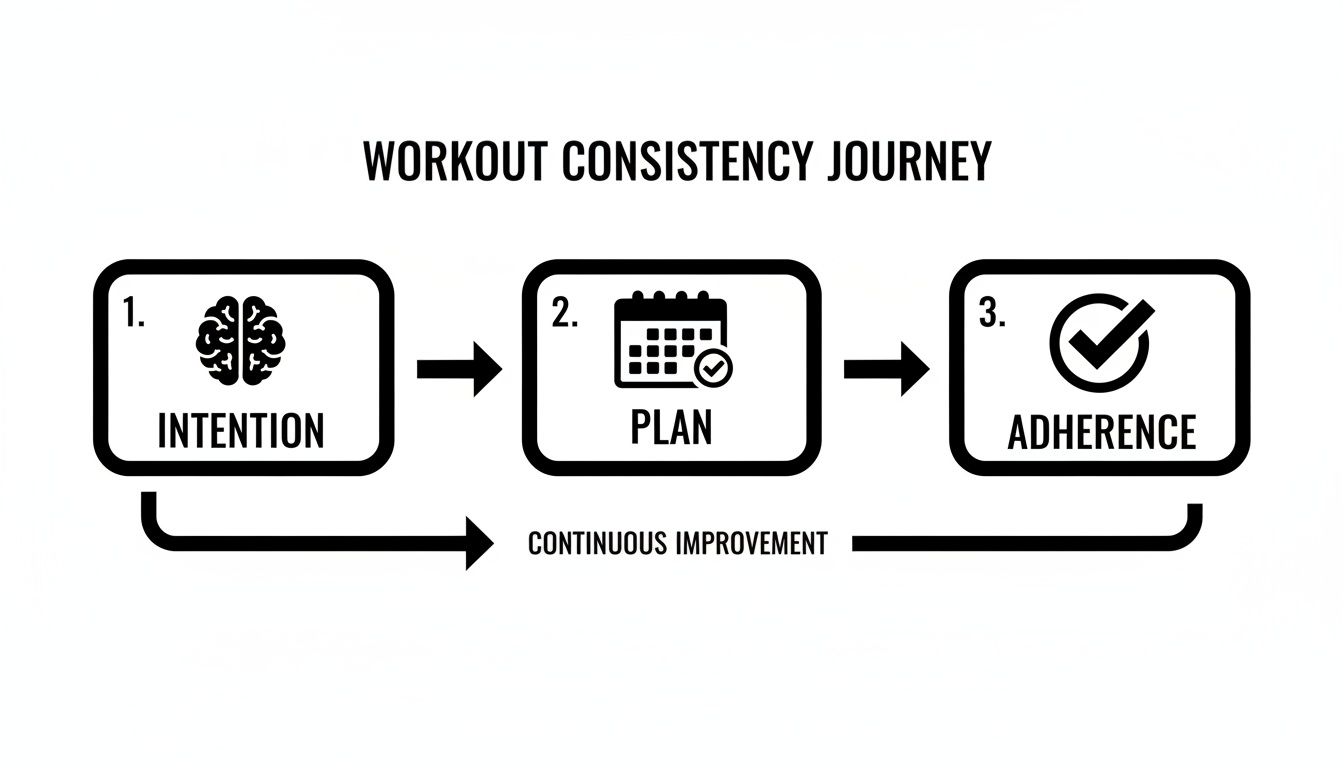
The image above nails it. Just intending to exercise isn't enough. You need that concrete plan to bridge the gap and create consistent action. The goal isn't perfection; it’s building a framework that has your back. This means creating tiny, positive feedback loops that make you want to keep going. If you're curious about this approach, you can dive deeper into what is mindful movement in our detailed guide.
To put it all together, here's a quick look at the core strategies we'll be breaking down. Think of this as your cheat sheet for building an exercise habit that actually sticks.
Each of these pillars is a tool in your toolbox. When you combine them, you create a powerful, personalized system that makes consistency feel almost effortless.
Look, the secret to sticking with exercise isn't some heroic feat of willpower you conjure up out of thin air. It’s built in the boring, tiny, almost invisible decisions you make before you even think about breaking a sweat. The real goal is to craft a routine so ridiculously easy to start that skipping it feels like more work than just doing it.
We've all been there. You're slumped on the couch after a long day, and the mental effort required to get up and work out feels like climbing Everest.
But what if your yoga mat was already unrolled? What if your workout clothes were sitting on your bed, and your favorite pump-up playlist was just a tap away? That’s not magic; that’s just designing your environment to win.
So many of us trip up by thinking we need a perfect hour-long slot and a lightning bolt of energy. This is where the Two-Minute Rule becomes your secret weapon. The whole idea is deceptively simple: just commit to doing the first two minutes of whatever you planned.
Instead of facing the dreaded "I have to do a 30-minute workout," just tell yourself, "I'm going to put on my sneakers and stretch for two minutes." What usually happens? That tiny first step shatters the inertia. Once you’re actually moving, doing the rest of the workout suddenly feels way less daunting.
The real battle isn't the workout itself; it's the five minutes leading up to it. Win that, and you've won the day.
This is a brilliant little mind trick. It bypasses your brain's natural alarm system that goes off when it sees a big, intimidating task on the horizon. You lower the barrier to entry so much that you're in motion before you can even talk yourself out of it.
Another killer strategy is something called habit stacking. You’re basically hijacking a routine you already do on autopilot and attaching your new exercise habit to it. The formula is as simple as it gets: "After [My Current Habit], I will [My New Workout Habit]."
This creates an automatic trigger, so you don't have to rely on memory or decision-making. Your old habit essentially becomes the starting pistol for your workout.
Here’s what this looks like in the real world:
By anchoring your workout to something you already do, you let the momentum of the old habit pull the new one along for the ride. It's the difference between trying to push-start a train and simply adding one more car to a train that's already moving. The less brainpower you have to use, the better your odds of actually sticking with it.
Let's be honest. Vague goals like "get in shape" or "lose weight" are the arch-nemeses of workout consistency. Why? Because they have absolutely zero emotional punch. They're just bland, impersonal phrases that are ridiculously easy to ignore when life gets crazy and your couch starts whispering sweet nothings.
To build a routine that actually sticks, your reason for showing up has to be way more powerful than your best excuse for skipping.
This is where finding your personal "why" changes everything. It’s about tying your physical efforts to something that genuinely matters to you—something that goes way beyond what you see in the mirror or the number on a scale.
When your fitness journey is directly linked to your core values, it stops being a chore. It becomes a non-negotiable act of self-care you actually want to do. It's the difference between dragging yourself to the gym and eagerly stepping onto your yoga mat.
So, how do you unearth this magical "why"? You start by trading those generic goals for tangible, experience-based missions. This simple switch reframes the entire process, turning every workout into a clear step toward the life you want to live.
Here’s how to translate those common, blah goals into truly motivating missions:
Instead of: "I want to lose 10 pounds."
Try: "I want to have the energy to hike with my friends this summer and not get left in the dust."
Instead of: "I want to get stronger."
Try: "I want to be strong enough to pick up my toddler without my back screaming at me for the next two days."
Instead of: "I want to be more flexible."
Try: "I want to improve my mobility so I can get back to gardening without feeling stiff and sore afterward."
See the difference? This little perspective shift is huge. It makes your workouts a tool for building a richer, more vibrant life—and that's a far more compelling reason to show up than chasing a number.
Your "why" is your anchor. When motivation dips and you're tempted to quit, a strong purpose is what keeps you grounded and focused on the bigger picture.
Consistency isn’t just about hitting that big, final destination. It’s about celebrating all the little victories you rack up every single week. If you only focus on a goal that's months away, you're bound to get discouraged.
Instead, learn to fall in love with the process.
These non-scale victories are powerful reminders that your hard work is paying off right now. They create a positive feedback loop that keeps you hooked and coming back for more.
Take a moment to recognize and reward yourself for wins like:
Every single one of these moments is a win. By celebrating them, you build momentum and forge a positive emotional connection to your fitness journey, making it something you look forward to continuing. This is how you stay consistent with exercise for good.
Let's be honest, in a world practically designed to throw you off your game, technology can feel like another distraction. But what if you could flip that on its head? Instead of letting your phone derail you, you can make it your secret weapon for staying locked into your fitness goals.
We already use apps to manage our money, our calendars, and even our dinner plans. It's time to bring that same smart approach to our workouts. The right tools are built to tap into the very psychological triggers that help habits stick for good.
That fitness tracker on your wrist is doing more than just counting steps—it’s telling the story of your progress. Modern wearables and fitness apps take the abstract feeling of "effort" and turn it into cold, hard data: calories torched, miles crushed, personal bests shattered. This creates an incredibly powerful feedback loop.
There's a reason closing your activity rings feels so good. Hitting a new milestone delivers a tiny dopamine hit that your brain loves, making you eager to come back for more tomorrow. It effectively turns exercise from a chore you have to do into a game you actually want to win. If you're looking for the right fit, you can check out some of the best fitness tracking apps available today.
We’re all a little data-obsessed, right? Sometimes, seeing a simple graph that proves you’ve been consistent for a month is the only motivation you need to get moving on a day when you’d rather stay on the couch.
This isn’t just a niche trend. Wearable technology was crowned the number-one global fitness trend for both 2022 and 2023. One analysis even found that people who downloaded fitness apps ramped up their workout sessions by a whopping 57% year-over-year each January. You can dive deeper and discover insights on fitness technology to see just how big this is.
This is where things get really cool, especially if you work out at home. It’s one thing to follow along with a video, but it's a completely different ballgame to get real-time feedback that actually helps you get better. This is exactly how AI-powered yoga apps like Dalm are changing everything.
Picture this: you're trying to hold a Warrior II pose and you feel a bit shaky. Instead of just guessing if you’ve got it right, Dalm uses your phone's camera to analyze your posture with pinpoint accuracy. Then, it gives you immediate, personalized voice cues like, "Lower your hips an inch" or "Extend your arms further."
This approach totally transforms your practice:
This goes way beyond simple accountability. It’s about building mastery. When you can genuinely feel yourself improving at something, the motivation to stay consistent with exercise just naturally falls into place. You're no longer just ticking a box—you're honing a skill.
Let’s be honest: going it alone is tough. It’s probably the fastest way to find your new workout plan collecting dust in a corner. While self-discipline is a noble goal, the real secret weapon for staying consistent is surprisingly simple: other people.
Building a support network turns exercise from a solitary chore into a shared mission.
When you know someone is waiting for you—a friend for a morning run, a gym partner for a weightlifting session, or even an online community cheering you on—the whole dynamic shifts. Suddenly, skipping a workout isn't just about letting yourself down. It’s about letting your team down, too.

This isn't just fluffy, feel-good advice; the data backs it up. Social connection is a massive predictor of whether you'll stick with exercise for the long haul. Dropout rates for solo fitness programs can be a staggering 50% within just six months. Compare that to group-based programs, which often keep 70–80% of their members coming back. The group effect is a total game-changer.
Your support system doesn't need to be a stadium full of screaming fans. Sometimes, all you need is one reliable workout buddy.
This is the person you text when the snooze button is calling your name, the one who celebrates with you when you finally nail that tricky yoga pose. A great accountability partner knows how to balance empathy with a gentle kick in the pants. They get that you had a rough day, but they also won't let you bail without a really, really good reason. The trick is to find someone whose commitment matches yours—that mutual responsibility is pure magic.
Can't find a local buddy whose schedule lines up with yours? No problem. Digital communities can be just as powerful, if not more so.
Platforms like Dalm offer more than just workouts; they plug you into a global network of people who are on the exact same journey. Sharing your wins, asking for advice when you're stuck, and seeing others push through their own challenges creates an incredible sense of "we're all in this together."
A strong support system is your safety net. On days when your internal motivation is running on empty, your community is there to catch you and remind you why you started.
That shared experience is everything. It’s a constant reminder that you’re not the only one who finds a particular exercise hard or struggles with motivation on a rainy Tuesday. You might pick up a simple tip from another user that completely unlocks your progress, or your story could be the one that inspires someone else to stick with it for one more day. For anyone practicing at home, having access to a virtual yoga instructor can also fill that gap, giving you crucial guidance and connection.
Whether it’s in person or online, surrounding yourself with a solid crew is one of the most powerful things you can do. Never underestimate the power of a simple "You got this!" from someone who actually gets it.

Even with a rock-solid plan, you're going to hit a few roadblocks. It happens to everyone! Here are some straight-up, practical answers to the most common questions that pop up on the journey to fitness consistency.
Honestly? The best time is the time you'll actually do it.
Sure, some studies say morning workouts are great for building habits since your willpower is fresh. But that's useless advice if you're a night owl who can barely form a sentence before 9 AM. The "perfect" time is the one that fits your life, not someone else's.
For some, it's a 20-minute yoga flow before the day’s chaos kicks in. For others, it's a late-night session to burn off stress.
Try a little experiment for a week. Do a morning session, a lunch-break walk, and an evening stretch. See how your energy feels. The slot that feels the least like a chore is your winner. Consistency always beats timing.
First, take a deep breath and ditch the guilt. A missed week doesn't erase all your hard work. Berating yourself just makes it harder to start again. The all-or-nothing mindset is consistency's worst enemy.
Your comeback workout should be almost laughably easy. Don't try to cram a week's worth of exercise into one brutal session. Just aim for a 10-minute version of your usual routine.
The goal isn’t to have a ‘good’ workout; it’s simply to restart the habit. This small, achievable win rebuilds your momentum and reminds you that consistency is about getting back up, not about never falling off.
This tiny act of showing up is a powerful psychological reset. It tells your brain, "Hey, I'm still the kind of person who works out."
Ah, the classic motivation trap! The trick here is to stop obsessing over outcome goals (like a number on the scale) and start focusing on process goals (like showing up three times this week). You can control your actions, but you can't always control the results.
Start celebrating the "non-scale victories." These are tiny signs of progress that prove you're getting stronger and healthier, even if it doesn't show up in the mirror yet.
Using an app to track these little improvements gives you cold, hard proof that your effort is paying off. Celebrating these small wins is what keeps the fire lit for the long haul.
Boredom is a certified consistency killer. It's your brain's polite way of saying, "It's time for a change!" But that doesn't mean you need to burn your entire plan to the ground.
Try a little something called "novelty stacking." Keep your main workout schedule, but swap out one session for something completely different. If Wednesdays are usually for yoga, try a dance workout, go for a hike, or find a fun bodyweight circuit on YouTube.
This tiny injection of fun keeps things mentally fresh without derailing the amazing habit you've built. It’s the perfect antidote to monotony.
Ready to build a yoga practice that's so engaging you'll never get bored? Dalm uses AI-powered pose analysis and real-time voice feedback to turn every session into a private lesson. Perfect your form, track your progress, and find a routine you'll actually look forward to.