
Joint Mobility Exercises to Unlock a Pain-Free Body
Joint mobility exercises are all about moving your joints through their complete range of motion with deliberate control. Think less about just stretching a muscle until it pulls, and more about teaching your joints to move freely and powerfully on their own.
Ever stand up and sound like a bowl of Rice Krispies? Snap, crackle, pop. You're not alone. The best way to think about your joints is to picture a door hinge. When it’s used often and kept lubricated, it swings open without a peep. But let it sit, and it turns into a rusty, squeaky mess.

Our modern lives are basically rust factories. We spend hours slumped over desks, then melt into the couch for a Netflix binge. This lifestyle quietly sabotages our body's natural movement patterns. Before you know it, your hips have forgotten how to open up, your shoulders are permanently slumped forward, and your spine feels like one solid, inflexible block.
Okay, let's clear something up right now. Mobility and flexibility are not the same thing. They're partners in crime, for sure, but they have different jobs. Trying to improve one without the other is like building a race car with a massive engine but wheels that can’t turn.
This quick table breaks it down:
See the difference? Mobility is about what you can do, while flexibility is about what can be done to you. This guide is all about what you can do.
Working on your joint mobility isn't just for elite athletes or hardcore yogis. It's about getting back to basic human movements. It's the freedom to squat down to pick something up without a grunt, to play with your kids on the floor without wincing, or just to move through your day without that constant, nagging stiffness.
The real win is when you stop noticing your body's limitations and start enjoying its capabilities. Consistent joint mobility exercises are your ticket to that freedom.
The need for this is bigger than you might think. The global market for joint reconstruction devices was valued at around USD 28.7 billion and is projected to climb to USD 42.7 billion by 2033. That’s a staggering number that screams one thing: we need to be more proactive about taking care of our joints. You can explore more data about joint health solutions and their growth, but this guide gives you the practical tools you need to feel and move better, starting today.
Ever try to bend a frozen rubber band? That's what you're doing to your joints when you jump into mobility work cold. It's a recipe for disaster. Before you ask your body to explore new ranges of motion, you've got to give it a little heads-up.
This quick warm-up is your non-negotiable first step. We’re not aiming for a full-on sweat here. The goal is much simpler: gently wake everything up. Think of it as sending a friendly "good morning" text to your muscles, joints, and nervous system, letting them know it's time to get moving.
A good warm-up is magic. It gets blood flowing to your muscles, encourages your joints to produce that all-important synovial fluid (think of it as oil for a rusty hinge), and gets your brain and body talking to each other again. This mind-muscle connection is what makes the main event—your joint mobility exercises—so much more effective.
Here’s a simple flow you can do anywhere, anytime.
Cat-Cows: Get on all fours. Inhale as you drop your belly and look up, creating a nice arch in your back. Exhale as you round your spine, tucking your chin to your chest. This is fantastic for gently waking up your entire spine. Aim for 5-8 slow, deliberate reps.
Shoulder Rolls: Whether you're standing or sitting, just roll your shoulders up toward your ears, then back, and then down. Feel that? Now go the other way. This is your secret weapon against upper-body tension. Do 5 rolls in each direction.
Hip Circles: Stand with your feet about shoulder-width apart, hands on your hips. Now, make big, slow, hula-hoop-style circles. This gets that crucial ball-and-socket joint in your hip ready for action. Knock out 5 circles clockwise, then 5 counter-clockwise.
Ankle Circles: Lift one foot off the ground (hold onto something if you need to!). Pretend you're drawing a circle with your big toe. Go slow and make the circle as big as you can. Do 5-8 circles per side, and don’t forget to switch directions.
Quick tip: This is all about dynamic movement, not static stretching. We're actively preparing the body for more work, not telling it to chill out and relax. Big difference.
This whole ritual takes less than five minutes, but the payoff is massive. Your mobility work will feel better, be safer, and you'll see results faster. If you want a few more ideas to get you started, our guide to yoga warm-up exercises has some other great, gentle movements you can mix in.
Alright, let's get into the good stuff. Think of this as your personal, à la carte menu of mobility exercises, served up from head to toe. We're not just throwing random movements at the wall to see what sticks; each one is carefully chosen to help you reclaim your range of motion and remind your joints how they're supposed to move.
Don't feel like you need to conquer this whole list at once. Just pick one or two from each section, get a feel for them, and build from there. The name of the game is consistency and quality, not quantity.
This simple three-step process is the secret sauce to any effective warm-up.
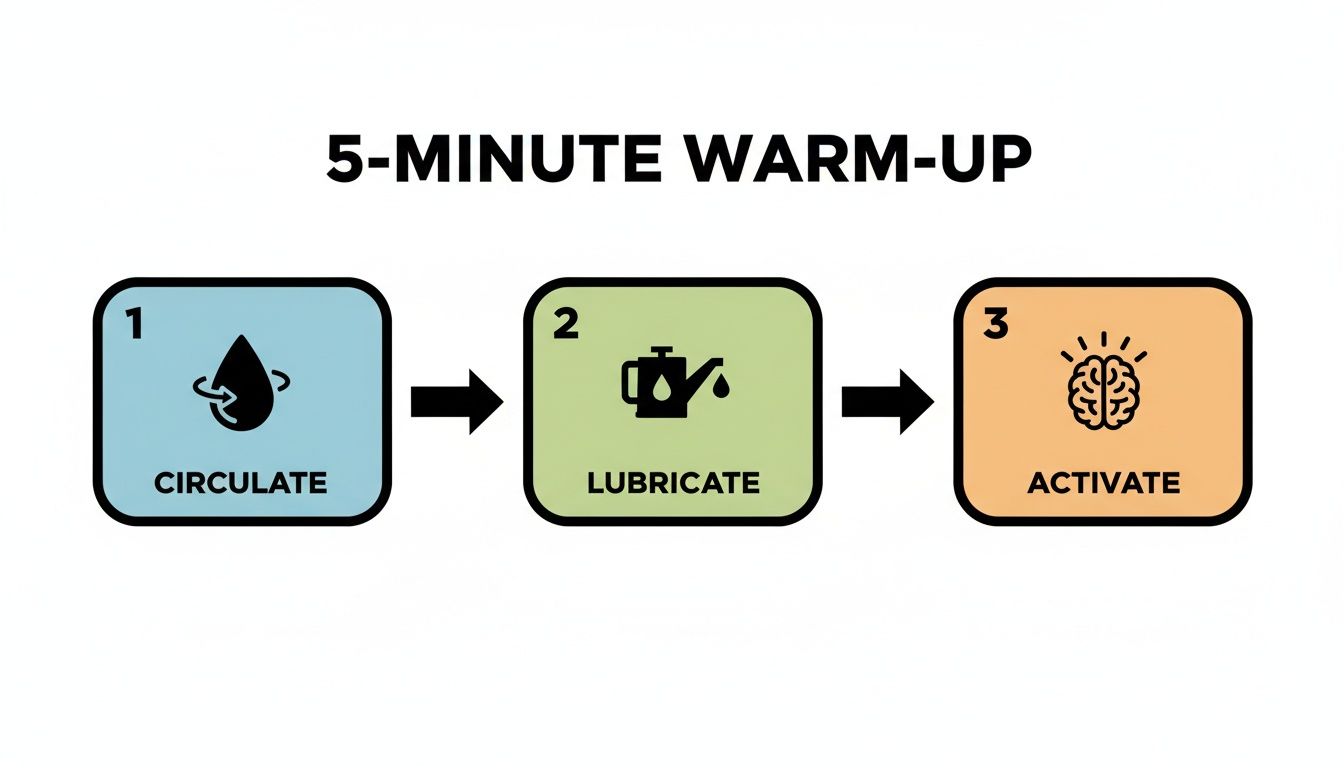
Getting blood flowing, prepping the joints, and waking up your nervous system is the magic formula that readies your body for safe, powerful movement.
We hoard a ridiculous amount of tension in our necks and shoulders. Blame our phones, our desks, our stress—whatever the cause, these movements are the antidote to "tech neck" and that permanent hunch.
Neck CARs (Controlled Articular Rotations)
First thing's first: this isn't about whipping your head around like you're at a rock concert. This is a slow, mindful exploration of every millimeter of your neck's range.
Shoulder CARs
Your shoulder is a ball-and-socket joint, which means it’s built for 360-degree movement. Let's make sure it can still do its job.
A mobile spine is a happy, healthy spine. These moves are designed to combat the concrete-like stiffness that comes from sitting all day, helping you stand taller and ease back tension.
Seated Spinal Twists
This is an absolute gem for breaking up a long day at the desk. You can do it without even leaving your chair.
Our poor hips. They get notoriously tight from endless sitting, which can cause a cascade of problems down to your knees and up to your lower back. It's a huge issue—globally, the orthopedic market hit about USD 59 billion, with knee and hip procedures accounting for USD 17.4 billion of that total. Getting your hips moving well is one of the single best investments you can make in your long-term health.
The 90/90 Stretch
This is the undisputed king of hip mobility exercises. Why? Because it cleverly targets both internal and external rotation in one fell swoop.
Beginner Tip: If you find yourself collapsing into a heap and can't sit upright, don't sweat it. Just prop a yoga block or a firm cushion under the hip of your front leg. That little bit of elevation is a total game-changer.
Think of your feet and ankles as the foundation of your house. If the foundation is crumbly, the whole structure suffers. Poor mobility here sends problems right up the chain.
Wall Ankle Mobility Drill
This ridiculously simple drill is a powerhouse for improving ankle dorsiflexion—your ability to pull your toes up toward your shin.
While mobility is all about active control through a range of motion, it goes hand-in-hand with flexibility. If you find deep stretches are a real struggle, it might be worth exploring how you can learn how to improve your flexibility to complement these drills.
Let’s be honest. Knowing a dozen fancy joint mobility exercises is completely useless if you never actually do them. The real trick isn't learning the moves; it’s weaving them into your life so they become as automatic as brewing your morning coffee.
The secret? Stop treating mobility like another grueling workout. Instead, think of it as a quick, 10-minute daily tune-up for your body.
So, how often should you really be doing this stuff? Unlike heavy lifting, gentle mobility work can—and probably should—be a daily habit. Your joints crave frequent, low-intensity movement. It's the perfect antidote to the stiffness that builds up from, well, just living life. Think of it as hitting the reset button on your body's alignment each and every day.
Forget about complicated splits and confusing schedules that require a spreadsheet to track. The best routine is the one you don't have to overthink. To get you started, here are a couple of plug-and-play templates you can steal, depending on what your day looks like.
This one is for all of you who spend hours hunched over a screen. It’s designed to undo the damage of sitting and prevent that dreaded "tech neck" from becoming your permanent posture.
Perfect for active folks who push their bodies hard on the weekend. This session is all about boosting recovery and getting you prepped for the week ahead.
This kind of consistency pays off big time, especially for major joints like the hips. We're seeing a sharp rise in conditions like osteoarthritis, which is no surprise when you look at the numbers. The global market for physical therapy rehabilitation, valued at a whopping USD 27.41 billion, is projected to more than double. The hip joint segment is growing the fastest, which tells you just how common these issues are becoming. You can discover more insights about the physical therapy market on Precedence Research if you want to see the full scope of this trend.
The most effective mobility routine isn't the most intense—it's the most consistent. Ten minutes of focused movement every day will always beat an hour-long session you only manage to do once a month.
Ultimately, you can mix and match these ideas to create something that feels right for you. A full-body routine three times a week works great. Or you could split it up—upper body one day, lower body the next.
The specific structure really doesn't matter as much as building the habit. To help you visualize this, here's a simple schedule you can adapt.
This is just a template to show you how easy it can be to fit mobility into your week. Feel free to move days around, combine sessions, or focus on areas that need the most love. The key is to just get started.
Just pick a template that excites you (or doesn't bore you to tears), stick it in your calendar, and get moving. Your future self—the one who can touch their toes and squat without a symphony of creaks and pops—will thank you for it.
Let's be real for a second. It's ridiculously hard to know if you're actually doing mobility drills correctly when you're on your own. Are you isolating your shoulder joint like you're supposed to, or is your entire upper body twisting to cheat the movement? This is exactly where some cool new tech can step in and be the on-demand coach you never knew you needed.
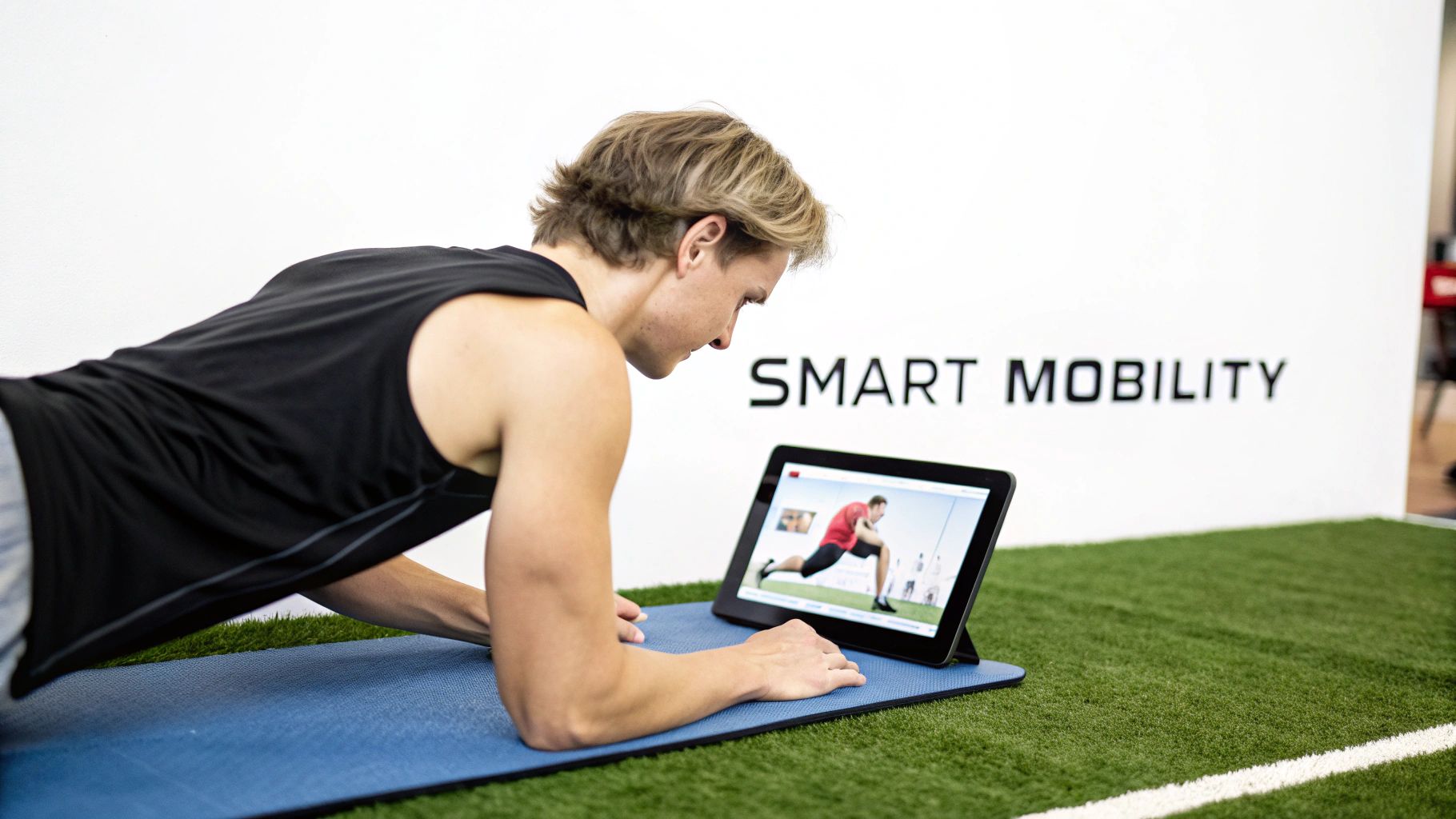
AI-powered tools can now give you feedback on your form and range of motion as it's happening. Picture this: you’re easing into a 90/90 stretch, and a voice cue immediately chimes in, "Keep your chest upright," or "Sink deeper to feel that stretch." This isn't some far-off sci-fi concept; it's the game-changing advantage of having smart tech guide your practice.
This kind of immediate guidance helps you build solid movement habits from day one. It ensures you're squeezing every last drop of benefit from each exercise while steering clear of potential injuries. It’s like having a physical therapist’s expert eyes on you, catching those tiny mistakes that compound into big problems over time.
But it’s more than just form correction. These tools give you something incredibly motivating: cold, hard proof that you're getting better.
Here’s why that matters:
Think of it this way: AI feedback gives you the precision of a movement specialist combined with the convenience of an app on your phone. You get the 'what' and the 'how' right in your pocket.
Platforms are now baking this intelligence into everyday fitness gear. For instance, learning about the features of a smart yoga mat reveals how tech can analyze your poses with startling accuracy, giving you a clear roadmap to improvement. This approach doesn't replace the fundamentals of good movement; it makes them sharper, helping you practice safer and hit your mobility goals way faster.
Jumping into any new routine can feel like you're staring at a big, confusing map. Let's clear up some of the most common questions I get, so you can start moving with confidence.
You're going to feel better almost immediately. Seriously. That sense of relief and spaciousness you get right after a good mobility session is the first win, and it happens from day one.
But for those bigger, more permanent changes in your range of motion? You'll want to give it about 4-6 weeks of consistent work. The real magic isn't in one monster session; it's the drip-drip-drip of showing up regularly. Just 10-15 minutes, a solid 3-5 times a week, is enough to build serious momentum and change how your body feels for good.
Let me be absolutely crystal clear on this one: NO. Never.
You should feel a stretch, maybe some deep tension, or the satisfying feeling of a muscle waking up. What you should never feel is sharp, shooting, or pinching pain.
Think of pain as your body’s bright red stop sign. It's not a suggestion; it's a command. If a movement hurts, back off immediately. Shrink the range of motion or try an easier version. We’re gently coaxing our joints to open up, not trying to force them into submission.
Yes, you absolutely can, and your body will love you for it. Unlike a heavy lifting session that requires recovery time, gentle mobility work is like daily maintenance for your joints.
It’s the perfect way to start your day, shaking off the stiffness from sleep in just 5-10 minutes. Or, you can use it to unwind in the evening and undo all that time spent hunched over a desk. Daily movement keeps your joints lubricated and happy, making it one of the best habits you can build for feeling great long-term.
Ready to stop guessing and start seeing real progress? The Dalm app uses AI to analyze your form in real-time, making sure every move you make is the right one. It's like having a coach in your pocket. Start your journey with Dalm today.