
Learn how to start preventing repetitive strain injuries with our expert guide on ergonomics, exercises, and AI-powered yoga. Stay pain-free and productive.

Ever wrap up a long day at the keyboard and feel that nagging, persistent ache in your wrist? Or maybe it’s a dull throb in your shoulder that just won’t quit. That’s not just fatigue—it's your body sending up a flare, an early warning for a Repetitive Strain Injury (RSI).
These injuries are the slow-burn villains of our modern, desk-bound lives. Knowing your enemy is the absolute first step to stopping it in its tracks, long before it has a chance to sideline you for good.
Let's get one thing straight: a Repetitive Strain Injury is a big deal. This isn't a single dramatic event like breaking a bone. Instead, it’s a stealthy condition that creeps up on you. RSI is an umbrella term for pain and inflammation in your muscles, nerves, and tendons, all caused by doing the same small movements over and over... and over again.
Imagine this: every tap on your keyboard, every click of the mouse, every swipe on your phone is like a tiny drop of water. One drop is nothing. But thousands of drops, day after day, can eventually wear down solid rock. That's exactly what's happening inside your body—this cumulative stress creates micro-trauma, tiny bits of damage to your soft tissues.
At first, it’s easy to ignore. You might just feel a little stiff or notice a faint ache after a long day. That’s the whisper. But if you don't listen, that whisper gets a whole lot louder. The early signs often show up as:
These symptoms pop up from the most ordinary activities. We’ve all heard of "mouse shoulder" from endless clicking or "texting thumb" from doomscrolling. These aren't just funny names; they’re real-world examples of how RSIs sneak into our lives.
The real danger with RSIs is how slowly they develop. Because the pain isn't sudden, we tend to brush it off until it becomes a constant, unwelcome guest that disrupts everything we do.
And this isn't just a personal headache; it's a massive economic problem. Job-related repetitive strain injuries rack up an estimated $20 billion a year in workers' compensation claims. Tack on another $100 billion in lost productivity and other costs, and you start to see the true scale of the issue. You can dig into more of this data through the CDC's findings.
Understanding what an RSI is—and the serious ripple effect it can have on your life and work—is your most powerful weapon in the fight against it.
Let's turn your desk from a pain factory into a productivity haven. You don't need to drop a ton of cash on fancy ergonomic gear; this is all about making smart, simple tweaks you can do right now. Think of it as outsmarting your workspace before it outsmarts your body.
Your throne—I mean, your chair—is the starting point. Adjust it so your feet are flat on the floor and your knees are bent at a relaxed 90-degree angle. Feet dangling? No problem. Grab a footrest, or even a couple of old textbooks. It works.
Next up, your back. That natural "S" curve in your lower spine needs support. If your chair's lumbar support is non-existent, don't rush to buy a new one. Just roll up a small towel or snag a couch cushion and tuck it into the small of your back. Instant relief.
Alright, now look straight ahead. The very top of your computer monitor should be at or just a smidge below your eye level. This tiny adjustment is a game-changer for preventing that dreaded "tech neck" from hunching over all day. If your monitor is too low, a stack of books or a proper stand will get it right where you need it.
Keep that monitor about an arm's length away. This isn't just a random distance; it's the sweet spot for reducing eye strain and stopping you from craning your neck forward to read the fine print.
Where you place your keyboard and mouse is just as crucial. They need to be close enough that your elbows can stay bent at that same comfy 90-degree angle, keeping your wrists nice and straight. If you look down and see your wrists bent up or down while you type, you're basically sending an open invitation for strain.
This whole process is about stopping tiny, harmless-looking movements from ganging up on you. It's a slow burn that you often don't notice until it's too late.
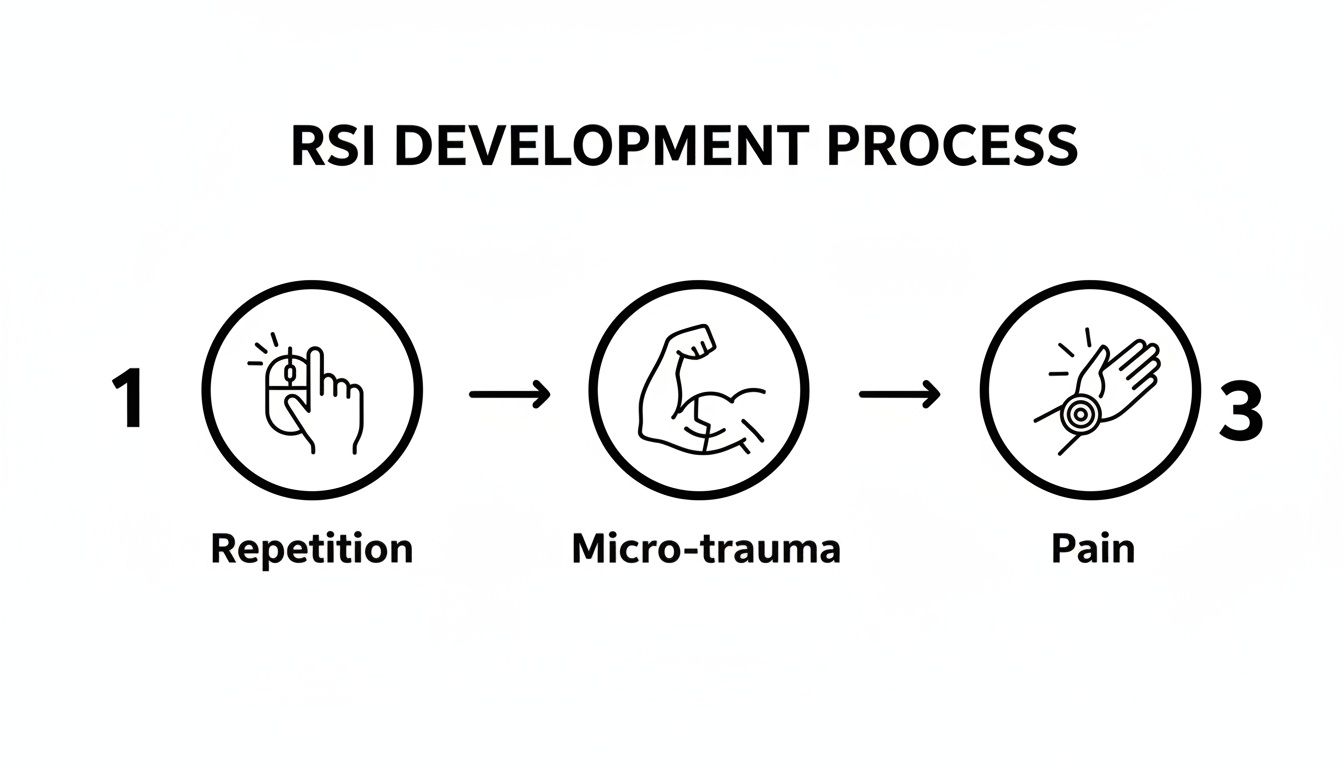
As you can see, it's a simple, predictable path: the repetition leads to tiny bits of damage (micro-trauma), which eventually snowball into real, noticeable pain.
Not convinced these little tweaks matter? Think again. Comprehensive prevention programs have proven that good ergonomics are a powerful shield. According to the Bureau of Labor Statistics, musculoskeletal issues like RSIs accounted for nearly one-third of all worker injury cases back in 2019. That's a staggering number.
To help you get started, here are some quick and dirty fixes you can implement immediately.
These aren't just suggestions; they are foundational habits for a pain-free work life.
The big idea here is to make your environment fit you, not the other way around. Your body should be able to hold a relaxed, neutral posture without even thinking about it.
But even with the world's most perfect setup, posture is a moving target. It requires awareness, not just a one-and-done fix. For anyone wanting to geek out on a deeper analysis of their alignment, you might find our guide on posture analysis software pretty interesting.
Ultimately, these tips help create a space where your body can actually thrive, not just survive, the 9-to-5 grind. It's not about achieving perfection overnight, but about making small, consistent changes that pay huge dividends in long-term comfort.
If your ergonomic setup is the foundation for avoiding repetitive strain injuries, then daily movement is the maintenance crew that keeps the whole structure from falling apart. Our bodies just weren't built to be stuck in one spot for eight hours a day. The real secret to fighting off that desk-bound stiffness isn't a punishing, hour-long gym session after work. It's all about frequent, simple "movement snacks."

I'm talking about quick, two-to-five-minute breaks that get your blood pumping, wake up your sleepy muscles, and give your tendons a much-needed breather. The best part? You don't even have to leave your desk. The whole point is to make these little movements so ridiculously easy that they become second nature.
For instance, got a minute while a big file downloads or you're muted on a conference call? Perfect. Time for some wrist circles. Just stretch your arms out and gently roll your hands, first clockwise, then counter-clockwise. It seems small, but this simple action helps lubricate the wrist joint and eases the pressure from all that typing and mousing.
Think of this as your personal menu of anti-stiffness options you can pull from all day long. Just pick one or two every hour to build your own little routine.
The best movement is the one you actually do. Don’t get bogged down trying to perfect it. Frequency is what matters. Moving for two minutes every hour is a thousand times better for preventing RSIs than one 30-minute stretch-a-thon at the end of a long day.
This whole approach is about breaking the vicious cycle of static posture that leads to micro-damage in your muscles and tendons. By introducing different ranges of motion throughout the day, you're essentially telling your body not to get "stuck." If you want to take it a step further, you can check out our complete guide on postural awareness exercises to build an even stronger defense.
Look, knowing what to do is only half the battle. The real magic happens when you actually build the habit. This is where a classic productivity hack can become your body's best friend.
You’ve probably heard of the Pomodoro Technique—the time management method that breaks work into focused chunks (usually 25 minutes) separated by short breaks. Let's hijack it for our own good! Set a timer for 25 or 30 minutes. When it dings, you don't just mindlessly scroll through your phone. You stand up, you stretch, you do one of your "movement snacks."
This little trick is brilliant because it automates the whole process. The timer goes off, you move. Simple as that. Think of these as tiny deposits into your body's wellness bank. They keep your muscles happy, your circulation flowing, and those nagging RSIs far, far away.
Let's be real: A fancy ergonomic chair is great, but it can't do push-ups for you. True prevention of repetitive strain injuries isn't just about your desk setup; it’s about building a body that's strong, flexible, and ready for whatever your day throws at it.
Your workspace can support you, sure, but an active, aware body is what truly protects you. This is where a consistent yoga practice can be a game-changer, acting as the perfect antidote to our modern, desk-bound lives.
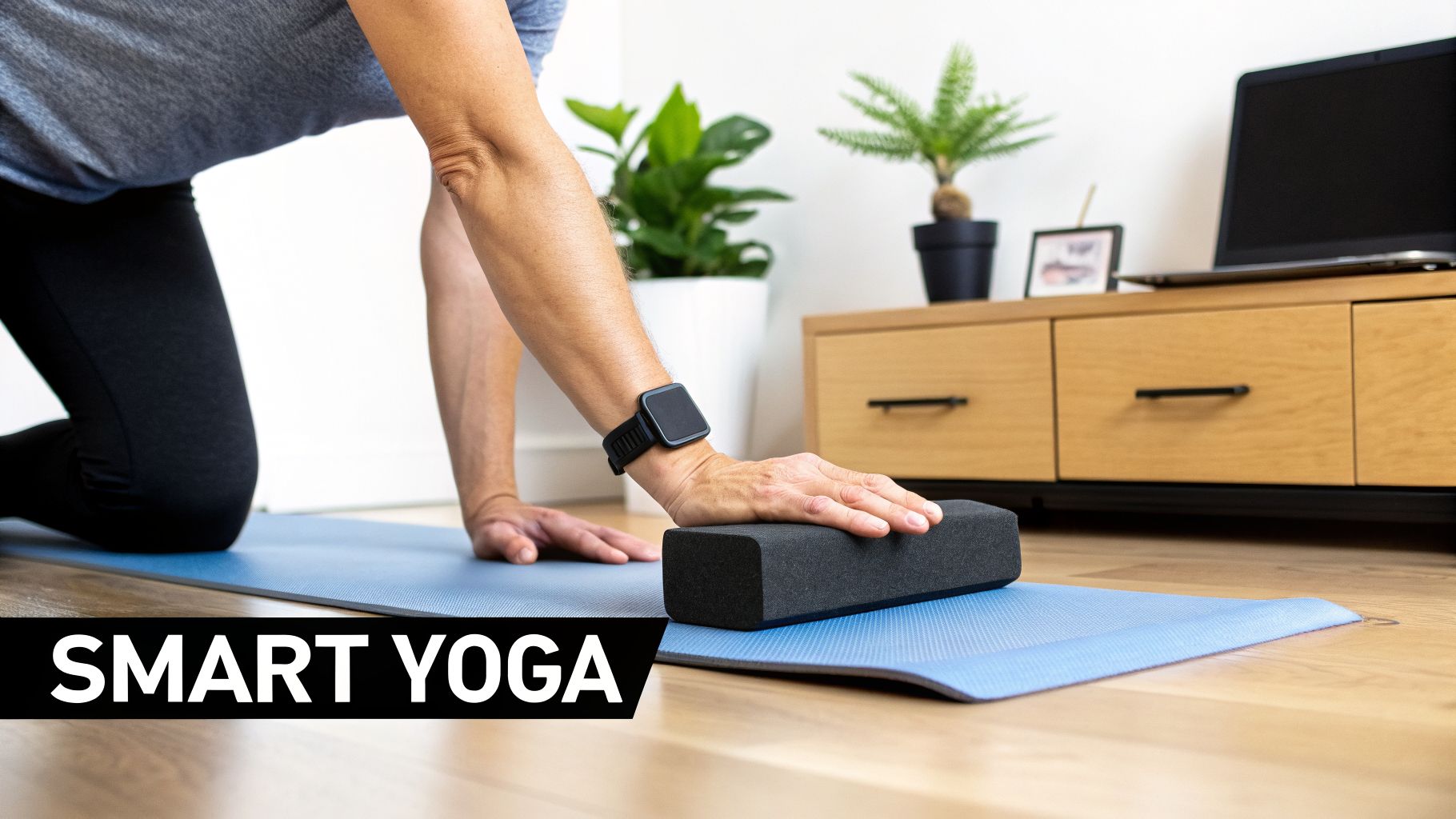
Think of it as hitting the reset button on your posture and actively countering all that hunching and typing. Poses like Cat-Cow are fantastic for getting a stiff, cranky spine moving again after hours of sitting. Meanwhile, a full-body classic like Downward-Facing Dog gets to work lengthening your hamstrings, opening up your shoulders, and melting tension from your neck all the way down to your heels.
These movements directly fight back against the static, locked-in positions that lead to RSIs. But what if you could take it a step further? What if you could guarantee every pose was not just good, but perfectly dialed in for your body?
Imagine having a personal yoga coach watching every move, giving you instant tips to fix your alignment on the fly. This isn't some far-off sci-fi concept; it's the reality of AI-guided yoga. This technology elevates your practice from a simple stretching routine into a precision-guided strategy for RSI prevention.
Let's play out a common scenario. You're holding a Plank pose, a beast of a full-body strengthener. After a few seconds, that all-too-familiar ache starts creeping into your wrists. It’s a classic mistake—you're dumping all your weight into the heel of your hands instead of spreading the load.
This is where a tool like Dalm works its magic. The app’s AI would spot this faulty weight distribution and immediately give you clear, actionable voice feedback, like: “Engage your core and press firmly through all your fingertips to take pressure off your wrists.”
This immediate correction does more than just stop the ache. It's actively teaching you proper alignment, ensuring you build functional strength without accidentally creating new strain patterns. It’s like having an expert by your side, fine-tuning your movements for maximum benefit and minimal risk.
By baking this level of precision into your routine, your yoga practice becomes so much more than a way to de-stress. It evolves into a proactive tool for building a body that’s genuinely resilient to the grind of daily life.
This approach turns every session into a personalized workshop on injury prevention. If you're curious about the tech, you can learn more about smart yoga mats and how they guide your practice.
Ultimately, combining the ancient wisdom of yoga with smart, modern technology gives you a powerful formula for keeping your body balanced, strong, and blissfully pain-free.
Your body is incredibly polite. Long before it starts shouting in pain, it tries to get your attention with whispers. Learning to tune into these subtle signals is your secret weapon for stopping a repetitive strain injury (RSI) before it ever really begins.
These early warnings are often so minor we just brush them off. It might be a faint tingle in your fingertips after a long typing session. Maybe it's a dull, forgettable ache in your forearm when you pick up your coffee mug. Or perhaps it’s a new stiffness in your neck when you back out of the driveway.
These aren't random annoyances. They are your body's early alert system, and it’s time to start listening.
Think about your daily grind. Does your hand feel a bit weak or clumsy after an hour of scrolling on your phone? That’s a signal. Do your shoulders feel tight and knotted up by the end of the workday, even if they felt fine in the morning? That’s another one.
The real trick is to catch these symptoms when they are just whispers, not screams. Here are the common early warning signs you should never ignore:
Sometimes, persistent localized pain might point to trigger points, which are essentially tight, cranky knots within a muscle. A technique like Trigger Point Massage can be fantastic for addressing these knots before they spiral into a bigger problem.
You can turn this awareness into a powerful habit with a quick "body scan" self-check. I recommend doing this once a day, maybe right when you sit down at your desk or during that mid-afternoon slump.
It's ridiculously simple:
If you spot a red flag during this quick scan—like that same recurring numbness in your fingers every afternoon—don't just push through it. That's your cue to act. Revisit your desk setup, take a few more movement breaks, and focus your stretches on that specific area. Listening and responding is how you stop an RSI in its tracks.
Alright, we've walked through setting up your workspace and using smart yoga to build a more resilient body. But I know from experience that this is usually the point where a few specific questions pop up. Let's tackle the most common ones head-on so you can move forward with confidence and, more importantly, without pain.
This is the million-dollar question, isn't it? The honest answer is: it completely depends. There’s no magic number. How long your recovery takes is tied directly to how severe the injury is and, crucially, how fast you start doing something about it.
If you catch a minor strain early—that first little twinge in your wrist or ache in your shoulder—you could be feeling better in just a few weeks. A little rest and some simple adjustments to your routine can work wonders. Think of it as a quick course correction before you drift too far off track.
But if we're talking about a chronic issue you've been ignoring for months (or even years), it's a completely different ballgame. The road back from a severe, long-term RSI can be a long and frustrating one, often taking many months to fully heal. This is exactly why prevention and jumping on those early warning signs are so non-negotiable. Dealing with the whispers of pain now saves you from having to listen to the screams of a chronic condition later.
If only it were that simple! Ergonomic gear is a fantastic and important piece of the puzzle, but it's definitely not a silver bullet. I like to think of a special keyboard or mouse as just one tool in a much bigger prevention toolkit. They're designed to encourage a more neutral, natural posture, but they can't force you to sit correctly or remind you to get up and move.
Truly effective prevention is about the whole picture. It’s about pairing that supportive equipment with a full suite of healthy habits.
Your equipment can nudge you toward a better posture, but it’s your daily actions that make it stick. Never expect your gear to do all the heavy lifting for you.
The biggest mistake I see people make is dropping a bunch of money on an ergonomic mouse and then continuing to work for four hours straight without a single break. The gear helps, but your behavior is what ultimately protects you.
This is a big one, so let's be crystal clear: you should feel a gentle, satisfying pull or stretch. You should never, ever feel sharp pain. It's totally normal to feel a bit of mild muscle soreness when you first start a new stretching routine, much like the day after a good workout. That’s just your muscles waking up and adapting.
However, any sharp, shooting, or stabbing pain is a massive red flag. That's your body slamming on the emergency brakes, screaming at you to stop. Pushing through that kind of pain will only aggravate the injury and make things worse.
This is where a little guidance can be a game-changer. For instance, using an app like Dalm gives you real-time feedback on your form as you do yoga stretches. It helps make sure you’re actually getting the benefit of the pose—like opening your chest and shoulders—without accidentally cranking on a vulnerable joint. It helps you find that sweet spot between an effective stretch and a safe one.
Ready to turn your yoga practice into a powerful tool for preventing repetitive strain injuries? Dalm uses AI to analyze your poses and give you real-time feedback, ensuring you build strength and flexibility safely. Start your journey to a pain-free body today at Dalm.co.