
Unlock your true potential with our guide to proper breathing during exercise. Learn techniques to boost endurance, power, and focus in any workout.
Ever feel like you’re hitting a wall in your workout? You’ve got more in the tank, your muscles aren’t done, but your lungs are screaming and you’re forced to stop. If that sounds familiar, you’re not alone. The culprit is almost always your breathing, and it's the single most overlooked secret to better performance.
Seriously, think of your breath as the engine that drives every single move you make in the gym, on the track, or on the mat. It’s not just about mindlessly sucking in air; it’s a skill. When you learn to control it, you unlock a new level of power, stamina, and even injury prevention.
Most of us just let breathing happen on autopilot. But what if you could sync it perfectly with every heavy squat, every mile of your run, or every yoga flow? That’s when your breath stops being a background process and starts being your greatest advantage.
When you breathe with purpose, you're not just getting through the workout—you're getting more out of it. Correct breathing floods your muscles with oxygen, the very fuel they need to produce energy. It also helps you keep your heart rate in check and stabilizes your core, giving you a rock-solid foundation for every movement.
Here’s the real-world payoff of dialing in your breath:
Breathing is the first place, not the last, to look for gains in performance. It is the most overlooked secret weapon in fitness.
Think about this: up to 70% of people who exercise are held back by poor breathing habits. That’s a huge number. Getting it right can boost your oxygen delivery by as much as 20%, which is a massive leap in endurance.
We see it all the time. Someone in a tough yoga class starts feeling lightheaded and their form crumbles—not because they aren't strong enough, but because they started mouth-breathing and holding their breath. Yogis who use real-time feedback from an app like Dalm often find that switching to nasal breathing can drop their heart rate by 10-15 beats per minute. This simple change helps them avoid hyperventilating and stay in a calmer, more controlled state.
Ignoring your breath is like trying to drive a performance car with the handbrake on. You’ll find tons of great info on why this is so critical from sources like cognitivemarketresearch.com.
This is your official invitation to stop leaving performance on the table.
Let's look at how common breathing mistakes hold you back and what simple changes can unlock better performance.
These small adjustments aren't just minor tweaks; they fundamentally change how your body responds to and recovers from exercise.
Alright, before we get into the nitty-gritty of breathing for squats or sprints, we need to address the elephant in the room: how you're breathing right now. For a lot of us, that means we're stuck in a pattern of shallow "chest breathing." We've got to fix that first. The secret to unlocking your athletic potential lies in mastering diaphragmatic breathing—what some people call belly breathing.
Think of it this way: your diaphragm is a big, powerful, dome-shaped muscle that lives right under your lungs. When you chest-breathe, you're basically ignoring this powerhouse and using the smaller, less efficient muscles in your neck and shoulders. This not only cheats you out of a full breath but also creates a ton of unnecessary tension. Diaphragmatic breathing, on the other hand, puts the star player in the game, pulling air deep into the bottom of your lungs where all the magic happens.
This one skill is the foundation for proper breathing during exercise, period.
Let's retrain your body's instinct with a dead-simple drill. Seriously, anyone can do this.
Find a comfortable spot on the floor and lie on your back. Bend your knees and plant your feet flat. Now, place one hand on your upper chest and the other on your belly, right below your rib cage.
Take a slow, deliberate breath in through your nose. Your mission is to feel the hand on your stomach rise toward the ceiling while the hand on your chest stays put. Picture a balloon inflating deep inside your belly, pushing your hand up.
Now, exhale slowly through your mouth. Feel the hand on your belly gently lower as you press every last bit of air out. This conscious, physical feedback is how you start rewiring your system.
The difference is night and day. Chest breathing is like taking tiny, anxious sips of air. Diaphragmatic breathing is like taking a long, satisfying drink that completely drenches your muscles in oxygen.
This isn't just about your lungs, either. It’s a full-on core exercise. A strong diaphragm and solid breathing mechanics are directly tied to better posture and a more stable spine. If you want to double down on that, our guide on postural awareness exercises offers some fantastic movements that pair perfectly with this.
To really lock this in, you might also want to look at how your face and mouth muscles are working. Exploring some orofacial myofunctional therapy exercises for better breathing can be a game-changer for strengthening the muscles that keep your airway open and functional.
Try to practice this belly breathing drill for just five minutes a day. Once it starts feeling second nature lying down, take it upright. Try it while sitting at your desk, then standing in line, and eventually during a casual walk. This is how you build the muscle memory to make diaphragmatic breathing your new normal, both in the gym and out.
Let's get real for a second. The way you breathe for a heavy deadlift has absolutely nothing in common with how you breathe during a 5k run, and that's exactly how it should be.
Every workout you do calls for a different breathing strategy to crank up your performance, keep you safe, and make every movement more efficient. Learning to match your breath to your workout isn't some secret pro tip—it's one of the most fundamental skills you can build.
Think of your breath as the drummer in your body's band. When the beat is locked in with the melody (your movement), the whole performance is powerful and smooth. But if the drummer's off? Everything falls apart.
When you're pushing, pulling, or squatting heavy iron, your breath is your best friend for creating stability and raw power. The trick is to brace your core and use a perfectly timed, forceful exhale.
Here’s how it works in practice:
A huge mistake I see all the time is people holding their breath through a heavy lift. That can send your blood pressure through the roof. Seriously, don't do it. Just remember the simple cue: "inhale down, exhale up."
For steady-state cardio like jogging, rowing, or cycling, it's all about finding a sustainable rhythm. Choppy, shallow breathing is a one-way ticket to getting a side stitch and gassing out way too early.
The key is to lock your breath into a consistent rhythm with your movement. A go-to pattern for runners is the 2:2 rhythm: breathe in for two steps, then breathe out for two steps. Simple, but effective.
This rhythmic breathing keeps a steady flow of oxygen coming in and helps prevent your diaphragm from spasming, which is a common culprit behind that dreaded side stitch. If you feel one creeping in, slow your pace and focus on long, deep exhales to help the muscle relax.
This infographic paints a clear picture of what we're talking about—the difference between weak chest breathing and powerful, efficient belly breathing.
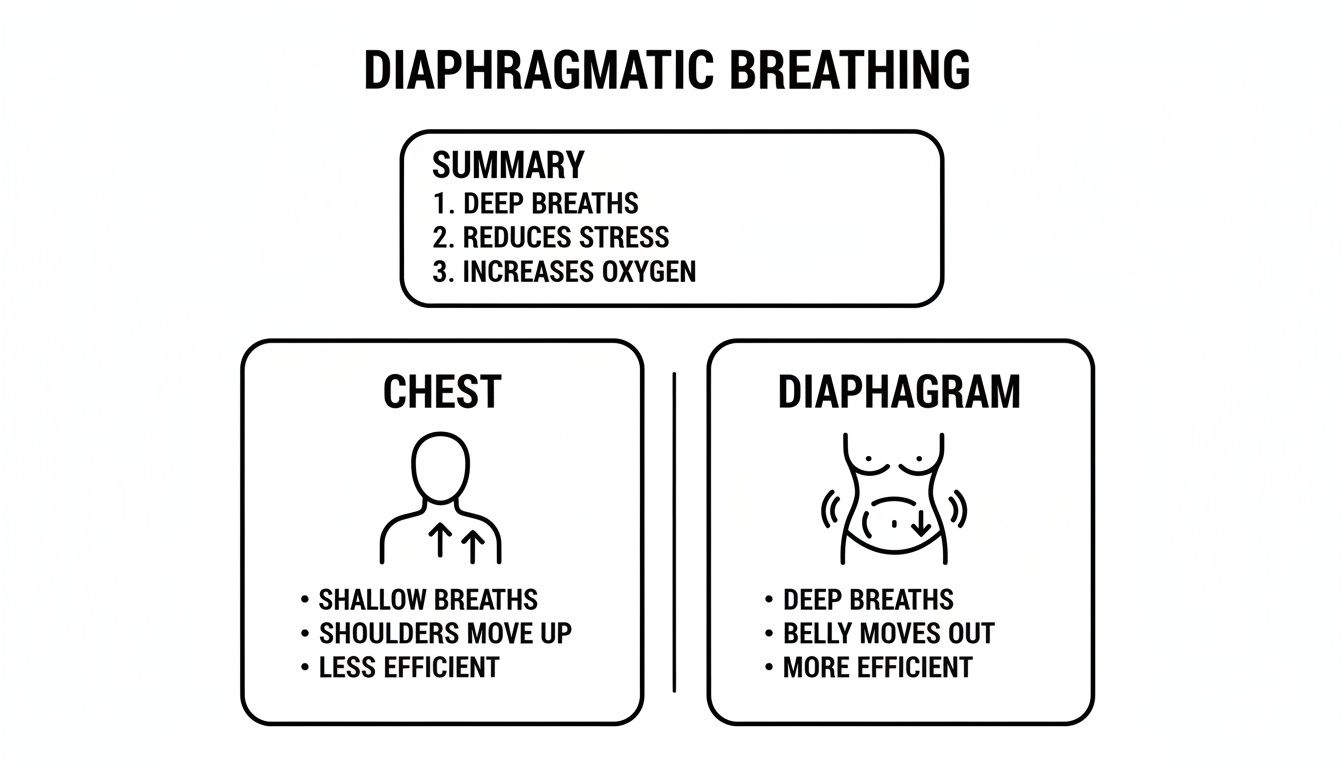
Focus on making your belly expand like a balloon, not just puffing out your chest. It unlocks so much more lung capacity and gives you a rock-solid foundation.
High-Intensity Interval Training (HIIT) is organized chaos—all-out effort followed by a scramble to recover. Your breathing needs to be just as dynamic.
During the "work" intervals, your exhales should be sharp and powerful, driving the movement itself. Think of a kettlebell swing: a forceful "hiss" or "ha!" sound on the upswing helps generate that explosive hip power you're after.
Then, the second the interval ends, switch gears. Immediately slow down and pull in deep, calming diaphragmatic breaths. This helps slam the brakes on your heart rate so you're ready to go again for the next round.
In yoga, the breath, or pranayama, isn't just an accessory; it's the main event. It's the bridge that connects your mind to your body. One of the most foundational techniques is Ujjayi breath, which you might hear called "ocean breath."
You create it by gently constricting the back of your throat as you breathe in and out through your nose. The result is a soft, audible sound, like waves rolling in and out. It’s incredibly focusing, builds internal heat, and helps you flow from one posture to the next.
Numbers don't lie. Research shows that shallow chest breathing during intense workouts can spike your blood lactate levels by a whopping 30%, making your muscles fatigue much faster. On the flip side, controlled breathing can boost aerobic capacity by 18% in trained athletes. And in yoga, a solid Ujjayi practice can increase lung capacity by 10-15%.
Mastering this sync can be tricky, which is where a tool like the Dalm app can be a game-changer. Its AI gives you real-time feedback to help you nail your breath-to-movement sync during your practice. If you want to go deeper on this style, check out our guide on what is Vinyasa Flow yoga.
Feeling a little overwhelmed? Don't be. Here’s a quick-reference table to help you remember the right breathing strategy for whatever workout you've got planned.
Bookmark this page or screenshot this table. Having this cheat sheet handy is a simple way to start building better breathing habits in every single workout.
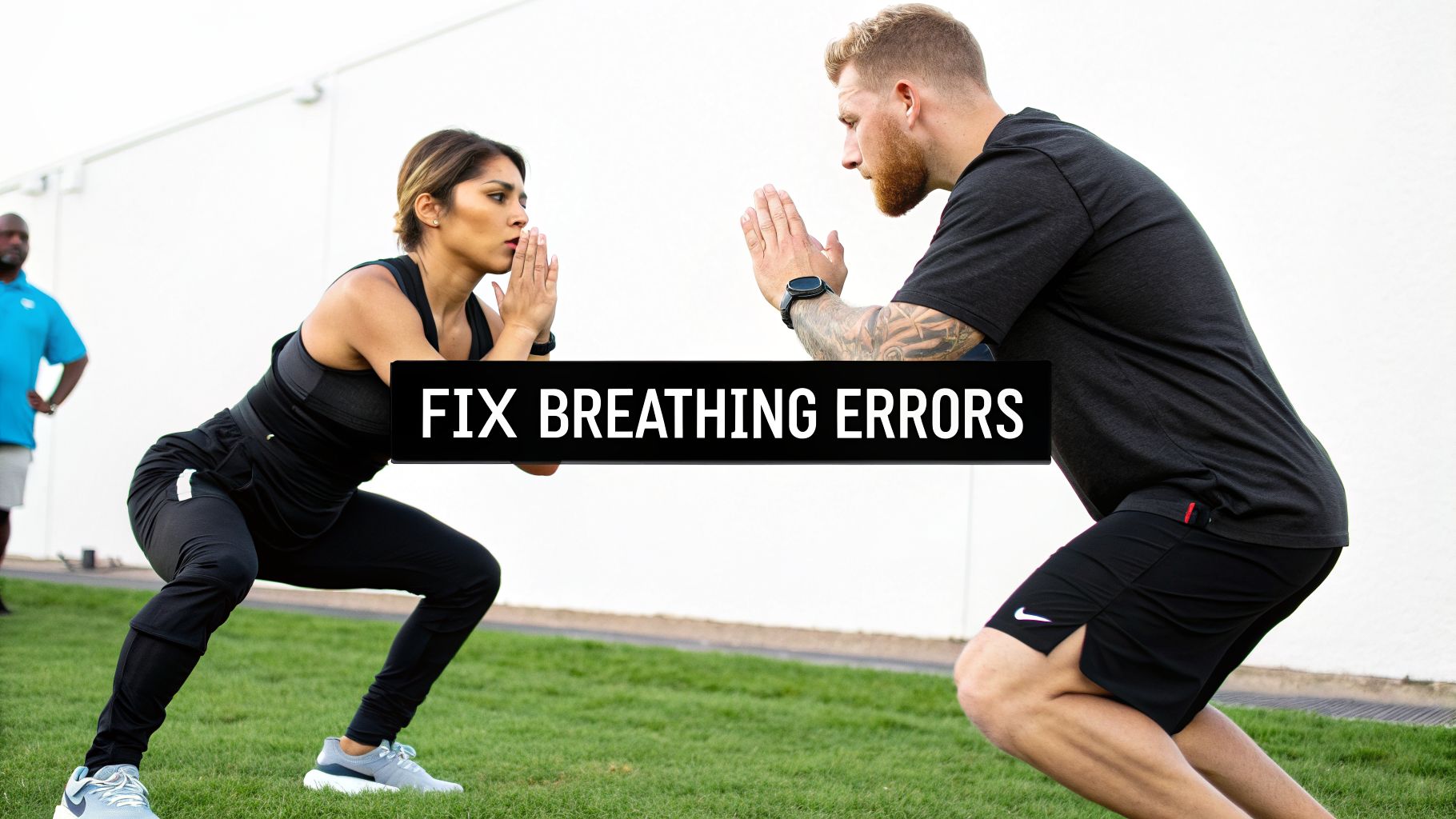
Even when you know the "rules" of proper breathing during exercise, bad habits have a sneaky way of sticking around. They creep back into your workouts, quietly killing your gains and leaving you wondering why you feel so gassed.
Consider this your personal cheat sheet for spotting and fixing the most common breathing slip-ups that trip up even seasoned gym-goers. We're not just going to point fingers; we're going to give you the exact fixes to make better breathing second nature.
Picture this: you're at the bottom of a heavy squat, muscles coiled and ready to explode upwards. What do you do? If you’re like a lot of people, you instinctively hold your breath, your face turning a lovely shade of tomato.
This is the infamous Valsalva maneuver. While it might feel like you’re creating a super-stable core, you’re actually just sending your blood pressure through the roof. It’s a risky move that can leave you feeling dizzy and lightheaded—exactly what you don't want with a loaded barbell on your back.
The Fix: Try a "hissing" exhale instead. On your next set of squats, deadlifts, or push-ups, take a big belly breath on the easy part (the descent). As you start the hard part (pushing or pulling), exhale forcefully through pursed lips with a controlled "sssssss" sound. This creates all the core stability you need without the dangerous pressure spike.
This one’s a classic cardio killer. You're a mile into your run, and you suddenly realize you're taking tiny, rapid sips of air. Your shoulders are creeping up toward your ears, your chest is tight, and that dreaded side stitch is starting to make its presence known.
This is shallow chest breathing, and it’s incredibly inefficient. You're only using the top third of your lungs, starving your hard-working muscles of oxygen. Your body panics, your heart rate skyrockets, and fatigue sets in way too early.
Inefficient breathing is a massive performance killer. Hitting a wall mid-workout from gasping for air is a real issue, with some data suggesting 60% of runners hyperventilate, slashing their efficiency. Learning proper breath control can restore it. You can learn more about the surprising impact of breathing on exercise performance and how specific tools are helping athletes get it right.
Okay, this one is a bit more subtle but just as destructive. Reverse breathing is when your stomach sucks in as you inhale and pushes out as you exhale—the complete opposite of how your diaphragm is designed to work.
When you breathe backward like this, you're literally putting a straitjacket on your diaphragm. It can't drop down, which dramatically shrinks your lung capacity and weakens your core. You're left using the small, weak muscles in your neck and shoulders to breathe, a perfect recipe for tension and poor performance.
Not sure if this is you? Try this quick check-in.
Alright, so you know the "what" and "why" of proper breathing. That's the easy part. The real game-changer is getting to a place where you don't even have to think about it.
The goal is to go from consciously forcing yourself to "exhale on the effort" to having it just... happen. We want that powerful, efficient breath to become your body's default setting, working for you 24/7 without a second thought. This is your roadmap to making proper breathing during exercise an automatic skill.
It all starts with small, consistent practice. You don't need to blow up your entire fitness routine overnight. We're talking about building simple awareness, just a few minutes a day, and then slowly weaving that skill into your workouts and daily life.
Let's make this manageable. Here’s a simple four-week journey designed to build the habit without feeling like another chore. This is how we turn conscious effort into second nature.
Week 1: Find Your Belly Breath Again. For just five minutes a day, lie on your back with a hand on your belly. Your only job? Feel it rise with your inhale and fall with your exhale. That’s it. We're just reminding your body what diaphragmatic breathing feels like.
Week 2: Take It on the Road. Keep up your daily five-minute practice, but now, start paying attention to your breath during low-stakes moments. Try that same belly breathing during your warm-up, your cool-down walk, or even just standing in line at the coffee shop.
Week 3: Bring It to the Workout. Now we're getting serious. During your next cardio session or a lighter strength day, make your breath the star of the show. Focus on syncing every inhale and exhale with your movements. It might mean slowing down a bit, and that's perfectly okay.
Week 4: The Real-World Test. Time to put it all together. Challenge yourself to maintain those solid breathing patterns during a tough HIIT workout or a heavy lifting session. It won't be perfect, but the goal is to see how well the habit sticks when things get intense.
This new-found breathing skill doesn't just stop at the gym door. It can have a massive impact on other parts of your life, even helping you figure out how to improve sleep quality naturally.
So, how can you tell if all this focus on breathing is actually paying off? You don't need a high-tech watch to see the results. One of the simplest and most effective ways is to check your Rate of Perceived Exertion (RPE).
Pick a workout you do all the time—maybe it's a 2-mile run on the treadmill or three sets of 10 squats at a specific weight. After you finish, just rate how hard it felt on a scale of 1 to 10. As your breathing gets more efficient, that RPE will start to drop for the exact same workout. What once felt like a grueling "8" might start to feel like a solid "6." That's a crystal-clear sign your body is working smarter, not harder.
The real win? It's when you completely forget to think about it. One day you’ll crush a tough workout, feel strong and in control the whole time, and only realize afterward that your breath was the silent engine powering you through. That's when you know you've made it.
For those of us who appreciate a little digital nudge, technology can be a fantastic coach. An app like Dalm, for instance, can act as your personal breathing guide, which is incredibly helpful for practices like yoga where syncing breath to movement is non-negotiable.
Picture this: you're flowing through a Vinyasa sequence. Dalm's AI can give you real-time voice feedback, cueing you with a gentle "inhale" as you lift into Warrior I and "exhale" as you transition down. This kind of immediate correction helps cement that mind-body connection way faster than going it alone. You can also log your sessions and see your consistency over time, turning the abstract goal of "breathe better" into something you can actually track and achieve.
If you've still got a few things on your mind, you're not alone. When it comes to proper breathing during exercise, the same questions tend to pop up. Let's get into the nitty-gritty and clear up the confusion so you can breathe easier during your next workout.
Think of this as your personal troubleshooting guide. We're tackling the big three: the nose vs. mouth debate, how to banish side stitches, and what to do about that urge to hold your breath when things get heavy.
Honestly? It all comes down to how hard you're pushing yourself.
For lower-intensity workouts—think a light jog, a power walk, or a relaxing yoga session—nasal breathing is your friend. Your nose is a fantastic natural filter; it warms and humidifies the air you take in. This has a surprisingly calming effect on your nervous system, which is perfect for building endurance and staying focused.
But when you kick it into high gear for a sprint, a tough HIIT workout, or a new personal record on the squat rack, your body is screaming for oxygen. You'll find yourself naturally switching to breathing through your mouth just to get enough air in. Many pros use a smart combo: breathe in through the nose to stay composed, then let out a powerful exhale through the mouth to drive the effort.
Ugh, the side stitch. That sudden, sharp pain in your side that can completely ruin a perfectly good run. Officially called "exercise-related transient abdominal pain," this little menace is usually caused by shallow breathing that puts your diaphragm muscle under stress.
The best way to beat a stitch is to prevent it. From the moment you start your workout, focus on deep, full belly breaths to keep your diaphragm from cramping up. But if one ambushes you anyway, here’s what to do:
Think of a side stitch as your body's emergency brake. It’s a signal that your diaphragm is freaking out. The quickest way to get back on track is to listen, slow down, and focus on deep, intentional exhales.
Short answer: yes, it’s a risky move. Holding your breath under a heavy load is known as the Valsalva maneuver. It can cause a sudden, dangerous spike in blood pressure that might leave you feeling dizzy or lightheaded—not what you want when you're under a heavy barbell.
What you want to do instead is "brace" your core. Take a big belly breath before you start the lift. As you execute the most difficult part of the movement (like standing up from a squat), begin a steady, controlled, and powerful exhale through pursed lips. This gives you all the core stability and spinal support you need, without the head-spinning risks. It's the smarter, safer way to lift strong.
Your breath is also an incredible tool for keeping your head in the game. To learn more about this connection, take a look at our guide on breathing exercises for anxiety and see how you can use your breath to find calm, both in and out of the gym.
Ready to make perfect breathing a core part of your practice? The Dalm app uses AI-powered pose analysis and real-time voice feedback to sync your breath with every movement, helping you build a stronger, more mindful yoga habit. Discover your flow at dalm.co.