
Somatic movement exercises: Reclaim ease and lasting relief today
Somatic movement exercises are less about doing and more about feeling. The whole point is to turn your attention inward and get a better sense of how your body is actually moving, which in turn helps retrain the lines of communication between your brain and your muscles.
Instead of pushing or forcing a stretch, you’ll use gentle, super-mindful movements to release those chronic tension patterns that get locked deep in your nervous system. It’s like hitting a reset button on your body’s default settings, allowing for smoother, more efficient, and pain-free movement.
Think about that nagging ache in your lower back or the stubborn tightness in your neck after a long day hunched over a laptop. Somatic movement acts as both the diagnostic scan and the fix, all wrapped up in one gentle practice. It’s an incredibly effective “inside-out” method that can bring lasting relief where aggressive workouts sometimes fall short.
Most conventional exercise is all about external goals—lifting heavier, running faster, holding a pose longer. Somatic movement flips the script and turns your focus inward. The goal isn't performance; it's perception. You’re not just contracting a bicep; you’re starting a dialogue with your nervous system.
The core idea is beautifully simple: When you pay close attention to how you move, you can teach your body to release involuntary tension you didn’t even realize you were carrying.
This sneaky, subconscious tension has a clinical name: sensory-motor amnesia. It’s what happens when your brain gets stuck in a rut, holding certain muscles in a state of contraction because of stress, injury, or just repetitive habits. Your muscles literally forget how to let go and fully relax.
Ever finish a stressful day at the computer and find your shoulders are still hiked up to your ears, even when you're trying to chill on the couch? That's a classic case of sensory-motor amnesia. Your brain is keeping those muscles fired up on autopilot. Somatic exercises break that cycle. By moving slowly and intentionally, you send new sensory information back to the brain, essentially reminding it of the "off" switch.
This makes your brain the real hero in creating a body that feels fluid and free. The benefits often show up right away and can be pretty profound:
This emphasis on the internal experience is a key part of what is mindful movement, making it the perfect antidote to our chaotic modern lives. It’s all about feeling your way back to the ease that’s already there, just waiting to be rediscovered.
The world of somatics wasn’t dreamt up in some sterile lab. It was born out of pure, raw desperation by people who were told their bodies were broken and simply refused to believe it. These weren't just theorists; they were their own guinea pigs, forced to innovate because their quality of life—and their livelihoods—were on the line.
Think about it. Imagine being a renowned stage actor in the late 1800s, suddenly watching your career evaporate because of chronic voice loss. That was the nightmare facing Frederick Matthias Alexander. When doctors threw up their hands, he became a detective of his own body. He spent hours in front of mirrors, meticulously observing the almost invisible, unconscious tensions in his neck and posture that were literally strangling his voice. By becoming intensely aware of these habits and consciously changing them, he didn't just find a workaround—he completely restored his vocal power.
Fast forward a few decades, and you have another brilliant mind in a similar crisis. Moshe Feldenkrais was a physicist and a high-level judo master, but a brutal knee injury threatened to end his active life. Doctors told him his only option was a risky surgery, and he gave them a hard "no."
Instead, he turned his scientific brain inward, applying its principles to his own nervous system. He used incredibly small, gentle movements to explore how his brain could discover new, pain-free ways to move. He was essentially teaching himself to walk all over again, not by forcing the knee, but by rewiring the brain’s movement patterns around the injury.
These origin stories get right to the heart of what somatics is all about. It’s not an abstract wellness trend; it’s a practice rooted in gritty, real-world problem-solving. It proves that deep self-awareness is one of the most powerful healing tools we have, especially when the usual fixes fail.
What these pioneers were tapping into, long before it was a buzzword, was the incredible power of neuroplasticity. They knew, intuitively and through painstaking self-experimentation, that the brain isn’t set in stone. We can actively retrain it to let go of the chronic tension and dysfunctional patterns that cause so much pain. This is exactly why somatics works so well for modern problems like "tech neck" or stress-induced back pain—the principles are timeless.
While these Western innovators gave the practice its modern shape, the core idea—listening to the body—is as old as humanity itself. You can find threads of it stretching back thousands of years. Some historians even point to ancient shamanic rituals, where dance was used to heighten body awareness and unlock more efficient movement.
In the West, the field really began to crystallize in the early 1900s. F.M. Alexander started developing his famous technique back in the 1890s, and his work was so effective that by the time he died, he had personally taught over 10,000 students how to release their own unnecessary tension.
Later, building on Feldenkrais’s groundbreaking work, a philosopher named Thomas Hanna officially coined the term "somatics." He also introduced the concept of pandiculation—a voluntary, yawning-like muscle release—which studies found could reduce chronic muscle tension 50% more effectively than just passively stretching. To really appreciate how these ideas snowballed, you can dive into the full history of somatic education and see how it all unfolded.
Alright, let's get you out of your head and into your body. This is where the rubber meets the road—or rather, where your awareness meets your muscles. We're about to walk through a few foundational somatic movements designed to wake up that mind-body connection.
Forget about getting the pose "right." The only goal here is gentle, curious exploration. You're not trying to force anything. You're just slowing down enough to finally hear what your body has been trying to tell you all along.
This is the bread-and-butter of somatic movement, especially if you spend a lot of time sitting or dealing with a grumpy, stiff back. It’s a fantastic starting point for feeling the deep, often-ignored muscles around your pelvis and lower back.
Get started by lying on your back. Bend your knees, place your feet flat on the floor about hip-width apart, and let your arms rest comfortably by your sides. Before you do anything else, just feel the floor beneath you. Notice the contact points: your feet, the bony plate at the base of your spine (your sacrum), your shoulder blades, and the back of your head. Just be here for a moment.
Now, let's add the movement. As you inhale, imagine your pelvis is a bowl of water tipping forward, spilling a little water out the front. This will create a natural, easy arch in your lower back. The space between your low back and the floor will get bigger. Go slowly. Think less about doing and more about allowing.
As you exhale, slowly let the bowl of water tip back, letting your lower back gently flatten toward the floor. Don't press or jam it down! Just release the arch and let gravity do the work. The magic happens in that smooth transition. Can you feel the tiny, individual vertebrae shifting as your pelvis rocks? Repeat this 8-10 times, letting your breath be the guide.
Key Takeaway: The aim isn't to create the biggest, most dramatic arch. The real win is finding the smoothest, most effortless path between the two end points, ironing out any "glitches" or "jerky" spots along the way.
So much of our daily tension—from stress, from hunching over a screen—gets locked up in our sides. This simple move helps you use your own breath to melt it all away and free up your ribcage.
Stay on your back in the same starting position as before. Now, keeping your hips centered, gently slide both your feet and your upper body a few inches to the right. You'll end up in a soft, banana-like curve. It shouldn't feel like a big stretch.
From here, your only job is to breathe. With every inhale, can you feel the left side of your ribcage expanding, like an accordion opening up? With every exhale, just feel it all soften. You're not actively stretching; you're creating space from the inside out. After 5-6 deep breaths, slowly bring yourself back to the center and do the same thing on the other side.
The exercises you're learning today are the result of decades of brilliant work from several pioneers in the field. They each built on what came before.
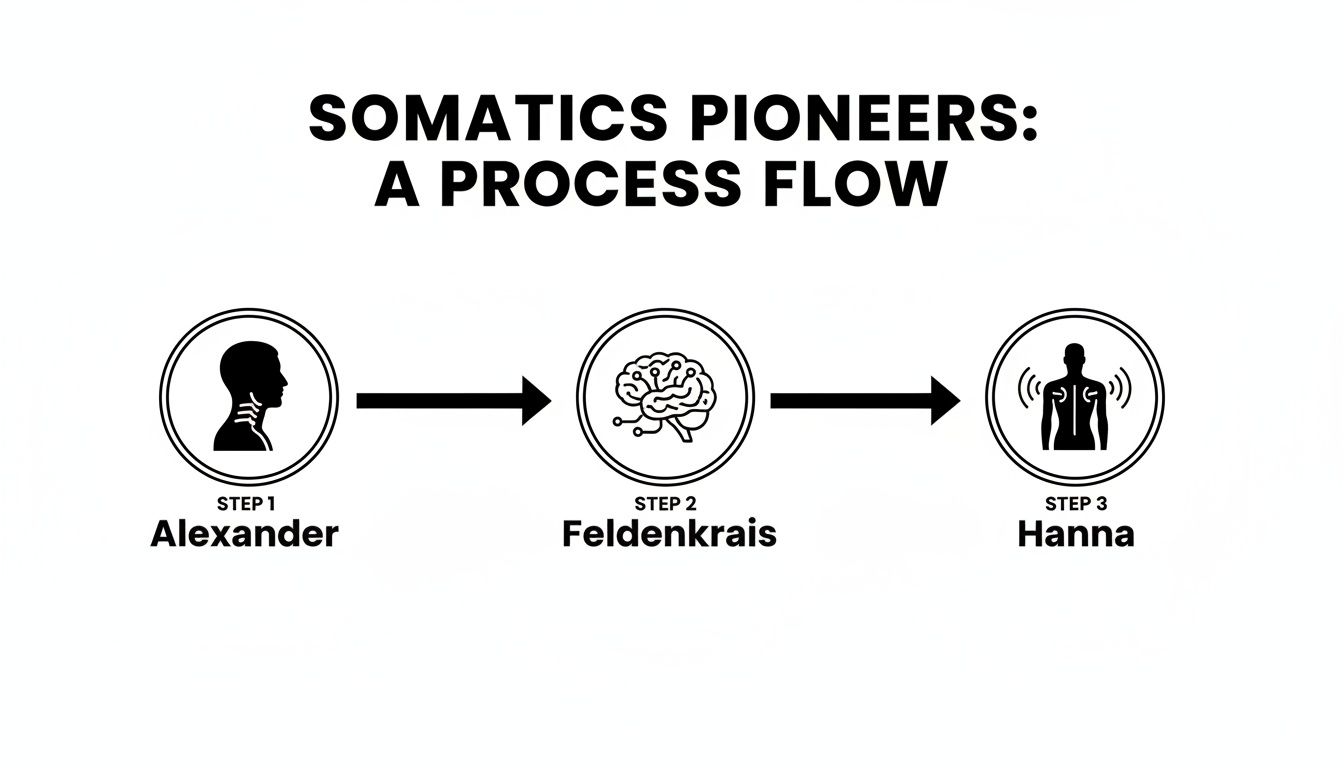
You can really see the evolution here, from Alexander's focus on posture, to Feldenkrais's genius for rewiring the brain through movement, and finally to Hanna's techniques for releasing chronic muscle contraction. It all leads to the refined internal control you're starting to feel right now.
Feeling these movements in your body is one thing, but sometimes having a quick-reference guide helps it all click. Here's a little cheatsheet for the exercises we’ve covered, plus a few other foundational moves you'll encounter.
Think of this table as your pocket guide. When you're on the mat and lose your way, just come back to that "Secret Sauce" cue to reconnect with the feeling of the movement, not just the shape.
This last one is my personal favorite for unwinding at the end of the day. It helps release the rotational tension we hold in our spine and obliques—the kind of tension that can lead to everything from a cranky back to a general feeling of being "stuck."
Still on your back, bring your knees up toward your chest for a gentle hug. Now, open your arms out to the sides in a "T" shape with your palms facing the ceiling. This helps anchor your upper body.
On an exhale, slowly let both knees drop over to your left side. Here's the key: only go as far as is completely comfortable. If your right shoulder starts peeling off the floor, you've gone too far. Back it up. Imagine your torso is a thick washcloth being gently wrung out.
Hold here for a few breaths. Send your awareness into that long, spiraling line of sensation from your right shoulder all the way down to your right hip. To come back, use an inhale and engage your deep core muscles to slowly float your knees back to the center. Then, repeat on the other side.
Somatic movement isn't one-size-fits-all. You have to listen to your body and adjust.
These three movements are a perfect entry point. The most important thing is to approach them with curiosity and kindness. You’re not just doing exercises; you're starting a conversation with your body. And believe me, it has a lot to say.
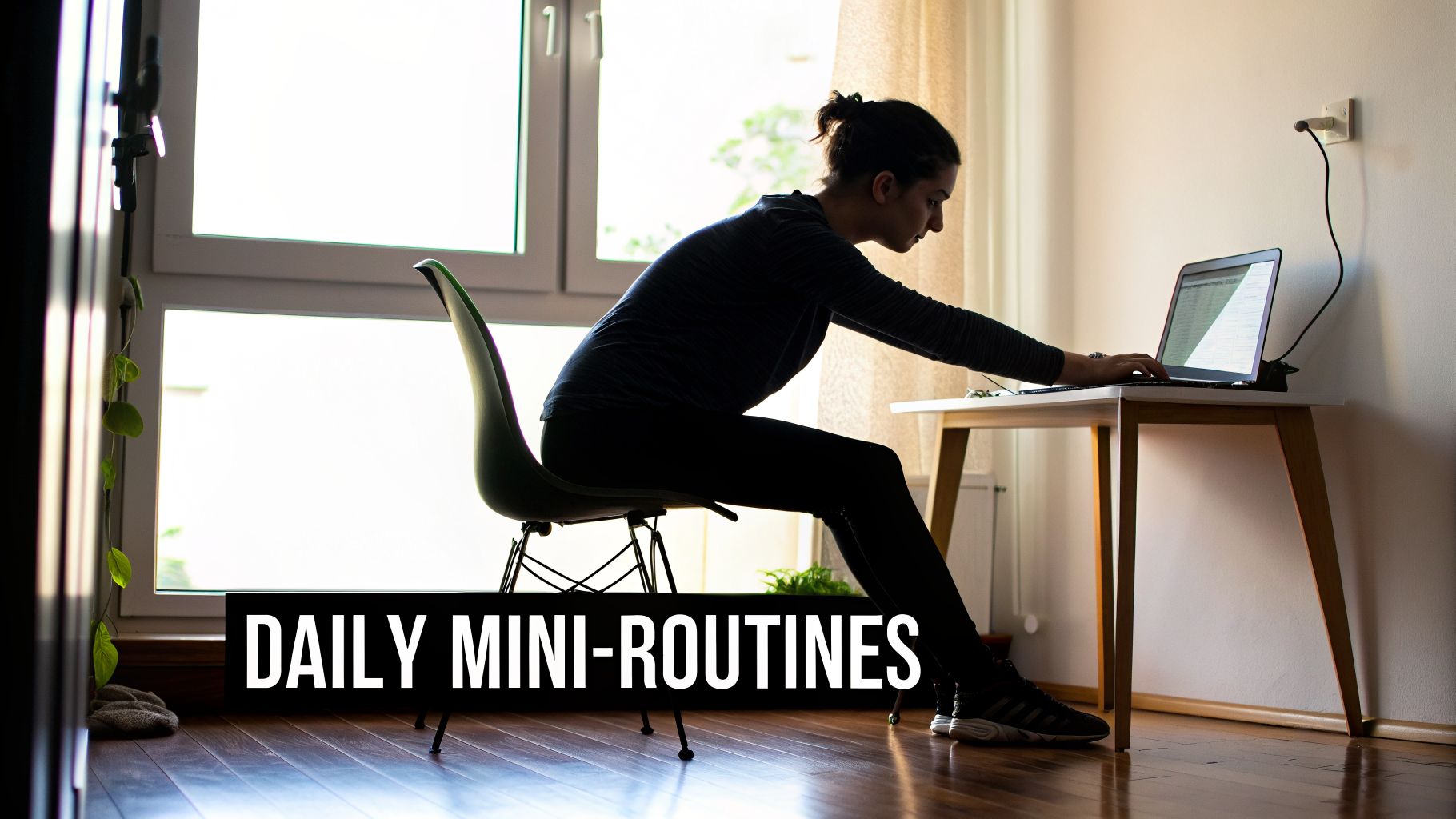
Knowing the individual exercises is great, but the real magic happens when you weave them into the fabric of your day. It’s all about consistency. A few focused minutes, done daily, will do more to rewire your brain-body connection than a single, marathon session once a blue moon.
Let's make this practical. Here are three super-short routines designed to fit into the busiest of schedules, offering an immediate reset button for your body and mind.
Chances are you’re reading this hunched over a screen right now. Let's fix that. This little sequence can be done right in your office chair and is a lifesaver for that creeping "tech neck" and shoulder tension.
This quick flow is a direct antidote to the stiffness that comes from sitting still for too long. In fact, some of the great pioneers of somatics, like Moshe Feldenkrais, developed their methods specifically to undo the damage of modern, sedentary work. His work, developed between 1940 and 1984, is a cornerstone of what we do today, and its power to reprogram these bad habits is incredible. Studies have shown his methods can lead to 60-70% improvements in mobility and posture, especially for adults over 50. You can get a sense of this history by checking out the Somatics page on Wikipedia.
Can't seem to quiet that buzzing in your brain before bed? This simple floor routine is designed to calm your nervous system right down, telling your body it's safe to switch off and get some deep, restorative rest.
This sequence is your nightly invitation to let go. By consciously releasing physical tension, you give your mind permission to unwind, paving the way for better sleep.
Just lie on your back and start with the Arch and Flatten exercise for a minute or two. Then, move into a gentle Washcloth Twist, holding each side for a few long, slow breaths. The real goal here is to feel your body getting heavier and sinking into the floor with every exhale.
Instead of rolling out of bed feeling like the Tin Man, try this gentle flow to wake up your hips and spine. It’s a much kinder way to start the day, helping you feel more fluid and open from the get-go.
Spend a couple of minutes doing slow, mindful Hip Circles while lying on your back. From there, you can move onto your hands and knees for a few rounds of a very deliberate Cat-Cow. These movements awaken the body without any jarring impact. By tuning into your body first thing, you set yourself up for better, more mindful movement all day long. If you like this, our guide on postural awareness exercises is a fantastic next read.
Internal awareness is the soul of somatic movement, no doubt. But what if you could get an expert’s eyes on your form, anytime, anywhere? Believe it or not, modern tech can be your secret weapon, acting as a digital guide to help you fine-tune your practice with incredible precision.
Picture this: you're doing a pelvic tilt and you feel like your hips are perfectly level. Then, an app using AI movement analysis points out a tiny, almost invisible imbalance you couldn't possibly have sensed on your own. This isn't about being nitpicky or finding flaws. It's about getting objective data to sharpen your internal GPS.
This kind of smart feedback is gold for retraining those stubborn, ingrained movement habits. It gives you the subtle, real-time cues that help close the gap between what you think you're doing and what's actually happening, making every moment of your practice count.
For the longest time, somatic work has been a deeply personal, subjective journey. While that internal focus is still the main event, layering in some objective data can be a total game-changer. It helps you confirm what you're sensing or, more importantly, shines a light on the "blind spots" in your body awareness.
Think of it like this:
This feedback loop doesn't replace your inner wisdom—it supercharges it. It provides cold, hard proof that these gentle, mindful movements are creating real, powerful change in your body.
The goal isn't to get a perfect score on an app. It's to use technology as an honest mirror, reflecting subtle patterns back to you so you can make smarter, more mindful adjustments from the inside out.
Bringing technology into the mix is a huge step forward in making somatic practices more accessible and effective for everyone. With a staggering 70% of people dealing with chronic pain, the demand for smart, personalized solutions is through the roof.
The global market for somatic practices is already on track to hit 15 million users across the US, Europe, and Japan by 2025. What's really exciting is that apps offering AI feedback are boosting how often people stick with their practice by 65%. The flexibility gains are also mirroring the 55% historical averages we've seen in traditional hands-on work. To get a sense of the foundations of this work, you can explore the rich history of the somatics field.
By tracking metrics like your flexibility and balance, you not only get a motivational boost but also a much deeper appreciation for your progress. You can take a deeper dive into how posture analysis software works and see how it might fit into your own routine. This fusion of ancient wisdom and modern tech is paving the way for a more efficient, injury-free way of living.
Feeling that little spark of curiosity but also have a few question marks popping up in your head? Totally normal. Stepping into something new always comes with a few "what-ifs" and "how-exactly-does-this-work" moments. I've gathered the most common questions I hear about somatic movement to give you some clear, encouraging answers.
My goal here is to iron out any confusion so you can feel excited and confident about exploring this incredible connection between your mind and body. Let's get into it.
Not quite, and it’s a game-changing distinction! While a yoga class can absolutely be somatic, the fundamental mechanics are different from your typical stretch. Most stretching is about externally pulling a muscle to make it longer. Somatic movement works from the inside out.
You’ll be using gentle muscle contractions and then very slow, mindful releases to essentially reprogram the communication lines between your brain and your muscles. The aim isn't just about becoming more flexible; it's about releasing chronic, subconscious tension and giving your brain better, more efficient control over your body.
Here’s how I like to think about it: Traditional stretching is like yelling at a tight muscle to let go. Somatic movement is more like having a quiet, persuasive chat with your nervous system to convince it that it's safe to release its grip.
When it comes to somatic movement, think consistency over intensity. Seriously. A focused 10-15 minutes every day will do far more for you than grinding through a 60-minute session once a week.
Why is that? Because these frequent, gentle check-ins help your brain constantly reinforce new, healthier ways of moving until they become your new normal. I've had many clients say they feel a drop in tension after their very first session. The bigger, more lasting changes—like better posture and relief from that nagging chronic pain—tend to show up after a few weeks of sticking with it.
Yes, and this is truly where somatic work can be a lifesaver. It’s known for being incredibly gentle, making it a fantastic tool for rehabilitation. The golden rule is to move slowly and never push into pain, which makes it one of the safest practices out there.
Don't forget, many of these methods were originally created to help people recover from serious injuries. That being said, it is absolutely crucial to listen to what your body is telling you and respect its limits.
If you're dealing with any of these situations, please have a conversation with your doctor or physical therapist before you begin:
Nope, and that's one of the best parts! All you really need is a comfortable spot on the floor with enough space to move your arms and legs. A yoga mat, a plush rug, or even a carpeted floor works perfectly—just a little cushioning is nice.
The real magic happens internally, so you can ditch the weights, bands, and fancy props. Just throw on some comfy clothes that let you move and breathe easily, and you're ready to start this inward journey.
Ready to stop guessing and start feeling? The Dalm app uses medical-grade AI to give you real-time feedback on your movements, helping you unlock deeper awareness and get faster results. Try it today and see how it can deepen your practice.