
10 Potent Spatial Awareness Exercises to Refine Your Practice in 2026
Ever feel like you're just going through the motions in a workout, a little wobbly in Tree Pose, or just a tad clumsy in daily life? You're not alone. The missing link isn't just strength or flexibility, it's spatial awareness. This is your brain's internal GPS, the secret sense that tells you where your body is in space without you having to look. It's the magic behind a graceful vinyasa, the stability in a challenging balance pose, and the coordination that keeps you from bumping into things.
But here’s the good news: this isn't an innate talent you either have or don't. Spatial awareness is a skill, and like any skill, it can be sharpened with the right training. Forget generic tips and vague advice. We've compiled 10 potent, practical, and surprisingly fun spatial awareness exercises designed to upgrade your body's navigation system. From simple drills you can do with your eyes closed to dynamic sequences that challenge your coordination, this listicle is your roadmap. We'll explore how each exercise works, who it's for, and how you can integrate smart tools like Dalm's AI-powered pose feedback to track your progress and perfect your form with medical-grade precision. Get ready to move with more confidence, control, and grace than ever before.
Ever wonder if your Warrior II looks less like a fierce warrior and more like a wilting daisy? Enter the humble mirror. Mirror gazing is one of the most direct and effective spatial awareness exercises, offering instant visual feedback on your body's position in space. It’s like having a brutally honest friend who shows you exactly where your hips are rotating or if your shoulders have decided to become earrings.
This technique bridges the gap between how a pose feels and how it actually looks, helping you correct asymmetries and postural quirks you’d otherwise miss. By comparing your reflection to your intended alignment, you begin to build a stronger mind-body connection. Vinyasa practitioners in studios and dancers have relied on this for decades to refine their form and prevent injury.
To get the most out of your mirror time, follow these simple but powerful steps:
This foundational exercise is crucial for developing the self-awareness needed for more complex movements. For a deeper dive into how visual feedback impacts your form, you can learn more about improving your postural awareness and see how it all connects.
Think you’ve mastered Tree Pose? Try it with your eyes closed. It’s the difference between walking on a sidewalk and a tightrope. Closing your eyes forces your brain to switch off its visual autopilot and tune into its other spatial sensors: proprioception (your internal sense of body position) and the vestibular system (your inner ear’s balance center). This is one of the most powerful spatial awareness exercises for building a rock-solid internal GPS.
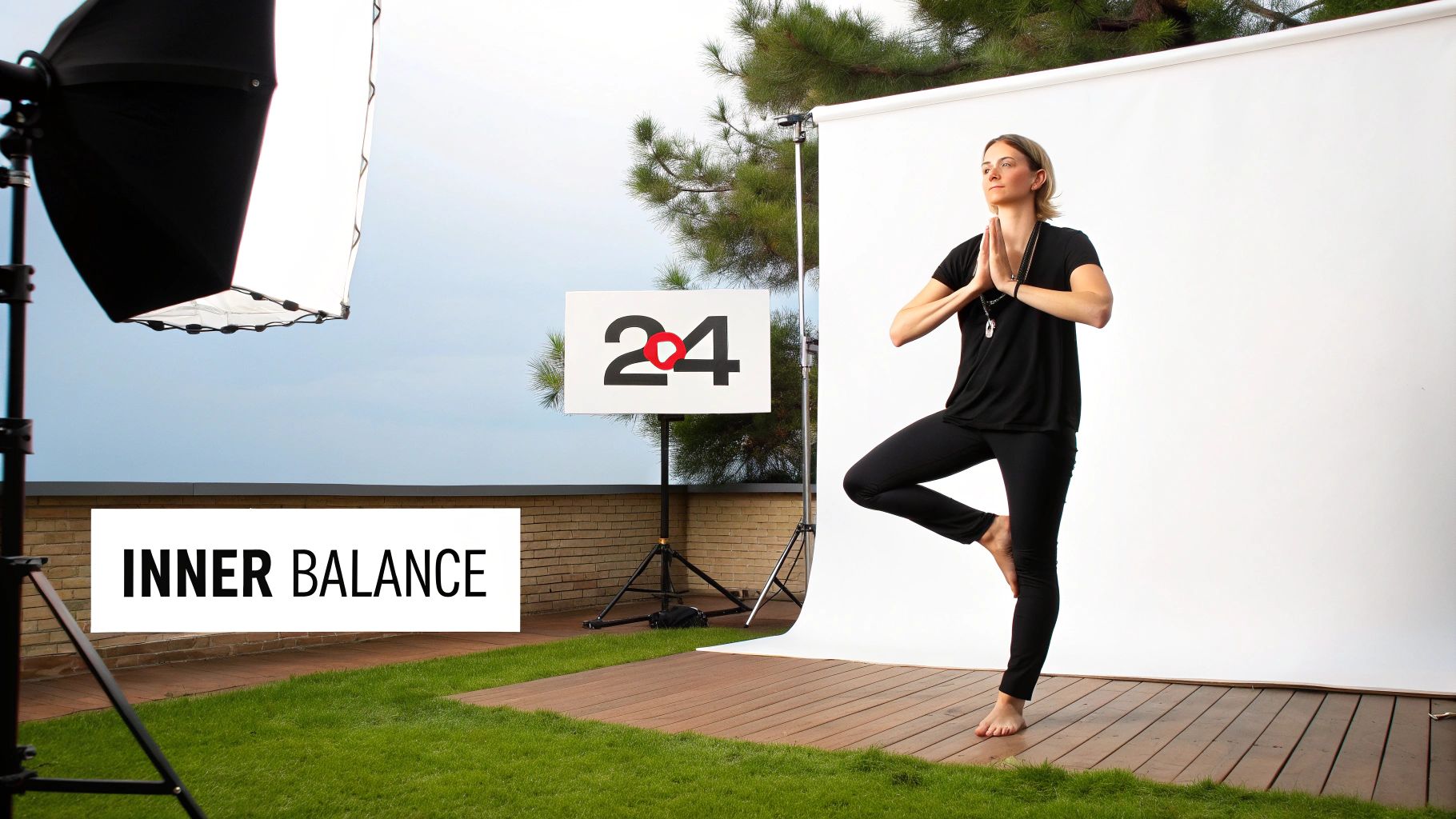
By removing visual feedback, you’re no longer just doing the pose; you’re truly feeling it. Every tiny wobble and correction becomes a conversation between your brain and your body. This technique is a staple in everything from advanced yoga classes and professional dance training to physical rehabilitation programs for balance disorders, proving its effectiveness across disciplines.
Ready to embrace the wobble? Here’s how to do it safely and effectively:
This exercise is less about achieving perfect stillness and more about learning to navigate instability. For those starting their balance journey, building a strong foundation is key. You can explore a variety of foundational postures with these yoga balance poses for beginners before you take the leap into the dark.
Ever feel like your living room yoga practice is just a series of disconnected poses? What if you could turn it into a graceful dance, intentionally navigating the space around you? That's the magic of directional flow sequences. This exercise involves moving through poses in specific patterns: forward, backward, side-to-side, and diagonally, transforming your mat into a compass. It’s less about just hitting a pose and more about the mindful journey between them.
Popularized by vinyasa instructors and movement therapists, this practice forces you to think about your body as a vehicle moving through a three-dimensional world. By tracing imaginary lines with your movements, you're not just doing yoga; you're actively mapping your surroundings, enhancing your ability to navigate space with grace and precision. This is a key skill for athletes, dancers, and anyone looking to move with more intention and less accidental furniture-kicking.
To turn your practice into a spatially aware masterpiece, try these focused tips:
This exercise is one of the best spatial awareness exercises for transforming static positions into a dynamic, intelligent practice. It trains your brain to think several steps ahead, planning your body's route through space.
If you’ve ever tried to high-five someone and completely missed, you know that interacting with others in space is a skill. Partner mirroring takes the solo act of self-correction and turns it into a dynamic, responsive duet. This exercise involves two people facing each other, where one leads slow, deliberate movements and the other acts as a living reflection, mimicking every action in real-time. It’s a fantastic way to improve spatial awareness exercises by forcing you to translate visual cues into immediate physical action.
This collaborative practice trains your brain to process spatial relationships not just with inanimate objects, but with another moving person. It sharpens your ability to judge distance, depth, and symmetry on the fly, a skill crucial in everything from partner yoga to navigating a crowded room. Popularized in couples yoga, acro-yoga foundations, and even team-building workshops, it builds a powerful connection between external observation and internal body control.
Ready to find your movement twin? Follow these steps for a successful mirroring session:
Ready to graduate from simply balancing with your eyes closed to actually moving through space without your sight? Blindfolded navigation flows are the ultimate test of your internal GPS. This exercise involves performing a pre-planned sequence, like a yoga flow, while blindfolded. You're forced to rely purely on proprioception, muscle memory, and your mental map of the room to move from one pose to the next.
This advanced practice takes the training wheels off your spatial awareness. Unlike static, eyes-closed poses, this method challenges your ability to dynamically orient and move your body through a defined space. Advanced yoga practitioners and sensory awareness coaches use this to build an unshakeable connection between mind and movement, forcing the brain to create a highly detailed, non-visual blueprint of the body.
Safety is paramount here. This isn't the time to be a hero, so follow these steps to build your skills safely:
Ever tried to stand on one leg and felt like a Jenga tower on the verge of collapse? That delightful wobbling sensation is your brain working overtime on its spatial awareness. Asymmetrical pose holds, like Warrior III or Half Moon, intentionally throw your body off-balance, forcing your nervous system to make constant micro-adjustments to keep you upright. It’s a brilliant way to train your body’s sensitivity to subtle spatial shifts.
This method forces you to become keenly aware of how your weight is distributed and where your limbs are without looking. Physical therapists and balance coaches use these exercises to enhance stability and prevent injuries, as they directly challenge and improve your proprioceptive feedback loop. The goal isn't perfect stillness but controlled stability within the imbalance.
To turn your teetering into triumph, focus on these key strategies:
Ever tried to nail a complex yoga transition in your mind before your body even attempts it? That’s spatial mapping, and it's one of the most powerful spatial awareness exercises available. You close your eyes and mentally rehearse movements, activating the same neural pathways as physical practice without lifting a finger. It's like having a full-dress rehearsal on the stage of your mind.
This technique is a secret weapon for elite performers, from Olympic gymnasts visualizing a flawless routine to dancers mentally choreographing a sequence. By creating a detailed internal map of your body, its position, and the surrounding environment, you’re essentially programming your nervous system for success. It builds a profound connection between intention and execution, making physical movements feel more intuitive and precise.
Ready to build your mental blueprint? Here are the steps to effectively map your movements:
Think your Tree Pose is solid? Try it on a sandy beach or a wobbly balance disc. Suddenly, your trusty yoga mat feels like a luxury cruise ship. Variable surface practice is one of the most effective spatial awareness exercises because it throws your body a curveball, forcing it to adapt to unpredictable environments. Your nervous system goes into overdrive, making constant micro-adjustments to keep you from face-planting.
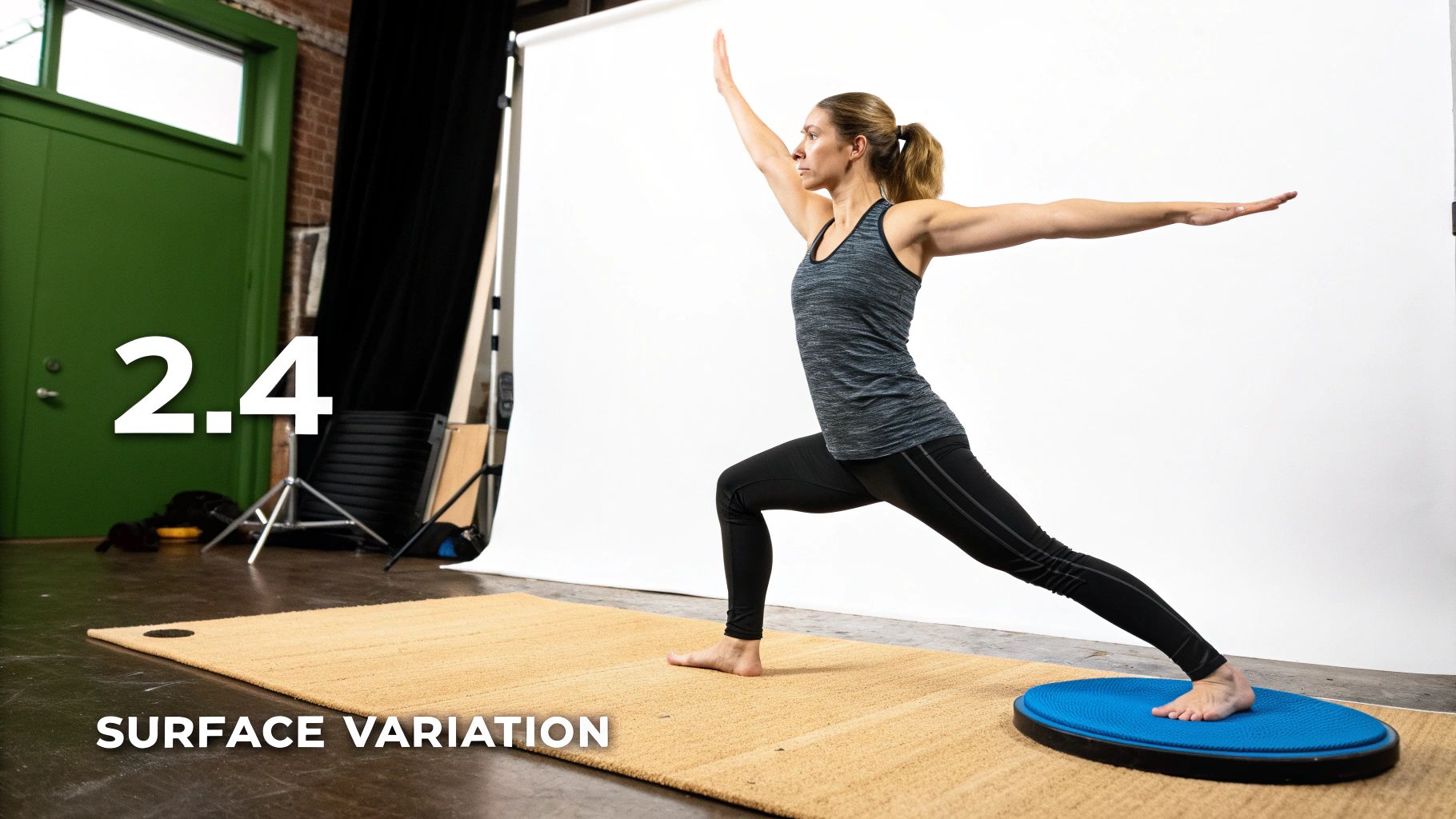
This method takes your training from the sterile studio environment to the chaos of the real world. By challenging your balance on different textures and stabilities like grass, wobble cushions, or uneven ground, you are directly training your proprioceptive system. Popularized by athletic trainers and functional movement specialists, this practice builds a resilient and adaptable sense of body awareness that translates far beyond the mat.
Ready to challenge your stability? Follow these steps to safely incorporate variable surfaces into your routine:
This exercise is a powerful way to enhance your body's internal GPS. For a deeper understanding of how this works, you can explore the fundamentals of what proprioception training is and its impact on movement.
Think life is all forward and backward? Think again. Most of our movement is multi-dimensional, yet we often train in straight lines. Rotational and spiral sequences throw a wrench in that linear thinking, forcing your brain and body to work together as you twist, turn, and spiral through space. This is where you truly test your internal GPS, moving beyond simple up-down or left-right awareness.
These dynamic flows, common in Vinyasa yoga and dance, challenge you to maintain balance and alignment while constantly changing your orientation. By practicing movements like twisted lunges or revolving chair poses, you’re not just stretching; you’re actively mapping your body’s position across multiple planes of motion (horizontal, sagittal, and frontal) all at once. It's a fantastic way to build the kind of robust spatial awareness exercises need to translate from the mat to the real world, whether you're a figure skater, a dancer, or just trying not to bump into furniture.
Ready to add a new dimension to your practice? Here’s how to do it safely and effectively:
Ever tried to step over an obstacle and completely misjudged the distance, resulting in an unflattering stumble? That’s your depth perception needing a tune-up. Depth perception and distance estimation drills are fantastic spatial awareness exercises that train your brain to accurately judge the space between you, your limbs, and the objects around you. It’s the difference between gracefully navigating a crowded room and bumping into every table along the way.
This practice hones your visual-spatial processing, a skill crucial in everything from martial arts to simply parallel parking. By consciously estimating distances before moving, you’re essentially calibrating your internal ruler. Dancers use this to maintain formation without collisions, while martial artists rely on it for precise strikes, proving that mastering your personal space is a powerful skill.
To sharpen your spatial judgment, incorporate these targeted drills into your routine:
You've just navigated a comprehensive toolkit of 10 powerful spatial awareness exercises, each a unique key to unlocking a deeper connection between your mind and body. We've journeyed from the foundational self-correction of Mirror Gazing to the advanced sensory challenges of Blindfolded Navigation and Depth Perception Drills. The path to a refined spatial sense isn't about tackling all ten at once; it's about choosing your adventure.
Think of these exercises not as a checklist, but as a menu of opportunities. Your goal is to weave them into the fabric of your existing routines, creating a richer, more mindful practice. Start small. Perhaps this week, you dedicate five minutes to the Eyes Closed Balance Poses, noticing the subtle shifts and corrections your body makes without visual cues. Next week, you might introduce a Partner Mirroring Exercise, discovering a new layer of non-verbal communication and synchronized movement.
The real magic happens with consistent, intelligent application. It's in the moments you realize you can hold an Asymmetrical Pose with newfound stability, or when you navigate a familiar space with your eyes closed and feel a sense of confident familiarity. These aren't just party tricks; they are tangible upgrades to your body's internal GPS.
This enhanced awareness translates directly into everyday life and athletic performance.
Mastering these spatial awareness exercises is an ongoing journey of discovery. The initial awkwardness of a new drill soon gives way to competence, and competence evolves into intuitive mastery. The key is to embrace the process, celebrate small victories, and stay curious about what your body can achieve. Notice how practicing on a variable surface makes your standard yoga mat feel like a rock-solid foundation, or how a simple visualization drill makes your rotational movements feel smoother and more integrated.
This isn't just about improving your balance or coordination; it's about fundamentally changing how you interact with the world around you. You become more present, more grounded, and more capable in every physical endeavor. You’re not just moving through space; you are consciously and skillfully commanding your presence within it. So, pick an exercise that sparks your interest, commit to exploring it, and prepare to unlock a level of physical intelligence you never thought possible.
Ready to stop guessing and start knowing? The Dalm AI coach provides real-time feedback on your alignment and form during these exact spatial awareness exercises, turning your practice into a precise, data-driven journey. Track your progress, eliminate bad habits, and accelerate your mastery by visiting Dalm to see how AI can transform your movement.