
What Is Active Stretching: what is active stretching for mobility
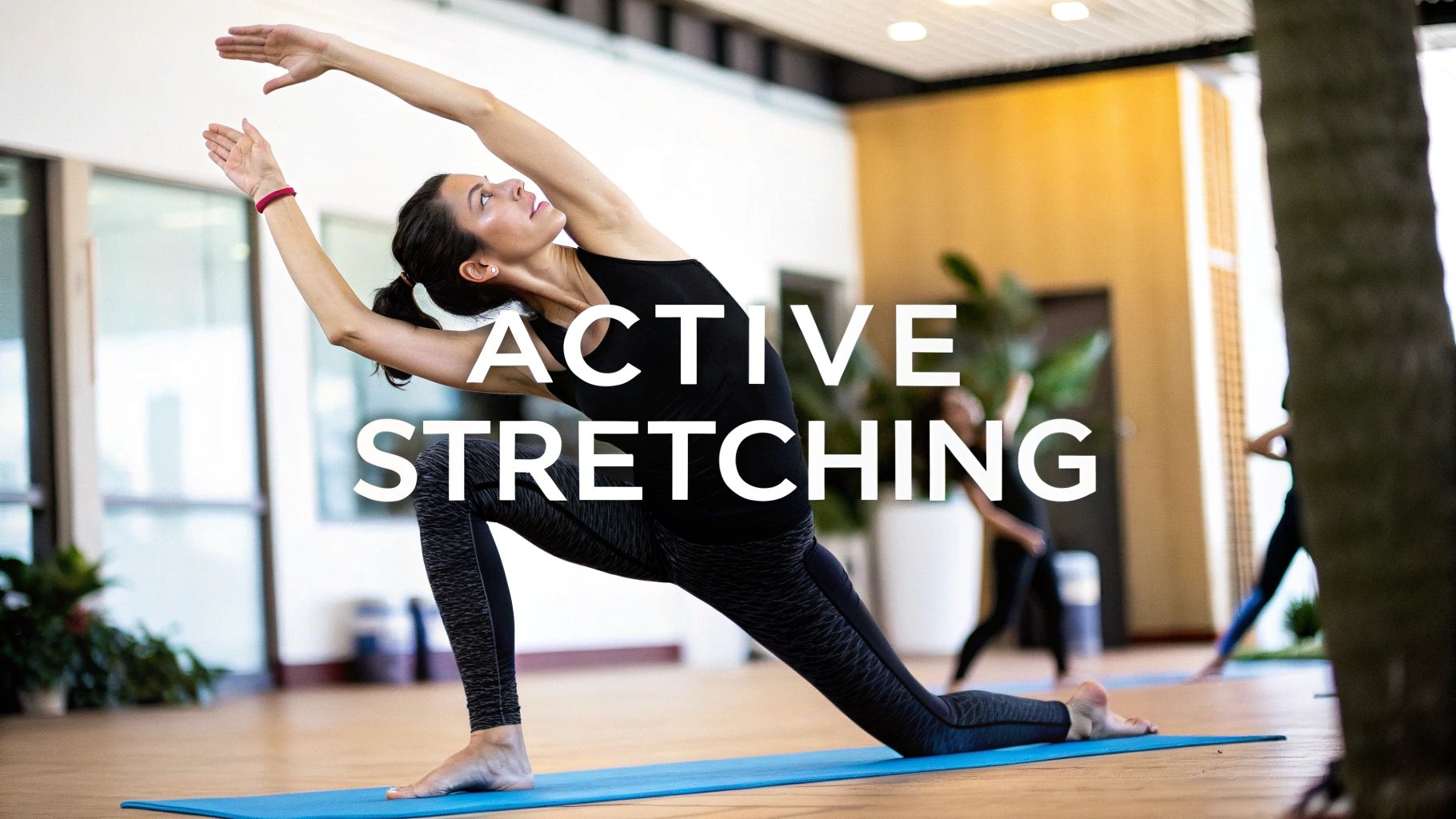
Tired of yanking on your limbs, hoping for a little more give? What if I told you there’s a smarter way to get flexible—one that uses your own body’s strength to unlock new ranges of motion, no props required?
Welcome to the world of active stretching. This isn't your old-school, grin-and-bear-it kind of stretching. Instead, you use one muscle group to stretch its opposite. It’s like turning your body into its own personal trainer, creating flexibility through controlled muscular effort instead of just yanking on things.
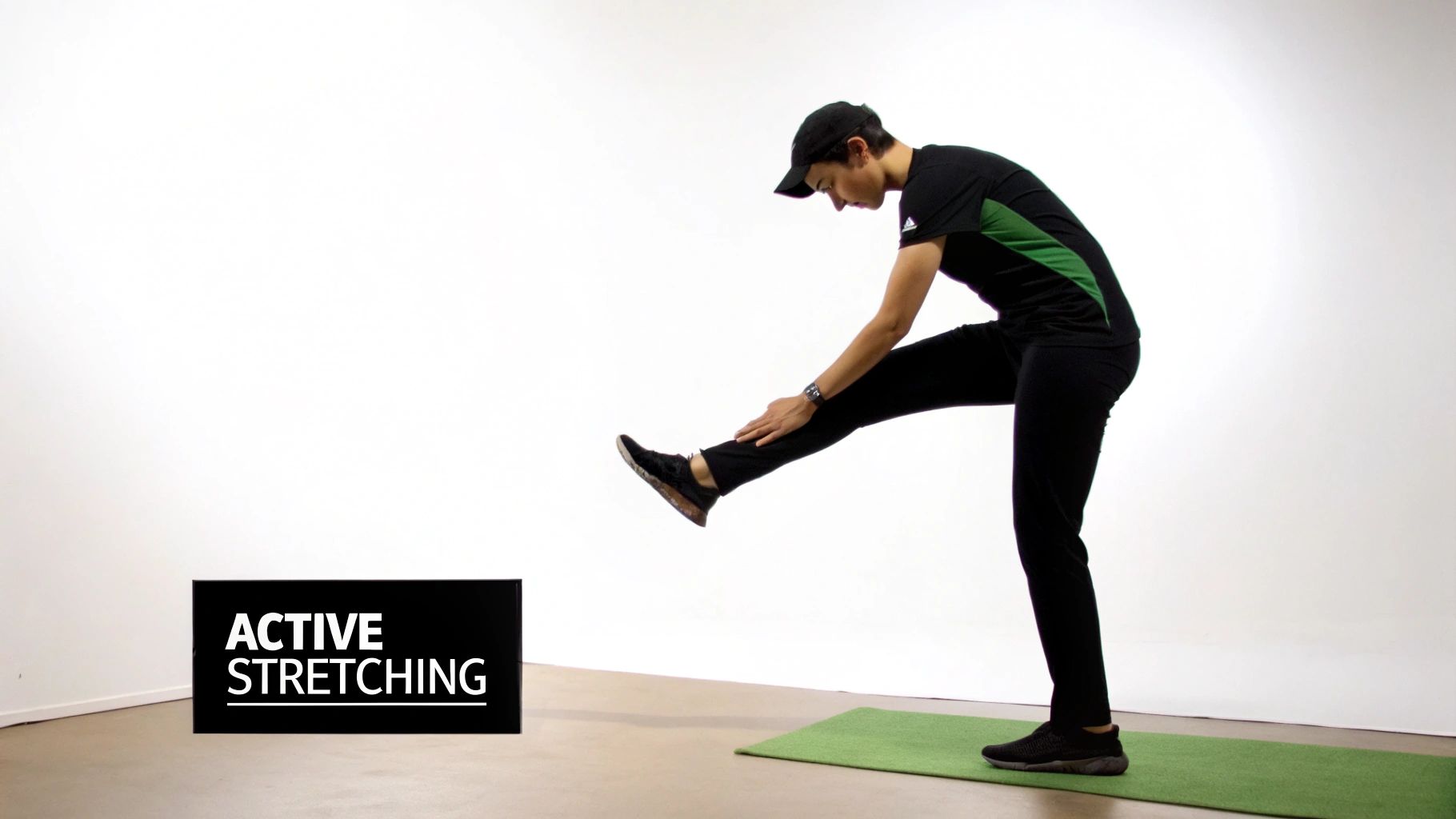
Forget the painful pulling and awkward positions you might associate with stretching. Active stretching completely flips the script. Rather than forcing a muscle into submission, you're cleverly convincing it to relax by putting another muscle to work.
Think of it as a friendly tug-of-war happening inside your body. To stretch your hamstrings (the muscles on the back of your leg), you actively contract your quadriceps (the muscles on the front). This sends a neat little signal to your brain that tells the hamstrings, "Hey, the quads are on duty, you can take a break!" This neurological trick is the secret sauce.
To get a quick handle on the concept, here’s a simple breakdown.
It’s an elegant system that works with your body's natural wiring, not against it.
This approach has been gaining some serious love since the early 2000s, especially with athletes and yogis. Why? Because it builds functional flexibility—the kind you can actually use in real life. It’s one thing to be able to pull your leg up to your ear with your hands, and another to lift it there with muscular control.
A fascinating 2014 study highlighted that while active stretching is a champ at increasing your range of motion, it can cause a temporary dip in muscle strength—about 10-15%—right after a session. This makes it a fantastic tool for a cool-down, but maybe not the best idea right before you try to hit a new personal record in the gym. You can dig into the science behind this on Greatist.com.
So, what does this look like in practice?
This method does more than just lengthen your muscles; it strengthens them at the same time. You're teaching your body to support its own flexibility, which is a massive win for improving stability, preventing injuries, and building a much deeper mind-muscle connection. It's a foundational concept when you're exploring how to improve flexibility.
Active stretching isn’t about how far you can go; it’s about how much control you have on the journey. You are both the mover and the stabilizer, building strength and flexibility in perfect harmony.
This technique is particularly amazing in yoga, where many poses demand you hold a position using nothing but your own strength. It transforms a simple pose into a dynamic expression of balance and control, making your practice smarter, safer, and way more effective.
Active stretching feels like a bit of a magic trick, but it's not sorcery—it's just brilliant biology. To really get what’s happening, we need to peek under the hood at your body’s internal wiring. It’s an elegant system that lets you build flexibility and strength at the same time, all thanks to a cool little neurological process.
Think of your muscles as dance partners working in pairs. On either side of any given joint, you have an agonist (the muscle doing the work, or contracting) and an antagonist (the muscle that has to relax and lengthen). They have a simple, unbreakable agreement: when one decides to lead, the other has to follow.
This perfect partnership is managed by a principle called reciprocal inhibition. It’s basically your nervous system's built-in safety net, preventing you from trying to flex both muscles at once, which would end in a painful stalemate.
Here’s a simple way to picture it: imagine your agonist and antagonist muscles are wired to the same light switch. When you flip the switch on for your agonist, the circuit automatically tells the antagonist to dim its own light. It doesn't shut it off completely, but it signals it to ease up, release tension, and just get out of the way.
So, when you do an active hamstring stretch by lifting your leg straight out in front of you, you're firing up your quadriceps (the agonist). That simple action sends a nerve signal telling your hamstrings (the antagonist) to chill out and lengthen.
Reciprocal inhibition is the secret sauce that makes active stretching work so well. By consciously contracting one muscle, you send an automatic, unconscious signal for the opposing muscle to relax. This lets you go deeper into the stretch safely.
This isn’t just a limp, passive lengthening. It’s a smart, coordinated effort orchestrated by your central nervous system. This same process is what allows for smooth, controlled movements in everything you do, whether you're walking down the street or holding a tricky yoga pose.
The beauty of reciprocal inhibition doesn't stop with a good stretch. While the antagonist muscle is getting a nice release, the agonist muscle is actively contracting, working hard, and building strength. This is the game-changer that sets active stretching apart from other methods.
This dual-action process is a powerhouse for your body:
This heightened sense of bodily awareness is tied directly to proprioception—your body's ability to know where it is in space. You can dive deeper into this with our guide on what proprioception training is and how it sharpens your movement skills. In short, you're not just stretching a muscle; you're upgrading your body's entire operating system.
Every active stretch is a mini-lesson in control. You're teaching your body how to support itself in a deeper range of motion without leaning on external forces like gravity or a yoga strap. This creates what we call functional flexibility—flexibility you can actually use in real-world movements, which is the bedrock of a strong, resilient yoga practice.
When you think about stretching, what's the first thing that comes to mind? Probably grabbing your foot and pulling it toward your glute, or leaning over to touch your toes, right? That classic “pull-and-hold” style is what most of us know, but it's just one player in the flexibility game.
Let's pit two of the heavyweights against each other: active stretching and its more famous cousin, passive stretching. Understanding how they work is the secret to unlocking a truly effective flexibility routine.
Imagine you're trying to stretch your hamstrings. In a classic passive stretch, you might fold forward and let gravity do the work, or maybe you'd use a yoga strap to gently pull your leg closer to you. You're essentially the passenger here; an external force is the driver, coaxing the muscle to lengthen. It feels relaxing, takes minimal effort, and is brilliant for increasing your static range of motion after a workout.
Now, let's flip the script and try an active stretch. Lie on your back and lift one leg straight up toward the sky, using only the power of your quads and hip flexors to pull it up and hold it there. No hands, no straps, no help. It’s all you. In this version, you're the driver, contracting one set of muscles to stretch another.
The big difference here is where the stretching force comes from. Passive stretching relies on an outside helper (gravity, a strap, a partner), while active stretching generates the force from within your own body. This isn't just a tiny detail—it changes everything about the stretch's purpose and what it does for you.
This is all thanks to a neat little trick your nervous system performs called reciprocal inhibition. It’s the magic behind every active stretch.

As you can see, when you actively switch on one muscle, your brain automatically tells its opposing partner to relax. This allows for a deeper, safer stretch without any forceful pulling.
To avoid any confusion, let’s throw a third contender into the ring: dynamic stretching. This is your leg swings, arm circles, and walking lunges. Dynamic stretching is all about movement, using controlled momentum to take your joints through their full range of motion.
While it's technically an "active" process (you are moving your own body, after all), its main job is to get your blood pumping and warm up your muscles for the main event. Active stretching, on the other hand, is about holding a position at your end range for a short period (usually 10-15 seconds) using pure muscle power. The focus is less on momentum and more on building strength and control right at the edge of your flexibility.
Think of it like this: Dynamic stretching is the peppy warm-up lap before a race. Active stretching is the focused strength training that also happens to make you more flexible.
So, who wins the showdown? The truth is, they all do. There’s no single "best" type of stretching—it all comes down to what you're trying to achieve. Choosing the right tool for the job is what gets results.
This handy table breaks down the key differences to help you pick your champion for any given situation.
By understanding these nuances, you can stop just stretching and start training for flexibility with real intention. Use dynamic movements to get the engine running, active stretches to build usable strength and mobility, and passive stretches to cool down and recover. It's not about picking one winner; it's about building a whole team of champions.
Forget everything you think you know about stretching. We're about to go way beyond simply lengthening muscles. This is where we rewire your entire approach to movement, turning flexibility from a passive trait into an active skill. This isn't just about becoming more bendy; it's about becoming more capable, powerful, and resilient in everything you do, from nailing a tricky yoga pose to just picking up your groceries without a groan.
Active stretching is all about building what we call functional range of motion. It’s the kind of flexibility you can actually use and control. Think about the difference between someone yanking your leg up high versus you lifting it there smoothly, all on your own. That’s the magic right there—usable strength at your limits.
By deliberately strengthening the muscles that support your joints at their end ranges, you’re basically building a biological scaffold from the inside out. This internal support system creates stability right where you need it most, making you far less likely to suffer from annoying strains and sprains.
One of the best things about active stretching is how it armors your body against injury. Instead of just passively tugging on tendons and ligaments, you’re actively teaching your muscles to be strong and stable through their entire length. This is a total game-changer for long-term joint health.
Imagine a suspension bridge. Its incredible strength comes from perfectly tensioned cables working in harmony, not from a bunch of floppy ropes. Active stretching does the same for your body, making sure the muscles around a joint are fired up and ready to handle whatever you throw at them. This dynamic stability is your best defense against the sudden, wonky movements that so often lead to injury.
But it’s not just about the muscles. This method fine-tunes the very conversation happening between your brain and your body.
When you actively contract one muscle group to stretch another, you're sharpening your neuromuscular pathways. You're building a smarter, more responsive body that can react with incredible precision and control.
Ever go through a workout and feel like you’re just moving, not actually engaging the right muscles? Active stretching is the perfect fix. It forces you to consciously turn on specific muscles, waking them up and priming them for action.
This improved muscle activation sends a ripple effect through your performance. When the right muscles are firing at the right time, your movements become more efficient, powerful, and coordinated. This is mission-critical in disciplines like yoga, where holding a pose like Warrior III requires pinpoint engagement from your glutes and core, not just sheer, wobbly willpower.
And this isn't just theory—the science backs it up. A 2012 review showed that active stretches can boost your immediate range of motion by 10-20% more than old-school static holds. Plus, experts generally agree that the functional flexibility you build can slash injury odds by 15-20% for many people. If you want to dive deeper into the science, you can start by exploring the research on active vs. passive stretching.
At the end of the day, active stretching is so much more than a warm-up or a cool-down. It’s a powerful form of movement intelligence training that teaches your body to work as one cohesive, graceful, and seriously powerful unit.
Alright, enough with the theory of agonists and antagonists—let's actually get moving! Knowing the why is great, but the real magic happens when you put it into practice. Think of this as your hands-on guide to active stretches that don't just lengthen muscles, but build real strength and control from the inside out.
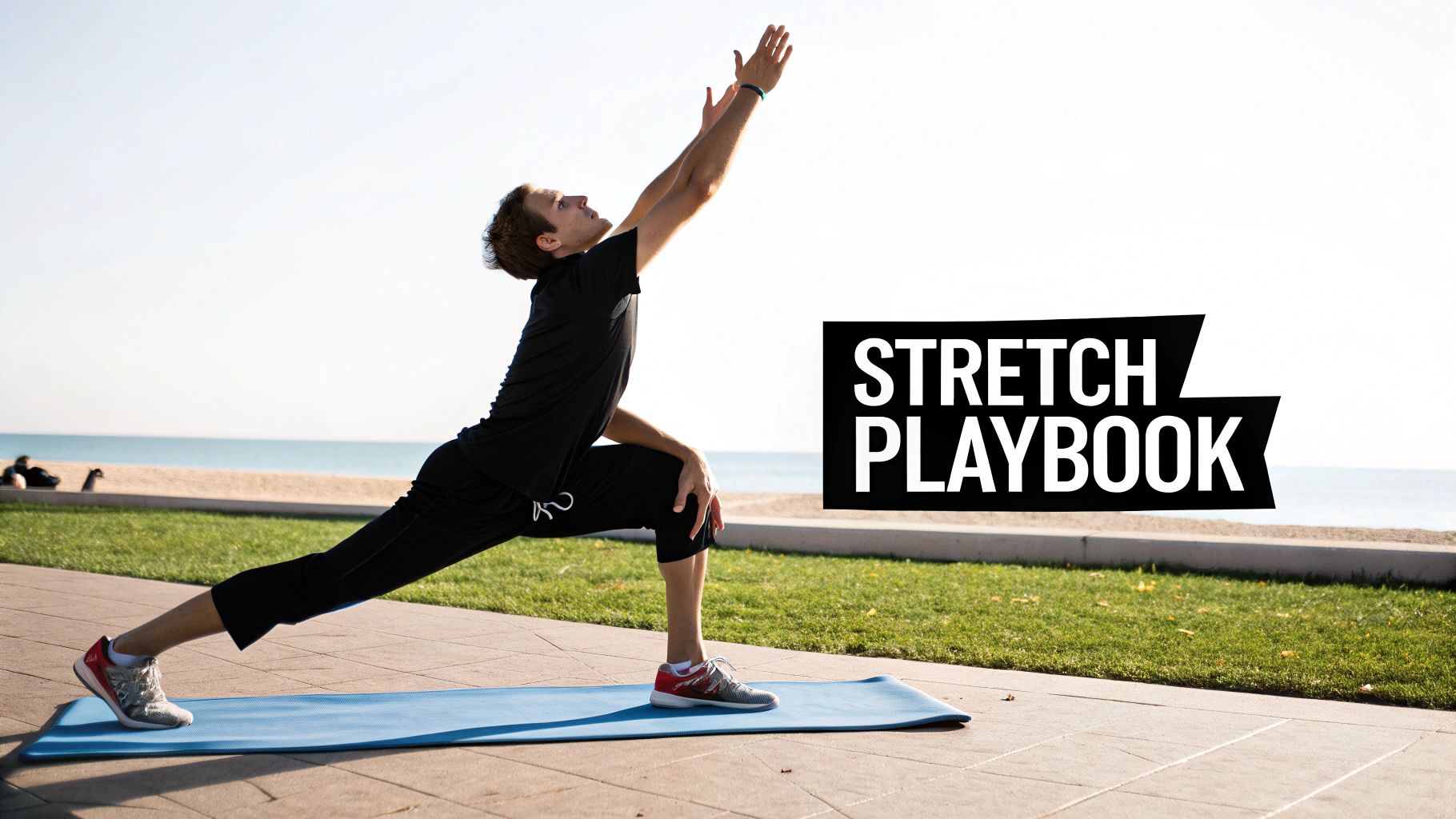
We're going to dive into a few foundational movements that hit some major muscle groups. The name of the game here is controlled, intentional effort—not forcing anything. Your entire focus should be on squeezing one muscle to feel that sweet, gentle release in its counterpart.
Here are a few powerhouse moves to get you started. For each one, aim for a 10-15 second hold at the peak of the contraction. Let it go, then repeat for 5-8 reps on each side.
1. The Standing Leg Lift (Hamstrings & Quads)
This is the poster child for an active hamstring stretch. It’s simple but incredibly effective.
2. The Glute Bridge March (Hip Flexors & Glutes)
This one is a champ for waking up your glutes and telling your tight hip flexors to take a break.
3. The Wall Angel (Chest & Back)
If you spend your days hunched over a desk, this move is your new best friend. It’s a miracle worker for tight chest muscles and slumpy posture.
You don't need an hour to weave active stretching into your day. Here are two quick-and-dirty routines you can try today.
The 5-Minute Morning Mobilizer
Forget the snooze button. Start your day by waking up your body and your brain with this snappy sequence.
- Standing Leg Lifts (5 reps per side)
- Glute Bridge March (5 reps per side)
- Wall Angels (8 reps)
This little circuit gets the blood flowing and preps your muscles for whatever the day throws at you. For a more comprehensive routine before a yoga class, take a look at our guide to essential yoga warm-up exercises.
The 10-Minute Post-Yoga Cool-Down
After a solid yoga session, this routine helps lock in your gains in both flexibility and strength. Active stretching is brilliant here because it boosts blood flow, which can slash that post-workout soreness. Think of it as kickstarting your recovery—this enhanced circulation might even trim recovery time by 15-25% compared to just collapsing on the couch.
Even better, a 2015 trial found that 75% of participants improved their spinal alignment after just six weeks of active routines, which reduced their chronic back pain by a whopping 28%. You can dive into the fascinating science behind these benefits and learn more about posture and recovery.
Ever wondered what separates a wobbly Warrior III from one that looks like it’s carved from stone? The secret isn't just about balance; it’s the hidden power of active stretching, and it’s a total game-changer for your yoga practice. This technique is the engine room behind many of yoga’s most demanding poses.
Think about holding Half Moon Pose (Ardha Chandrasana). It’s not about passively letting your leg flop open. It’s a dynamic, powerful action where you actively fire up your glutes and outer hip muscles to lift your leg. That strength is precisely what allows your inner thigh muscles to lengthen.
That’s active stretching in its purest form—strength creating flexibility. This is where you bridge the gap between simply knowing a pose and truly embodying it. You’re creating stability and control from within, not just chasing a deeper range of motion without any support.
Of course, understanding this concept is one thing. Actually applying it correctly on the mat? That’s a whole different ball game. It's surprisingly easy to cheat in a pose by relying on momentum or using the wrong muscle groups. This is where modern tech can give you a serious edge, helping you nail the subtle mechanics of active stretching in your yoga flow.
The Dalm app is like having a personal AI coach with an incredibly precise eye watching your every move. Using its advanced pose analysis, Dalm provides real-time voice feedback to guide you toward correct alignment and muscle engagement.
Dalm provides medical-grade precision to help you master your form. It analyzes your pose and gives you specific, actionable cues, like "engage your glutes more" or "lift from your inner thigh," turning abstract concepts into concrete actions.
This isn’t just about making the pose look pretty for Instagram. It’s about forging the neuromuscular connections that make your practice safer and way more effective.
Dalm’s AI feedback system essentially teaches you active stretching as you move. It helps you pinpoint exactly which muscles you need to contract to hold a pose with integrity, and which ones can relax into the stretch. This is crucial for avoiding common missteps, like using your lower back to hoist your leg up instead of your glutes.
By giving you instant, personalized guidance, Dalm takes the guesswork out of the equation. You learn to feel the right muscles firing, which accelerates your progress and builds a more intelligent, intuitive practice. It finally connects the dots, transforming your understanding of active stretching from a cool theory into a powerful skill that will supercharge every single session on the mat.
Alright, so you get the theory behind active stretching. But when the yoga mat is rolled out and it’s time to actually do it, some questions always seem to pop up. Let's get into the nitty-gritty and clear up the common "how-tos" and "what-ifs."
Think of this as your quick-and-dirty FAQ to using this technique like a pro.
If you’re used to static stretching, your brain is probably telling you to hold that stretch for 30 seconds, maybe even a minute. Time to unlearn that habit! With active stretching, it's all about quality over quantity.
The sweet spot is a 10 to 15-second hold for each rep. The real magic isn’t in hanging out at the end range; it’s in the work your muscles are doing to get you there and keep you there.
Instead of one long, grueling hold, you'll do several shorter reps. Think about doing 5-10 repetitions on each side, focusing on that crisp muscle contraction, the stretch it creates, and then the release.
You bet! This is one of the best things about it. Since you're using your own muscle power instead of yanking on a limb or using a prop, it's incredibly safe and gentle on your body. It doesn’t create the same micro-tears or stress on your tissues that an aggressive passive stretch can.
It’s like a daily check-in with your body, a way to keep everything firing properly. It's fantastic for:
Of course, the number one rule always applies: listen to your body. If you feel anything sharp or pinching, back off. No exceptions.
Ah, the classic question. It's like asking if a hammer is better than a screwdriver. They’re both great tools, but you wouldn’t use one to do the other’s job.
For a warm-up, active stretching is the undisputed champ. It gets blood pumping, wakes up the exact muscles you're about to use, and improves the range of motion you can actually control. It's the perfect pre-game prep.
Static stretching, on the other hand, is your cool-down hero. It’s perfect for after your workout when you want to signal to your nervous system that it’s time to chill out, release any leftover tension, and gently encourage long-term flexibility. A smart, well-rounded routine uses both, playing to their individual strengths.
Ready to stop guessing and start mastering your yoga practice with perfect form? Dalm uses AI-powered pose analysis and real-time feedback to guide your muscle engagement, helping you build strength and flexibility safely. Discover how it can transform your practice at https://dalm.co.