
What Is Body Alignment And How Can You Master It

Let's talk about body alignment. Forget the dry, textbook definitions. At its core, alignment is simply how your body parts—your head, spine, hips, and limbs—stack up to work together efficiently and keep strain at bay.
Think of it as your body's personal architectural blueprint. It's the key to making sure everything from your bones to your muscles is supported just right, setting you up for peak performance and a long, healthy life.
Imagine your body is a skyscraper. For that building to stand tall and strong against the elements, its foundation and frame have to be perfectly lined up. Even a tiny deviation in the architect's plan can create stress points, eventually weakening the entire structure. Your body operates on the exact same principle.
When you're properly aligned, your whole system just works better. This isn't just about your mom telling you to stand up straight. It's about creating a beautiful, harmonious balance where you can move with ease, your weight is distributed evenly, and you're not putting unnecessary wear and tear on your joints.
Our ancestors were always on the move, but our modern lives have us glued to screens in some pretty funky positions. Spending hours hunched over a laptop or slouched on the couch slowly but surely pulls our bodies out of that ideal blueprint. This constant misalignment can trigger a whole host of problems, from chronic neck pain and nagging headaches to reduced mobility and even issues with breathing.
It's no surprise that sedentary lifestyles have made posture a huge global concern. The posture corrector market, currently valued at a whopping USD 1.24 billion, is expected to soar to USD 1.99 billion by 2030. That's a lot of people realizing just how important alignment is. If you're curious, you can discover more insights on the posture corrector market trends and its growth drivers.
This little map below gives you a great visual of how alignment, posture, and even modern tech are all connected.

As you can see, getting your alignment right is about more than just one thing. It's a mix of being aware of your posture and physical structure, and now, we have some incredible technology to help us out.
The good news is that your body has an incredible capacity to adapt. By becoming aware of your alignment and taking small, consistent steps, you can guide your internal architecture back to its intended design.
To make things a bit clearer, let's break down the main ingredients of good body alignment.
Understanding these components is the first step. The next is putting that knowledge into practice.
Fortunately, we have tools at our fingertips that our ancestors could only dream of. AI-powered apps, like Dalm, are giving people the power to check and correct their own internal architecture with incredible precision. Getting your alignment right has never been more accessible.
Think of proper body alignment as your body’s secret superpower. It’s not just about your mom nagging you to “stand up straight.” The effects of good posture ripple through your entire system, unlocking benefits you can feel every single day. This is about way more than just looking good; it's about feeling fantastic from the inside out.
When everything is stacked just right, your body works like a well-oiled machine. Your muscles, joints, and ligaments aren't constantly fighting a losing battle against gravity. This internal harmony saves a ton of energy, leaving you with more fuel in the tank for the stuff you actually want to do.
One of the first things people notice when they fix their alignment is a huge drop in those nagging, chronic aches. When your head, spine, and hips are stacked correctly, you take a massive amount of unnecessary strain off your neck and back muscles. That means less tension, fewer headaches, and sweet, sweet relief for your lower back.
But the perks don't stop at just feeling better. Proper alignment can seriously level up your athletic game. Every single movement, whether it’s a simple squat or an all-out sprint, becomes smoother and more powerful.
Think about it: when your body is aligned, force travels cleanly through your joints and muscles. This not only cuts down your risk of injury but actually lets you generate more power. You can run faster, jump higher, and perform with way more precision.
A straight, aligned posture also physically opens up your chest. This gives your lungs more room to do their thing, letting you take deeper, fuller breaths. That boosts oxygen flow to your brain and muscles, which translates to more energy and sharper mental focus all day long.
This might sound a little out there, but your alignment has a surprising link to your mental and emotional state. Standing tall with your shoulders back doesn't just make you look taller—it projects an undeniable aura of confidence and self-assurance. It's a classic mind-body feedback loop; when you hold yourself differently, you genuinely start to feel differently.
Even your gut will thank you. Slouching literally squishes your abdominal organs, making it harder for them to function properly. By keeping a neutral spine, you give your digestive system the space it needs to work smoothly, which can help ease issues like bloating and indigestion.
Here’s a quick rundown of the domino effect:
Ultimately, understanding what body alignment is isn't just a yoga concept; it's a practical guide to upgrading your entire life. It’s about making small, smart adjustments that lead to massive improvements in how you move, feel, and show up in the world.
Ever catch a glimpse of your reflection in a shop window and do a double-take? That familiar slump… we all do it. You're definitely not alone. The modern world is practically a minefield of subtle traps that yank our bodies out of their natural, healthy alignment. Learning to recognize these culprits is the first step toward reclaiming your posture and just feeling better every single day.
Think about your daily grind. Most of us fall into the same postural habits without a second thought. These little quirks might seem harmless, but over time, they create a domino effect of strain that can lead to chronic pain, stiffness, and feeling older than you are.

Two of the biggest villains in the story of modern posture are born from our love-hate relationship with technology and our desk jobs. They’re sneaky, worming their way into our lives until we don’t even notice them anymore.
1. "Tech Neck"
This is the classic. It's that forward head posture you get from constantly looking down at your phone, tablet, or laptop. Here’s a wild fact: for every inch your head juts forward, it adds about 10 pounds of extra weight for your neck and upper back muscles to carry. That constant strain is a fast track to neck pain, shoulder tension, and even nagging headaches.
2. "Desk Slump"
Ah, the quintessential hunched-over position many of us melt into after hours at a computer. Your shoulders round forward, the upper back curves like a question mark, and the lower back flattens out against the chair. This posture basically squishes your spine, makes it harder to breathe deeply, and can lead to some serious lower back pain down the road.
Spotting these traps in the wild (or, let's be honest, in your own living room) is a skill you can build. The key is to start listening to your body's little whispers. Do you feel a crick in your neck after a deep dive into social media? Is your lower back screaming after a long meeting? Those are your body's alarm bells telling you that your alignment is off.
While tech and desk work are the main offenders, plenty of other habits are secretly messing with your body's alignment. Think about how you stand while waiting for your coffee—do you pop all your weight onto one hip? Or what about that heavy bag you always sling over the same shoulder, creating a subtle, lopsided pull?
These misalignments have become so widespread that the market for corrective gadgets is exploding. The global posture corrector market was valued at around USD 1.67 billion and is expected to hit USD 3.03 billion by 2032, all because so many of us are dealing with back pain. You can read the full research about the posture corrector market if you're curious.
Simply becoming aware of your own alignment traps is a powerful way to start addressing the root cause, not just the aches and pains.
You don't need a fancy lab or expensive equipment to start playing alignment detective. Nope. All you need is a wall and a mirror to get a baseline read on your body's unique patterns, right in your own living room.
Think of it like this: you're gathering clues about how your body handles the constant pull of gravity. These quick, simple tests give you a snapshot of your current posture, highlighting the little imbalances that reveal a ton about your daily habits and where you might be holding tension. Spotting them now means you can get ahead of them before they turn into bigger problems.
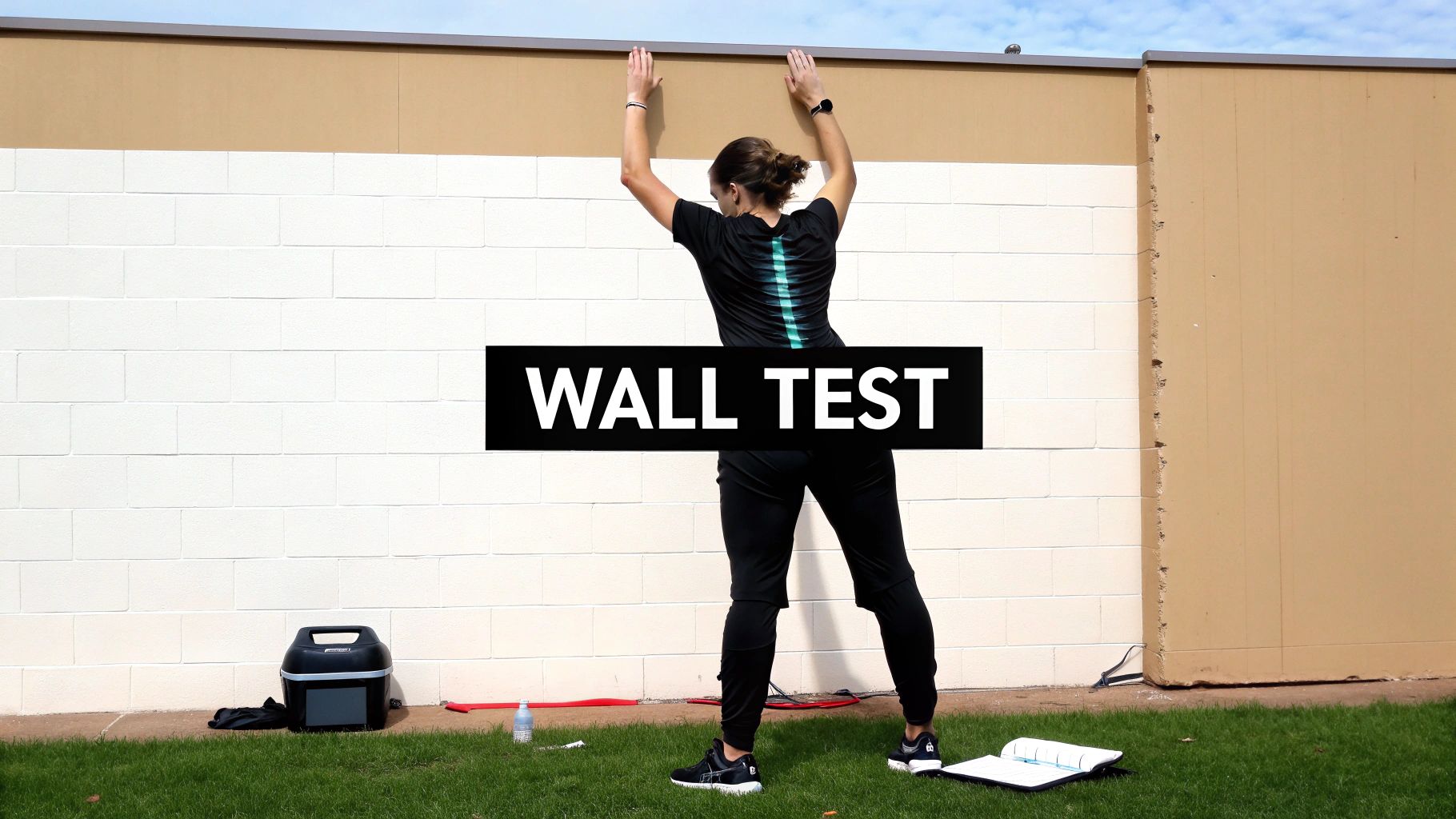
This old-school check is surprisingly revealing and one of the best ways to get acquainted with the natural curves of your spine. It's fast, easy, and gives you instant, tangible feedback.
What are you feeling for? Ideally, there should be just enough room for your hand to slide in—about a hand's thickness. A huge gap behind your lower back could mean your spine is over-arched. Can't fit your hand in at all? That might point to a flat back. This simple exercise is a great first step in proprioception training, as it builds your internal sense of where your body is in space.
Next up, the mirror. This is your best tool for spotting any left-to-right imbalances you might not even realize you have. Just stand in front of a full-length mirror and settle into your normal, relaxed posture.
Take a deep breath and just let it all go. The goal isn't to strike the "perfect" pose. We want to see your real, everyday stance—the one you hold when you're not thinking about it.
Now, let's look for a few common clues that things might be a little off-kilter:
Remember, this isn't about judging yourself. It’s about gathering information. These checks create a personalized map of your body, showing you exactly which areas could use a little extra love and attention as you work toward better alignment.
Alright, enough of the theory. Let's get our hands dirty and start making some real, feel-good changes in your body. The great news is that improving your alignment doesn't mean you have to completely upend your life. It’s all about weaving small, conscious movements and mindful habits into the rhythm of your day.
Think of it like tending a garden. You don't just dump a truckload of fertilizer on it once a year. It's the daily watering, the gentle weeding, and providing a little support here and there that makes it flourish. These simple exercises and habit shifts are your tools to gently nudge your body back to its natural, happy place.
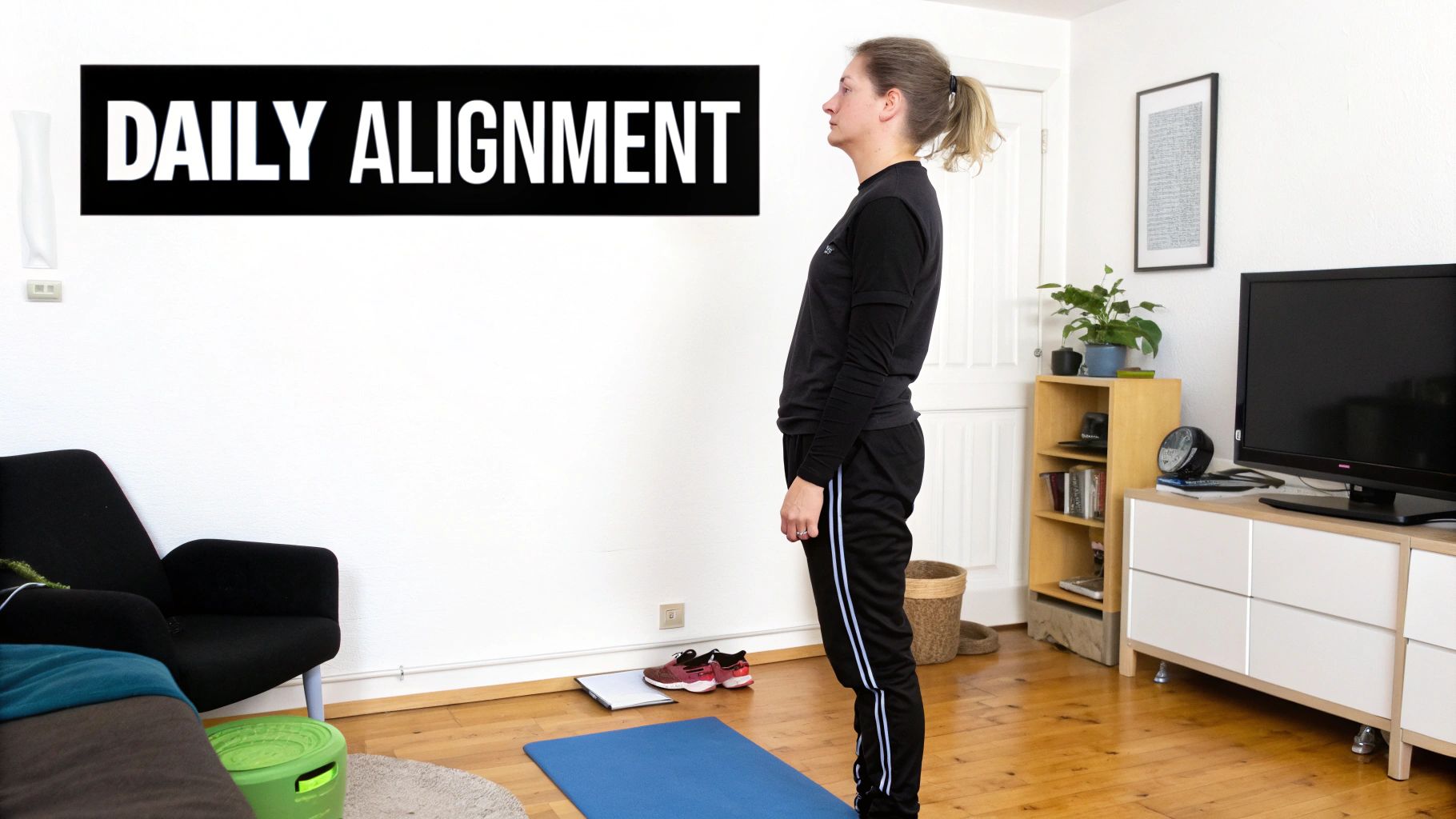
You don’t have to twist yourself into a pretzel to fix your alignment. A few key movements, done with intention, can work wonders for waking up those sleepy muscles and reminding your body how to stand tall.
Mountain Pose (Tadasana): This is so much more than just "standing there." Try it right now. Actively press down through all four corners of your feet, feel your thighs engage, lengthen your spine as if a string is pulling the crown of your head upward, and let your shoulders melt down and back. This is your blueprint for grounded, stacked alignment.
Cat-Cow Stretch (Marjaryasana-Bitilasana): I call this one a sanity-saver for the spine. As you flow between arching your back in "cow" and rounding it in "cat," you're lubricating each little vertebra and saying goodbye to that pesky tension in your neck and back.
These are just the starting blocks. If you want to dive deeper into building that mind-body connection, check out our guide on https://blog.dalm.co/postural-awareness-exercises. It’s packed with ways to tune into your body's signals all day long.
The goal here isn't about hitting the "perfect" pose. It's about building awareness. Every time you do one of these movements, you’re sending a friendly memo to your muscles and nervous system, reminding them where "home base" for your posture is.
Your alignment journey doesn't end when you roll up your mat. The little choices you make all day long—from the shoes on your feet to the way you crash at night—have a massive impact on your body’s framework.
1. Rethink Your Workspace: Your desk can be a postural paradise or a total nightmare. Get that monitor up to eye level to fight off the dreaded "tech neck." Find a chair (or a cushion) that supports the natural curve of your lower back. You’d be amazed at what these small ergonomic tweaks can do.
2. Choose Smarter Footwear: Seriously, your feet are the foundation of your entire body. Wearing flimsy shoes with zero arch support can set off a chain reaction of misalignment that travels right up your kinetic chain to your knees, hips, and spine.
3. Optimize Your Sleep Posture: We spend about a third of our lives in bed, so let's make it count! It's not just about being unconscious; it's a prime opportunity for restoration. Learning how to properly support your body and align your spine while sleeping is a game-changer.
By sprinkling these small, consistent efforts into your life, you'll start creating profound, lasting change without ever feeling overwhelmed. It’s all about the little wins
Welcome to the future of your yoga practice, where getting expert feedback on your alignment is no longer a luxury. It’s like having a personal posture guru right in your pocket, ready to give you pointers whenever you unroll your mat. This isn’t science fiction; it’s what artificial intelligence is making possible for anyone serious about mastering their body alignment.
AI-powered yoga and fitness apps deliver the kind of instant, precise feedback on your form that used to require shelling out for expensive private sessions. Think of these smart tools as a second pair of expert eyes, analyzing every angle of your poses with stunning detail.
This isn't about generic tips. This technology spots the tiny misalignments you’d almost certainly miss on your own. Picture this: you’re holding Warrior II, feeling strong, and your app gives you an immediate, personalized cue that your front knee is collapsing inward or that your shoulders are creeping up toward your ears. That’s a powerful ally for your practice.
Curious about the nitty-gritty of how AI "sees" and aligns things? The process is fascinating, drawing from concepts like image registration techniques.
And it's not just a niche trend. The global posture correction market was valued at a whopping USD 1.4 billion and is expected to climb by 7.6% every year. A huge chunk of that growth comes from smart AI tools that give you real-time feedback—something health-savvy Millennials and Gen Z can't get enough of.
See how the AI interface above pinpoints specific areas needing a tweak? It highlights key joint angles and gives you clear, actionable feedback, turning a vague feeling into solid data you can actually use. Platforms with this kind of posture analysis software hand you the power to make immediate, meaningful corrections.
By translating complicated biomechanics into simple, easy-to-follow advice, AI makes body awareness accessible to everyone. It gives you the tools to not just know what proper alignment is, but to actually feel it in your own body, one pose at a time. This makes your practice safer, way more effective, and a whole lot more rewarding.
The path to better alignment is a journey, not a destination, and it's totally normal for questions to bubble up. Think of this as your personal cheat sheet—a place to bust some myths and get straight-up answers so you can move forward with confidence.
Let's dive into a few of the most common questions we hear.
This is the big one, isn't it? The honest answer: it's more like learning a new language than flipping a switch. You're retraining muscles that have been doing their own thing for years, so it takes time.
While you might feel some amazing relief from pain in just a few weeks, creating deep, lasting change is a long game. Most people start to see significant, permanent shifts after several months of consistent practice. The trick is to stay patient and celebrate the small victories—like catching yourself sitting up straight at your desk without even thinking about it.
Nope! Not even close. Think of poor alignment as a traffic jam in your body. It creates a ripple effect that goes way beyond your spine.
It can actually cramp your lungs' style, restricting how deeply you breathe. It can mess with your circulation, create digestive problems by squishing your internal organs, and totally drain your energy because your body is working overtime just to stay upright.
Fixing your alignment isn't just about getting rid of aches and pains. It’s about letting your entire body breathe and function the way it was meant to—with ease and efficiency.
Absolutely, positively not. It is never too late. Our bodies are incredibly resilient and have a remarkable capacity to adapt and heal, no matter how many candles were on your last birthday cake.
Sure, it might take a bit more patience to gently coax long-held patterns into a new way of being, but you are never "stuck." With smart exercises, consistent stretching, and mindful movement, you can make huge strides in your mobility and overall quality of life. Every small adjustment you make is a powerful investment in feeling good for years to come.
Ready to stop guessing if you're doing it right? Dalm uses AI to give you instant, precise feedback on every yoga pose, basically putting a personal alignment coach in your pocket. Perfect your practice and feel the difference today.