
Boost Your Warm-Up: what is dynamic stretching and why it matters

Let's be honest, the old-school advice of holding a toe-touch for 30 seconds before a run is officially dead. Welcome to the era of dynamic stretching, the smarter, more effective way to get your body ready for action.
So, what is it? Think of it less like stretching and more like a dress rehearsal for your workout. Dynamic stretching uses controlled, flowing movements to take your muscles and joints through their full range of motion. It’s all about actively prepping your body for the specific movements you're about to perform.
Imagine trying to sprint right after rolling out of bed. It wouldn't be pretty, right? Your muscles are cold, your joints are stiff, and your brain is still half-asleep. Hitting the gym or the trail in that state is basically asking for an injury.
Dynamic stretching is your body’s ignition sequence. It’s the process of turning the key, warming up the engine, and making sure every part is firing correctly before you hit the gas. Instead of just holding a pose and hoping for the best, you're actively moving, waking everything up from your muscles to your nervous system.
When you perform dynamic stretches, you're doing a lot more than just "loosening up." You're triggering a cascade of physiological responses that get you primed for peak performance.
It gets the blood flowing. Those continuous movements ramp up your heart rate, sending a fresh supply of oxygen-rich blood straight to the muscles you're about to use. This makes them more elastic and ready to work.
It flips the switch on your nervous system. Dynamic movements are like a wake-up call for your brain-to-muscle communication lines. This sharpens your coordination, balance, and reaction time.
It raises your core temperature. A warm muscle is a happy muscle. Think of a cold rubber band—it's stiff and likely to snap. A warm one, however, is pliable and resilient. That's your body on a dynamic warm-up.
The real magic of dynamic stretching is that it's not about forcing flexibility. It’s about gently coaching your body into a state of readiness. Every leg swing, arm circle, or torso twist is a signal to your joints and muscles that it’s go-time.
To really get it, it helps to see how dynamic stretching stacks up against its more traditional cousin, static stretching. They both have their place, but their timing and purpose are completely different. This table breaks it all down.
In short, think of dynamic stretching as your "on" switch and static stretching as your "off" switch. Use them correctly, and you'll get the best of both worlds.
This isn’t just fitness folklore; the science backs it up. Modern research consistently shows that dynamic warm-ups improve a muscle's ability to use elastic energy while decreasing stiffness—a perfect recipe for injury prevention.
And the proof is in the pudding. Hamstring injuries alone sideline countless athletes every single year. But since major sports leagues across the US and Europe began widely adopting dynamic warm-up routines around 2015, they've seen as much as a 20-30% drop in soft-tissue injuries. If you want to dive deeper, you can discover more insights about how dynamic stretching lowers injury risk in athletes.
It’s clear: a dynamic warm-up isn't just a formality. It’s a powerful strategic tool for staying healthy and performing at your best.
Dynamic stretching might look like just a bunch of random flailing, but there’s some seriously cool science happening under the skin. It’s a deliberate strategy to prep your body for whatever you're about to throw at it. Think of it less like a chore and more like the secret ingredient that turns a decent workout into an amazing one.
So, what’s actually going on when you do those walking lunges and arm circles? You’re essentially sending a series of wake-up calls to your entire system, getting everything online and ready for action. Let's lift the hood and see how it works.
The first big win is something called neuromuscular activation. It sounds a bit nerdy, but all it means is revving up the communication line between your brain and your muscles.
Imagine your nervous system is a network of light switches. A dynamic warm-up goes around and flips every single one of them to the "on" position. This pre-activation helps your muscles fire faster and more efficiently, which means better coordination, sharper balance, and quicker reactions when you start your main workout.
Ever feel stiff and creaky before you get moving? That's because your joints are still "cold." Dynamic stretching tackles this head-on by encouraging the production of synovial fluid.
Think of synovial fluid as the WD-40 for your joints. It's a natural lubricant that cuts down on friction, allowing your knees, hips, and shoulders to glide smoothly without grinding.
When you perform movements like leg swings or arm circles, you’re literally bathing your joints in this stuff. The result is that they can move through their full range of motion effortlessly, which is a massive factor in keeping injuries at bay.
This concept map breaks down how dynamic stretching both readies your systems and actively engages your muscles.
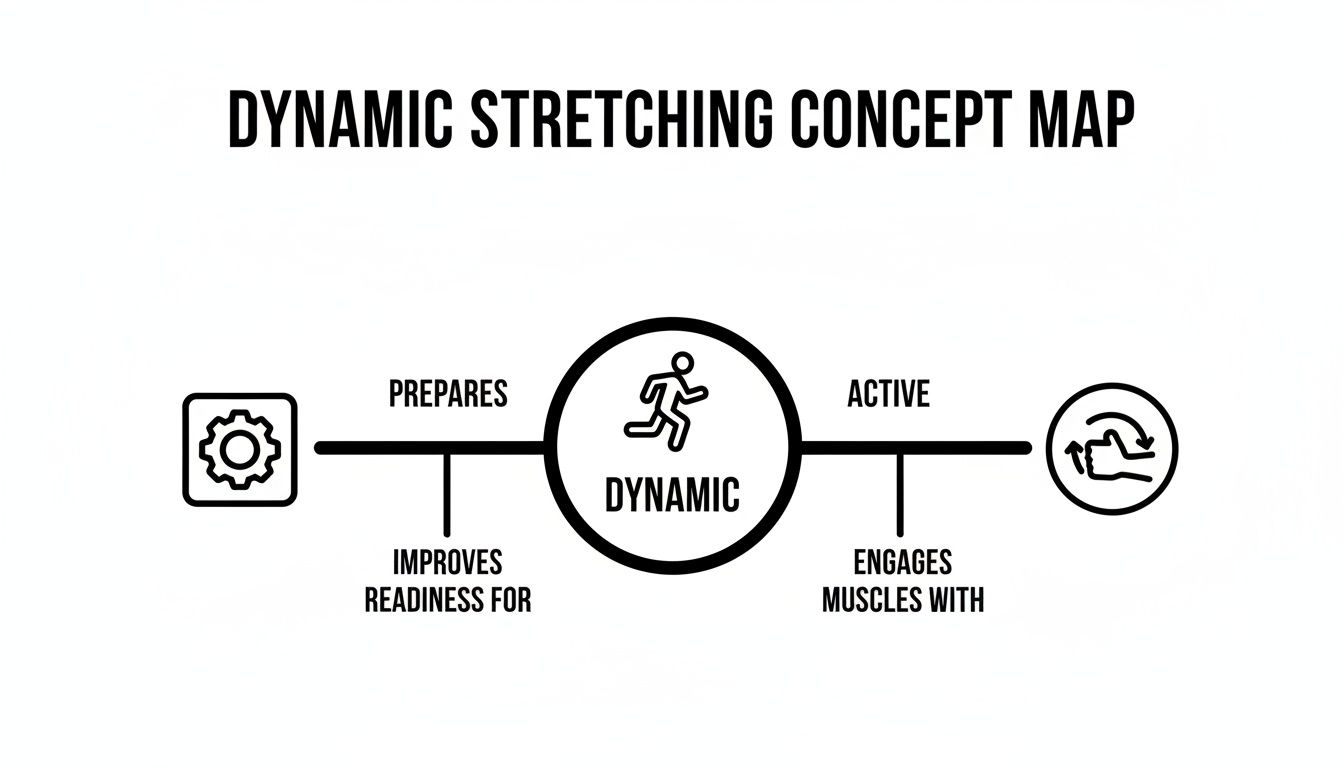
As you can see, it’s a one-two punch: it warms up the body's engine while putting the muscles and joints right to work.
It’s simple, really: a warm muscle is a happy muscle. Dynamic stretching gets your blood pumping, raising your core and muscle temperature through continuous movement.
Why is this so important? Because warmer muscle fibers are more elastic and forgiving. Picture a cold rubber band—it’s stiff and more likely to snap. Warm it up, and it becomes pliable and resilient. Your muscles work the same way, and this added elasticity makes them far less prone to strains and tears.
This gentle warm-up also kicks your metabolism into a higher gear, helping your muscles access and use energy more efficiently right from the get-go. This kind of intentional prep work is a cornerstone of what is mindful movement, where every action is done with purpose.
Here’s the real kicker. Dynamic stretching can trigger a wild phenomenon called post-activation potentiation (PAP). In plain English, it’s a temporary boost in muscle strength and power that happens right after you warm up.
It's pretty straightforward:
This means a good dynamic warm-up doesn't just get you ready—it can actually make you stronger and more explosive from your very first rep. It’s the science-backed reason why athletes feel so primed and powerful after a solid pre-game routine.
For decades, the classic pre-workout ritual was set in stone: drop down, grab an ankle, and hold that stretch for dear life. That “stretch and hold” method, known as static stretching, was the undisputed king of the warm-up. But if you’ve been to a gym, a yoga class, or a sports practice recently, you’ve probably noticed the king has been dethroned.
The fitness world had a massive lightbulb moment, and it completely flipped the script on how we get ready to move. This wasn't just another trend—it was a seismic shift driven by a mountain of evidence suggesting that old-school static stretching before a workout might be doing more harm than good.
So, what caused this dramatic pivot? It turns out that holding a muscle in a long, relaxed position is the exact opposite of what you want to do right before asking it to perform powerful, athletic movements.
Picture your muscles as rubber bands. A static stretch slowly lengthens that rubber band, making it loose and pliable. While that's fantastic for improving your overall flexibility, doing it right before you need to sprint, jump, or lift can temporarily rob the muscle of its springy, explosive power.
This isn't just a hunch. Research from as far back as the early 2000s started showing how static holds before an activity could actually sabotage performance. Studies revealed it could slash isometric force by up to 5-10% and mess with everything from your one-rep max to your sprint speed. That lit a fire under the fitness community to find a better way. If you want to dive into the science, you can learn more about the findings that shifted warm-up protocols.
This chart breaks down how each type of stretching impacts performance right before you get moving.
The takeaway is crystal clear: dynamic movements get you ready to perform, while static holds can put the brakes on your power and agility.
This is where dynamic stretching swoops in like a superhero. Instead of lulling your muscles into a sleepy, relaxed state, it wakes them up with a shot of espresso. It’s like a dress rehearsal for the main event, hitting several critical goals at once.
The results are pretty staggering. Elite soccer teams that adopted the FIFA 11+ dynamic warm-up saw an incredible 30-50% drop in lower-limb injuries across Europe’s top leagues. This proves an active warm-up isn't just about feeling ready—it's a seriously powerful tool for preventing injuries.
The big misunderstanding was never that static stretching is "bad." It's an incredibly valuable tool; it was just being used at the wrong time. It’s like using a screwdriver to hammer a nail—it’s the right tool for the wrong job.
The smart way to think about flexibility is to see dynamic and static stretching as specialists on the same team. Each has a distinct and vital role to play, and you wouldn’t ask your star goalie to play forward, right?
Here’s a simple way to remember who does what:
By getting this one simple difference, you can build a much smarter and more effective routine. You'll go into every session primed for success and finish every cool-down knowing you’ve given your body exactly what it needs to recover. It's a strategic approach that makes sure you get all the benefits of stretching without ever compromising your performance.
Alright, enough with the theory—let's get moving. Knowing what dynamic stretching is is great, but the real magic happens when you actually do it. Think of this section as your personal playbook, packed with killer dynamic stretches you can start using today to kick your warm-ups into high gear.
We’ve sorted these moves into logical groups, so you can easily snag what you need for any workout. Prepping for a heavy lifting session? Got you covered. Gearing up for a long run or a tough yoga class? The right tools are right here. Each exercise comes with simple instructions, pro tips for nailing your form, and a "Level Up" challenge to keep things interesting.
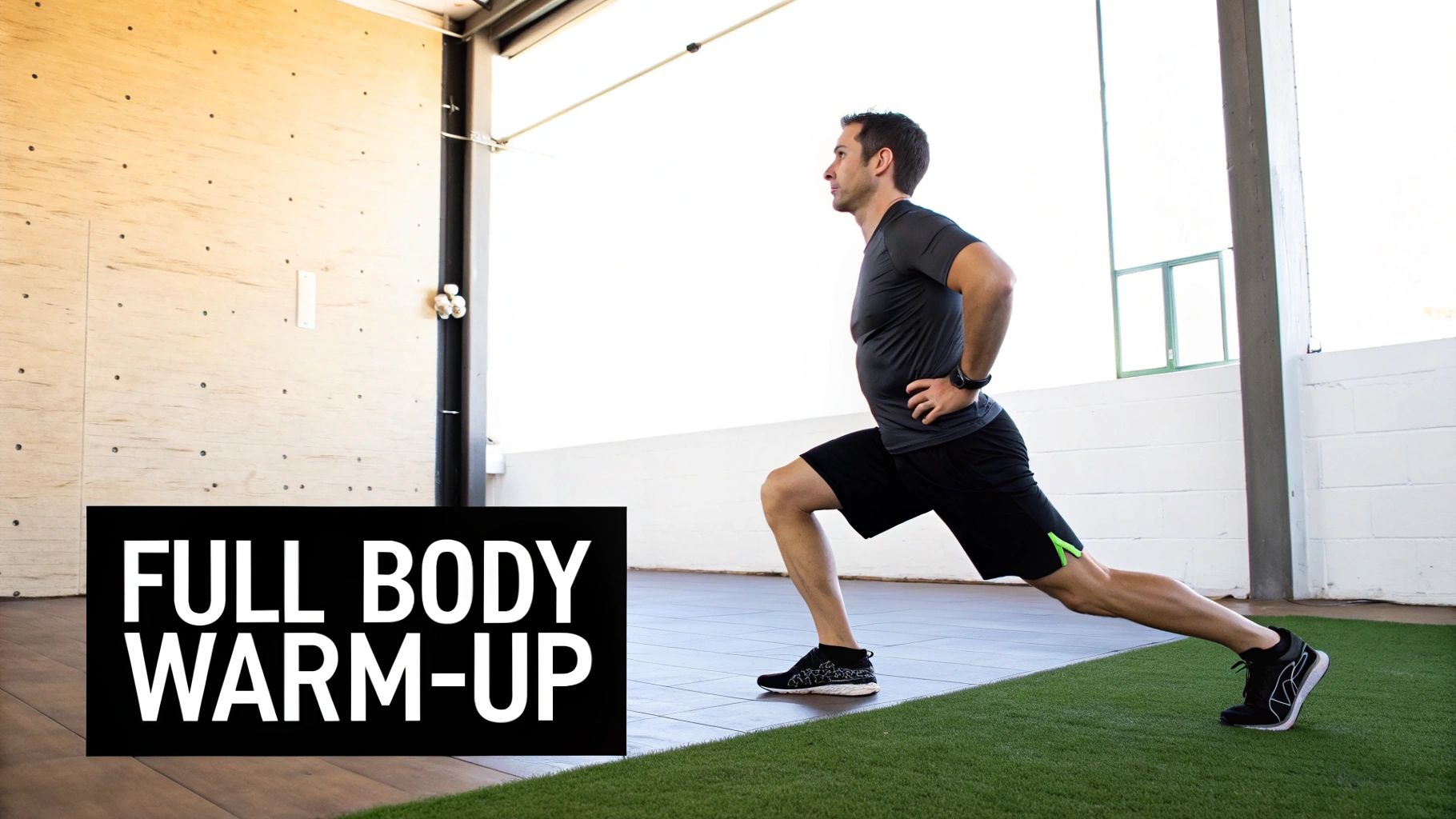
These are your all-rounders, designed to wake up your entire body from head to toe. They're perfect for getting the blood pumping and hitting multiple muscle groups at once, making them an amazing kickoff for any warm-up.
1. Plank Walk-Outs
This move is a total powerhouse. It fires up your core, shoulders, and hamstrings all at the same time, making it a fantastic way to build stability and control before you even touch a weight.
2. High Knees
A classic for a reason! High knees are brilliant for jacking up your heart rate, waking up your hip flexors, and getting your lower body primed for explosive action.
For anything involving your legs—running, cycling, or the dreaded leg day—you need to give your lower half some focused attention. These dynamic stretches target your hips, glutes, hamstrings, and quads, getting them ready for whatever you're about to throw at them.
1. Leg Swings (Forward and Backward)
This is the ultimate hip-opener. It gets the synovial fluid moving in the hip joint while actively stretching the hamstrings and hip flexors.
2. Walking Lunges with a Twist
This is a fantastic two-for-one. You're prepping your legs for action while also mobilizing your mid-back (the thoracic spine). It's a must-do for anyone playing a sport that involves rotation, like tennis or golf.
Dynamic movements are foundational for achieving greater mobility. By actively taking your joints through their full range of motion, you’re not just warming up; you're teaching your body to move more freely. This active preparation is a key part of learning how to improve flexibility both on and off the mat.
Don't be that person who only warms up their legs! Whether you're swimming, lifting, or just trying to undo the damage of sitting at a desk, these moves will open up your shoulders, chest, and back.
1. Arm Circles (Forward and Backward)
Simple, timeless, and ridiculously effective. Arm circles get the delicate rotator cuff muscles warm and improve the mobility of the whole shoulder joint.
2. Cat-Cow Stretch
Borrowed straight from the yoga studio, this is one of the best things you can do for your spine. It gently gets every vertebra moving, from your neck all the way down to your tailbone.
Let’s be honest, when most people think of yoga, they think of stretching. But there’s a secret sauce to a truly great practice, and it lies in blurring the line between your warm-up and your main flow. Purposefully kicking things off with a dynamic stretching phase before you even think about holding those deep poses? It’s an absolute game-changer for your safety and your progress.
You’re essentially telling your body, "Hey, we're about to move," instead of just throwing it into the deep end.
Think about a classic Sun Salutation. It’s not about holding a pose and gritting your teeth; it’s a beautiful, flowing sequence. That, right there, is dynamic stretching in its purest yoga form. It’s designed to build heat, get your joints ready for action, and gently wake up all the muscles you're about to ask to do some heavy lifting. It's the perfect handshake between stillness and movement.
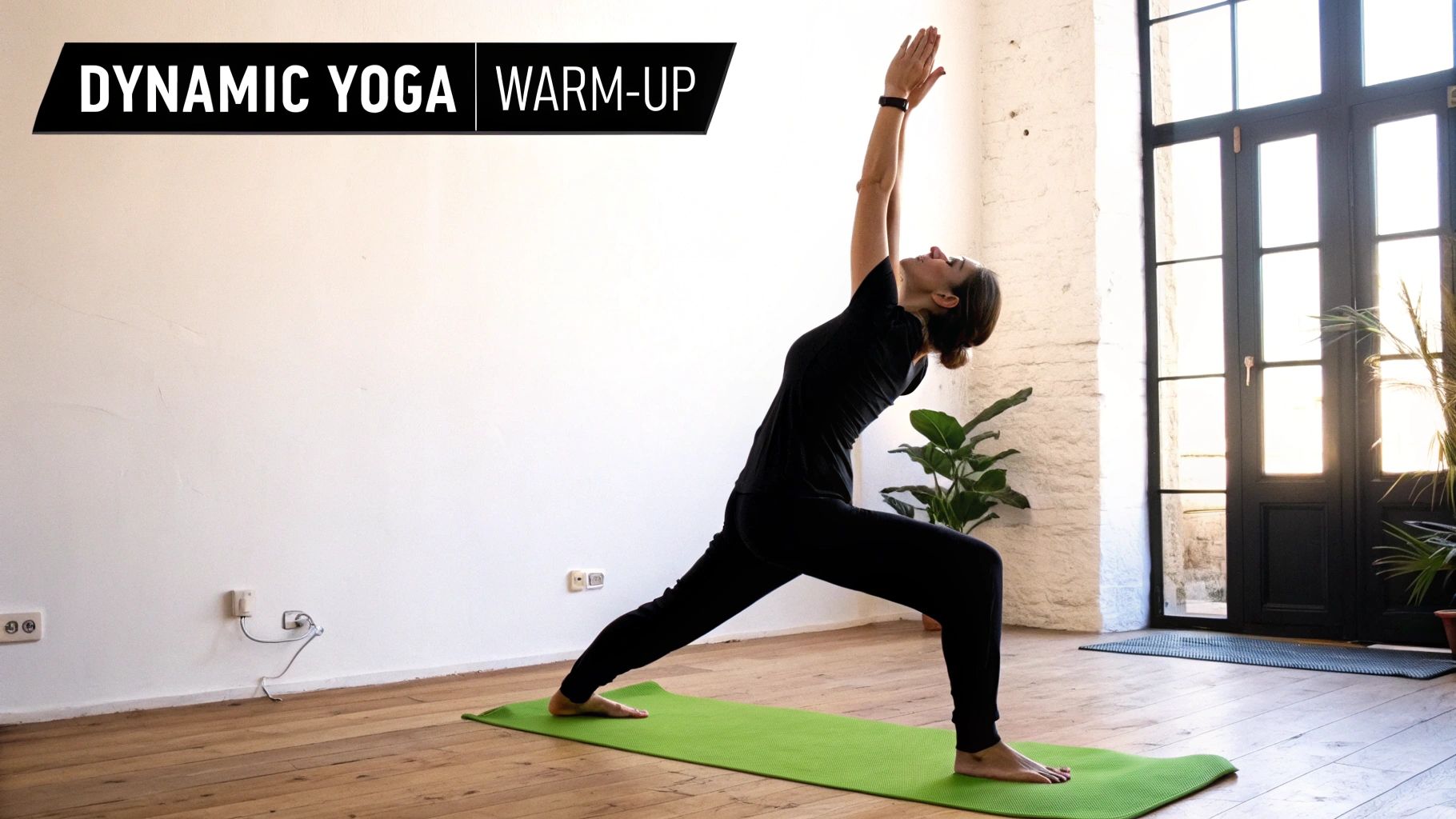
When you start with something as simple as a Cat-Cow flow or some gentle torso twists, you're sending a memo to your body that it's time to prepare for more complex asanas like Warrior III or Triangle Pose. This isn’t just a physical heads-up. You're also firing up the neurological pathways, priming that crucial brain-muscle connection for way better balance and control.
A smart dynamic warm-up makes your entire practice feel more intuitive and a whole lot less jarring on your body.
And this isn't just some yogi theory. The science backs it up. Research has shown that dynamic movements give a major boost to both your static and dynamic flexibility. Static stretching on its own? It just doesn’t improve your active range of motion in the same way. One study even found that just 225 seconds of dynamic stretching was enough to see these incredible effects. If you're a data nerd, you can dig into the full research on these flexibility findings and see for yourself.
Think of a dynamic warm-up as the key that unlocks a safer, more profound yoga practice. It ensures your muscles are supple and your joints are primed, turning what could be a moment of strain into an expression of controlled, graceful strength.
This is where modern tech can step in to support an ancient practice beautifully. Imagine having a personal coach analyzing your movements during your warm-up, making sure every single twist and lunge is perfectly aligned for your body. That’s exactly what AI-powered platforms like Dalm do, giving you real-time feedback on your form as you flow through your dynamic prep.
This kind of intelligent guidance helps you warm up more effectively by catching those subtle misalignments that could, over time, lead to an injury. It’s not about replacing the soul of yoga, but about enhancing it with precise, data-driven insights. If you're looking for some great routines to get started, our complete guide on yoga warm-up exercises has you covered.
By keeping an eye on your range of motion over time, an AI partner can show you real, tangible progress. We've seen Dalm users hit their flexibility goals 15-20% faster simply because they're warming up smarter and practicing with better form from the get-go. This blend of tradition and technology helps you build a practice that’s not just safe, but incredibly effective for the long haul.
To really get the goods from your dynamic warm-up, you’ve got to do it with some intention. Just flopping around won’t cut it, and worse, it can actually set you up for an injury. Think of it like tuning a guitar—mindlessly cranking the pegs gets you nowhere, but a little focus creates perfect harmony.
The biggest mistake I see? People confuse dynamic stretching with ballistic stretching. The goal is smooth, controlled movement, not flinging your limbs around like you’re trying to launch them into orbit. This isn't a competition; it's a careful conversation with your body.
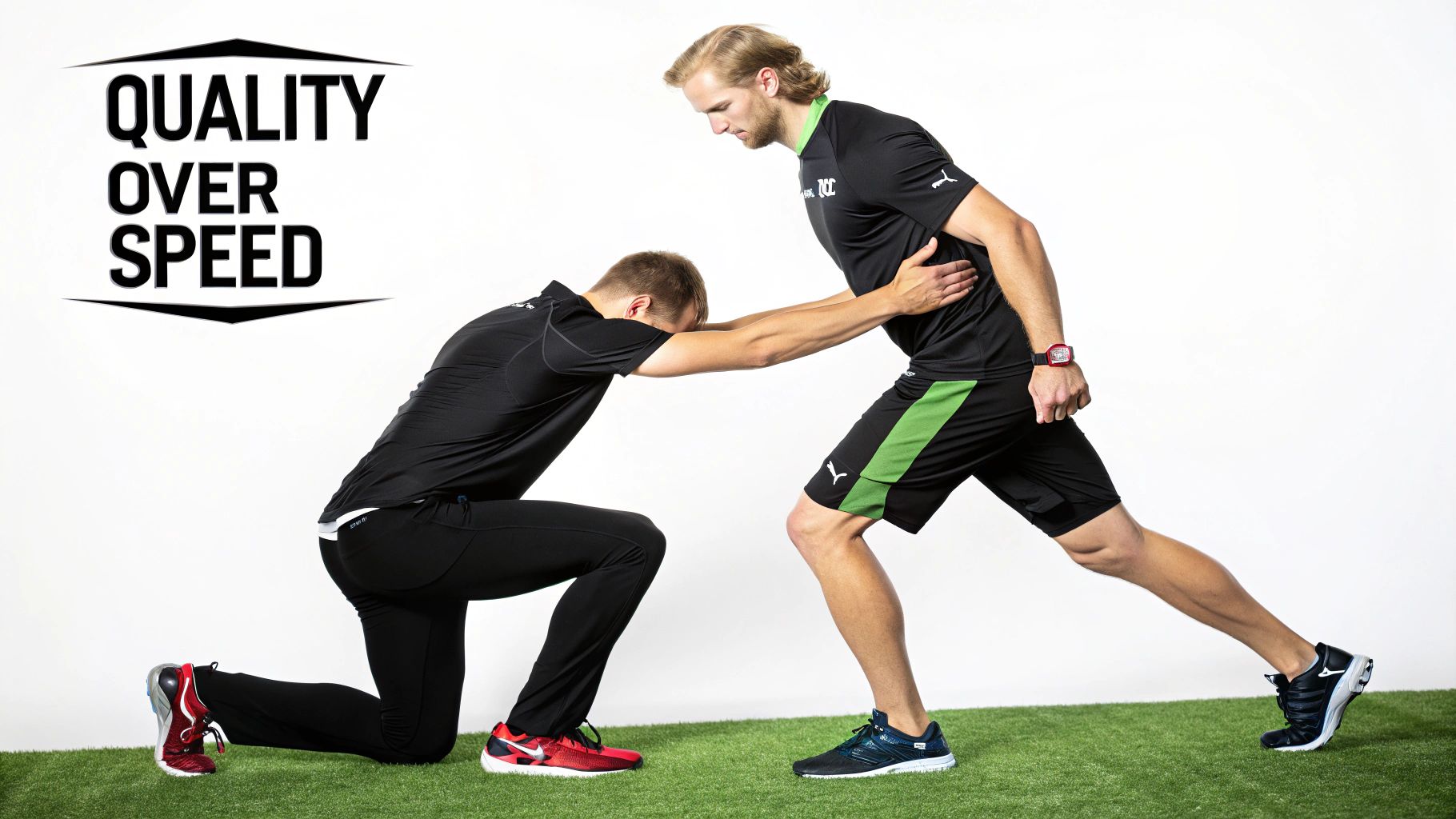
It's so easy to just rush through the warm-up, right? We've all done it. We treat it like a chore to get through, turning controlled leg swings into chaotic, frantic kicks. But that sloppy execution completely misses the point.
Ah, form. It's everything. A walking lunge with a back hunched over like a question mark or knees caving inward does way more harm than good. When you move with bad form, you're just teaching your body bad habits that will absolutely follow you into your main workout, jacking up your risk of injury.
Remember, the whole point of a dynamic warm-up is to prep your body for perfect execution later. If your warm-up form is sloppy, you can bet your workout form will be, too.
Let's be clear: a dynamic warm-up should feel good, maybe a little challenging, but never painful. If you feel a sharp, pinching, or stabbing sensation, you’re either pushing too hard or something is wrong. Your body is sending you a pretty clear signal—and it’s yelling "STOP!"
Nail these basics, and you'll be building a smarter, safer, and way more effective foundation for every single workout.
Still have a few things bouncing around in your head? It happens. Let's clear up some of the most common questions about dynamic stretching so you can move forward with confidence.
The sweet spot for a great dynamic warm-up is usually somewhere between 5 and 15 minutes. Honestly, it all comes down to what you're about to do.
If you’re prepping for a chill yoga flow or a light jog around the block, 5-7 minutes is probably all you need to get the blood flowing. But if you're about to tackle a high-intensity run or a serious weightlifting session, you'll want to lean closer to that 10-15 minute mark to make sure everything is properly fired up.
The real goal? Finish your warm-up feeling warm, loose, and ready to go—not like you’ve already done a full workout.
You bet! In fact, making dynamic stretching a daily habit is a brilliant move for your overall mobility and well-being.
It’s gentle enough to do every day and makes for a fantastic morning ritual to shake off the sleep and wake up your body. Even on rest days, a quick 5-minute dynamic session can boost circulation and keep you from feeling stiff.
Here's something important: Dynamic stretching is NOT ballistic stretching. Dynamic moves are smooth and controlled. Ballistic stretching involves bouncing or jerking, which can force your body past its natural range of motion and has a much higher risk of injury. We're not fans.
Nope, you definitely shouldn't feel pain or major soreness. A good dynamic warm-up should leave you feeling energized and mobile, not achy.
If you’re feeling sore, it’s a big red flag that you might be pushing it too hard, moving too fast, or using sloppy form. Always, always choose control over speed, and never force a movement. Listen to your body and stay in a range that feels good.
Ready to bring smarter warm-ups into your yoga practice? Dalm uses AI to analyze your poses in real-time, giving you instant feedback on your form. This makes sure every dynamic move you make is safe and sets you up for an amazing session. Start your personalized yoga journey today at dalm.co.