
What is eccentric muscle contraction: The braking power behind stronger workouts
Let’s talk about a type of strength you use every single day, probably without even thinking about it. It’s the hidden power that keeps you from collapsing into a chair, the steady control that lets you place a sleeping baby in a crib without a jolt.
This isn't about lifting heavy things; it's about lowering them with control. This is the world of eccentric muscle contraction.
An eccentric muscle contraction is what happens when a muscle lengthens while under tension. Think of it as your body's built-in braking system. It’s the opposite of a concentric contraction, where the muscle shortens to create movement (like the “up” part of a bicep curl).
The eccentric phase is the controlled, deliberate release. It’s the slow descent from a pull-up, the careful lowering of a heavy grocery bag, or the graceful transition from a high plank down to the mat in a yoga class. It’s where real control and stability are forged.
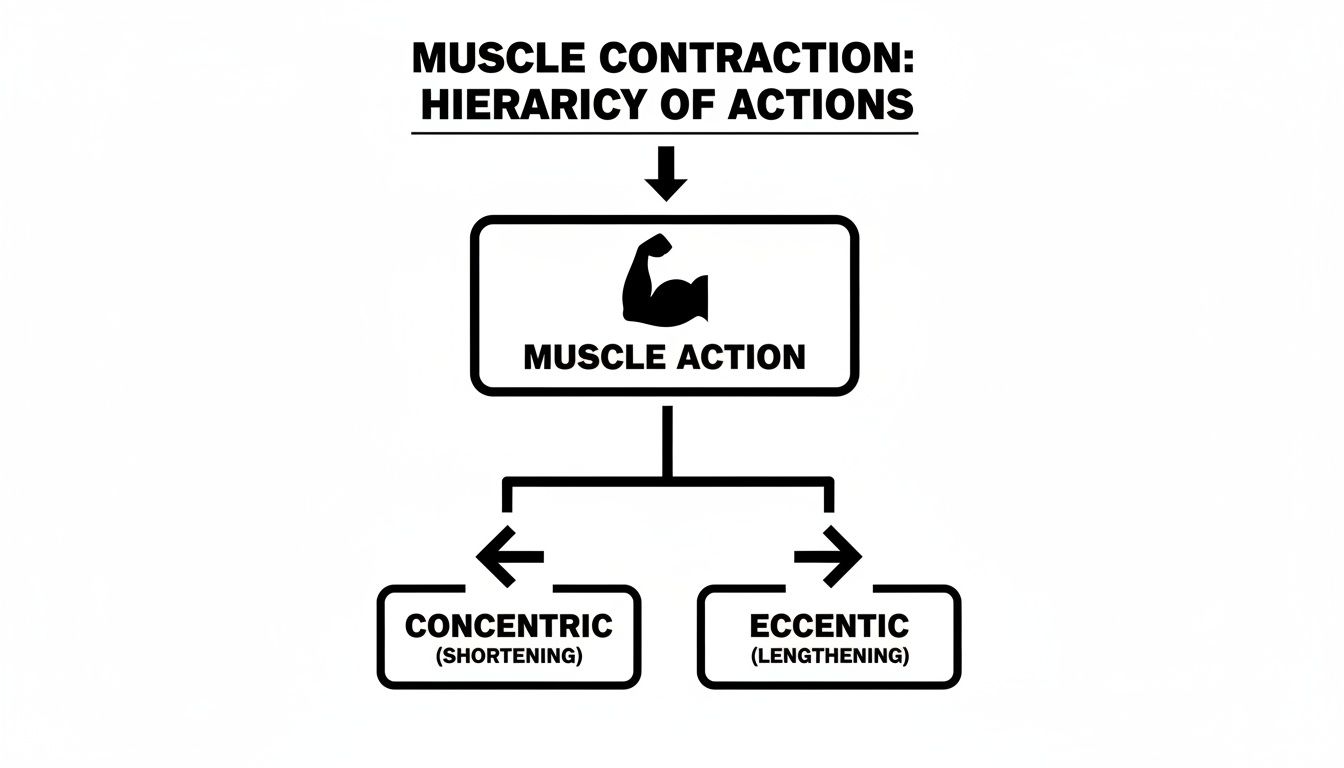
As this chart shows, both shortening and lengthening actions are crucial for balanced, functional movement. One creates the force, and the other masterfully controls it.
To put this into perspective, let's quickly break down the three main ways our muscles work. Each one plays a distinct role in how we move through the world.
While all three are important, the eccentric phase is often the most neglected—and arguably, where the most potential for building strength and preventing injury lies.
Here’s the wild part: you are significantly stronger during an eccentric contraction than a concentric one. Research shows your eccentric strength can be 16–53% greater than your concentric strength. You can control more weight on the way down than you can lift on the way up. It’s a genuine superpower.
This ability to absorb and control force is why focusing on the “negative” portion of an exercise is a game-changer for building muscle and resilience.
It’s not just about lifting the weight; it’s about owning the weight on its entire journey. That’s where the real magic happens for strength, control, and resilience.
Mastering this control also has a profound effect on your body's internal GPS. It sharpens your sense of where you are in space, a skill deeply connected to what is known as proprioception training. When you consciously slow down and control the lengthening of a muscle, you're not just getting stronger—you're fine-tuning the mind-body connection that governs every single move you make.
To really get what's happening during an eccentric contraction, we need to zoom in and look at the muscle itself. Picture your muscle fibers as one team in a seriously intense game of tug-of-war. The other team? That’s any external force you’re up against—a dumbbell, your own body weight, or even just good old gravity.
During an eccentric contraction, your muscle team is pulling for all it's worth, but the opposing force is just a bit stronger. So, your team is forced to give ground. But they don't just drop the rope; they dig in their heels, letting the rope slide through their hands slowly and with total control. This controlled "losing" is precisely where the magic happens. The muscle is lengthening, but it's fully fired up and under a ton of tension the entire time.
This lengthening phase actually puts a much greater mechanical load on your muscle fibers than the shortening (concentric) part of the movement.
Hidden deep within your muscle fibers are microscopic proteins that are the real MVPs of managing all this tension. One of the key players is a massive, spring-like protein called titin. The easiest way to think of titin is as millions of tiny, internal bungee cords running through your muscles.
When your muscle lengthens under a load, these titin "bungee cords" stretch out, storing up elastic energy and creating a kind of passive force. This is a huge reason why you can handle so much more weight on the eccentric part of a lift. It’s not just your muscle fibers actively pulling; it's this passive, spring-loaded resistance from titin pitching in to help control the descent.
This controlled lengthening under a heavy load is the single most powerful stimulus for muscle growth and strength adaptation. It’s the physiological secret to building a stronger, more resilient body.
This intense tug-of-war creates tiny, microscopic tears in the muscle fibers. Now, that might sound bad, but it’s actually the whole point. These micro-tears are the signal that screams to your body, "Hey! We need to rebuild this area way stronger to handle this stress next time!"
That signal kicks off an amazing repair process. Your body rushes satellite cells—the stem cells of skeletal muscle—to the site to fix the damage. But here’s the cool part: they don't just patch things up to the way they were. They overcompensate, adding more protein strands to make the muscle fibers thicker and tougher than before. This is exactly how muscles get bigger (hypertrophy) and stronger.
Over time, this cycle of controlled lengthening, micro-damage, and super-compensated repair leads to huge gains in:
In short, by strategically losing the tug-of-war, your muscles learn how to come back and dominate the next game. It's a brilliant biological hack for adaptation, turning controlled resistance into real, functional power. This is the science behind why that slow, burning negative feels so challenging—and why it works so well.
Alright, we’ve covered the "what" and the "how" of eccentric contractions. But the real magic is in the "why." Why should you pour precious mental and physical energy into simply slowing down? Because the payoff is huge, touching everything from your raw strength to how you move through the world every day.
Focusing on that lengthening phase isn't some obscure training hack. It's one of the most direct routes to building serious strength and more muscle.
Here’s a wild fact: your muscles are way stronger on the way down than they are on the way up. They can handle a much heavier load during the eccentric phase than the concentric one. When you intentionally slow down and control the “negative” part of any lift, you force your muscles to work harder, creating more tension and firing up more muscle fibers. This is a massive trigger for both hypertrophy (that’s muscle growth) and pure strength.
For years, people just associated this intense part of the lift with getting sore. But we know better now. Modern research has completely flipped that idea on its head, showing that controlled eccentric work is a powerful catalyst for change. A big 2023 meta-analysis even confirmed that eccentric training gives a major boost to upper-body strength, with real gains showing up in just 4–8 weeks. You can dig into the strength adaptation findings yourself.
What does this mean for you? Simply by focusing on the slow, deliberate descent of your push-up or the controlled lowering of a dumbbell, you’re tapping into your body's most powerful system for getting stronger.
Think of eccentric strength as your body's built-in braking system. It’s what teaches your muscles and tendons how to absorb shock and decelerate force, which is absolutely critical for sidestepping common injuries like hamstring pulls or Achilles tendon issues.
Picture a sprinter at full speed. When their foot smacks the ground, their hamstrings have to contract eccentrically to slow down the forward momentum of their lower leg. If that eccentric strength isn't there, the muscle gets overloaded, and pop—you've got a strain. This is why athletes build resilience with exercises like slow, controlled Romanian deadlifts; they're fortifying their body's brakes.
Eccentric training isn't just rehab; it's pre-hab. It’s how you teach your body to handle surprises, sudden stops, and unexpected forces, making you a far more robust human.
This fine-tuned control shows up everywhere, whether you're balancing on a yoga mat or just trying not to fall down a steep hill. An athlete who can slam on the brakes and instantly change direction is relying on powerful eccentric contractions in their legs and core.
Take a yogi flowing from a challenging pose like Warrior III into a lunge. That slow, graceful lowering of the back leg isn't just for show. It's the glute and hamstring of their standing leg working eccentrically to keep them stable and balanced. That exact same skill is what you use walking down a flight of stairs, as your quads lengthen under tension with each step to keep you from tumbling.
At the end of the day, getting a handle on eccentric muscle control improves the quality of every single move you make. It’s a smarter, more efficient way to train that builds a stronger, more capable body with results that are faster, safer, and built to last.
Once you get the hang of what an eccentric muscle contraction is, you'll start seeing it everywhere. Seriously, everywhere. It's the unsung hero of countless movements you do every single day without even thinking about it.
Let's turn you into an eccentric-spotting expert.
Think about walking down a really steep hill. To stop yourself from just tumbling forward, your quadriceps—those big muscles on the front of your thighs—have to lengthen with every step, acting like brakes against gravity and your own body weight.
Or picture yourself carefully placing a heavy box of books on the floor. You don't just drop it, right? You use your biceps, shoulders, and back muscles, letting them lengthen slowly to lower the box with control. That’s eccentric action in its purest form.
Nowhere is this controlled braking more important than in yoga. Eccentric strength is the secret ingredient that turns a wobbly, clumsy transition into a moment of pure grace and power. It's what separates collapsing out of a pose from flowing out of it with intention.
Of course, you can't just jump into this kind of demanding work cold. Making sure your muscles are primed and ready is crucial. We’ve got some great movements to get you started in our guide to yoga warm-up exercises.
Here are a few classic yoga moments where eccentrics are the absolute star of the show:
Once you start noticing these moments in your own practice, it's a total game-changer. That slow-burn feeling as you lower down isn't just a sign of work; it's you actively building strength, stability, and a much deeper connection between your mind and your muscles.
Bringing this awareness to the mat is just the beginning. This newfound sensitivity for how your body moves doesn’t just disappear when you roll up your mat; it follows you into your everyday life.
Suddenly, you’ll notice the eccentric work in your calves as you walk down a flight of stairs. You'll feel your back muscles controlling the movement as you bend over to tie your shoes.
By paying attention to these lengthening, braking actions, you can turn totally mundane tasks into mini-opportunities to build a more resilient, coordinated, and injury-proof body. It's a simple shift in focus that pays off big time.
Ready to tap into this muscle-lengthening power? Let's get into it. While eccentric training is a potent way to build strength, going too hard too soon can leave you waddling like a penguin for days. The secret is a smart, gradual approach that keeps you in the driver's seat.
The biggest thing people worry about is Delayed Onset Muscle Soreness (DOMS). You know the feeling—that classic "I can't walk down stairs" ache a day or two after a killer workout. Eccentric contractions are famous for causing more DOMS because they create more of those tiny micro-tears in the muscle fibers. But don't let that scare you. This is actually a sign your body is adapting, and if you start off right, you can keep it manageable.
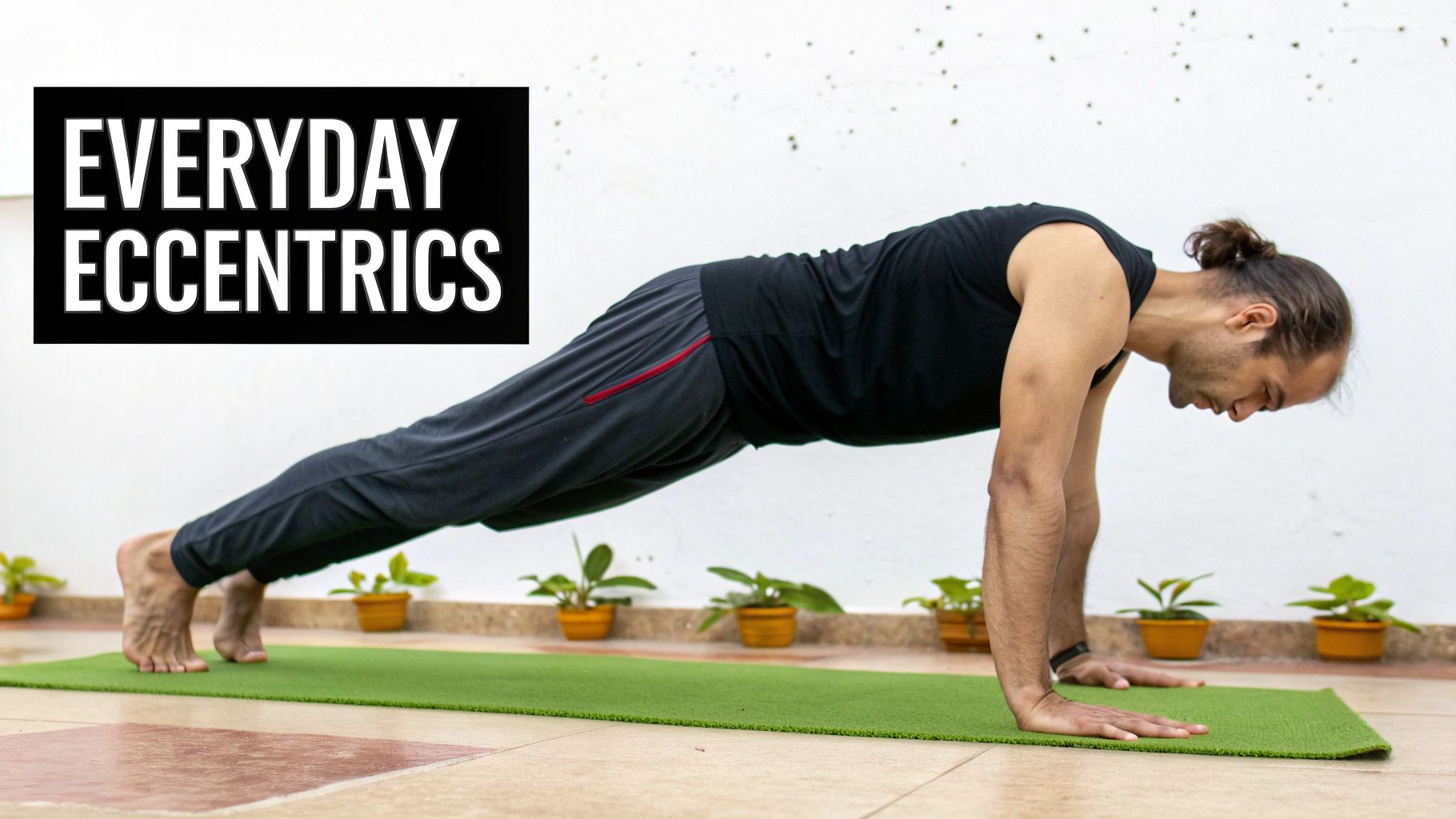
Your mission, should you choose to accept it, is to introduce this new challenge without completely shocking your system. The best way to do that is to slow things down and start with exercises you already know like the back of your hand.
Think of it like learning to drive a stick shift. You wouldn't jump on the highway and start redlining it. You'd practice easing off the clutch, getting a feel for that friction point. It's the exact same idea here.
The golden rule for starting eccentric training? The '3 to 5-second negative.' For any exercise, make the lowering part of the movement last at least three full seconds. Feel the muscle fighting gravity every inch of the way down.
Because eccentric work can bring on serious soreness if you jump in cold, all the best practices for safely introducing it preach a gradual ramp-up of both volume and weight. This is where tools like Dalm can be a huge help. Its AI can analyze your poses in real-time, coaching you on the eccentric phase of a movement—like ensuring your knee tracks correctly as you lower into a Warrior pose—giving you a science-backed path to getting stronger, safer.
You don't need a gym or any fancy gear to get started. Your own body weight is the perfect tool for building eccentric control.
Here are a couple of my favorites to begin with:
By starting with these simple, mindful movements, you give your body a chance to adapt without getting totally wrecked. You're building a solid foundation of resilience and control, setting yourself up to tackle just about any movement you want to master next.
Let's be honest: mastering that perfect, slow-burn eccentric contraction can feel like trying to pat your head and rub your stomach at the same time. You think you're moving with control, but are you really? Is your speed consistent? Is that tiny wobble in your knee a sign of trouble?
Self-monitoring this stuff is notoriously difficult. It takes an almost superhuman level of body awareness to catch the small mistakes that can derail your progress or lead to injury. This is where a little bit of tech can be a game-changer.
Think of it like having an expert coach glued to your side, giving you precise, instant feedback on every single rep. That's essentially what AI-powered movement analysis does. Platforms like Dalm become your digital spotter, using your phone or tablet's camera to break down your form with mind-boggling accuracy.
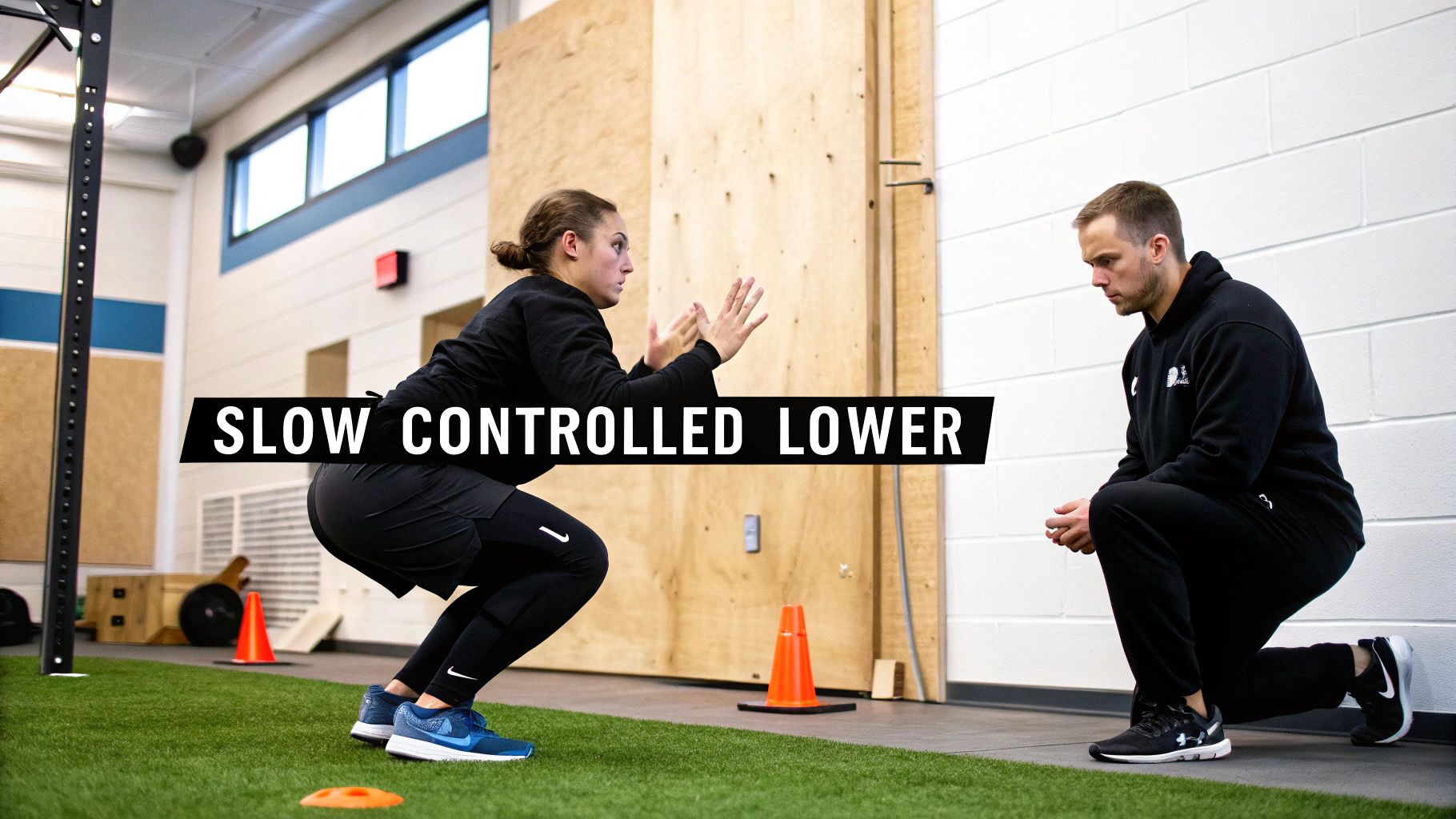
This isn't just about hitting "record" and watching yourself later. It's about getting live, actionable cues that help you improve in the moment. Imagine lowering into a Chaturanga and hearing a calm voice prompt, "Keep your hips level," or "Slow your descent by 20%."
This kind of technology can zero in on the key metrics that define a great eccentric:
By giving you this kind of objective data, AI takes all the guesswork out of the equation. It transforms that vague feeling of control into solid, measurable feedback you can actually use to get better.
Ultimately, this makes the powerful principles of eccentric training safer and more accessible for everyone, whether you're a total beginner or a seasoned pro. You stop wondering if your form is right and start moving with the confidence that it is. Tools offering this level of posture analysis software are invaluable for building strength more efficiently and slashing your injury risk by keeping your form on point, rep after rep.
Alright, let's tackle some of the common questions that pop up when people first hear about eccentric contractions. Getting your head around these concepts is the first step to using them like a pro.
That’s like asking if inhaling is better than exhaling. You need both to be effective! It’s not about one being “better,” but about completing the full picture of a movement.
Most of us instinctively focus on the "up" part of an exercise—the push, the pull, the lift. That’s the concentric phase, and it gets all the glory. But by ignoring the controlled "down" part—the eccentric phase—you're leaving a massive amount of strength and muscle-building potential on the table. A truly powerful routine embraces both sides of the coin.
Okay, I won't lie to you—you might be. At first, anyway. Eccentric training is notorious for causing Delayed Onset Muscle Soreness (DOMS) because it creates more of that productive micro-damage in the muscle fibers.
But here’s the secret: start slow and be smart. Don't go loading up the bar for heavy negatives on day one. Begin with bodyweight or light loads, really draw out the tempo, and give yourself a solid day or two to recover. Your body is an amazing machine; it adapts way faster than you think, and that intense soreness will dial way down after just a couple of sessions.
This is where things get really interesting. Yoga is absolutely loaded with opportunities for eccentric work, but they’re often hidden in the transitions between poses. The trick is to stop rushing and start resisting gravity.
Think about moving from Plank down to the mat. Instead of just plopping down, what if you took five full seconds to lower through your Chaturanga? You’d feel every muscle fiber in your triceps and chest screaming (in a good way!). Or when you come out of Warrior II, instead of just snapping your leg straight, feel the tension and control as you slowly lengthen the muscles.
When you consciously slow down the "down," you transform what was just a transition into a potent, muscle-sculpting exercise. It adds a whole new layer of strength and mindfulness to your flow.
Curious how your eccentric control actually looks? Dalm uses AI to analyze your form, speed, and stability in real-time, giving you the kind of feedback that helps you master every phase of a movement. Explore how Dalm can transform your practice.