
What Is Embodied Learning and How It Transforms Yoga
Have you ever struggled with a concept, only for it to finally click the moment you tried doing it yourself? That's the secret sauce behind embodied learning. It’s the wonderfully simple (yet profound) idea that we don't just learn with our brains—we learn with our entire bodies.
It’s about turning physical experiences into deep, lasting knowledge.
If you've ever learned to ride a bike, you're already an expert in embodied learning. No amount of reading a manual or watching a YouTube video could teach you the subtle art of balance. You had to get on the bike, feel it wobble, and let your body figure it out.
That’s because your body isn't just a taxi for your brain; it's an active, intelligent partner in the entire learning process.
Embodied learning kicks passive, sit-and-get learning to the curb. Instead of just soaking up information, you use physical actions, sensations, and your interactions with the world around you to build real understanding. Your muscles, your senses, even your posture—they're all sending a constant stream of crucial data to your brain, which then builds surprisingly powerful mental maps. It makes abstract ideas feel tangible and way more memorable.
Think about it this way: trying to describe the color red to someone who's never seen it is almost impossible. They need the direct, sensory experience. Embodied learning works on the exact same principle. When you physically perform an action, you're not just creating a mental memory; you're creating a physical one, too. We often call it "muscle memory," but it’s really a form of deep, integrated knowledge.
This simple diagram perfectly captures how the brain, body, and understanding connect in this learning loop.
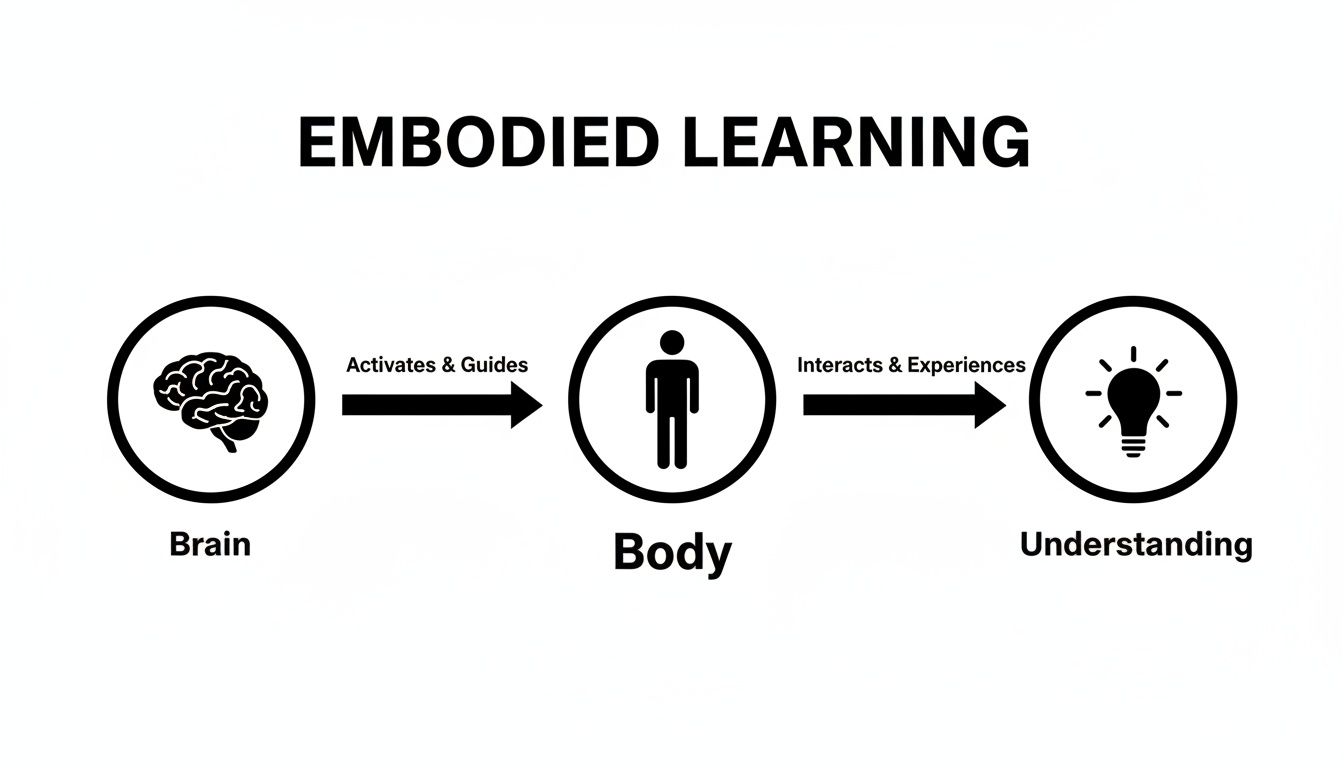
The takeaway here is huge: real understanding isn't just a lightbulb moment in your head. It's the result of a feedback loop where your brain tells your body what to do, and your body's experience tells your brain what it all means.
To make the distinction crystal clear, let's break down how embodied learning stacks up against the old-school way of doing things.
As you can see, the difference isn't just a matter of style—it's a fundamental shift in how we approach learning itself, moving from knowing about something to knowing it in our bones.
Now, this isn't some woo-woo concept; it's backed by some seriously compelling evidence. Research consistently shows that mixing physical movement and sensory experiences into learning gives academic performance a major boost.
For instance, a massive analysis of 46 different studies confirmed that embodied learning methods are flat-out more effective than traditional, passive approaches. The researchers found that students who physically acted out concepts blew past those who just watched. It’s a powerful testament to the power of doing over just observing. If you’re a data nerd, you can read the full research about these learning outcomes and see the numbers for yourself.
Here’s the bottom line: Your body is your most underrated learning tool. By consciously getting it in on the action, you unlock a more intuitive and powerful way to grasp new skills and ideas.
This is especially true for a practice like yoga, where the entire point is to unite mind and body. The sensation of grounding through your feet in Mountain Pose or lengthening your spine in a forward fold teaches you more about alignment than any verbal cue ever could.
By treating each pose as a little physical experiment, you transform your yoga practice from a simple workout into a true journey of discovery.
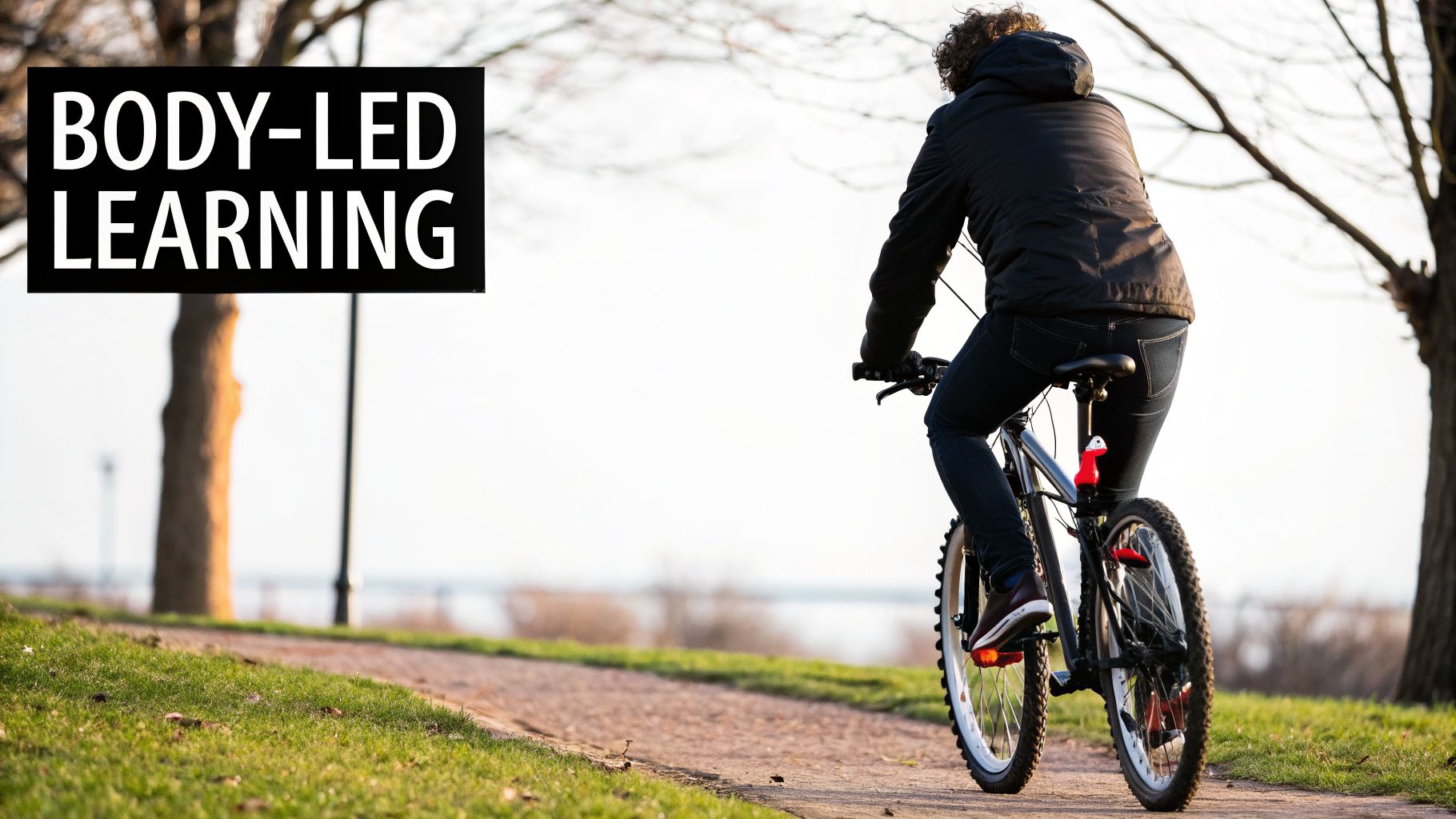
To really get why learning with your body feels so natural, we need to peek behind the curtain at a fascinating concept called embodied cognition. This idea completely flips the old script. It argues that your mind isn't some isolated supercomputer tucked away in your skull. Instead, your thoughts, feelings, and even your brightest ideas are shaped by your entire physical being.
Think of your body as a massive, intelligent network of sensors. Your feet feel the ground's texture, your muscles send constant updates on balance and effort, and your posture can even broadcast your mood. This river of physical information flows to your brain, influencing everything from abstract concepts to how you solve complex problems.
The connection between your mind and body isn't just philosophical—it's hardwired into our brains. Neuroscientists have shown that when we move, we create stronger, more lasting neural pathways. It's the difference between looking at a map of a forest and actually hiking a trail through it yourself.
Which experience do you think sticks with you? The physical act of moving through the space, feeling the uneven ground, and ducking under branches creates a rich, multi-sensory memory that a flat image just can't touch. When you do something, you're not just telling your brain about it; you're inviting it to join the party.
This is exactly why practicing a yoga pose feels worlds apart from watching a video of it. Those tiny, instinctive adjustments your body makes to find balance are actively teaching your brain what stability feels like on a physical level.
Yogis, dancers, and martial artists have known this for centuries. They understood that true mastery doesn't come from intellectualizing a movement, but from experiencing it directly in the body. It’s pretty cool to see modern science finally catching up to this ancient wisdom. This is where embodied and kinesthetic learning often shake hands. If you want to explore this more, check out our guide on what kinesthetic learning is.
Researchers now see that our bodies do way more than just follow orders from the brain; they actively help us think. The way you stand, the gestures you make while talking, and the sensations you feel are all part of a dynamic feedback loop that shapes how you understand the world.
Embodied cognition is the scientific proof behind what we often call a "gut feeling." It acknowledges that our physical state—our posture, our breath, our movements—isn't separate from our mental state but is deeply, fundamentally connected to it.
This integrated system is why standing tall can actually make you feel more confident, or why taking a slow, deep breath can quiet a racing mind. Your body isn't just a vehicle; it’s your co-pilot on the journey to understanding.
This isn’t just some fun theory to toss around; it has real, measurable effects. Study after study shows that when we get our bodies involved in learning, we get better results.
For instance, when students use their hands to gesture while working through a math problem, they often find the solution more easily. The physical act of "shaping" the problem with their hands helps organize their thoughts and cements the concept in their minds. This is embodied learning in action—using the body to help the brain do its best work. Your body doesn't just express ideas; it helps you form them in the first place.
This whole idea of embodied learning isn’t just some lofty theory for academics to debate—it's happening all around us, often in places we don’t even think to look. It’s the secret sauce that transforms abstract concepts into skills you can actually use. Once you start paying attention, you’ll see it everywhere.
The principle is refreshingly simple: when you involve your body in the learning process, the information sticks. It becomes more intuitive and way easier to remember. It’s about moving knowledge out of your head and into your hands, your feet, and your very bones.
Let’s start with a place we’ve all been: the classroom. Picture a group of elementary school kids wrestling with a tough math problem. The old-school method? Drill them with the formula on a whiteboard until someone gets it. But an embodied learning approach gets them up and moving.
Teachers using this method might have students use physical blocks to represent numbers or create hand gestures to show what addition and subtraction actually do. The physical act of moving blocks or shaping their hands creates a tangible experience the brain can lock onto. Suddenly, abstract numbers on a page become real objects they can manipulate. The result? They don't just solve the problem; they understand it on a much deeper level and remember it for way longer.
And this isn't just a hunch. A UK program for students who were falling behind brought movement and language exercises into their lessons. The outcome was a huge leap in their national test scores for reading, writing, and math. Even better, teachers reported that students were more focused and their behavior improved. It turns out letting kids move can actually help them sit still and learn. For a closer look, you can dive into the review that highlighted these educational findings.
The Takeaway: The body isn't a distraction from learning; it’s a direct pathway to it. When students embody concepts, they build a deeper, more resilient understanding that goes beyond rote memorization.
This same principle holds true whether you're a kid learning multiplication or an adult tackling a new language. Physically pointing to objects as you name them or using dramatic gestures to act out a new word creates a much stickier memory than just staring at a vocabulary list.
Now, let's roll out the yoga mat, which is arguably one of the most powerful spaces for embodied learning. Here, every single pose is a lesson just waiting to be felt. A yoga practice built on embodied principles is a world away from one that's just about copying shapes. It’s about shifting your focus from "How does this look?" to "How does this feel?"
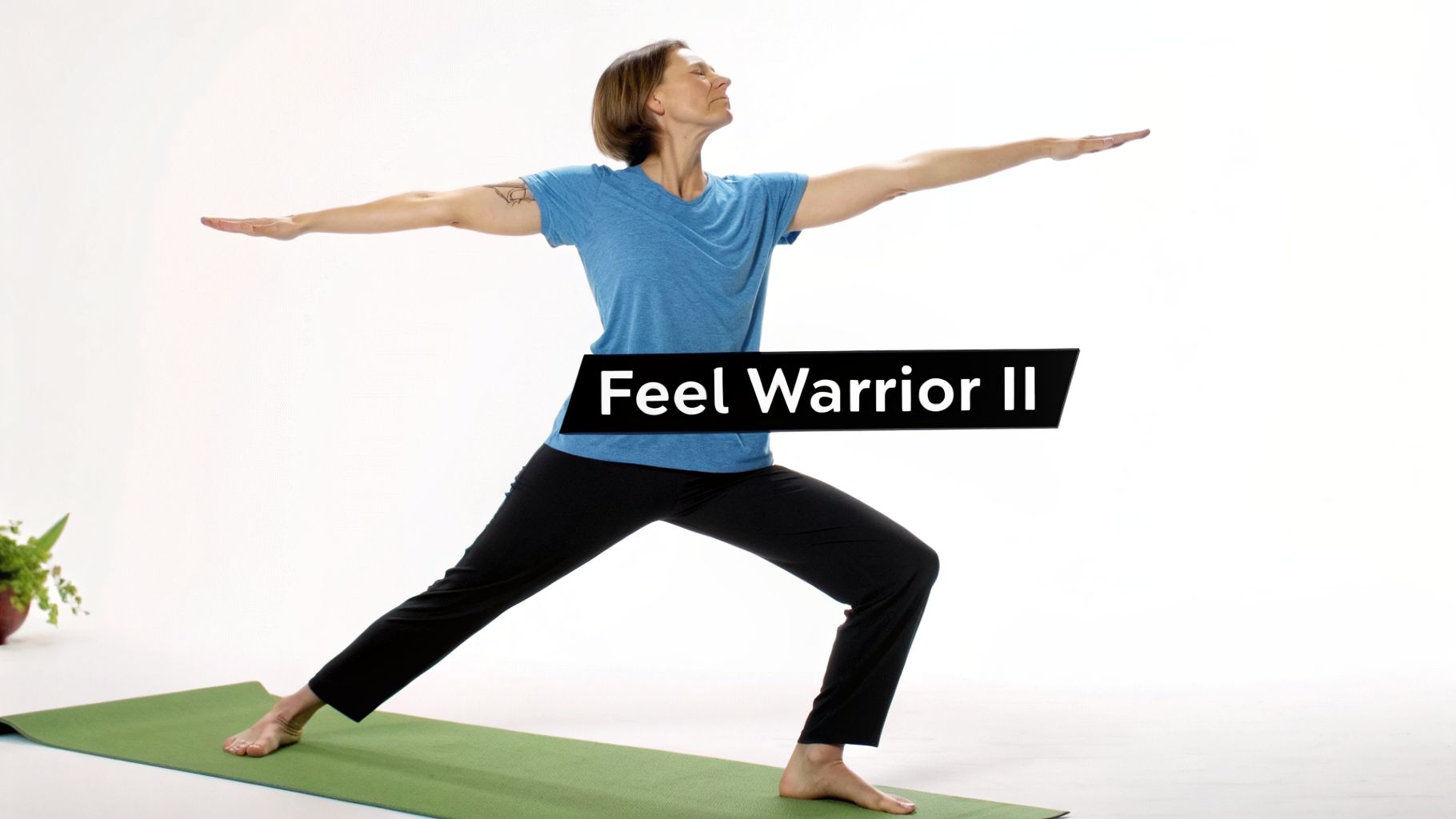
Let's unpack this with a classic pose: Warrior II (Virabhadrasana II).
When you first learn it, you probably just mimic the instructor, trying to get your arms and legs into roughly the same position. That's imitation, not embodiment. The real magic begins when you start to tune into the internal sensations of the pose.
Feel the Ground: Don't just place your feet. Actively press down through all four corners of each foot. Feel how that simple shift creates a chain reaction, firing up your leg muscles and giving you a solid, unshakeable foundation.
Discover Your Hips: Instead of just cranking your hips open, explore the sensation of opening them. Notice the subtle stretch in your inner thighs and the feeling of space you're creating in your pelvis. This is your body teaching you about alignment from the inside out.
Extend Your Energy: Rather than just holding your arms up, imagine energy radiating from your core, flowing down your arms, and shooting out through your fingertips. This transforms the pose from a static hold into a dynamic expression of power and expansion.
Each of these cues is an invitation to connect with your body on a much deeper level. The pose stops being just a physical shape and becomes a rich experience of sensation, balance, and intention. That "aha!" moment—when you finally feel the stability in your feet or the true opening in your hips—is the essence of embodied learning. It's when your mind and body finally sync up, turning yoga from a workout into a profound journey of self-discovery.
When we hear “embodied learning,” it’s natural to think about the most obvious win: you learn a skill better. Fair enough. But the real magic lies in the ripple effects. Engaging your entire body in the learning process doesn't just sharpen a new skill—it sends waves of positive change across your mental, emotional, and even physical wellbeing.
The rewards go way beyond just "getting it" faster. This whole-self approach builds a stronger, more connected, and more confident you from the inside out.
One of the most immediate perks of learning with your body is a huge boost to your memory. When you learn by doing, you’re not just filing away a single piece of information in your brain. You’re weaving a rich, multi-sensory web of connections—how the movement felt, the space you occupied, the subtle shift in balance you finally nailed. All this makes memories incredibly sticky and easy to pull up later.
It also transforms abstract ideas into something you can actually grasp. Concepts that once seemed fuzzy suddenly click when you can link them to a real, physical sensation. This is why a yoga student who can literally feel the external rotation of their thigh in a standing pose has a much deeper understanding of alignment than someone who just reads about it in a book. That physical lightbulb moment turns theory into true, intuitive knowledge.
The good stuff doesn't stop with your brain. When you start tuning into your body’s signals and trusting its feedback, something incredible happens to your confidence. Nailing a tricky yoga pose or finally feeling the “aha!” of proper alignment isn't just a mental victory. It's a tangible win—concrete proof of your ability to learn, adapt, and grow.
This newfound self-awareness doesn't just stay on the mat, either. It seeps into the rest of your day, fostering a powerful sense of mindfulness. Suddenly, you'll catch yourself noticing your posture while hunched over a laptop or paying attention to your breath when you start feeling stressed.
By learning to listen to your body, you develop a powerful internal compass. This practice cultivates a deep sense of presence and self-trust that builds a foundation for greater emotional regulation and resilience.
Here’s something really cool: this method can be a great equalizer. One fascinating study on statistics education found that students who engaged in embodied activities—acting out the concepts—caught up with their more knowledgeable peers way faster. For these beginners, the "Perform-First" approach led to post-test scores that were far less dependent on their prior knowledge compared to traditional learning groups.
The results were stunning. This hands-on method led to up to 30% higher accuracy on certain tasks. It’s solid proof that getting your body in the game can help close the gap for newcomers. You can dive into the full study about how embodied activities support beginners on escholarship.org.
Ultimately, all these benefits feed into each other, creating a powerful upward spiral.
By inviting your whole self to the party, you’re not just learning something new. You’re building a more integrated, aware, and capable version of you.
The path of embodied learning is all about tuning into your body’s unique language. It's a deeply personal journey. But let's be real—it can be incredibly hard to figure out what you're supposed to be feeling, especially when you're just starting out or wrestling with a tricky new pose. This is where a little bit of smart tech can make a world of difference.
Imagine having a top-tier yoga instructor in your living room, available 24/7. Not just an instructor who tells you what to do, but a coach who gives you hyper-specific, real-time pointers that help you forge that mind-body connection way faster. It’s the bridge between just looking at a pose and truly feeling it from the inside.
When we first learn yoga, most of us just watch an instructor and try to mimic their shapes. It's a natural way to start, but it's really just imitation. The magic of true embodied learning kicks in when your focus shifts from the outside in, and you start to understand the sensation of correct alignment.
An AI yoga guide is designed to help you make that leap. Using sophisticated pose analysis, it can spot tiny misalignments you’d never catch on your own. It won't just say, "Straighten your leg." It might whisper, "Ground down through your back heel to wake up your hamstring," directing your awareness to a very specific physical action.
This process seriously speeds up your learning by teaching you what proper alignment feels like, from your bones to your skin. All of a sudden, you're not just making a shape with your body; you're experiencing the pose as a complete system of energy, stability, and flow.
An AI guide doesn't replace your inner teacher; it gives it a clearer voice. Think of it as a set of expert eyes that connects abstract cues to concrete physical feelings.
This kind of technology opens the door to deep embodied practice for everyone, regardless of how long they've been on the mat. It takes the guesswork out of the equation and helps you build a practice that's safer, smarter, and way more tuned-in. If you're curious about the tech itself, you can learn more about how a smart yoga mat becomes the foundation for this experience.
One of the coolest things about using an AI guide like Dalm is seeing your own progress unfold over time. Embodied learning isn’t about nailing a "perfect" pose overnight. It’s about all the small, incremental discoveries you make along the way.
An AI coach makes this journey tangible. It doesn’t just feel like you’re getting better; you can actually see it.
Real-Time Feedback: You get instant voice cues that help you self-correct right in the moment. This creates an immediate link between making an adjustment and feeling the new sensation. You finally learn what a one-degree shift in your hips actually feels like.
Pose Analysis: The AI breaks down your alignment with incredible precision, pinpointing exactly where you might be compensating or holding back. This targeted info lets you focus your awareness right where it's needed most.
Progress Tracking: Celebrating your wins is a huge part of the journey! Seeing hard data showing your balance in Tree Pose has improved by 15% or that you’re sinking deeper in Warrior II gives you concrete proof that your body is getting smarter.
This cycle—perform a pose, get precise feedback, make a tiny adjustment, and feel the difference—is the very engine of embodied learning. The AI is a patient, consistent partner in this dance, guiding you toward those "aha!" moments where it all just clicks. It helps you learn to listen to, trust, and ultimately understand your body’s own profound wisdom. You become your own best teacher.
Alright, enough with the theory. It's time to get this stuff out of your head and into your body. This is your hands-on guide for turning the idea of embodied learning into a real, tangible feeling on your yoga mat. We're going to take a fundamental pose and explore it not just with our minds, but with our entire being.
This isn't about simply copying a shape you see on a screen. Think of it more like starting a conversation with your own body. The goal is to shift your focus from, "Am I doing this right?" to "What can I feel right now?"
We’ll start with what seems like the easiest pose in the book: Mountain Pose, or Tadasana. It’s so often rushed through or dismissed, but honestly, it’s a whole universe of sensation just waiting to be explored. Let go of trying to look like a perfect statue; we're going to build this pose from the ground up, one sensation at a time.
In just those few moments, you’ve had a rich, embodied experience. You didn't just think about grounding yourself; you physically felt the earth supporting you through your feet. That’s the heart of it all. If you want to dive deeper into this feeling of alignment, you might enjoy our guide on postural awareness exercises.
Now, learning to listen to your body’s internal signals is a skill, and like any skill, it takes time and practice. This is where an AI yoga app like Dalm can be a game-changer, acting as an accelerator to help you zero in on these subtle feelings with an almost expert eye.
Think of it as having a coach who can hear what your body is whispering. The AI isn't just there to correct your form. It guides your awareness to what you should be feeling and where, fast-tracking that all-important mind-body connection.
When you're using an AI guide, try not to just passively follow the instructions. Instead, use the feedback as a breadcrumb trail leading you back into your own physical experience.
Consider this your launchpad. From here, every single pose becomes an opportunity for discovery. By shifting your focus to the feeling, you transform your practice from a simple workout into a fascinating, ongoing dialogue with your wisest teacher: your own body.

As you start to explore embodied learning, it’s totally normal for a few questions to bubble up. The whole idea can feel like a paradox—somehow both anciently familiar and totally new.
Let’s tackle some of the most common head-scratchers with simple, no-fluff answers. Think of this as your friendly FAQ for connecting these powerful concepts to your own yoga practice and daily life.
Heck no! While yoga is a fantastic playground for embodied learning, the truth is, it applies to just about everything. It’s all about using your physical body to understand and interact with the world around you, whatever you’re doing.
Ever found yourself talking with your hands when explaining something tricky? That’s it. You’re doing it when a child uses physical blocks to figure out a math problem, or when actors role-play a scene to truly get a character. The magic happens when you bring your body into the learning process, turning an abstract idea into something you can actually feel.
This is a great question, because they're definitely related, but there’s a crucial difference. Let's break it down.
Kinesthetic learning is a preference. It’s a label for folks who learn best through hands-on activity and "doing." It's one of several learning styles.
Embodied learning is a universal process. It’s a much bigger idea from cognitive science that suggests all of us—no matter our preferred style—think and learn through our bodies.
So, a kinesthetic learner might naturally reach for physical ways to learn. But the concept of what is embodied learning argues that our brains are built to learn this way from the ground up. We all benefit from it because we’re all wired for it.
Embodiment isn't just a learning style; it's how the human mind is designed to work. It’s the recognition that your body isn't just a vehicle for your brain—it's an active partner in the process of thinking and understanding.
You absolutely can. In fact, you already are! Embodied learning is as old as humanity itself. You can dive deeper right now just by paying more attention to what your body is telling you.
Feel the soles of your feet connecting with the ground as you walk. Notice the different textures of vegetables as you chop them for dinner. Tune into the sensation of your muscles lengthening in a good morning stretch. This simple, mindful attention is the heart of the practice.
Where technology comes in, like an AI-powered yoga app, is as an incredible accelerator. It doesn't invent the experience, but it gives you the kind of precise, expert-level feedback that helps you build that mind-body connection way faster and more effectively. Think of it as a helpful guide, not a required ticket.
Ready to feel how an AI guide can deepen your embodied practice? Dalm offers real-time, medical-grade pose feedback to help you tune into every movement. Start your journey at dalm.co and see what it feels like to transform your practice from the inside out.