
What Is Functional Fitness Training and Why It Matters

Functional fitness is all about training for life. It’s not about building biceps that just look good in the mirror; it's about building a body that can handle whatever you throw at it, whether that's hoisting a toddler, carrying all the groceries in one trip, or just getting up off the floor with ease.
Instead of isolating muscles one at a time, functional training strengthens the movement patterns you use every single day. Think squatting, pushing, pulling, and carrying. It's about developing usable strength that makes you more capable and resilient in the real world.
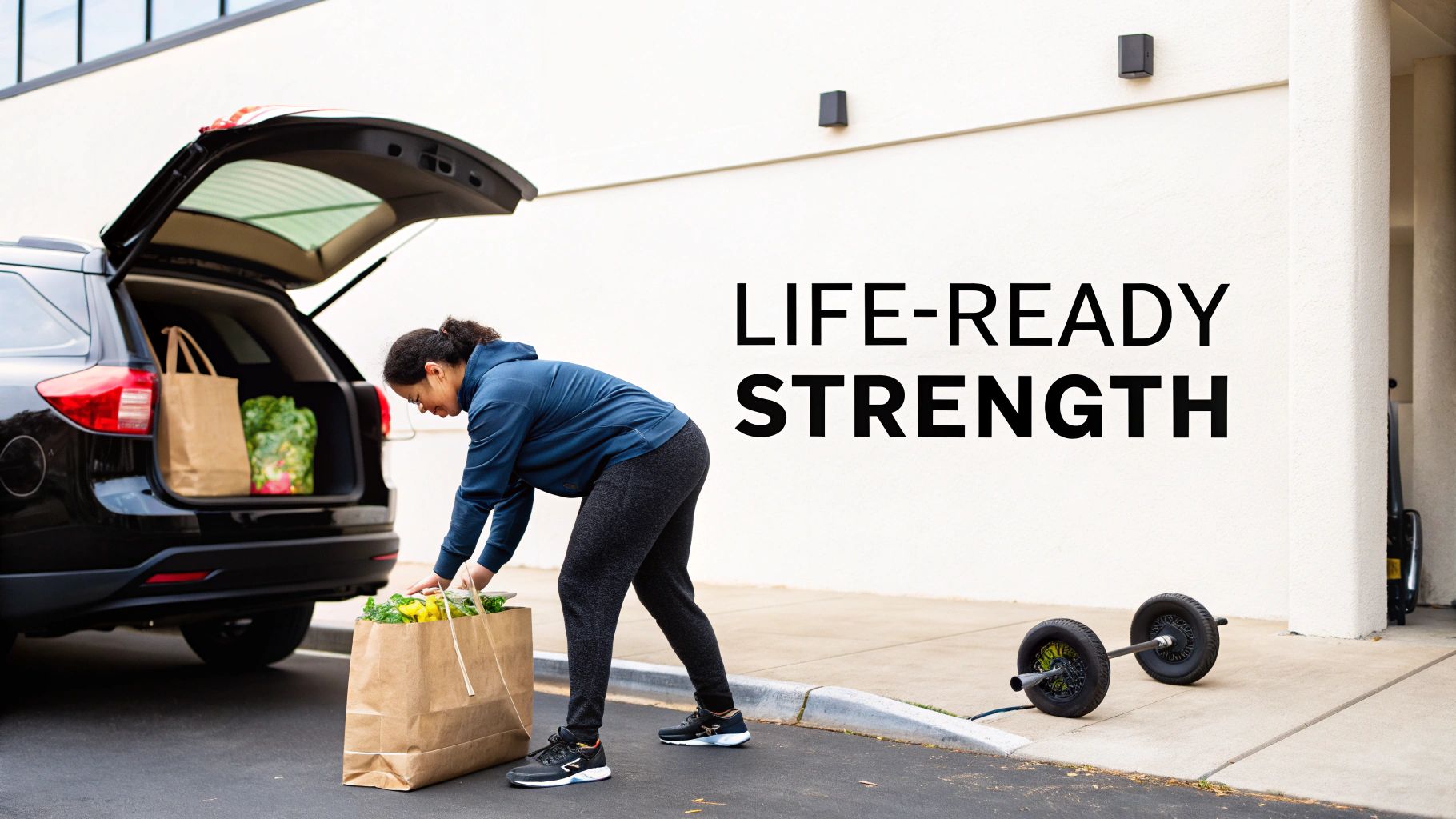
Ever feel like a superhero at the gym, crushing your personal best on the leg press, only to throw your back out a week later while lugging a case of water from your car? It's a classic—and frustrating—example of how being "gym strong" doesn't always translate to being "life strong."
This is exactly the problem functional fitness was born to solve. It bridges the gap between the gym and your daily life by shifting the focus from single-muscle exercises (like bicep curls) to integrated, multi-joint movements that your body was actually designed to perform.
It's less about aesthetics and more about preparing for life’s messy, unpredictable physical challenges. This whole approach actually got its start in physical therapy, where the goal was to help people regain the strength and coordination for simple, everyday tasks. Now, it’s a full-blown movement for anyone who wants a body that’s as useful as it is strong.
And it seems everyone is catching on. Functional fitness training has exploded in popularity, rocketing to the 9th top fitness trend for 2025. People are tired of workouts that don’t deliver practical, real-world benefits.
This massive shift in mindset is driving big business, too. The global market for functional fitness equipment is expected to jump from $17.01 billion in 2023 to a staggering $25.17 billion by 2030. You can dig into the details of this fitness equipment market trend to see just how big this wave is.
The goal isn’t perfection in the gym; it’s freedom and confidence in everyday life. Functional training builds a foundation to stay active, capable, and injury-free.
To really get what functional fitness is all about, it helps to see how it stacks up against the old-school way of working out.
Here’s a quick comparison to highlight the fundamental differences in approach, goals, and common exercises between functional and traditional fitness routines.
As you can see, the core philosophy is completely different. One prepares you for a specific, controlled lift in the gym; the other prepares you for pretty much everything else.
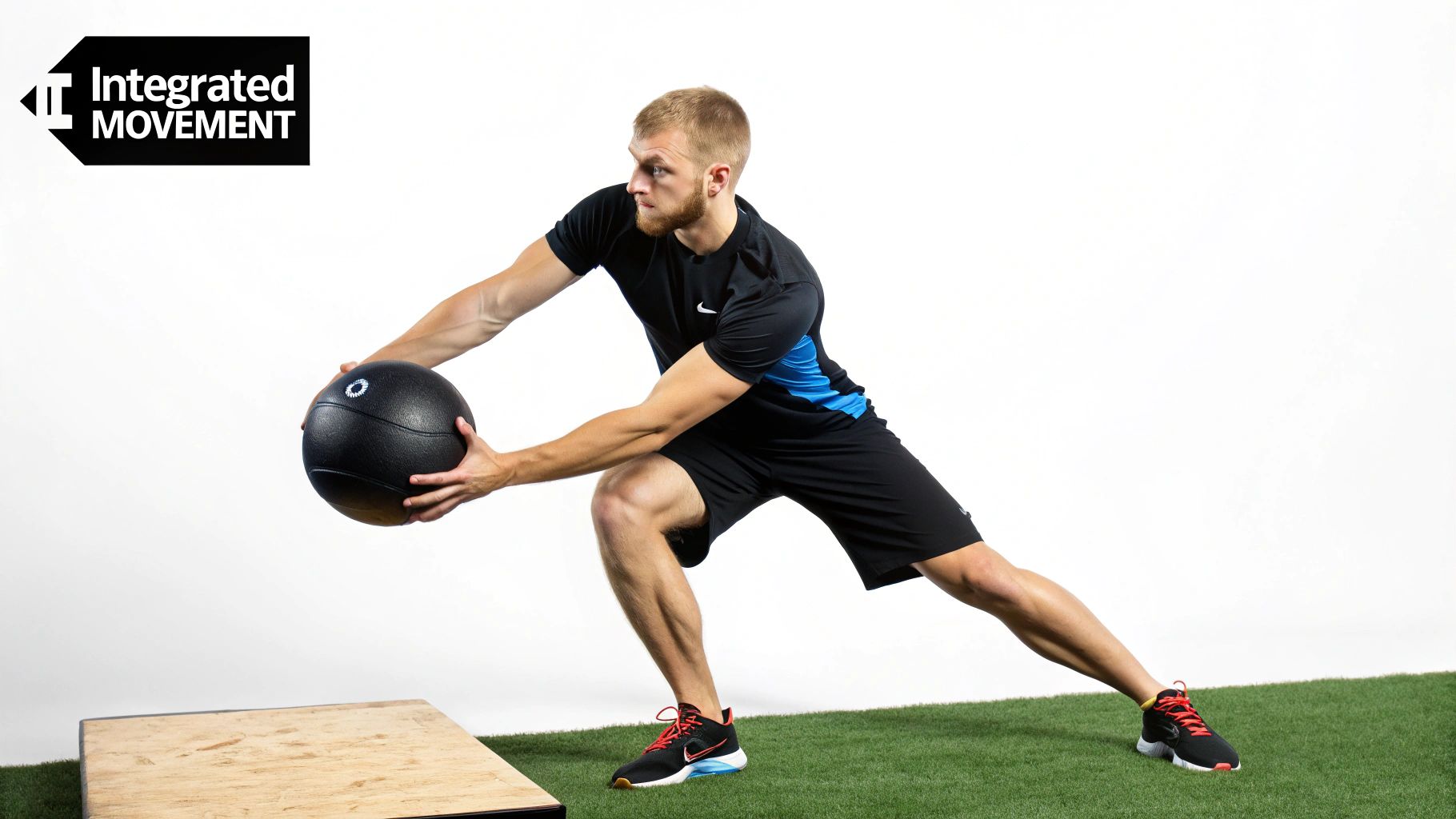
So, what’s the secret sauce that makes functional fitness work so well? It’s not just a random collection of cool-looking exercises. It's a philosophy built on a few core principles that completely change the game when it comes to building strength.
Forget thinking about your body as a collection of separate parts. The central idea here is that your body is one big, interconnected system. Every single thing you do—from hoisting a heavy grocery bag out of the car to sprinting across the street—demands that your muscles work together in perfect harmony. Functional fitness is all about training for that kind of teamwork.
Most of us started our fitness journey with exercises that target one muscle at a time. Think bicep curls or leg extensions. They have their place, but functional training flips that idea on its head by focusing on multi-joint, compound movements.
A perfect example is the squat. When you squat, you’re not just working your quads. You’re firing up your hamstrings, glutes, and core all at the same time. These are the exercises that mimic what you actually do in real life. You never just use your bicep to lift a heavy suitcase off the floor; you use your legs, back, core, and arms as a single, powerful unit. That’s the kind of strength that matters.
And it’s not just a niche trend. The fitness world is catching on, big time. Post-pandemic, gym space for free weights and functional training areas shot up by 25-30%, while the cardio machine sections actually got smaller. It’s all because consumer demand for this style of training has exploded by 40% since 2022. You can read more about how the U.S. fitness industry is evolving to keep up.
Life isn't a video game where you only move forward and backward. We’re constantly twisting, turning, and moving side-to-side. You twist to grab something from the back seat, you sidestep to avoid a puddle, and you rotate your whole body to throw a ball for your dog.
Functional fitness prepares you for this three-dimensional reality by training you in all three planes of motion:
By training your body to be strong and stable in every direction, you’re building a truly resilient machine that’s far less likely to get injured when life throws you a curveball.
Functional fitness doesn’t just build muscle; it builds coordination. It trains your brain and muscles to speak the same language, resulting in smoother, more efficient, and safer movement in everything you do.
This sounds super technical, but the concept is actually pretty simple. Functional fitness is like upgrading the communication highway between your brain and your muscles. We call this neuromuscular coordination—getting the right muscles to fire at the right time with just the right amount of force.
Every time you do a complex exercise like a kettlebell swing, you aren't just building muscle. You're fine-tuning that mind-body connection. It’s all tied into your body’s natural sense of where it is in space. Want to go deeper on that? Check out our guide on what is proprioception training.
The better that connection gets, the better your balance, agility, and reaction time become. It’s what turns you into a capable "everyday athlete" ready for anything.
Let’s be honest, the real magic of functional fitness isn't just about looking better—it's about feeling unstoppable. It shifts the entire purpose of working out from aesthetics to pure, unadulterated capability. We're talking about building a body that’s resilient, confident, and ready for whatever life throws at it.
A huge win here is how it dramatically slashes your risk of getting hurt. Many traditional workouts chase the "mirror muscles," leaving the small but mighty stabilizing muscles that protect your joints in the dust. Functional fitness puts these unsung heroes front and center, forging them into a rock-solid support system.
Think of it as building a protective internal scaffolding. This means you’re far less likely to throw out your back lifting a heavy box of holiday decorations or pull a shoulder reaching for that top-shelf item. You're building a body that’s durable by design.
Whether you’re a weekend hiker or a competitive athlete, functional fitness is the secret sauce for upping your game. The skills it hones—raw strength, solid balance, sharp coordination, and nimble agility—are the very foundation of nearly every athletic move imaginable.
It just makes sense. A monster golf swing? That comes from rotational core power. A lightning-fast crossover on the basketball court? You need stable knees and hips for that. A blistering tennis serve? That’s all about channeling power from your legs, through your core, and out through your arm.
By training the way your body is actually meant to move, you’re not just getting "gym strong." You're directly upgrading your performance in any sport or activity you're passionate about.
Forget sports for a second. Perhaps the most rewarding part is the effortless confidence you'll start to feel in your day-to-day life. Better balance means you're no longer second-guessing yourself on an icy patch of sidewalk or a crowded flight of stairs.
Functional fitness doesn't just change how you look or how much you can lift. It fundamentally changes how you move through the world, making daily tasks feel effortless and safe.
This newfound confidence even affects how you carry yourself. A strong, engaged core is nature's corset, helping you stand taller and sit straighter, which can be a game-changer for nagging back and neck pain. Pairing this with some simple postural awareness exercises can seriously amplify these perks for long-term health.
Suddenly, hoisting your kids into the air, rearranging the living room furniture, or spending a full day gardening doesn’t feel like a recipe for a week of soreness. These are just things your capable body does. You're not just training for an hour a day; you're investing in a more vibrant, active, and pain-free life, 24/7. Now that's a return on investment.
Ready to ditch workouts that feel disconnected from real life? Let's get practical and break down functional fitness into the five fundamental movements your body was literally designed to perform. Think of these as the operating system for your body—the core programs you run every single day without even realizing it.
Nailing these patterns is your express pass to moving better, feeling ridiculously strong, and building a body that’s prepared for whatever life throws at it. We’re talking about the Squat, Hinge, Push, Pull, and Carry. Each one is a non-negotiable cornerstone of a truly capable human machine.
Getting started with functional fitness is way simpler than you might think. You don't need a room full of chrome-plated machines. You just need to re-learn how your body is supposed to move.
This diagram perfectly illustrates how these movements directly translate into a better, more resilient life.

As you can see, functional training isn't about looking good in the gym (though that's a nice side effect). It's about building a body that works for you everywhere else.
Okay, theory time is over. Let's put this into action with a simple, effective exercise for each movement pattern. If you're thinking about setting up a space at home for this, you should check out our guide to the best smart home gym equipment.
Here's an easy-to-follow table to get you started. It maps out the essential patterns, example exercises, and what they do for you.
This table is your cheat sheet. Pick one exercise from each category, and you've got a killer full-body workout.
The goal isn't just to lift weight; it's to master the movement. Always start with just your body weight to nail the form before you even think about adding resistance.
This whole approach isn't some new fad. It actually has its roots in physical therapy and exploded into the mainstream through programs like CrossFit, which now has a community of over 10 million people. And the science backs it up. Recent analysis shows that functional training can boost balance by an incredible 28%, increase strength by 22%, and even slash the risk of falls in older adults by a massive 40%. By focusing on these five core movements, you're not just exercising—you're building a foundation for a long, strong, and capable life.
Alright, enough theory. The real magic happens when you start moving. Knowing what functional fitness is matters, but feeling it work in your muscles? That's what really counts.
I've put together two dead-simple workout templates to get you started today. One is perfect for your living room with minimal gear, and the other uses classic gym equipment to build some serious real-world strength.
Pick your playground, and let's get after it.
No gym membership? No problem. This entire routine can be done with just your body and a single resistance band. The name of the game here is control—focus on making every single rep smooth and intentional.
You’ll do these exercises as a circuit. That means you’ll flow from one to the next with as little rest as possible. Once you finish the last exercise (the Farmer's Walk), take a breather for 60-90 seconds, then jump back in and run through the whole thing 2-3 more times.
If you've got access to a gym, this workout is your ticket to leveling up. We're bringing in the big guns—dumbbells and kettlebells—to challenge your strength, stability, and coordination.
For this one, complete all the sets for one exercise before moving on to the next. Don't rush it. Form is your king, especially when you start adding weight to the bar (or bell).
A quick but important note: Don't just jump straight into the main workout. A solid 5-10 minute dynamic warm-up (think leg swings, arm circles, torso twists) is non-negotiable. It gets your body ready for action. Afterward, finish with a 5-minute cool-down of static stretching to help you recover and improve your flexibility. Think of them as the essential bookends to a great session.
It’s awesome to be fired up about starting functional fitness, but let's be real—jumping in too fast is a one-way ticket to the sidelines. If there’s one golden rule to tattoo on your brain, it’s this: master the movement form before you even think about adding weight.
Seriously. Think of it like learning to play guitar. You wouldn’t try to shred a complex solo on day one; you'd start by getting the basic chords right until they're second nature. Rushing the process in the gym is the quickest way to get hurt. Your first, and most important, job is to build a rock-solid foundation of perfect, controlled movement using nothing but your own body weight.
The secret to getting stronger without breaking yourself is a principle called progressive overload. It’s a fancy term for a simple idea: you only make things harder once your body has mastered the current challenge. And "harder" doesn't just mean grabbing a heavier dumbbell.
Progress can take a bunch of different forms:
Only after you’ve milked those options for all they’re worth should you consider adding more weight. This patient, methodical approach is what builds real-world, resilient strength that lasts.
Back in the day, the only way to get instant feedback on your form was to hire a personal trainer to watch your every move. Now, technology can be an incredible co-pilot, helping you train smarter and stay on the right track.
The goal isn't just to get through the workout; it's to understand and improve how your body moves. Safe progression is what turns all that effort into actual results.
This is where AI-powered apps like Dalm are changing the game. By analyzing your movements with some pretty slick precision, these tools give you immediate feedback on your alignment and form. They can spot weak links in your mobility and help you track your progress over time, making sure every single workout is both effective and safe.
It's like having a movement expert in your pocket, giving you the personalized guidance you need to take charge of your training, sidestep injuries, and see faster results.
As you get ready to jump in, a few common questions always seem to surface. Let's tackle them head-on so you can start with confidence, knowing exactly what you're getting into—and what you're not.
Ah, the million-dollar question. I get this one all the time, and the simple answer is no. But I get why people ask.
Think of it like this: all CrossFit workouts are functional, but not all functional fitness is CrossFit. CrossFit is a specific, high-octane brand of fitness—it’s a competitive sport that uses a lot of functional movements. Functional fitness, on the other hand, is the underlying philosophy of training your body for the demands of real life. It’s often tailored to your individual needs and focuses on moving well before moving fast.
So while you'll see a lot of the same exercises, functional fitness isn't necessarily about beating the clock or climbing a leaderboard. It’s about building strength you can actually use outside the gym.
You bet. While the main goal isn't to look like a bodybuilder getting ready for the stage, building lean muscle is a very happy byproduct of training this way. You're constantly performing big, compound movements like squats, lunges, presses, and pulls.
These exercises recruit tons of muscle fibers all at once, which is a potent recipe for growth. You won't get that isolated, "puffy" look, but you will build a powerful, athletic physique—strong legs, a solid back, and a core that's ready for anything. It’s strength that shows because it works.
The point of functional training isn’t just to look strong—it’s to be strong in every part of your life. Building capable, athletic muscle is a huge piece of that puzzle.
Consistency is king, but you don't have to live in the gym. For most folks, hitting 3 to 5 functional workouts a week is the sweet spot. That gives your body a strong signal to adapt and get stronger, while still leaving enough time for crucial rest and recovery.
Can you only swing two sessions a week? You’ll still make great progress in how you move and feel. The most important thing is to listen to your body and find a schedule that challenges you but doesn't burn you out. It’s a marathon, not a sprint.
Ready to stop guessing and start moving with precision? Dalm uses AI to analyze your form, giving you real-time feedback to improve your alignment, boost mobility, and track your progress safely. Take control of your fitness journey by visiting the Dalm website.