
What is gait analysis: what is gait analysis, and how it improves movement
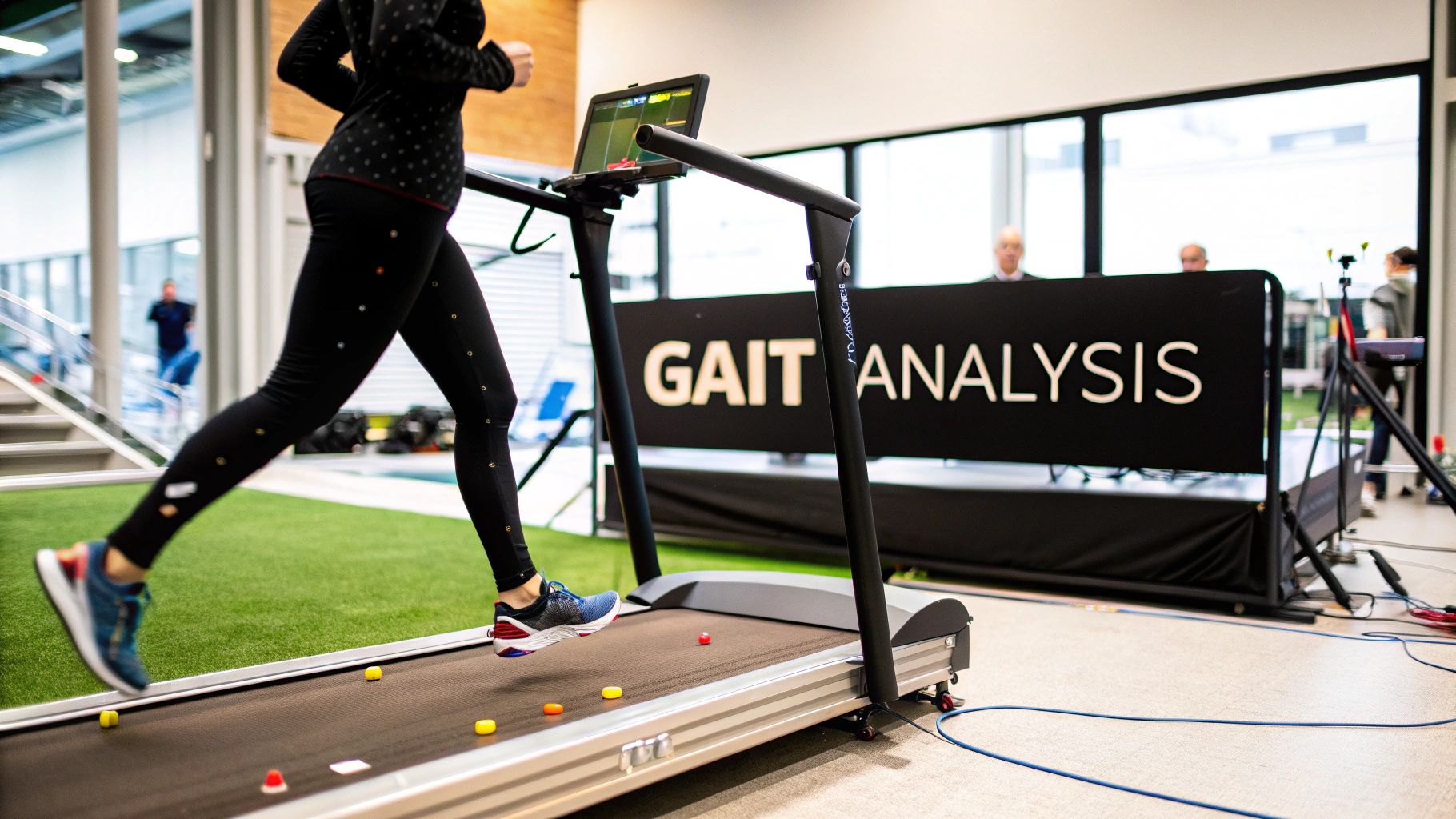
Ever wondered why one person glides when they walk while another stomps? It all comes down to their gait, which is just a fancy way of describing a person’s unique way of walking or running. Gait analysis is the science of breaking down that movement, step by step, to understand exactly what your body is doing.
Think of it like a detective for your movement. It reveals the hidden clues in your stride that point to your body's overall health, efficiency, and any sneaky imbalances you might not even feel.
Your walk is a story your body tells with every step. It’s far more than just a way to get from point A to point B—it’s an intricate, high-speed dance between your muscles, bones, and nervous system.
Just like a car with bad alignment, a small hiccup in your stride can cause major wear and tear over time. That tiny imbalance in your ankle could be the real reason for your nagging back pain, creating a ripple effect that travels all the way up your body. This is why understanding your movement blueprint is so important, whether you're an elite marathoner or just someone who wants to walk the dog without an ache.
While the high-tech tools we use today are new, the idea of studying how we walk is anything but. The first person to really dig into it was Aristotle, who was making notes on human movement patterns in Greece over 2,300 years ago.
This long history proves one timeless truth: how we move matters. From dodging injuries to smashing a personal best, analyzing your gait gives you a powerful inside look at your body’s mechanics.
The goal of gait analysis is to identify asymmetries and abnormalities in your movement. By correcting these patterns, you can reduce stress on your body, improve efficiency, and unlock a new level of physical potential.
To do this, we start by looking at the two fundamental parts of every single step you take.
Every step, whether you're sprinting or strolling, is made up of two main phases. Understanding them is the key to spotting what’s working and what isn’t.
By breaking down this simple cycle, we can pinpoint exactly where things might be going wrong. This detailed view is also deeply connected to your body's sense of its own position in space. In fact, you might be interested in learning more about proprioception training and how it can supercharge your movement.
Ever thought about how you walk? It feels automatic, right? But if your walk could tell a story, gait analysis metrics would be the words on the page. These aren't just dry, technical numbers; they're fascinating clues that reveal how your body accomplishes the incredible feat of moving you from point A to point B.
Think of your walking rhythm, or cadence, as the beats-per-minute of a song. A tempo that's a little too frantic or a bit too slow can hint at problems with efficiency or even stability. Then you have stride length—the distance you cover from one heel strike to the next with the same foot. If your stride is choppy or uneven, it might be a sign of muscle weakness or tightness on one side.
But the story gets much more interesting.
Every single time your foot connects with the ground, the ground pushes back. This is called ground reaction force, and it’s the engine that propels you forward. By looking at these forces, an expert can see if you're a natural shock absorber or if you're landing in a way that sends extra stress rattling up through your joints.
And what about those joints? Your hips, knees, and ankles are the hinges that make this whole operation possible. The joint angles measured during a gait analysis show how well those hinges are doing their job. Are they swinging open and closed with buttery smoothness, or is there a "rusty" spot somewhere that's making other parts of your body work overtime to compensate?
A gait analysis doesn't just measure what your body is doing; it tells the story of why. It translates your unique movement into a clear narrative, shining a light on your strengths and pointing out the little plot twists that might be causing you pain or holding you back.
This whole process breaks down into two fundamental parts: the stance phase and the swing phase.
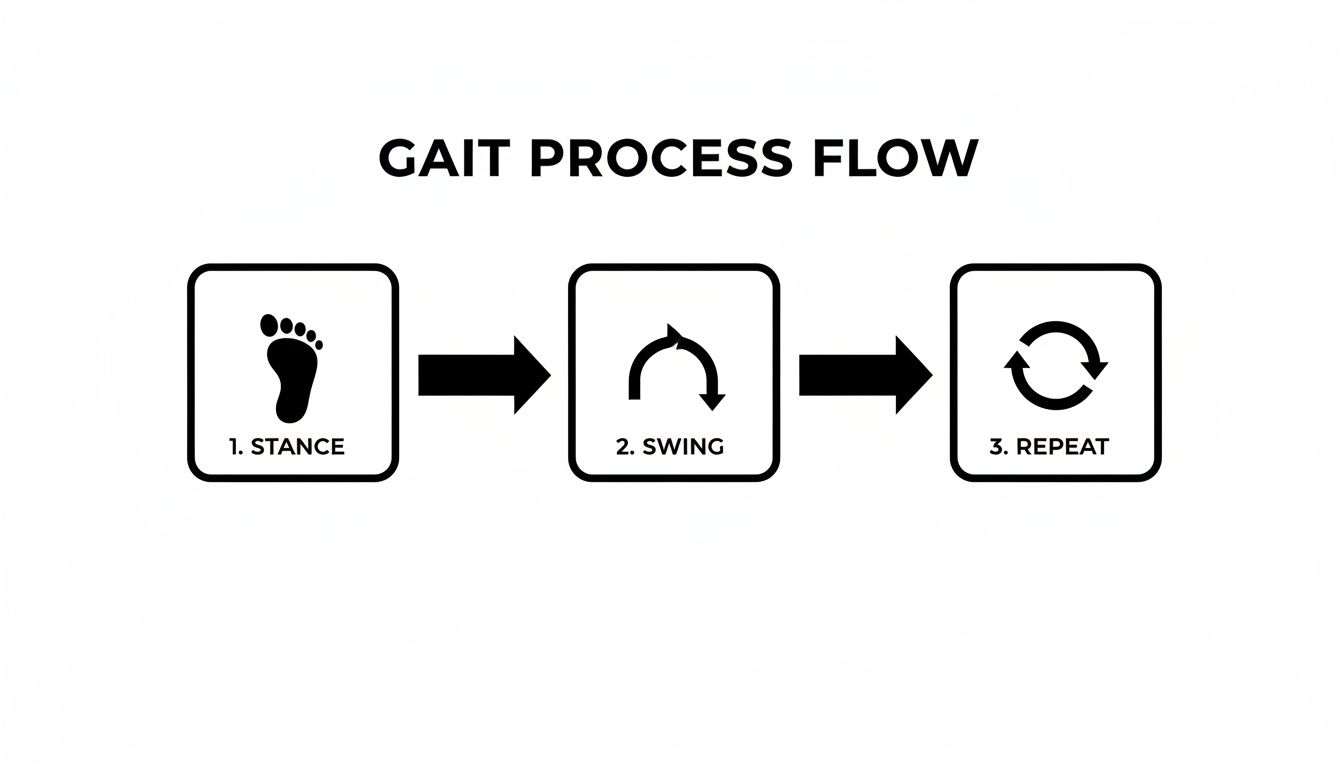
As you can see, a huge chunk of your walking time is spent with one foot planted firmly on the ground. That makes the stance phase absolutely critical for everything from absorbing impact to keeping you upright.
The entire analysis revolves around this gait cycle. For most of us, the stance phase (when your foot is on the ground) makes up about 60% of the cycle, while the swing phase (when your foot is in the air) takes up the other 40%. A healthy adult typically strolls along at a cadence of 110-120 steps per minute with a step length around 0.7-0.8 meters, but of course, these numbers can vary wildly from person to person.
When you put all these pieces together—the rhythm, the distance, the forces, and the angles—a vivid picture of your body's unique mechanics starts to form. Getting a handle on these elements is a massive first step in learning how to improve your balance and stability for years to come.
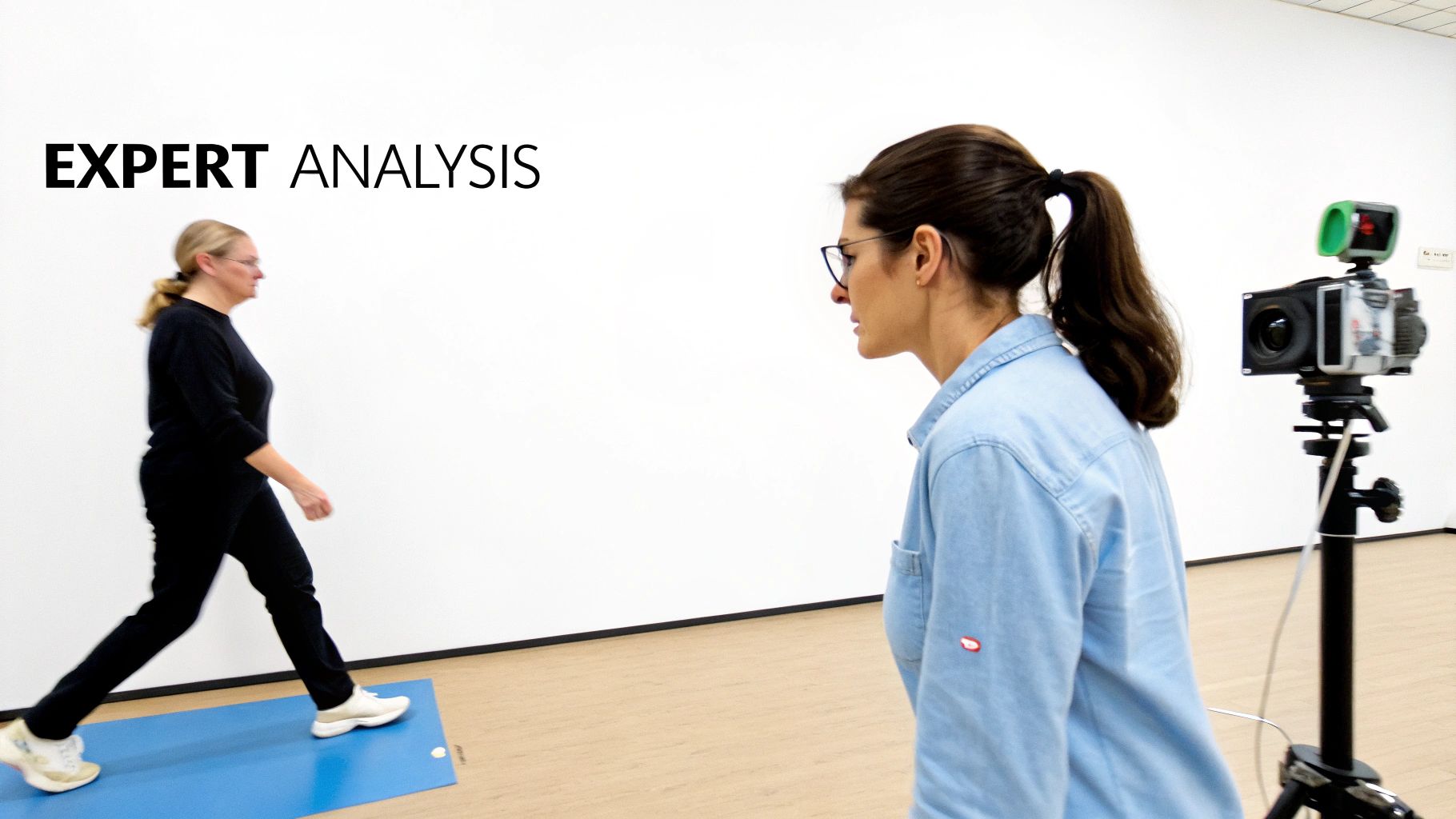
So, how exactly do professionals peek into your movement blueprint? The toolbox for gait analysis is surprisingly diverse, ranging from old-school observation to mind-bendingly futuristic tech. Each method offers a different lens for viewing how you walk.
It all starts with the original movement analysis tool: a pair of expertly trained eyes. A seasoned physical therapist can tell a phenomenal amount just by watching you walk down a hallway. They're scanning for the big picture stuff—any obvious limping, asymmetries between your left and right sides, or quirky patterns that scream, "Hey, look over here!" It's both an art and a science, built on years of experience recognizing what "normal" looks like and when something is slightly off.
To get a much deeper, more granular look, we turn to technology. For decades, the undisputed champion has been marker-based motion capture. If you've ever watched a "making of" video for a movie like Avatar, you know the drill. Actors are covered head-to-toe in little reflective dots.
That same Hollywood magic is used in biomechanics labs to create a stunningly precise 3D digital skeleton of your body in motion. Infrared cameras track every single marker, measuring joint angles and body segment movements with an accuracy the human eye could never hope to match. This approach gives us a mountain of incredibly detailed and reliable data.
The field has come a long way. Over the last 50 years, what started with simple film studies has blossomed into a world of digital processing and artificial intelligence. This evolution has been a godsend for understanding and treating conditions like cerebral palsy, which affects 1 in 345 children, and Parkinson's disease, which impacts over 10 million people worldwide. You can dive deeper into the fascinating history of gait analysis from its photographic origins to modern tech.
As powerful as marker-based systems are, they have one big drawback: you need a dedicated, expensive lab. This is where a new wave of technology is completely changing the game.
Wearable Sensors: Think tiny, smart sensors tucked into your shoes or strapped to your body. These little gadgets measure forces, acceleration, and your body's orientation in space, giving you real-time feedback as you move through your actual life—not just on a treadmill. It’s a fantastic way to see how you really walk day-to-day.
Markerless AI Analysis: This is where things get truly exciting. Using nothing more than a standard camera—yep, even the one on your smartphone—powerful AI algorithms can now identify key points on your body and analyze your movement patterns. This completely removes the need for special markers or clunky equipment, making top-tier gait analysis accessible to virtually anyone. It’s like having a biomechanics expert on call, right in your pocket.
By ditching the lab, markerless AI is making movement health available to everyone. It turns gait analysis from a once-a-year checkup into an ongoing conversation with your body, allowing for continuous monitoring and instant feedback.
This kind of technology is the engine behind many of today's most innovative movement analysis tools. By tracking how your body moves, these systems can offer insights on everything from your walking pattern to your yoga form, much like the feedback you’d get from advanced posture analysis software.
Gait analysis isn't some dusty concept locked away in a research lab. It’s out in the real world, making a tangible difference in people's lives every single day. It’s the tool that turns complex biomechanical data into simple, powerful changes that help people move better, feel stronger, and get back to doing what they love.
Think about a stroke survivor, working tirelessly to regain their footing. Gait analysis is often the unsung hero in their recovery. It can spot the subtle weight shifts and muscle imbalances that are nearly invisible to the naked eye but make all the difference between a hesitant shuffle and a stable walk.
By pinpointing exactly which muscles are lagging or which joints aren't moving through their full range, therapists can craft incredibly precise exercise plans. They're not just guessing; they're rebuilding neural pathways with data-driven purpose.
It’s a similar story for someone managing Parkinson's disease. Gait analysis provides a clear, objective way to track the disease's impact on their movement. It can pick up on a shortening stride or the beginnings of a "freezing" episode, giving doctors the hard data they need to fine-tune treatments and help patients hold onto their independence for as long as possible.
In sports, victory and defeat are often separated by millimeters and milliseconds. For athletes pushing their limits, gait analysis is the key to unlocking that next level of performance and durability.
Ever known a runner who's constantly sidelined by shin splints? A detailed gait analysis will often uncover the culprit: overstriding. This is where you land with your foot way out in front of your body, essentially hitting the brakes with every single step and sending a shockwave right up your leg.
It’s a classic case of working harder, not smarter. By shortening their stride just a bit, a runner not only sidesteps injuries like stress fractures but also becomes radically more efficient. All that wasted energy is suddenly channeled into pure forward momentum.
Gait analysis is brilliant at flagging other common performance killers, too:
By catching these tiny flaws, gait analysis helps rewrite an athlete's story from one of nagging injuries to one of smashing personal records.
The power of gait analysis isn't just for the young and athletic; it's absolutely critical for older adults. For many, staying active and independent hinges on one simple thing: not falling. A fall can be a devastating, life-changing event, but the warning signs are often hiding in plain sight within a person's walk.
A trained eye, aided by technology, can spot the tell-tale signs of increased fall risk: a drop in walking speed, a little more side-to-side sway, or a step that’s become just a bit too short. These aren't just vague "signs of aging"; they are measurable, objective markers of declining stability.
Once you have that data, you can act. A healthcare provider can introduce targeted balance exercises, a simple strength-training routine, or even suggest small changes around the house. By spotting these risks before a fall happens, gait analysis becomes a powerful tool for preserving independence, keeping people on their feet and living confidently in their own homes.
So, you’re about to get your gait analyzed. Whether you're heading to a high-tech lab or using an app on your phone, the whole idea can seem a little intimidating. What are they going to find?
The good news is, it's a pretty straightforward process. Think of it less like a final exam and more like a discovery session about how your body works. It’s all about creating a blueprint of your unique movement patterns.
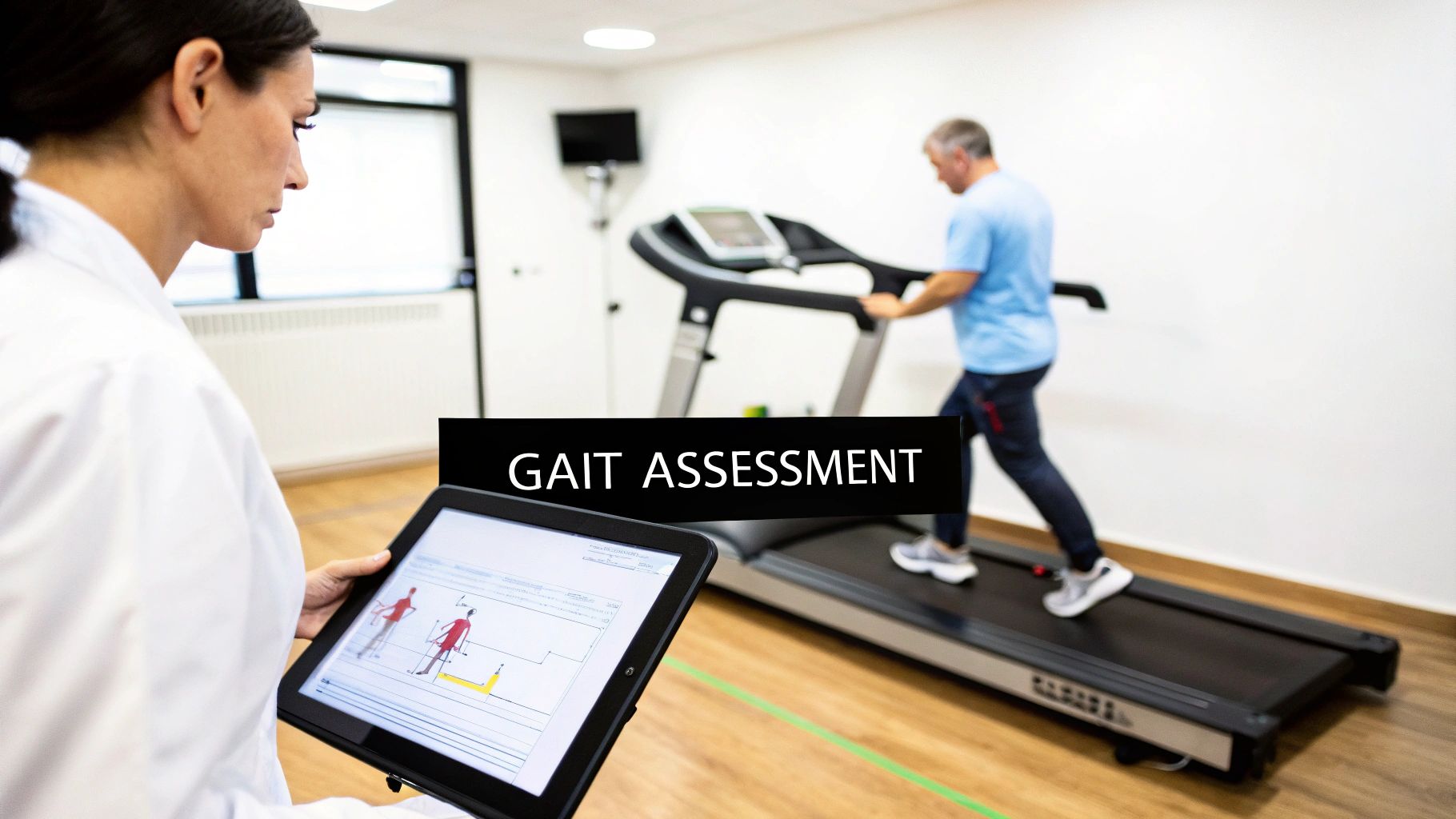
The entire experience is built around one thing: you. Are you here to figure out why that old knee injury keeps acting up? Trying to shave a few seconds off your 5K time? Or are you simply curious about how to move better and feel better? This initial chat sets the scene for everything else.
Before you even start walking, the session kicks off with a conversation. The practitioner wants to hear your story—your activity level, injury history, and what you hope to achieve. This context is everything, because your gait isn't just a set of mechanical movements; it’s a direct reflection of your life.
Next up is a quick physical look-over. Don't worry, this isn't some grueling workout. It’s more of a quick inventory of your body’s hardware. You’ll likely be asked to do a few simple things to check your:
This hands-on assessment helps connect the dots between your body's physical capabilities and how it actually performs in motion. It gives the expert clues that they’ll look to confirm once you start moving.
Alright, time for the main event. This is where you’ll be asked to walk or run, usually on a treadmill or a clear path. While you’re moving, your every step is being captured and recorded.
If you’re in a traditional lab, this might mean having small, reflective markers placed on key points of your body. If you’re using a more modern, markerless system, it's as simple as a camera recording you. Either way, the goal is the same: to gather the raw data of your movement.
The heart of the session is translating your motion into measurable data. Every step you take is turned into a story told through numbers, revealing the forces, angles, and timing that define your stride.
Once the data is collected, it's crunched and analyzed to spot key patterns. The practitioner will then sit down with you and break it all down, often using video replays or charts to make it crystal clear. They’ll show you what you’re doing well and pinpoint any little quirks or imbalances, explaining what it all means for you.
You'll walk away with more than just a bunch of numbers. You’ll have a clear picture of your personal movement signature and, most importantly, a solid plan with actionable steps to improve it.
The next great leap in movement health isn’t some far-off fantasy—it's already here, and it’s powered by artificial intelligence. This isn't just about making things a little easier; it’s about unlocking deep, personal insights for everyone, everywhere.
The days of needing a multi-million dollar biomechanics lab to really understand how you walk are fading fast.
Markerless technology is the engine behind this change. By using nothing more than the camera on your phone, these new systems can analyze your movement with stunning precision. It’s like having a professional motion capture studio right in your living room. This is a ground-up rethinking of how we manage our physical well-being.
Not too long ago, getting personalized, real-time feedback on your movement was a luxury reserved for Olympic athletes. Now, AI-driven tools can give anyone immediate, actionable advice to improve how they move.
This technology puts the power back in your hands. You’re no longer a passive bystander; you're an active participant in your own wellness journey, guided by data that’s all about you.
Getting to know your unique gait is the first, most critical step toward building a stronger, more resilient body. This new wave of tech fits right into your daily life, turning complex biomechanics into a simple conversation with your body. It’s not just about asking “what is gait analysis,” but exploring what it can do for your future.
Let's tackle some of the common questions that pop up around gait analysis. You might be surprised by just how relevant it is to your everyday life and fitness goals.
Not a chance. While gait analysis is a game-changer for rehab, it's just as powerful for prevention and performance. Think of it less like a trip to the emergency room and more like a regular check-up for your body's movement system.
It's all about spotting the small hitches in your mechanics before they snowball into bigger problems. Athletes use it to shave seconds off their time, runners use it to find a more efficient stride, and even yogis can use it to build a more stable foundation for their practice. It’s for anyone who wants to move better.
Gait analysis isn't just about fixing what's broken; it's about fine-tuning what’s working. The goal is to build a more resilient, efficient body for whatever you love to do.
This kind of proactive thinking is the secret to staying active and healthy for the long haul.
That really boils down to your goals. If you're coming back from an injury, your physical therapist will lay out a schedule. For an athlete, getting an analysis done before the season starts is a brilliant way to set a baseline, track improvements, and sidestep injuries when the pressure is on.
For the rest of us? A good time to get checked is when you're kicking off a new fitness routine, if you feel a nagging ache that won't go away, or even if you're just curious about how you can move with a little more grace. Plus, with modern apps, you can get ongoing feedback, turning it into a continuous conversation with your body.
You bet. A high-tech lab will give you the most detailed data imaginable, but technology has brought surprisingly powerful tools right into our living rooms. Many specialty running stores offer a basic video analysis to help match you with the right pair of shoes, which is a great starting point.
But things have gotten even cooler. Advanced tools that use nothing more than your phone's camera can now give you some seriously sophisticated insights into your movement patterns. This makes it easier than ever to understand how you move and take charge of your own physical health, no appointment necessary.
Ready to see how AI can transform your movement practice? Dalm uses medical-grade pose analysis to give you real-time feedback, helping you perfect your yoga form and build a stronger mind-body connection. Explore a smarter way to practice at https://dalm.co.