
What is Hatha Yoga? A Beginner's Guide to Its Benefits and Core Poses

So, you’ve heard the word "yoga" tossed around, and maybe you've pictured someone twisted into a pretzel. If that seems a little intimidating, let me introduce you to Hatha yoga. Think of it as the friendly, welcoming grandparent of almost every yoga style you see today.
Hatha is all about the fundamentals: combining physical postures (asanas) with controlled breathing (pranayama) and a sprinkle of meditation. The pace is gentle and deliberate, making it the perfect starting point for just about anyone.

If you're feeling a bit lost in the sea of yoga styles, Hatha is your anchor. The name itself gives you a clue to its philosophy. In Sanskrit, "Ha" means sun, and "tha" means moon. So, Hatha yoga is all about bringing these two opposite forces into harmony—the energetic and the calm, the effort and the surrender—to find a beautiful balance within yourself.
Unlike the cardio-heavy, fast-flowing styles like Vinyasa, a Hatha class is all about hitting the pause button. You’ll hold individual poses for a while, giving you plenty of time to figure out what you’re doing. This slower pace lets you really feel the stretch, nail your alignment, and connect your movement to your breath. It’s less about a non-stop "flow" and more about finding stillness in each shape.
The magic of Hatha lies in a few simple, yet profound, ideas that work together to soothe your mind and build a stronger, more aware body. Getting a handle on these will make your first class feel a lot less mysterious.
To put it simply, here’s a quick breakdown of what makes Hatha, well, Hatha.
These elements come together to create a practice that feels like a meditation in motion.
At its core, Hatha yoga is a moving meditation. It teaches you to find a perfect blend of effort and ease, not just on the mat, but in your daily life. It’s about building a sustainable practice that serves you for years to come.
The bottom line? Hatha is for everybody. It doesn't care if you can't touch your toes or if you've never stepped on a yoga mat in your life. It meets you right where you are, making it the perfect answer for anyone curious about what is Hatha yoga and ready to feel a whole lot better.

Every great tradition has a story, and Hatha yoga’s tale is a rich one, woven through centuries of philosophy and practice. To really get what Hatha yoga is all about, we have to hop in a time machine and travel way back—long before it landed in your neighborhood wellness studio. This isn't just a history lesson; it's the origin story of that peaceful power you feel on the mat.
Think of Hatha less like a sudden invention and more like a massive, slow-growing tree with roots that run deep. Its earliest seeds were planted in ancient tantric traditions, where hardcore practitioners aimed to master their physical bodies to unlock spiritual freedom. We're not talking about a casual drop-in class after work; this was a profound, disciplined path meant for ascetics.
The practice we know and love today really started taking shape over a thousand years ago. While hints of Hatha-like techniques pop up in texts from as early as the 1st century CE, the system itself came together much later. Documented textual origins point back to at least the 11th century, with a bunch of medieval texts pulling a wide range of methods together between the 10th and 15th centuries. You can dive deeper into Hatha yoga's historical timeline to see its full journey.
This evolution was a game-changer. It marked a huge shift from secretive, almost mystical rituals to a more organized approach that could actually be taught and shared. One of the most important texts to come out of this era was the Hatha Yoga Pradipika, written in the 15th century by a yogi named Swami Svatmarama.
The Hatha Yoga Pradipika was basically the first user's manual for the practice. It was one of the first texts to lay out the asanas (poses), pranayama (breathwork), and purification techniques in a clear, systematic way, making the path to self-awareness more accessible than ever before.
This incredible text didn't just give a list of poses; it explained the why behind them. It framed Hatha yoga as the warm-up act for higher states of meditation and consciousness. The physical stuff? That was all about getting your body ready to be a steady, stable container for your mind.
The road from ancient scripture to your local studio was a long one with a few major turning points. Here’s a quick look at how this powerful practice grew up:
This incredible history is exactly why Hatha yoga feels so deep. When you hold a pose, you're not just getting a good stretch. You're taking part in a tradition that's been refined for over a thousand years. It’s a time-tested method for connecting with yourself, one mindful breath at a time.
Millions of people unroll their mats for Hatha yoga, and it's not just for the serene vibes. This ancient practice delivers real, measurable results that science is finally starting to catch up with and quantify. Think of it as a powerful toolkit for the modern world, offering time-tested solutions for everything from a racing mind to a stiff back.
The magic happens where the physical postures (asanas) meet controlled breathing (pranayama). This one-two punch directly influences your autonomic nervous system—your body's internal control panel. It’s what helps you downshift out of that frantic "fight-or-flight" mode and cruise into a calm "rest-and-digest" state.
Let's be honest, one of the biggest reasons people try yoga is to deal with stress. Hatha delivers. By slowing your breath and holding poses with focused attention, you're essentially training your nervous system to stop freaking out over every little thing. This isn't just a feeling; it's a real physiological shift that can lead to lower cortisol levels and less anxiety.
But the benefits don't stop at just chilling out. A consistent practice also gives your brain a serious workout.
Hatha yoga is like a reset button for your nervous system. Each session helps dial down the background noise of modern life, creating space for mental clarity and genuine relaxation.
While Hatha is famous for its gentle pace, don't mistake "gentle" for "easy." This practice systematically builds strength, improves your balance, and increases flexibility in a way that’s both safe and sustainable. It’s a low-impact workout with some seriously high-impact results.
And the science backs this up. Clinical studies show that a typical Hatha session creates measurable changes in your breathing and has cardiovascular effects similar to a light-to-moderate walk. Plus, the research consistently points to better balance, more flexibility, and a major drop in how stressed people feel. You can geek out on the full research on Hatha's physiological effects to see the data for yourself.
The deliberate focus on the breath is the secret sauce behind it all. Learning to control your breath on the mat gives you an incredible tool to manage life's chaos off the mat. If you want to explore this further, we have a whole guide on specific breathing exercises for anxiety. At the end of the day, science is just confirming what yogis have known for centuries: Hatha yoga is a potent recipe for a healthier, happier you.
Stepping into the world of yoga can feel a bit like trying to pick a new show to watch—there are a million options, and they all sound vaguely similar at first. You've got Vinyasa, Ashtanga, Iyengar, Bikram… the list goes on. So, where does Hatha fit into this massive lineup?
Think of Hatha as the original blueprint. It’s the foundational practice from which most of the physical yoga styles you see today have sprung. It’s less about a specific brand and more about a fundamental approach to linking body and breath.
The most noticeable difference right off the bat is the pace. Hatha yoga isn't about rushing. It’s about taking your time. While some classes feel like a non-stop dance, a Hatha class is more like a thoughtful conversation with your own body. You hold poses, you breathe into them, and you really get to know what's going on before moving on.
This is probably the most common mix-up for yoga newcomers. The difference between Hatha and Vinyasa really boils down to one word: flow.
Imagine you're building a sentence. In a Hatha class, you focus on each word, perfecting its meaning and placement before moving to the next. In a Vinyasa class, you’re linking all those words together into a smooth, flowing sentence, where each part connects seamlessly to the next.
So, Hatha is a series of well-held moments, while Vinyasa is a moving meditation. Both are amazing, but they offer completely different vibes.
If Hatha is the friendly, go-with-the-flow grandparent, Ashtanga is its super-disciplined, type-A cousin. It’s also a form of Hatha yoga, but with a very specific set of rules.
While Hatha teachers have the freedom to craft unique sequences for every class, Ashtanga follows a precise, unchanging series of postures. Practitioners master the same sequence over and over, progressing through the series as they build strength and proficiency.
Think of it like music. Hatha is like a jazz improv session—creative and responsive. Ashtanga is like playing a classical symphony—every note is predetermined, and the goal is flawless execution. The intensity is also dialed way up in Ashtanga, making it a seriously demanding physical practice.
This flowchart can help you see how Hatha's gentler approach targets common wellness challenges.
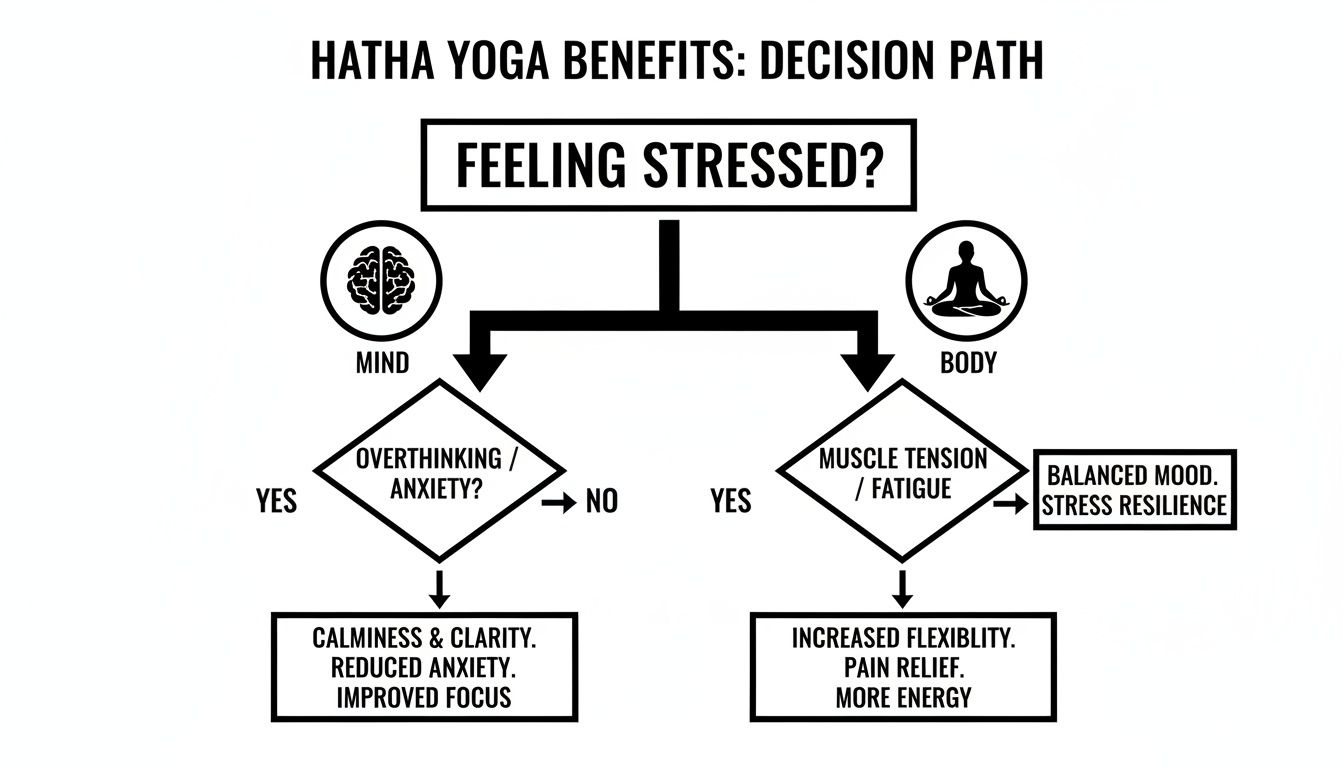
Whether you’re battling a racing mind or just trying to undo the knots in your shoulders from sitting all day, Hatha offers a clear, gentle path toward feeling better.
The real beauty of Hatha is its role as a launchpad. It teaches you the core principles of alignment and breath, giving you the toolkit you need to explore any other yoga style safely and confidently.
At the end of the day, the "best" style is the one that feels right for you. If you’re looking for a mindful, deliberate practice to build a solid foundation, Hatha yoga is your perfect match. If you’re craving a sweaty, dynamic workout, Vinyasa or Ashtanga might be more up your alley. But understanding what Hatha yoga is helps you see it not just as one choice among many, but as the very heart of modern yoga.

So, you're about to walk into your first Hatha yoga class. It’s totally normal to feel a cocktail of excitement mixed with a dash of "what on earth am I doing?" Take a deep breath. You’re in exactly the right place.
Hatha classes are famously welcoming, with a supportive vibe that’s all about exploration, not competition. Your first session is simply an invitation to see what your body can do, without any pressure to nail a perfect pose.
The class will probably kick off with a few moments of quiet. The instructor will guide you to tune into your breath, helping you leave the day's to-do lists and worries at the door. This isn't just some airy-fairy stuff; it’s how you set the stage for a mindful practice, shifting your focus from the world outside to what's happening inside.
After you’ve settled in, you'll start moving through a series of foundational poses, or asanas. Don't worry, the instructor will give you clear, step-by-step guidance, so you won't be left wondering which way is up. The whole point is to feel the pose in your body, not to force yourself into a shape you saw on Instagram.
You’ll definitely get to know some of these classics:
Each pose is held for several breaths, giving you plenty of time to find your footing and really explore what you’re feeling. This slower, deliberate pace is what makes Hatha such a brilliant place to start.
Forget about memorizing a complicated routine. A beginner Hatha class follows a simple, logical path. You’ll start with gentle warm-ups, move into standing poses, transition to seated stretches, and wrap it all up with deep relaxation.
You might even work through a simple sequence like the Sun Salutation, done slowly and with intention. If you’re curious to see what that looks like, you can check out our step-by-step guide to the Sun Salutation.
The grand finale is almost always Savasana, or Corpse Pose. You’ll lie down on your back for several minutes of quiet, still rest. This might just be the most important—and for many, the most challenging—part of the class. It’s where your body and mind get to soak in all the good stuff you just did.
Your first class isn’t a performance. It’s an experiment. The goal is to leave feeling more connected to your body and calmer in your mind than when you arrived.
If you’re feeling a little nervous, you're not alone. But you'll be joining a massive community! In the United States, between 10–16% of adults practice yoga each year, and Hatha-style classes are one of the most popular gateways into the practice. You're in good company.
Feeling that little spark of inspiration? The beautiful thing about Hatha yoga is that you can start this very moment, no matter your fitness level or flexibility. Forget about pretzel-like poses; the real first step is simply showing up for yourself with an open and curious mind.
Your best bet is to find a class labeled "Beginner," "Gentle," or simply "Hatha" yoga. These sessions are specifically designed for newcomers, focusing on foundational principles in a welcoming space. Don't hesitate to let the instructor know you're new—they're there to help you build confidence and practice safely.
So, what's the first move? Here are a few practical ways to get the ball rolling:
The most important step is simply the first one you take. Hatha yoga isn't about achieving a final destination; it’s a rewarding path of self-discovery that unfolds one breath at a time.
For a deeper dive into getting started, check out our complete guide on how to start yoga. Enjoy the journey
Alright, so you’ve got the gist of what Hatha yoga is all about. But a few practical questions are probably bouncing around in your head. Let's dive in and tackle the things everyone secretly wonders before their first class.
Consider this your Hatha yoga cheat sheet.
Let’s be real: Hatha isn’t going to feel like a high-intensity boot camp. But can it help with weight management? Absolutely. You’re building lean muscle, and more muscle means a faster metabolism. Simple as that.
But here’s the secret weapon: stress reduction. Hatha is incredible for chilling you out, which can lower cortisol—that pesky stress hormone linked to belly fat and late-night snack raids. By making you more mindful, Hatha helps you tune into what your body actually needs, paving the way for healthier habits that stick.
If you're just starting out, hopping on your mat two to three times a week is a fantastic goal. It gives your body time to recover and get used to the new movements without feeling overwhelmed.
It’s all about consistency, not intensity. A few solid 20-minute sessions each week will do you a world of good—way more than one epic, exhausting class every other weekend.
Think of it as a marathon, not a sprint. Just show up, do what you can, and let the benefits unfold naturally.
Then you are in the perfect place! Saying you’re not flexible enough for yoga is like saying you're too dirty to take a shower. Flexibility isn’t the price of admission; it’s one of the awesome souvenirs you pick up along the way.
Hatha is designed to meet you exactly where you are. Your teacher will show you all sorts of ways to modify poses using blocks, straps, and blankets to make everything feel good in your body. Your only job is to show up and be willing to try.
Ready to build your confidence at home with personalized feedback? The Dalm AI app acts like a virtual instructor, analyzing your form in real-time to help you practice safely and effectively. Kickstart your practice at https://dalm.co.