
What Is Kinesthetic Intelligence and How to Unlock Your Body's Smarts

Ever watched a dancer float across the stage or an athlete pull off a seemingly impossible play and thought, "How did they do that?" It's not just raw talent or endless practice. It's a kind of genius—a hidden superpower called kinesthetic intelligence.
Think of it as being "body smart." It's the incredible ability to use your body with precision, skill, and grace to solve problems or create something beautiful.
The idea of kinesthetic intelligence exploded onto the scene thanks to psychologist Howard Gardner. Back in 1983, he published his game-changing theory of multiple intelligences, which completely shook up our old-school ideas about what it means to be smart. Gardner argued that intelligence isn't some single, fixed number you get from an IQ test. Instead, he believed we all have a mix of distinct capabilities.
For too long, our schools and culture have put "word smarts" (linguistic) and "number smarts" (logical-mathematical) on a pedestal, often ignoring other kinds of brilliance.
Bodily-kinesthetic intelligence is one of these crucial, yet often overlooked, "smarts." It’s all about having masterful control over your body's movements and being able to handle objects with dexterity. This isn't just for Olympic gymnasts. It’s in the steady, confident hands of a surgeon, the lightning-fast fingerwork of a concert pianist, and even the wobbly determination of a kid learning to ride a bike for the first time.
It's that deep, intuitive connection between your mind and your body. This allows you to learn, express yourself, and solve problems through physical action. It’s what turns movement into art.
To really get what makes bodily-kinesthetic intelligence special, it helps to see where it sits among Gardner's original "smarts." He identified eight of them, each offering a different window into how we process the world.
Here's a quick rundown of the whole family of intelligences.
When we embrace this bigger picture, we can finally appreciate that physical mastery isn't just "athleticism"—it's a powerful and valid form of intellect.
This means that when you're on your yoga mat, you're not just stretching. You're actively sharpening your kinesthetic intelligence. By focusing on the feel of each pose, you're engaging in a powerful form of mindful movement that strengthens that critical mind-body connection.
So, how can you tell if this “body smarts” is your secret superpower? It’s not like there’s a standardized test for it. Instead, it’s about recognizing how you instinctively engage with the world.
Ever catch yourself talking with your hands? You’re not just being dramatic. You're probably using your body to flesh out ideas that words alone can't quite get across. This is a classic sign of someone who thinks through movement. For these folks, sitting still through a long meeting can feel like putting their brain in a cage.
They’re the people who learn by doing, not just by seeing or hearing. A lecture on fixing an engine might just be noise, but put the tools in their hands, and they’ll figure it out before you know it. For them, true knowledge is felt in their muscles and fingertips.
Remember the last time you bought some flat-pack furniture? Did you immediately start fitting pieces together, trusting your gut and only grabbing the manual when you were truly stuck? That impulse to just get your hands dirty is the very essence of kinesthetic intelligence.
And this learning style isn't just a preference; it's incredibly effective. Research on how we retain information shows that active, hands-on practice can boost recall to a staggering 75%. That blows passive learning, like lectures (which clocks in at a measly 10%), right out of the water.
A person with high kinesthetic intelligence doesn't just see a problem; they feel their way to a solution. Their body is a tool for thinking, experimenting, and understanding the world in a tangible way.
This type of intelligence shows up in all sorts of ways, some obvious and some surprisingly subtle. Here are a few tell-tale signs you might be a kinesthetic genius in disguise:
Sure, it's easy to look at superstars like Simone Biles or Michael Jordan and see kinesthetic intelligence on full display. But this kind of genius is everywhere. It’s in the master mechanic who can diagnose an engine issue just by its hum and vibrations. It’s in the surgeon whose hands move with unshakable precision.
It’s also in the artist who coaxes clay into form on a potter's wheel, turning a thought into something you can hold. You can see it in the chef whose knife flies with a rhythmic, perfect chop. These are all incredible examples of high kinesthetic intelligence hard at work, proving this form of smarts is vital in countless fields, far beyond the arena.
The idea that moving your body makes your mind sharper isn't just some feel-good platitude; it's a hardwired biological fact. When you get your hands dirty with a new skill, you’re not just training your muscles—you’re literally building a better, faster brain. This is why kinesthetic intelligence is so much more than just being "good at sports."
Physical activity is like a turbo-boost for learning. Anything that demands coordination, balance, and fine motor skills is busy forging new neural pathways in your brain. Think about it: you can read a recipe a dozen times, but it’s the hands-on act of chopping the garlic, kneading the dough, and smelling the spices that truly cements the process in your memory.
Your brain doesn't neatly separate "physical work" from "mental work." When you move, you're firing up regions responsible for memory, focus, and even creative problem-solving. This is exactly why a brisk walk can suddenly solve a problem you've been stuck on for hours, or why pacing around the room helps you organize your thoughts.
The most powerful proof of this mind-body connection comes from seeing it completely upend traditional learning. Picture this: you’re trying to teach abstract math to a group of middle schoolers. This is an age where interest in STEM subjects often nosedives, particularly for girls.
Now, what if you threw out the worksheets and turned algebraic equations into dance routines?
That’s exactly what the SHINE for Girls program did. Launched back in 2012, it brilliantly paired math lessons with dance, creating a learning environment that was pure kinesthetic energy. The results? They were jaw-dropping. Girls in the program showed a 273% improvement in their math scores and a 110% boost in confidence, based on pre- and post-program tests. You can dig into these incredible curriculum research findings over at the National Math Foundation's website.
This real-world example just blows up the myth that kinesthetic intelligence is only for the athletic field. It proves that learning through movement can demolish mental barriers and make even the toughest subjects feel exciting and within reach.
This isn't a fluke; it's just how our brains are built to learn. The SHINE program’s success is a perfect example of why kinesthetic learning is a preferred style for so many people. It works because it engages the whole person, transforming abstract ideas into concrete, unforgettable experiences.
When you link physical action to an intellectual concept, you’re creating much stronger and more durable memories. Your body becomes a true partner in the learning process. This helps you:
Understanding what is kinesthetic intelligence means realizing that moving your body isn’t a break from learning—it’s one of the most powerful ways to learn. By embracing this connection, we can find smarter, more effective ways to teach, grow, and tackle problems in every part of our lives.
Alright, enough talk about kinesthetic intelligence—let's start building it! The absolute best way to sharpen your body smarts is to get up, move, experiment, and just play.
Think of these exercises less like a rigid workout and more like a playground for your brain and body. The goal isn't to nail perfect form on day one. It's all about tuning into the feel of the movement. That’s how physical practice becomes a powerful way to learn.
This first group of activities is all about listening to your body's quieter signals. They help you tune out the world and pay attention to what your muscles and joints are trying to tell you. It’s all about building that internal awareness.
Mindful Walking: Don't just walk to get from point A to B. Walk just for the sake of walking. Notice the feeling of your feet hitting the ground. Pay attention to the subtle swing of your arms and the natural rhythm of your breath. If you can, try it barefoot on a safe surface like grass or sand to really crank up the sensory feedback.
Yoga: Yoga is so much more than just stretching; it's a masterclass in kinesthetic awareness. Every single pose challenges your balance, coordination, and your sense of where you are in space. As you flow from one posture to the next, you're constantly fine-tuning that critical link between your mind and your muscles. If you really want to level up, you can learn more about how to use proprioception training to supercharge your practice.
Next up, let's sharpen the high-speed connection between what your eyes see and what your hands do. These activities demand precision, timing, and practice, which makes them fantastic for honing fine motor skills and reflexive control.
Juggling: It might seem impossible at first, but start simple. One ball or even a light scarf is all you need. Juggling is a classic brain-rewiring exercise that works wonders for your coordination and rhythm.
Playing Video Games: You read that right! Gaming can seriously boost your body smarts. Fast-paced games force you to make split-second decisions with quick, precise hand movements. It's basically high-engagement training for your hand-eye coordination.
Drawing or Doodling: You don't need to be the next Picasso. Just tracing objects around you or letting a pen wander aimlessly across a page improves fine motor control and strengthens the connection between what you see and what your hands create.
Here’s where movement becomes a language. These activities are less about following rules and more about letting your body translate feelings and ideas into physical form. They tap into a totally different side of your kinesthetic intelligence.
Learning through movement isn't just for fun; it delivers serious results. Programs using kinesthetic methods have demonstrated incredible academic gains.
For instance, one initiative that folded movement into math lessons saw a mind-blowing 273% improvement in math scores among the students. These numbers, detailed in this insightful breakdown of kinesthetic education on Edutopia, show just how much physical engagement can unlock our mental potential.
Dancing: Seriously, just put on your favorite song and move. Forget about proper technique. The only goal is to explore how your body wants to respond to the music.
Sculpting or Pottery: Getting your hands dirty with clay is an intensely tactile experience. It forces you to think with your fingertips, molding and shaping a material based purely on touch and feel.
Improvisational Acting or Charades: Trying to act out an idea without using words is kinesthetic communication in its purest form. It’s a fun challenge that pushes you to use your body to express everything from simple objects to complex emotions.
By mixing these activities into your routine, you’re doing more than just having a good time—you’re actively rewiring your brain and building a smarter, more connected body.
So, what’s the next frontier for developing your body intelligence? It turns out technology is stepping onto the mat with us, offering incredible new ways to master physical skills. We're moving beyond just watching and copying; we're entering an era of active, intelligent practice.
Think about it: what if you had a world-class yoga instructor in your pocket, ready 24/7 to give you precise, immediate feedback? That’s exactly what AI-powered platforms like Dalm are bringing to the table. For a kinesthetic learner who needs to learn by doing, this is a total game-changer. Watching a video is fine, but AI provides the interactive feedback loop that truly cements learning.
If you have high kinesthetic intelligence, you know that just watching someone else perform a movement doesn’t cut it. True mastery is built through physical repetition, feeling your way through trial and error. In fact, research shows that hands-on practice can lead to a staggering 75% information retention, a huge jump from the measly 10% you get from just listening to a lecture. This is where AI-driven apps really start to make sense.
That massive gap in retention is exactly why a tool that engages your body is so much more effective. Even if some academics quibble over strict learning style models, the preference for hands-on methods is clear. One survey found that a whopping 90.5% of medical students preferred kinesthetic approaches. Even in a visual field like graphic arts, 45% identified as kinesthetic learners. For more stats about how people learn by doing, check out this great overview of the kinesthetic learning style from SimpleK12.
The infographic below really nails down the core benefits that these kinds of exercises deliver.
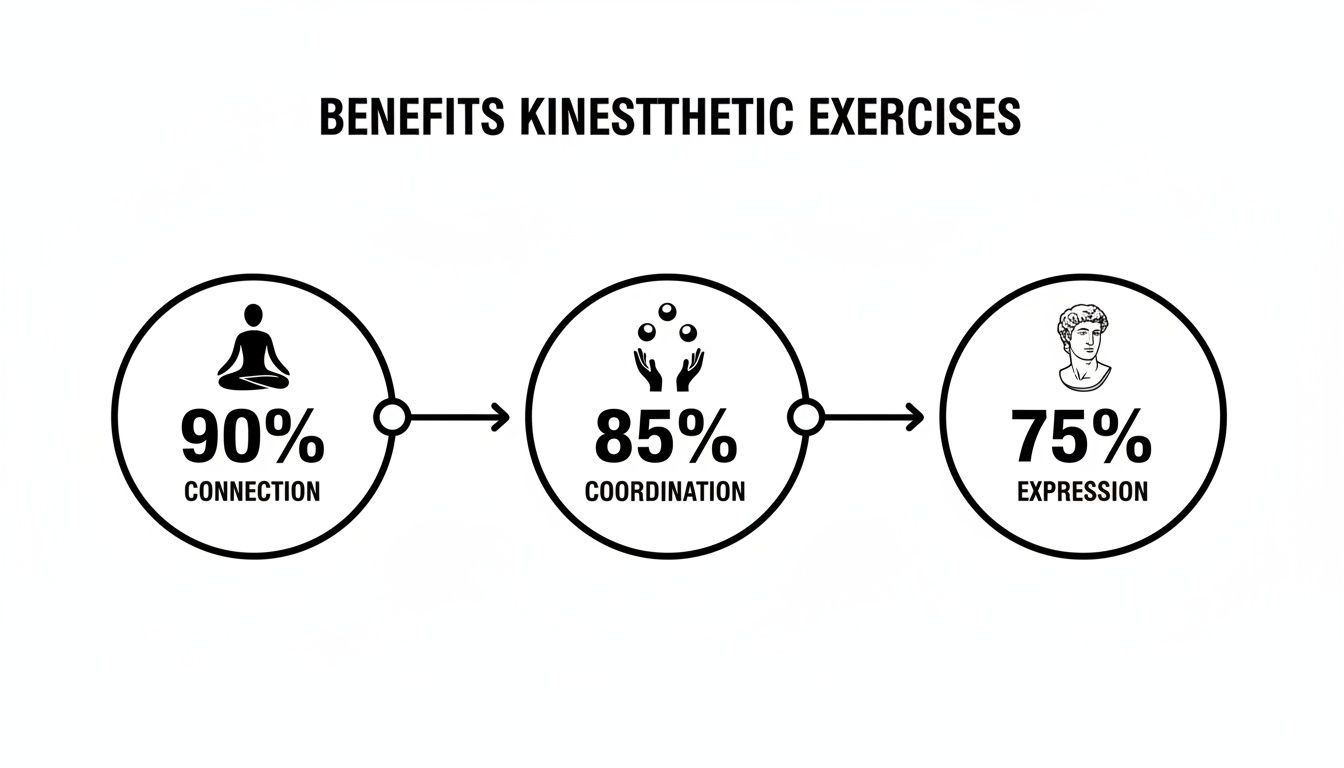
As you can see, physical activity isn't just about moving your limbs around—it’s about weaving together a powerful set of skills that deeply connect your mind and body.
AI is essentially turning your practice session into a smart, adaptive conversation with your own body. Instead of just hoping your form is right, you get instant, data-driven guidance. This flips the script, transforming your practice from a simple routine into a dynamic feedback loop that sharpens your body awareness with every move.
AI-powered training makes expert guidance accessible to everyone. It democratizes skill development by providing personalized feedback that was once only available through expensive, one-on-one coaching.
Let's break down how an AI app like Dalm specifically helps you build your kinesthetic intelligence:
This type of posture analysis software is more than just a slick feature; it's a dedicated tool for sharpening your kinesthetic intelligence. It creates a personalized training ground where every movement becomes a chance to learn, helping you unlock your body's full potential faster than ever before.
Once you start digging into kinesthetic intelligence, you'll probably find a bunch of questions bubbling up. This type of intelligence is often wrapped up in myths about being a "natural athlete" or just having good genes. Let's cut through the noise and tackle the big questions head-on.
It's time to bust some myths and get down to the facts about your body's incredible ability to learn and adapt.
Oh, absolutely. One hundred percent. The old wives' tale that you’re either born coordinated or you’re not is pure fiction. Your brain is a masterpiece of adaptability, constantly rewiring itself through a process known as neuroplasticity. This means you can absolutely teach an old dog—and an old brain—new tricks, no matter your age.
Think of it like this: your brain is a muscle. When you take up a new physical hobby—whether it’s learning to salsa, trying your hand at pottery, or mastering a tricky yoga pose—you're giving your brain a solid workout. Every new movement you learn forges new neural pathways, beefing up the communication lines between your mind and your body.
So, if you’ve always felt like you missed the boat on being "graceful" as a kid, take a deep breath. Starting a guided practice now, especially with something like an app that gives you real-time feedback, is the perfect way for adults to build those mind-body connections from the ground up and awaken their inner kinesthetic genius.
Not in the slightest. This is a huge misconception that keeps so many people on the sidelines. Slapping the "clumsy" label on yourself is usually just a story you've been telling yourself for years—it's not an accurate measure of your true potential. More often than not, what we call clumsiness is just a lack of practice, focus, or body awareness. It's not a life sentence.
Being clumsy isn't a permanent state; it’s an invitation. It’s a sign from your body that there's a massive opportunity for growth and a deeper connection just waiting to be discovered.
Instead of seeing it as a fixed trait, try reframing it. You're not clumsy; you're just "unpracticed." Nobody picks up a guitar and shreds a solo on day one. The exact same principle applies to movement. Your coordination and grace are skills you can build over time with a little patience and mindful effort.
A fantastic way to start is with slow, deliberate movements. Practices like Tai Chi or yoga are brilliant for this because they make you slow down and tune into what's happening in your body. This mindful approach can work wonders for your coordination, balance, and overall body awareness, turning that feeling of clumsiness into one of confident control.
Here's another myth we need to kick to the curb for good. While athletes are a powerful and obvious example of kinesthetic intelligence in action, saying only they have it is like saying you have to be a published poet to be "word smart." It’s a ridiculously narrow view of a wonderfully broad human talent.
Bodily-kinesthetic intelligence shines just as brightly in a massive range of professions and hobbies that have nothing to do with scoring goals or winning medals. Just think about the incredible physical control these people have:
This kind of intelligence is vital in any field that calls for fine motor skills, dexterity, and physical precision. When you understand that, the whole concept of what is kinesthetic intelligence becomes much more inclusive and relatable to all of us, no matter what we do for a living.
Ready to build your body smarts with personalized feedback? Dalm uses AI to analyze your yoga poses in real-time, giving you the expert guidance you need to improve your alignment and deepen your mind-body connection. Discover your potential and transform your practice.