
Confused about what is muscle activation? Learn the secrets to power up your yoga poses, prevent injury, and transform your practice with our ultimate guide.
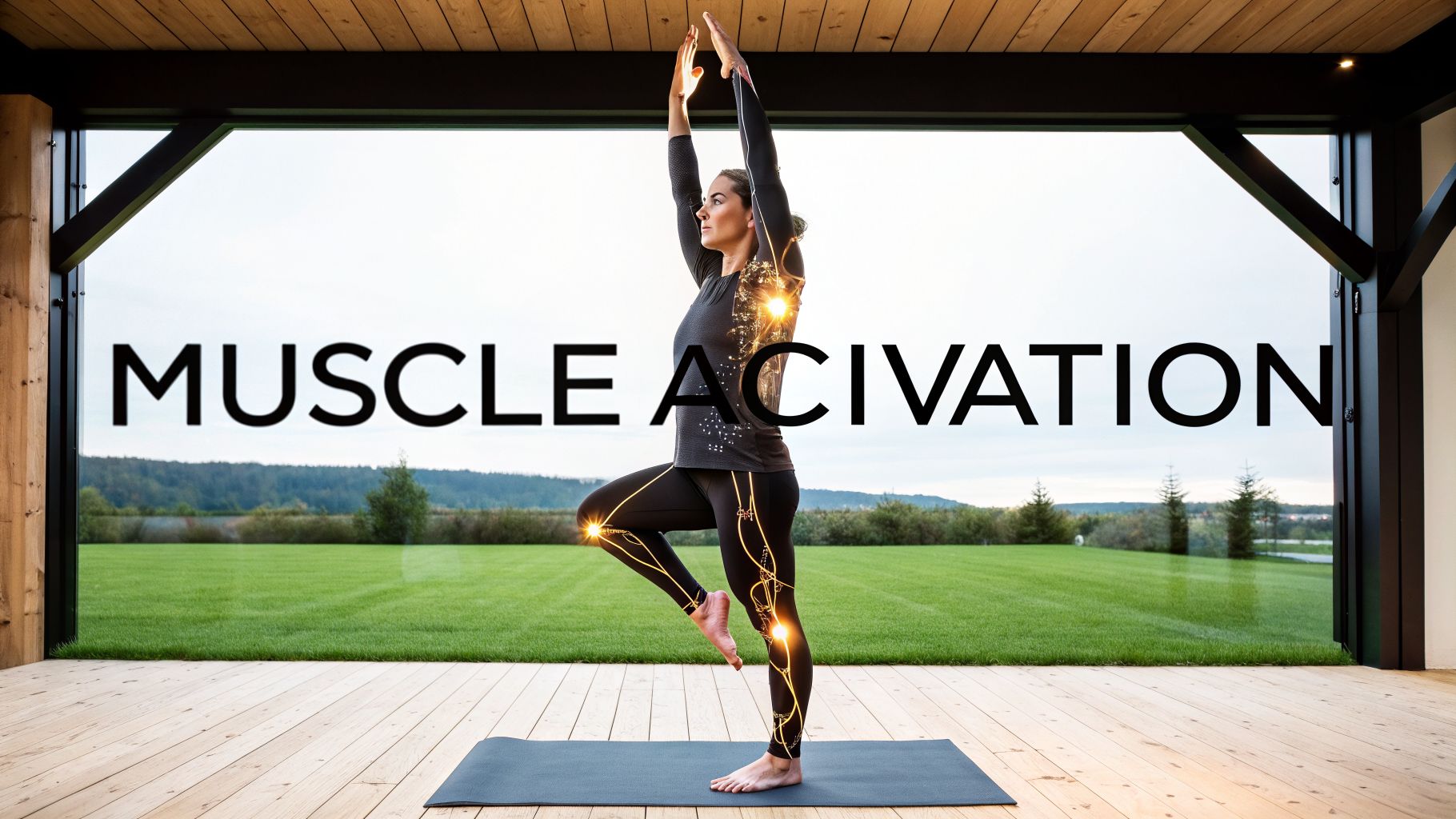
Ever find yourself in a yoga class, going through the motions, but not really feeling it in the right places? It’s a common feeling. You're trying to hold a pose, but it feels wobbly and weak, almost like something’s not switching on. Well, that "something" is muscle activation.
Think of it as the secret handshake between your brain and your body. It’s the process where your brain zaps a signal to your muscles, telling them to wake up, contract, and get to work. Without that clear signal, your muscles are basically asleep on the job.
Let’s quickly clear up some confusion with a simple breakdown.
Getting this right is the difference between a movement that builds you up and one that just… happens.
Imagine your brain is the mission control center for your body's movements. When you decide to lift your arms into Warrior II, your brain doesn't just hope for the best. It sends a specific electrical command down your neural pathways straight to the muscles required to lift your arms, stabilize your core, and ground your feet.
That command is the "power up" signal. It’s the spark.
This is the real reason your Tree Pose might feel more like a wilting sapling than a mighty oak. It’s often not a lack of raw strength, but a fuzzy connection between your brain and the key players—your glutes, core, and the tiny muscles in your standing foot. Mastering muscle activation is really about learning to move with powerful intention.
When you sharpen this brain-muscle dialogue, your yoga practice completely changes. It’s not just about making pretty shapes anymore.
This isn't just some fringe yoga concept; it's a massive focus in the wider wellness world. The market for tools that help with muscle activation, like muscle stimulators, was valued at a whopping USD 760.6 million in 2023 and is expected to climb past a billion by 2033.
Why the boom? It’s directly tied to the explosion of practices like yoga and the tech that supports them. For example, AI-driven apps like Dalm analyze your poses to give you real-time feedback on your form and activation. With this kind of guidance, beginners are learning to fire up deep stabilizing muscles 20-30% faster than by just following a class. You can dive deeper into the market trends in this detailed report.
Getting a grip on muscle activation is your first real step toward a smarter, stronger, and more rewarding yoga journey. It's about making sure that when your brain gives an order, your body is ready to listen and respond perfectly.
So, what's really happening on a biological level when you feel a muscle "fire up"? It’s not just some fitness buzzword; it’s a stunningly efficient process that turns a simple thought into powerful, physical action.
Think of it like this: your brain is the CEO, and your muscles are different departments in a company. To get a project done (like lifting your arm), the CEO doesn't just yell into the void. It sends a specific, targeted memo.
That "memo" is your neural drive—a precise electrical signal that zips from your brain, down your spinal cord, and out to the designated muscle. It's the official command to get to work. When this signal arrives, it doesn’t just tap one lonely muscle fiber; it rallies a whole team.
This team is called a motor unit, which is made up of a single nerve cell (a motor neuron) and all the muscle fibers it’s connected to. When that nerve gets the signal, every single fiber in its unit contracts. It’s an all-or-nothing deal.
Let's put this into a real-world yoga scenario. Imagine you're slowly lowering into a deep squat. At the top, your brain might only need to call on a few motor units—the "interns" of your leg muscles—to control the easy part of the movement. But as you go deeper and things get shakier, the CEO starts calling in the senior managers.
More and more motor units are recruited to generate the force needed to control your descent and hold the position. This is how your body brilliantly dials the effort up or down. A delicate movement might use a few small motor units, while a powerful one, like exploding into Crow Pose, demands that nearly all of them get recruited at once.
The intensity of an exercise isn't just about how heavy or difficult it feels; it's a direct reflection of how many of these tiny 'muscle teams' your brain has called into action.
This simple diagram perfectly captures that powerful pathway from brain to brawn.
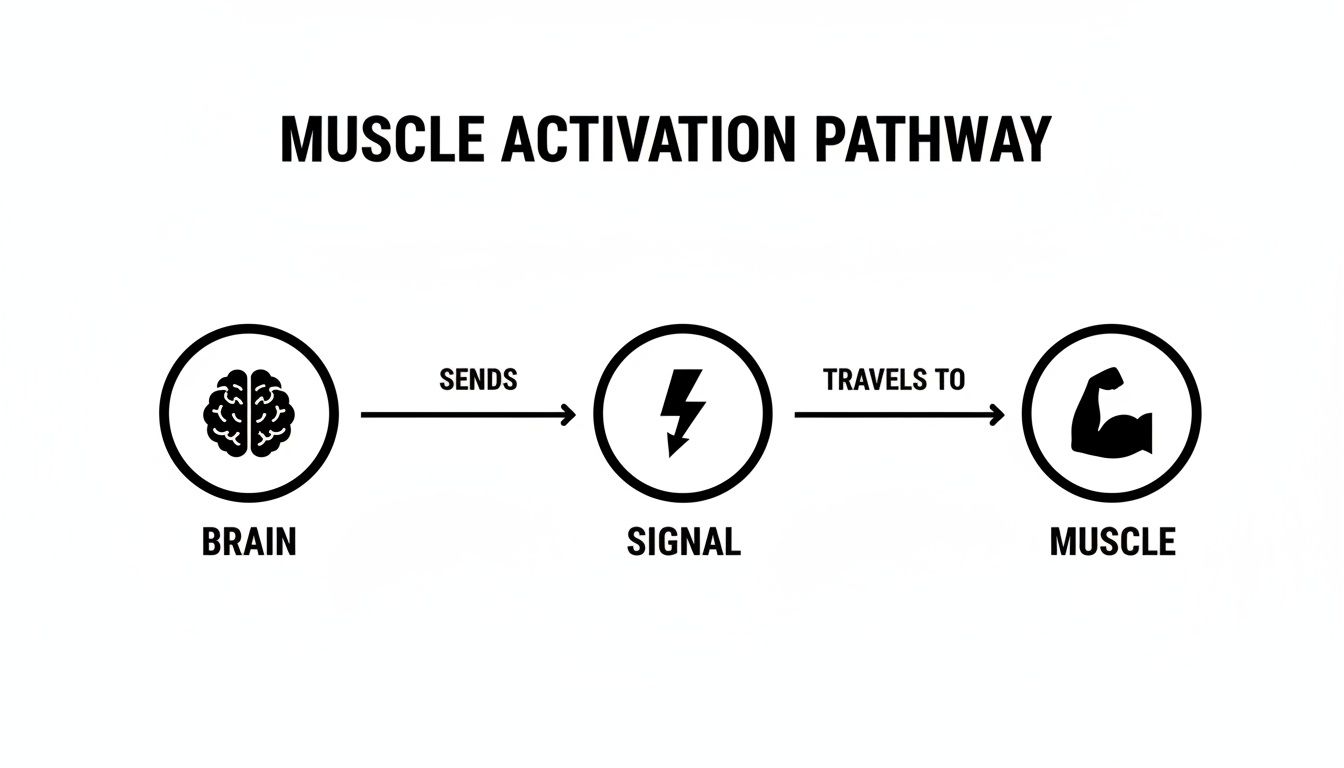
As you can see, muscle activation is fundamentally a communication game. Your brain sends the message, and your muscles execute the command.
So, how do we actually know which muscles are working and which are slacking off? Scientists have a cool tool for this called Electromyography (EMG). Think of it as an applause meter for your muscles.
By placing sensors on the skin, EMG measures the electrical activity—that neural drive—flowing into a muscle. It lets us peek under the hood and see exactly which muscles are firing during a movement.
Are your glutes actually doing the heavy lifting in a Glute Bridge, or are your hamstrings stealing the show? EMG can tell you. This process is deeply connected to your body's internal GPS, which you can read more about in our guide to proprioception training. It's an incredible way to make the invisible world of muscle activation visible, giving you the data to fine-tune your movements with near-surgical precision.
Knowing the science is great, but bringing that knowledge onto your mat is where the real transformation begins. So, why get obsessed with how your muscles fire? Because mastering muscle activation is probably the single most powerful key to changing how you move, how you feel, and how you grow in your yoga practice.
It’s the difference between just going through the motions and truly owning a pose. When you finally learn to wake up the right muscles at the right time, your entire practice gets a major upgrade. Imagine you've been listening to music on an old-school transistor radio, and someone suddenly hands you a pair of high-fidelity headphones—the clarity, depth, and power are on a whole new level. That's what proper activation feels like.
Think of muscle activation as your secret weapon for unlocking next-level strength and stability. When the intended muscles are awake and doing their jobs, poses that used to feel shaky and impossible suddenly become steady and accessible. This isn't about muscling through with brute force; it's about smart, targeted effort.
Take a deep backbend like Wheel Pose, for example. Activating your glutes and core isn't just about pushing yourself higher. It creates a powerful, stable base that shields your lower back from compression, freeing you up to open your chest and shoulders more fully. The result? A stronger, safer, and way more expressive pose.
This idea pops up everywhere:
Maybe the most important benefit of mindful activation is its role in keeping you out of harm's way. So many common yoga injuries boil down to one thing: the big, primary muscles get lazy. When they don't show up for work, smaller, less-equipped muscles and joints are forced to pick up the slack. This compensation is a direct path to strain and pain.
By consciously engaging the correct stabilizing muscles, you create a protective "scaffolding" around your vulnerable joints, dramatically reducing your risk of injury.
This proactive mindset is gaining huge momentum everywhere, from physical therapy clinics to professional sports teams. In fact, the muscle strengthening device market, valued at a hefty USD 2.14 billion in 2024, is booming in part because of its role in rehabilitating musculoskeletal disorders—conditions that affected a staggering 1.71 billion people in 2023.
Technology is leading the charge here. Studies show that focusing on precise activation can slash injury risk by as much as 30% in fitness routines, hammering home just how critical proper form really is. You can dig into more details on this growing market and its impact.
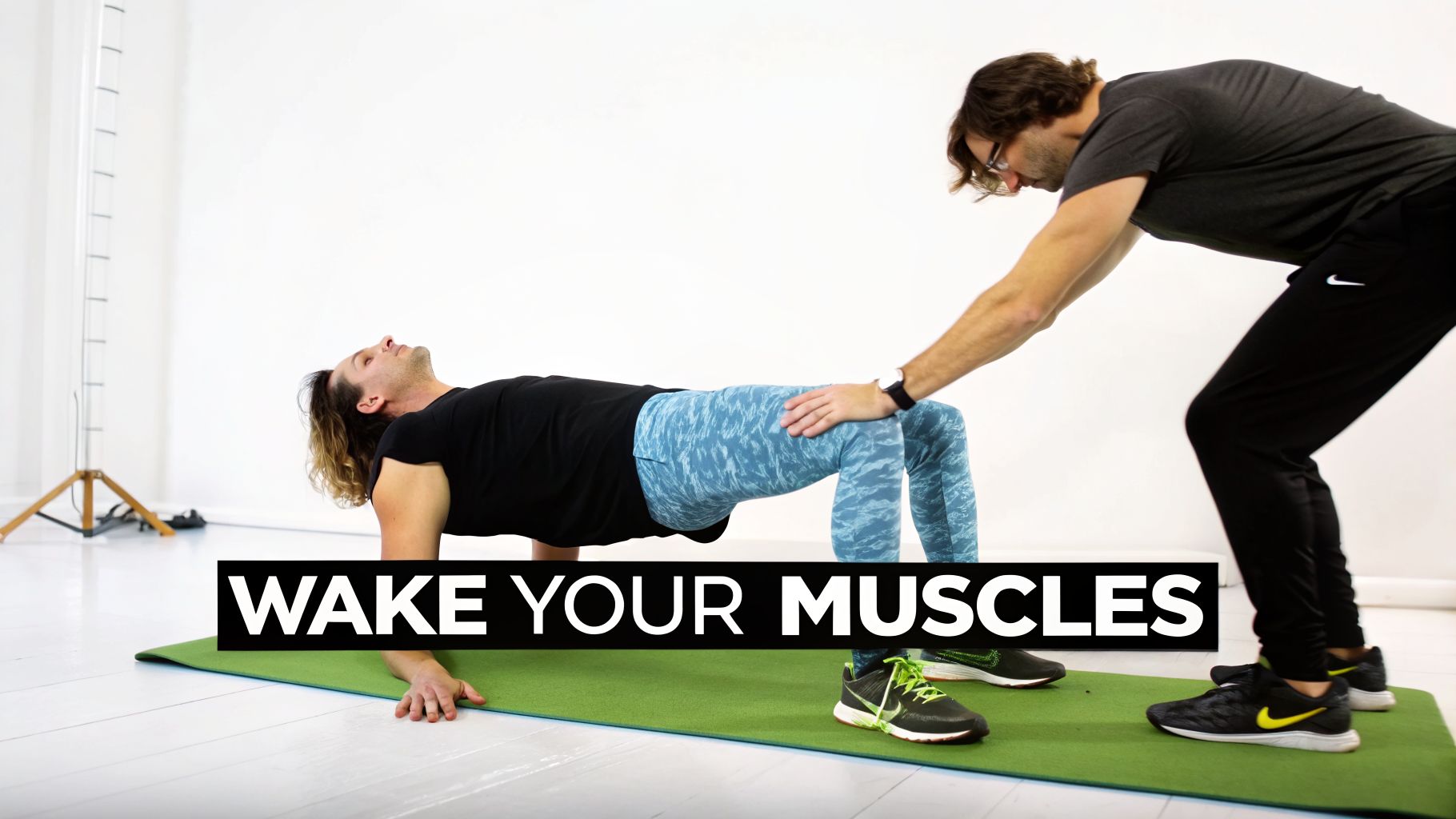
Alright, knowing why muscle activation matters is one thing. Actually feeling it happen in your own body? That’s where the real magic happens. Let's move from theory to the mat and explore how to intentionally "wake up" those sleepy muscles.
This isn’t about adding a bunch of complicated exercises to your routine. It’s about using smart, simple techniques to supercharge that mind-body connection. We'll dive into three game-changing methods: using targeted cues, running through simple activation drills, and the powerful process of neuromuscular re-education.
One of the quickest ways to get a muscle online is to give your brain a better instruction. These are what we call targeted cues—imaginative little commands that go way beyond a generic "engage your core." A great cue sends a crystal-clear signal to the exact muscle you want to fire.
Take Mountain Pose (Tadasana), for instance. Instead of just standing there, try this cue: “Imagine you're trying to screw your feet into the floor.” Bam! You'll feel the arches of your feet lift, your quads firm up, and your glutes subtly clench. That simple thought just turned a passive stance into a powerhouse of stability.
Here are a few more to try in your practice:
Sometimes, a muscle is so dormant—so "asleep at the wheel"—that it needs a direct wake-up call before your main practice even begins. These quick, focused drills are designed to isolate and prime specific muscles, getting them ready to contribute when you need them most.
Activation drills are like a shot of espresso for your muscles. They ensure the key players are awake and ready to support you before you ask them to perform in more complex poses.
Glute Bridges are a fantastic example. Before a practice heavy on standing poses, lie on your back and perform 10-15 slow, controlled Glute Bridges. This awakens your glutes, making it less likely that your hamstrings and lower back will try to do all the work in a pose like Warrior III. For a full pre-flow routine, check out our guide to effective yoga warm-up exercises.
To help you get started, here are a few simple drills you can do right before stepping into some common yoga poses.
Simple pre-pose exercises to help you feel and engage the correct muscles.
Think of these drills as the appetizer. They get your neurological system excited for the main course, ensuring the right muscles are ready to join the party.
This term sounds a bit clinical, but the idea is actually quite intuitive. Neuromuscular re-education is simply the process of retraining the communication lines between your brain and your muscles. It’s all about fixing old habits where your body has gotten used to using the "wrong" muscles for a specific job.
Ever noticed that one side of your body feels way weaker or less coordinated than the other? You've just stumbled upon a faulty neuromuscular pattern. Through focused practice and specific exercises, you can literally rewrite these ingrained habits and teach your body more efficient, stable ways to move.
As you start waking up your muscles, you’ll inevitably find areas that are lagging behind. When you correct muscle imbalances, you help your entire body work as a team, creating a much stronger and more resilient foundation for your entire yoga practice.
Let's be real: getting real-time feedback is the ultimate cheat code for mastering muscle activation. While all the cues and drills we've talked about build a killer foundation, nothing speeds up your progress like having an expert eye on your form. And what if that expert could live right in your pocket?
Now it can.
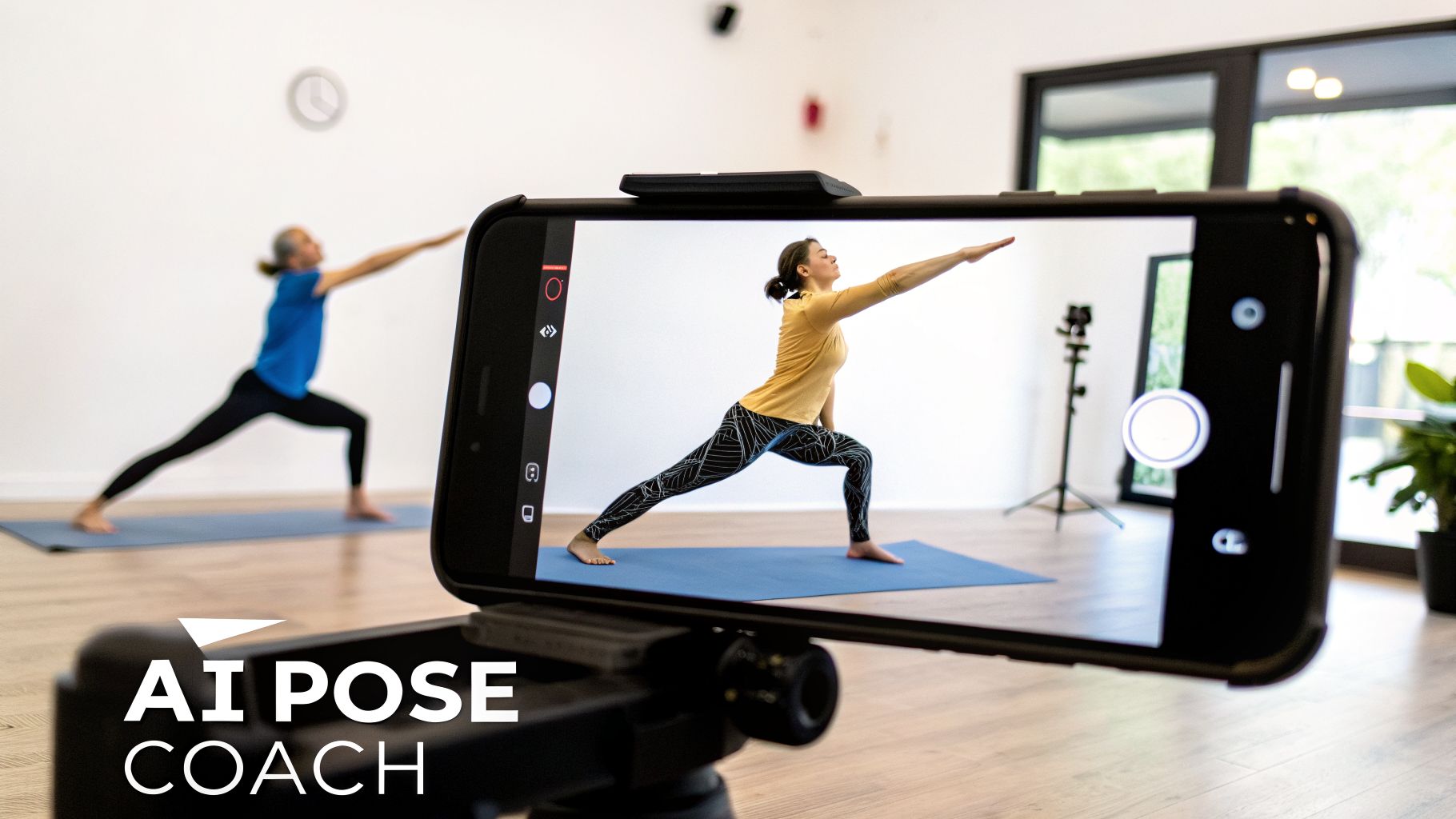
AI-powered platforms like Dalm use your phone's camera to analyze your every move with shocking accuracy. This isn’t about replacing your favorite yoga studio. It’s about making every single practice—whether at home or on the road—smarter and way more effective.
Imagine having a yoga instructor with superhuman vision. That's essentially what an AI coach offers. It catches those tiny misalignments you’d never feel on your own.
For instance, you might think your Warrior III is solid, but the AI sees your hips are slightly uneven. You’ll get a real-time voice cue like, “Engage your core and level your hips.” That one small tweak instantly fires up your glute medius—a crucial stabilizer—and makes you feel rock-solid.
This immediate feedback loop is exactly why AI is such a game-changer for learning what is muscle activation feels like in your own body. You stop guessing and start knowing.
By turning your phone into an objective observer, you get to skip the guesswork. You finally learn how to connect a verbal cue to an actual physical sensation, training your brain and body to sync up perfectly.
This technology makes a difference you can actually feel. We’ve seen yoga lovers using Dalm who were only getting about 40% core engagement in Tree Pose—a recipe for a wobbly ankle. With AI spotting the misalignment and offering a quick cue, they boosted that engagement to 70%. That’s the difference between tipping over and standing strong.
This kind of tech-driven precision is part of a bigger movement. Just look at how the muscle stimulator market is projected to grow, all thanks to huge strides in sports medicine and personal tech.
Beyond fixing your form in the moment, these platforms also keep a running log of your progress. You get to see tangible proof of your improvements in balance, stability, and strength. It's incredibly motivating to look back and see hard data showing how far you've come.
This isn’t just about doing the poses; it’s about understanding them from the inside out. You can dive deeper into how this tech is shaking things up in our guide to the smart yoga mat. It’s all about building a practice that’s safer, stronger, and more dialed-in, one pose at a time.
We've covered a lot of ground, from the tiny electrical sparks firing in your brain all the way to the practical feel of your feet on the yoga mat. If there's one big takeaway from all this, it's that true muscle activation is the art of moving with intention. It’s the secret ingredient that transforms your yoga practice from just making shapes into a rich, intelligent conversation between your mind and body.
This isn't just about building bigger muscles or holding a pose for longer. It's about cultivating a deep, lasting awareness that will serve you everywhere, not just during your time on the mat. When you start focusing on how you move, you tap into a whole new level of power and precision.
Getting a handle on activation means you’re finally done with the guesswork. You're consciously telling your body where to send its resources, making sure the right muscles are awake and ready to work. This simple idea is the key that unlocks everything else.
Ultimately, getting what muscle activation is all about means taking the driver's seat. It's the difference between letting your body run on autopilot and you sitting confidently behind the wheel, directing the journey.
Whether you're poking your own glutes to make sure they're firing in a Bridge Pose or using sophisticated AI feedback from a tool like Dalm to nail your alignment, the goal is one and the same: to turn a physical routine into a mindful practice.
So, step onto your mat for your next session with a fresh sense of curiosity and control. Pay attention, feel the connections, and embrace the power of your own intention. You’re about to discover a level of strength and awareness you never knew you had.
Jumping into the world of muscle activation always sparks some curiosity. It’s one of those ideas that feels simple on the surface but gets surprisingly deep. Let's tackle some of the most common questions and clear the air.
Oh, absolutely. It's a real thing, often called muscle guarding or chronic tension. This is when your muscles stay clenched and "on" even when they should be resting. It’s a classic sign of stress, a lingering echo of an old injury, or a byproduct of poor posture. The result? Stiffness, nagging pain, and feeling constantly drained.
A truly effective yoga practice isn't just about learning to fire up your muscles. It's just as much about learning to let them go. The real magic happens when you can find that perfect balance—intentional, powerful engagement during a pose, followed by a complete, blissful release.
This is a fantastic question, and it really gets to the core of moving with intention. Here’s a simple way to think about it:
You can't really strengthen a muscle that's still half-asleep. Trying to load a poorly activated muscle is a surefire way to get other, bigger muscles to jump in and take over. This is how stubborn imbalances are born and how injuries sneak up on you. First, teach the muscle to show up for work; then you can give it a promotion.
This is the million-dollar question, especially when you're starting out. How can you be sure you're feeling the right thing? One of the best ways to start is with tactile feedback—literally just putting a hand on the muscle you're trying to engage. Doing a Glute Bridge? Place a hand on your glute and feel it firm up as you lift.
With practice, you'll develop a sharper sense of proprioception, which is your body's built-in GPS for knowing where it is in space. You'll move from needing to feel it with your hand to just knowing when a muscle is firing correctly.
This is exactly where a little bit of tech can be a game-changer. Tools that offer real-time feedback on your form are incredibly valuable because they take the guesswork out of it. They make the invisible act of activation something you can see and understand, helping you connect the dots way faster.
Ready to stop guessing and start knowing? Dalm uses advanced AI to give you real-time voice feedback on your yoga poses, ensuring you activate the right muscles every time. Perfect your form and unlock your true potential by visiting https://dalm.co.