
What is muscle activation technique? How it boosts strength and reduces pain

Ever feel like you're stuck in a frustrating loop with a tight muscle? You stretch that nagging hamstring every single day, but the tightness just comes roaring back. It's a common story, and it usually means you're chasing a symptom, not the real problem.
Muscle Activation Technique (MAT) flips the script. Instead of focusing on what’s tight, MAT pinpoints and resolves the root cause: muscle weakness.
Think of your body as a finely tuned orchestra. When one musician—let's say a specific muscle in your hip—dozes off, the others have to play louder and harder to pick up the slack. This is exactly what happens when a muscle gets "switched off" or inhibited due to things like stress, injury, or overuse.
Those other muscles, like your hamstrings or lower back, are forced to work overtime. This overcompensation leads directly to that familiar feeling of strain, tightness, and pain. You can stretch them all day long, but you're not addressing the lazy musician who started the whole mess.
This is where Muscle Activation Technique comes in. A MAT practitioner acts like the orchestra's conductor, finding the exact musician who fell asleep on the job. The entire process is about re-establishing a clear line of communication between your brain and that muscle.
By "waking up" the inhibited muscle, MAT restores balance across the entire system. It’s all about improving your body's internal feedback loop, which is the foundation of things like proprioception training.
MAT is founded on a simple but powerful premise: Muscle tightness is a secondary response to muscle weakness. If you resolve the weakness, the tightness often disappears on its own because the body no longer needs to protect itself.
To put this into perspective, let's compare the core philosophy of MAT with what most of us have been taught about stretching.
Essentially, while stretching asks an overworked muscle to do even more by lengthening, MAT gives that muscle a break by getting its lazy teammate back in the game.
This whole approach was developed by Greg Roskopf back in 2000 and has since become a secret weapon for countless elite performers. Legendary NFL quarterback Peyton Manning, for example, famously flew Roskopf out for regular MAT sessions, crediting the technique for helping him recover from injuries and stay at the top of his game.
As you can see, the shift from chasing tightness to correcting weakness is what makes MAT so different—and for many, so incredibly effective. It's a game-changer for anyone looking to move better and live without pain.
So, you've booked your first Muscle Activation Technique session. What's it actually like? If you're picturing a relaxing massage where you just zone out, think again. A MAT session is an interactive experience—you're not a passive recipient, you're an active participant in your own body's investigation.
Think of it less like a spa treatment and more like being a detective. The MAT specialist is your guide, but you're helping uncover the clues. The whole point is to systematically figure out which muscles have decided to take an unscheduled vacation, forcing other muscles to work overtime.
Your session kicks off with a detailed assessment. A certified MAT specialist will lead you through a series of specific, gentle resistance tests. This isn't a strength test or a workout; it's a super-detailed diagnostic process designed to map out your body's muscular firing patterns.
The practitioner will ask you to hold a certain position while they apply a tiny bit of pressure. If a muscle can't maintain its position against that light force, it's a dead giveaway that its connection to the nervous system is weak—it’s essentially "switched off." This process meticulously uncovers the weak links in your kinetic chain.
This evaluation is the bedrock of the whole technique. The biomechanics behind MAT are all about restoring the lines of communication between your brain and your muscles. The goal is to correct the imbalances that so often lead to chronic pain and nagging injuries. You can get a deeper dive into this unique approach over at fyxsports.com.
Once a weak muscle is flagged, the real magic begins. The practitioner uses precise, targeted manual pressure, often right at the muscle's attachment points where the nerve receptors are most concentrated.
Imagine you're trying to reboot a frozen computer. That targeted pressure is like hitting the reset button. It sends a strong signal to the brain, essentially telling it, "Hey, pay attention to this muscle again!" It's a jolt to get the system back online and functioning properly. This pinpoint accuracy is crucial for breaking the painful cycle of compensation.
This flowchart perfectly shows how one lazy muscle can set off a chain reaction that ends in pain.

You can see how an "inhibited" muscle forces others to overcompensate, and that overcompensation is what you ultimately feel as pain.
Right after the activation, the specialist re-tests the muscle. It’s pretty wild. You’ll almost certainly feel a major difference in your ability to hold against that same gentle pressure that felt impossible just moments before. This instant feedback is one of the coolest parts of a MAT session.
So, what happens when you walk out the door? The benefits can be both immediate and long-term. Many people report feeling more stable and strong, with an improved range of motion, before they even get to their car.
Don't be surprised if you feel a little sore the next day, though. It's not injury pain. It's more like the "good sore" you get after a workout—the feeling of muscles that have been woken up and put back to work for the first time in a long time.
Key Takeaway: A MAT session is a true partnership. Your active participation in the testing process is essential for the practitioner to accurately find and fix the root cause of your muscular imbalances.
To help the changes stick, your practitioner will probably give you some simple isometric exercises to do at home. These aren't intense movements. They're gentle contractions designed to strengthen those newly re-established neural connections. Doing your homework helps your brain and body lock in the new, more efficient patterns. It’s all about teaching your body to remember how to use every muscle in its toolbox.
Ever feel like a certain muscle just refuses to cooperate, no matter how much you stretch or massage it? You're not alone. The problem often isn’t the muscle tissue itself, but the complex wiring that connects it to your brain. This is where Muscle Activation Technique (MAT) comes in. Think of a MAT practitioner less like a traditional physical therapist and more like a master electrician for your body’s intricate neural network.

To really get how MAT works its magic, you first need to understand a basic rule of human movement: reciprocal inhibition. It sounds technical, but the idea is simple. For your bicep to contract when you flex, its opposing muscle—the tricep—has to relax and lengthen. It's a beautiful, elegant partnership that allows for smooth, coordinated motion.
So what happens when that system goes haywire?
Life happens. Stress, an old injury, or even just sitting at a desk all day can put too much load on a specific muscle. When your central nervous system senses this overload, it does something brilliant to protect you from harm: it flips a switch. It’s just like a circuit breaker in your house popping to prevent an electrical fire. Your brain essentially cuts the power to that overworked muscle.
This "off" state is what we call muscle inhibition. The muscle isn't torn or damaged; it’s just neurologically offline. Its ability to contract properly tanks, sometimes falling to less than 50% of its actual potential. This is the sneaky weakness that MAT is designed to hunt down and fix.
Of course, when one muscle checks out, your body doesn't just give up. Other muscles nearby jump in to pick up the slack. This is the compensation pattern that eventually leads to all that tightness, strain, and pain in muscles that are simply doing way too much overtime.
The entire goal of MAT is to find that flipped switch and turn it back on. A practitioner uses a series of highly specific tests to pinpoint exactly which muscles have gone offline. Once the culprit is found, the activation process begins.
This involves applying precise, targeted pressure right where the muscle attaches to the bone (its origin and insertion points). These spots are packed with sensory nerve receptors that have a direct line to the brain. The pressure acts like a powerful "wake-up call" zapped straight through the nervous system.
Think of it like a hard reset on a frozen computer. The targeted stimulation essentially overloads the faulty nerve signal, forcing the whole system to reboot and re-establish a clean, strong connection between the brain and the muscle.
This isn't about brute force. It's about making your muscles neurologically smarter.
Once that connection is re-established, the difference is often immediate and totally measurable. A muscle that tested weak just moments before can suddenly contract with its full, intended force. No, the muscle didn't magically grow bigger in 30 seconds. The communication pathway was simply cleared, allowing the brain to finally use the muscle's full, existing capacity.
By waking up that inhibited muscle, MAT achieves a few key things almost instantly:
Ultimately, the science behind MAT is all about restoring your body's original blueprint for movement. It’s not just chasing symptoms; it's a systematic process for debugging your body’s operating system to get every part working together as a smooth, efficient team. This is what helps people finally break free from those frustrating cycles of chronic pain and limitation.
When you hear about a technique trusted by NFL players and pro golfers, it's easy to think, "Well, that's not for me." But Muscle Activation Technique (MAT) isn't just a secret weapon for elite athletes. Its reach is surprisingly broad, helping all sorts of people get to the bottom of their aches, pains, and performance plateaus.
Let's put it this way: if you have a body, you have muscles. And if you have muscles, chances are some of them have decided to take an unscheduled vacation, leaving their teammates to pick up the slack. MAT is for anyone ready to get their muscular system working like a well-oiled machine again.
We all know the "weekend warrior." They're chained to a desk all week, then go all-out on the hiking trail or basketball court on Saturday. This abrupt shift from zero to one hundred is a perfect storm for muscle compensation, leading to those nagging injuries—like runner's knee or a lower back that just won't quit aching. MAT gets in there to find the lazy glutes or sleepy core muscles that are forcing the hamstrings and back to do all the heavy lifting.
The same goes for the office worker spending eight hours a day hunched over a laptop. That chronic neck stiffness and dull ache in your lower back? Those are classic signs of postural muscles that have basically checked out. MAT reactivates these crucial support muscles, offering a foundational solution that goes way beyond what a simple posture corrector or stretching routine can do.
Recovering from surgery is another area where MAT can be a game-changer. After something like an ACL repair or a rotator cuff surgery, the body’s natural response to trauma is to shut down the surrounding muscles as a protective measure. This inhibition can throw a major wrench in your recovery, as your body tries to learn new, dysfunctional ways to move without those key players.
Physical therapy is absolutely vital, but MAT can act as a powerful accelerator. By "waking up" these inhibited muscles, a practitioner ensures your body is rebuilding strength on a solid, stable foundation. This is huge for preventing those frustrating long-term compensation patterns that often lead to new injuries down the road.
By reactivating muscles that have gone dormant due to trauma, MAT helps bridge the gap between surgical repair and functional strength, allowing for a smoother and more complete recovery.
Take the story of a client named Brady, who dealt with persistent hip pain for years. It turned out the root cause was a meniscus tear from 20 years earlier. A single MAT session was able to pinpoint the adaptive movement patterns he’d unknowingly developed over two decades. By reactivating the dormant muscles with targeted exercises, the real source of his chronic pain was finally addressed. This is a perfect example of how MAT digs deep to find issues other methods might skim over. You can find more of these fascinating case studies from the founder of MAT.
For older adults, staying stable and balanced is everything. It’s the key to preventing falls and maintaining independence. As we age, it’s not just that our muscles get weaker; the neurological connection that tells them to fire quickly and stabilize us can get a bit fuzzy.
MAT goes right to the source, working to clear up that muscle-brain communication. By activating the key stabilizing muscles in the hips, core, and legs, MAT can make a world of difference in balance and confidence. It’s not about grueling workouts; it’s about making sure the right muscles turn on at precisely the right time to support you, whether you're walking, climbing stairs, or just getting up from a chair.
The table below breaks down how MAT can be applied to different people with unique challenges.
See how Muscle Activation Technique can address specific issues for various individuals.
From athletes to office workers and seniors, the underlying principle is the same. MAT is for anyone whose body has fallen into compensatory patterns that are causing pain, instability, or holding them back. Think of it as a reset button for your entire muscular system.
If you're serious about yoga, you know that alignment is king. We obsess over grounding our feet in Warrior II or firing up the core in Plank, but sometimes, a pose just feels… stuck. No matter how much you practice, you hit a wall.
But what if the problem isn't your flexibility? What if the real roadblock is a hidden muscular weakness that no amount of stretching will ever fix? This is where Muscle Activation Technique (MAT) can be an absolute game-changer for your time on the mat.
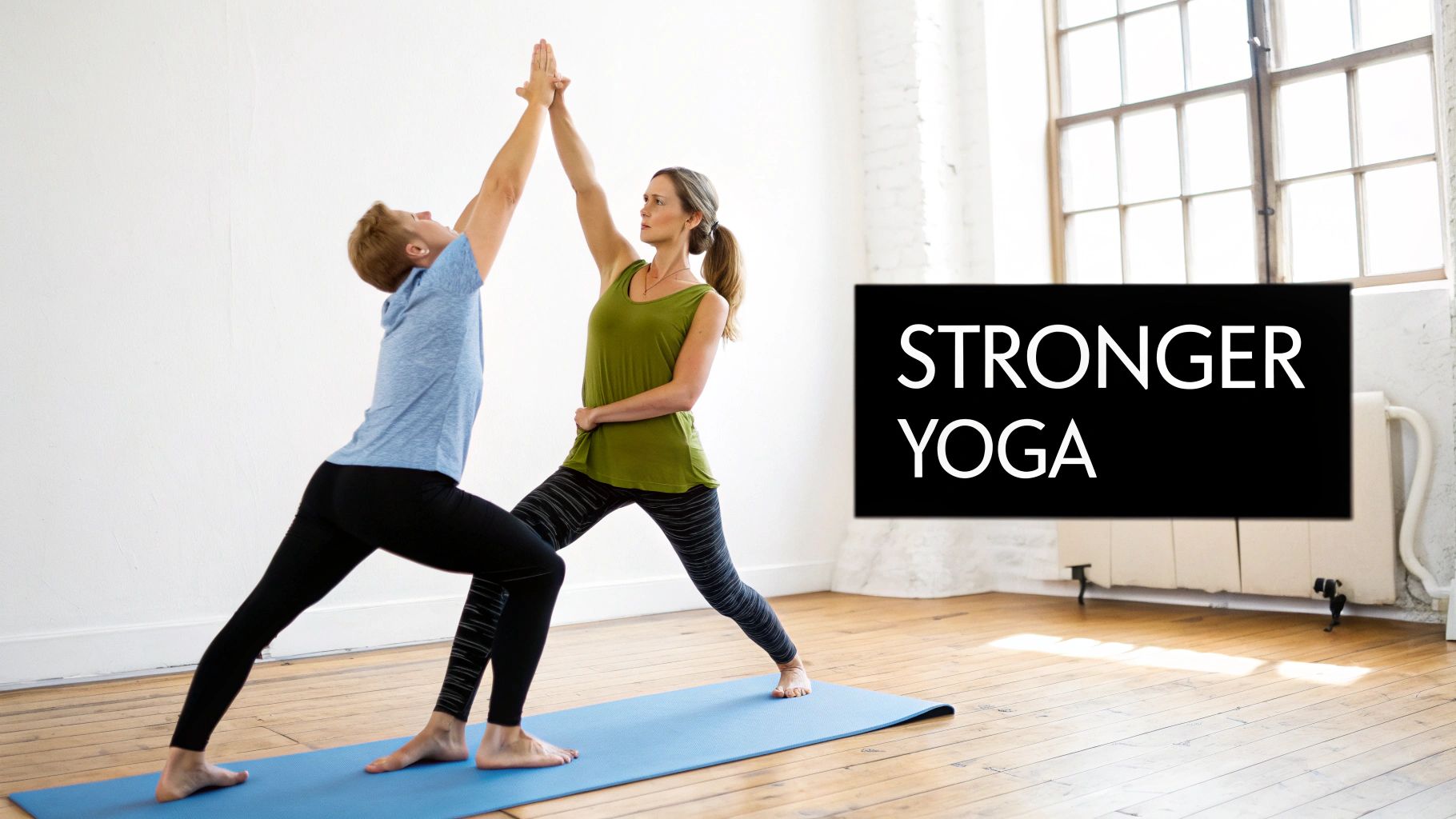
Here’s a good way to think about it: your favorite yoga teacher is the architect of your asanas, expertly guiding your form. A MAT specialist, however, is the mechanic who tunes up your engine before you even start driving, making sure every part is firing on all cylinders. They find the muscles that have checked out and bring them back online.
Let's break it down with a real-world example. Say you're constantly fighting for balance in Tree Pose (Vrksasana). You wobble, your standing leg burns out way too fast, and you just can't seem to find that solid, rooted feeling. It’s easy to blame a "weak core" or tight hips.
But the real culprit might be an inhibited gluteus medius—one of the most important stabilizer muscles on the side of your hip.
When this muscle isn't doing its job, your body has to get creative to keep you upright. It might call on your TFL (tensor fasciae latae) or a deep back muscle called the quadratus lumborum to pick up the slack, leading to that all-too-familiar tightness in your hip and lower back.
A MAT practitioner can spot this muscular "glitch" in minutes.
By applying precise, targeted pressure to essentially reboot that lazy glute medius, the change can be instant. Your body suddenly remembers it has a primary tool for stability. The next time you step into Tree Pose:
This isn't just about nailing one pose. It's about completely rewriting your body's entire playbook for stability.
MAT doesn’t replace your yoga practice; it prepares your body to get more out of it. By ensuring all your muscles are online and ready to work, you can achieve deeper, safer, and more expressive poses.
By getting to the root of these muscular imbalances, MAT clears out the invisible hurdles that have been holding you back. It’s like the difference between driving a car with a flat tire and one that’s perfectly aligned.
When your entire muscular system is working as a team, you build strength and stability on a whole new level.
This means you’ll finally have the strong foundation needed for more advanced poses, unlocking parts of your practice you thought were out of reach. For example, a truly activated core is non-negotiable for inversions and arm balances. MAT can ensure the right muscles are awake and ready to engage when you need them most. You can dive deeper into this with our guide to yoga for core strength for beginners.
Ultimately, MAT lets you build strength on a solid, functional base. You’ll find yourself progressing faster, moving with more confidence, and leaving behind the chronic aches that may have been holding you back for years. It’s all about making sure your body is truly ready for the amazing work you're asking it to do.
So, you’re thinking Muscle Activation Technique might be the secret weapon you’ve been looking for? Awesome. But hold on a second—before you jump on the first practitioner you find on Google, let's talk about what separates the pros from the rookies.
Finding the right expert is every bit as important as the technique itself. You wouldn't hire a handyman to perform heart surgery, right? Same idea here. A truly qualified MAT specialist is part detective, part body mechanic, with a deep understanding of the body's complex wiring. They’ve gone through some serious training to pinpoint exactly which muscles have gone on vacation, rather than just taking a wild guess.
As you start looking around, you'll see a few different titles thrown about. This isn't just jargon; the certification levels tell you a lot about a practitioner's training and what they can do for you.
Greg Roskopf's system has been around for over 20 years, and in that time, it's grown into a well-respected discipline with thousands of certified practitioners. Back in the early 2000s, the MAT Jumpstart program was introduced for personal trainers, and by 2008, you could find these trainers in high-end gyms across the US, Mexico, Spain, and the UK. If you're curious about the backstory, you can discover the origins of MAT certification. Having a structured educational pathway like this is what separates a legitimate therapy from a passing fad—it’s the same standard you’d expect from credible wellness coaching certification programs.
Alright, let's get down to brass tacks: what’s this going to cost? MAT is a highly specialized skill, and the price tag reflects the years of training and the meticulous, one-on-one attention you receive. It’s not a quick-fix massage.
A typical MAT session runs about 45 to 60 minutes. You can expect to pay anywhere from $100 to over $250 per session, depending on where you live and the practitioner's level of expertise.
When you go in for that first visit, come armed with questions. Ask about their experience with your specific problem, what a treatment plan might look like, and be clear on the costs. A great practitioner will be an open book, helping you feel confident about the investment you're making in your health. Finding that perfect fit is the first step toward unlocking your body’s true potential for moving without pain.
As you dig into Muscle Activation Technique, you're bound to have some questions. It’s a pretty unique way of looking at the body, and it’s not quite like anything else you’ve tried before. So, let’s tackle some of the most common curiosities head-on.
Let's be straight: the assessment part is a breeze. It's just a series of gentle resistance tests to see which muscles are firing and which are taking a nap. No pain there.
Now, the activation part? That can feel… intense. The practitioner uses very specific, deep pressure right where the muscle attaches to the bone. If a muscle has been snoozing for a while, waking it up can be a bit of a jolt.
Most people call it a "good pain." It's that feeling of knowing something important is happening. The key is to keep talking to your practitioner so they know your comfort level. You’ll probably feel a little sore for a day or two afterward, kind of like the day after a really good workout. That’s just your newly activated muscles reporting back for duty!
Great question. While MAT, chiropractic, and physical therapy all want to get you out of pain and moving better, they come at the problem from completely different angles.
Chiropractic Care: This is all about the skeleton, focusing on spinal and joint alignment to make sure your nervous system is communicating properly.
Physical Therapy: PT is usually about rehabilitation. Think exercises, stretches, and other tools to help you recover from a specific injury.
Muscle Activation Technique: MAT has one laser focus: finding and fixing muscle weakness. It’s obsessed with identifying which muscles have checked out and turning them back on.
Instead of just chasing the symptom (like your tight hamstring), MAT goes after the root cause (the weak glute that’s making the hamstring overwork). This is why it works so well alongside chiro and PT—it helps other treatments stick by fixing the underlying muscular foundation.
MAT is a methodical way to hunt down and correct the muscular imbalances that cause pain and limit performance. It’s for everyone, from pro athletes to someone who just wants to get through their day pain-free.
Ah, the million-dollar question! The honest answer is, "it depends." And it truly does. The number of sessions you need is a direct reflection of your body's history and what you're dealing with.
If you have a recent, straightforward issue, you might feel a world of difference after just one or two visits.
But if you're dealing with chronic pain from years—or even decades—of your body compensating for old injuries, it's going to take more time. Think of it like peeling an onion. Your practitioner has to systematically work through layers of dysfunction to get to the core problem. After a thorough assessment, they'll be able to give you a realistic roadmap based on your body and your goals.
Ready to see how a stronger, more balanced body can transform your yoga practice? Dalm uses AI-powered pose analysis to provide real-time feedback, helping you build strength and stability on a solid foundation. Discover the difference when every muscle is working as a team. Explore Dalm today.