

What is myofascial release therapy? A Simple Guide to Pain Relief

Myofascial release therapy, or MFR, is a hands-on technique that zeroes in on the body's fascia—that intricate web of connective tissue that wraps around pretty much everything inside you. It's less about digging into sore muscles and more about applying gentle, sustained pressure to coax tight, stuck areas into letting go. Think of it like slowly and patiently untangling a delicate, knotted necklace.

Picture your fascia as a single, seamless spider web woven throughout your entire body. It encases every muscle, bone, nerve, and organ, providing support and structure. When everything is in good working order, this web is supple and allows all your internal parts to slide and glide past each other without a hitch.
But life happens. Injury, chronic stress, repetitive motions, or even just sitting hunched over a desk for years can cause this web to get tight, sticky, and dehydrated. These sticky spots, often called adhesions or restrictions, are like tiny traffic jams in your body’s internal highway system.
These restrictions can put a massive amount of pressure—up to 2,000 pounds per square inch—on your nerves and muscles. This can lead to pain, stiffness, and a frustratingly limited range of motion. The real kicker? The pain you feel in your shoulder might actually be coming from a fascial restriction way down in your hip. It’s all connected.
This is where MFR steps in, and it's fundamentally different from a deep tissue massage that focuses on pounding out muscle knots. The primary goal of myofascial release is to tend to this underlying fascial network. A skilled therapist uses slow, deliberate touch to feel for these "stuck" areas.
The core idea is brilliantly simple: apply gentle, steady pressure to a tight spot for at least 3-5 minutes. This sustained pressure gives the hardened, almost glue-like tissue the time it needs to soften, lengthen, and finally "release," bringing back its natural, fluid state.
This patient process helps to:
It’s so important to get this distinction. Myofascial release is its own unique therapy. The practitioner isn't just rubbing muscles; they're feeling for the texture and pull of the fascial lines. They’re "listening" with their hands, waiting patiently for the tissue to give way on its own terms.
This unique, patient approach is why MFR can be a total game-changer for people struggling with chronic pain, especially when other treatments have failed. It gets to the root cause of the problem instead of just chasing the symptoms, paving the way for relief that actually lasts.

To really get what myofascial release therapy is all about, you first have to meet the main character in this story: your fascia. Think of it as a single, continuous sheet of intelligent cling film, a fibrous, web-like tissue that wraps around and weaves through everything in your body. It encases individual muscle fibers, entire muscle groups, bones, and even your organs, giving them all a structural home.
But this isn't just some passive packing material. It's a living, breathing system. When your fascia is healthy and well-hydrated, it’s slick and supple. It lets your muscles glide past each other like silk, which is what gives you that effortless feeling of fluid movement when you walk, stretch, or reach for something on a high shelf.
The trouble starts when this beautiful system gets messed up. Physical trauma, inflammation, the repetitive stress of sitting hunched over a desk, or even emotional tension can cause the fascia to dehydrate and stiffen up. Instead of being smooth and stretchy, it becomes thick, sticky, and restrictive.
These hardened areas are called adhesions, and they're like snags in a delicate sweater. They clamp down on whatever they surround—muscles, nerves, blood vessels—creating a perfect storm for pain and dysfunction. It’s like trying to move around in a wetsuit that's two sizes too small. Every move is a struggle.
The pressure this restricted fascia can exert is no joke. Research has shown it can put a crushing force of up to 2,000 pounds per square inch on sensitive structures. That’s enough to create all sorts of unexplained aches and severely limit your mobility.
Now, here's where things get really interesting. Because fascia is one continuous network, a restriction in one spot can create a pulling effect that causes pain somewhere else entirely. This is called referred pain, and it’s why so many people get frustrated chasing symptoms without finding relief.
Let me give you a few real-world examples of how this plays out:
Getting your head around this concept is the key to understanding myofascial release. The therapy isn't just about rubbing the sore spot; it’s about being a detective, tracing the tension back to its source within this complex, body-wide web. By releasing that root cause, you can finally restore balance and get lasting relief.
Every great therapy has an origin story, and the tale behind myofascial release is a pretty wild ride through medical history. This wasn't something cooked up in a high-tech lab. Instead, it grew over a century, shaped by the hands-on work of pioneers who were brave enough to look at the body differently. The story doesn't start with muscles, but with the weird, web-like stuff that holds everything together.
Our journey kicks off in the early 1900s with Andrew Taylor Still, the maverick founder of osteopathy. He was one of the first to talk about techniques that sound a lot like modern MFR, using cool terms like "fascial twist." He was obsessed with the body's interconnected structure and planted the seed that this seemingly "useless" connective tissue might actually be the secret to unlocking serious healing.
The next big jump forward came from a total trailblazer, Dr. Janet Travell. Back in 1942, she officially gave a name to those nasty, hyper-irritable knots we all know and hate: "trigger points." You know, the ones that can shoot pain to totally random parts of your body. Her groundbreaking work might have stayed buried in medical journals if it weren't for one very famous patient.
In 1955, a young senator named John F. Kennedy was dealing with crippling back pain that was threatening his entire political future. Dr. Travell stepped in and successfully treated his intense muscle spasms. That success story eventually landed her a job as the official White House physician. Suddenly, trigger points—and the whole idea of treating fascial pain—were on the medical map for good. You can dive deeper into the story of these early visionaries in this fascinating historical overview from Integris Touch Therapy.
While Dr. Travell was all about hunting down and zapping trigger points, the therapy we recognize today was really molded by physical therapist John F. Barnes in the 1970s and 80s. He flipped the script, developing a signature style that ditched aggressive manipulation for a more intuitive, patient approach.
Barnes was all about gentle, sustained pressure. His whole philosophy was to "listen" to the body with his hands, waiting for the rock-hard fascia to soften and release on its own schedule, rather than trying to bully it into submission.
This subtle but incredibly powerful technique became the foundation of what's now known worldwide as the Barnes Myofascial Release Approach®. He started teaching his methods to other therapists in 1986, and what was once a niche idea exploded into a global movement. It just goes to show you, myofascial release isn't some fly-by-night trend; it's a discipline built on decades of real-world observation by people who learned to speak the body's hidden language.
Myofascial release isn't a single, rigid technique; think of it more like a family of approaches, each with its own personality. Figuring out which one clicks with your body is the first step, whether you're working with a pro or rolling it out on your own at home.
When you see a therapist, their work generally falls into one of two camps. The first is the direct method. This is where the therapist applies firm, sustained pressure right into the heart of a fascial restriction. It’s a more assertive approach, designed to physically stretch and lengthen that stubborn, sticky tissue.
On the other hand, you have the indirect method. This technique is much subtler. The therapist uses a surprisingly light touch, gently guiding the fascia and patiently waiting for the body to let go of the tension on its own. It's less about force and more about coaxing the tissue to unwind naturally.
Of course, you don't always need a therapist's table to get relief. Welcome to the world of self-myofascial release (SMR). This is the DIY version, where you become your own therapist using a few simple tools to work out the kinks. It’s an incredibly empowering way to manage daily aches and keep your body feeling fluid between professional sessions.
The most common tools in the SMR arsenal include:
The history of these hands-on approaches has been a fascinating journey, evolving from the foundational osteopathic ideas of A.T. Still to the more focused techniques pioneered by figures like Janet Travell and John F. Barnes.
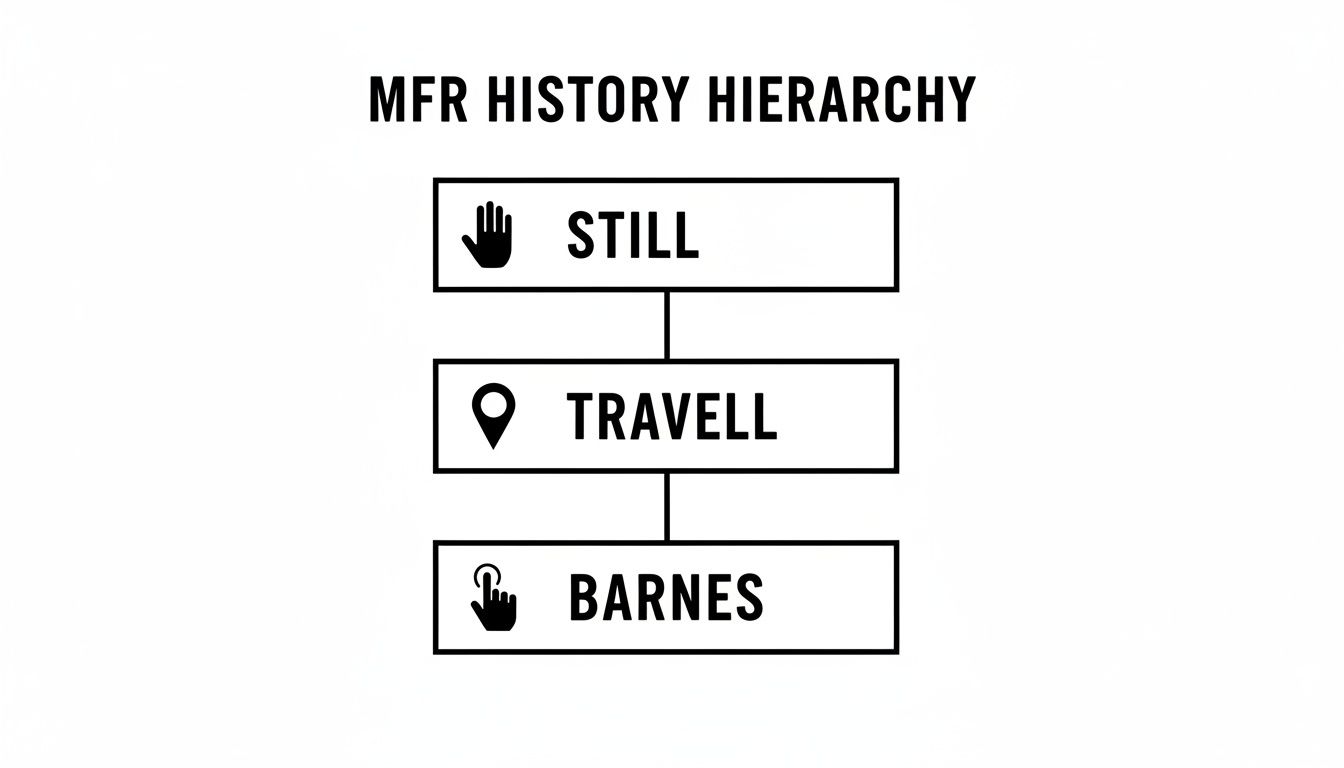
This evolution highlights a move away from general manipulation toward the patient, sustained, and highly specific techniques that define modern MFR.
It's super common to lump MFR in with other types of bodywork, but they're really apples and oranges. Each has a distinct goal and a unique way of getting there.
To help clear things up, let's break down how MFR stacks up against a couple of other popular therapies. They might all feel good, but what's happening under the surface is quite different.
So, what’s the takeaway? Myofascial release is all about the fascia—that intricate web of connective tissue. It uses time and sustained pressure to create change. Massage, on the other hand, is muscle-focused, using rhythmic strokes to ease tension. And trigger point therapy is like a laser beam, targeting one tiny, angry spot until it gives up.
Ultimately, the right choice boils down to your body's specific needs. If you're dealing with complex, chronic pain patterns, a professional MFR therapist might be your best bet. For daily maintenance and general soreness, SMR is a fantastic and accessible tool to have in your wellness kit.
So, is all this talk about untangling your body's "hidden web" for real? You bet it is. The perks of myofascial release aren't just gym-floor gossip or wellness fads; there's a solid pile of research showing just how powerful this technique can be for getting your body back on track.
Let's cut to the chase: MFR is a beast when it comes to kicking pain to the curb. It’s especially good for those stubborn, chronic aches that just don't seem to quit. That slow, sustained pressure coaxes tight fascia to let go of its stranglehold on nerves and blood vessels, which is often the ticket to sweet, sweet relief.
The proof is in the numbers. A big-picture review back in 2014 pulled together 23 different trials involving over 1,000 patients. The conclusion? MFR was a whopping 40% more effective than placebo treatments for tough-to-treat issues like chronic neck and low back pain.
And it gets better. Practitioners using the well-known John F. Barnes MFR method report that 85% of their clients with gnarly conditions like fibromyalgia or back pain see at least a 50% improvement after just 5-10 sessions. That’s a serious win. If you want to geek out on the data, you can dig into this detailed meta-analysis on Myofascial Pain Syndrome.
But it's not just about pain. MFR is a game-changer for getting you moving again. Think of tight fascia like a wool sweater that's been shrunk in the wash—it’s stiff, restrictive, and just won’t give. Releasing those sticky spots lets your muscles glide like they're supposed to, which can dramatically open up your range of motion.
This isn't just about feeling a little looser. It's about restoring your body's natural alignment and function, which helps you move better, prevent future injuries, and even up your game in sports.
Athletes have been all over MFR for years, and for good reason: it helps you bounce back faster. When you break up those fascial knots, you get the blood flowing again. This improved circulation is key for flushing out all the gunk that builds up after a tough workout and delivering fresh, nutrient-rich blood to your tired muscles. The result? Less soreness and a quicker return to your training.
This ability to restore fluid, easy movement is a cornerstone of physical well-being. If you feel like you've lost that spring in your step, addressing the fascial system is non-negotiable. For more on that, check out our guide on how to improve flexibility.
Ultimately, working on your fascia gives you back a sense of freedom in your own skin. It makes everyday movements—from picking up groceries to reaching for something on the top shelf—feel effortless and pain-free again.

So, you've booked your first myofascial release session. Fantastic. If you're picturing a spa day with fluffy robes and soothing whale sounds, you might want to adjust your expectations a bit. This is less about pampering and more about problem-solving—a deep, therapeutic conversation with your body.
The whole thing starts with a chat. Your therapist will want to know your story—what’s been aching, how it started, and what a typical day looks like for you. They aren't just being nosy; they're hunting for clues in your history that point to your body’s unique tension patterns.
Next up is the assessment. You’ll probably be asked to stand, walk around, or do a few simple movements. The therapist is playing detective, watching for subtle asymmetries and imbalances that scream "fascial restriction over here!" Getting a head start on this by exploring some postural awareness exercises can make you a much more active participant in your own healing journey.
Alright, this is the main event. You'll hop on a treatment table, usually in shorts and a tank top or sports bra—something you can move in. One big difference from massage? No oils or lotions. The therapist needs a direct, grippy connection to your fascia.
They'll use their hands, knuckles, or even forearms to apply slow, steady, and deliberate pressure to those tight spots. This isn't the fast, kneading motion of a Swedish massage. It’s a patient process. They sink into a restricted area and just... wait. Sometimes for several minutes, until they literally feel the tissue start to give way and melt.
People often describe the feeling as a "good hurt." It’s an intense stretch, a deep pulling sensation that can be challenging but shouldn't be sharp or agonizing. Open communication is key here; your therapist relies on your feedback to hit that sweet spot of effective pressure.
A session typically runs between 60 and 90 minutes. When you get up, don't be surprised if you feel a little tender in the areas they worked on. That's totally normal.
But what most people notice is an incredible feeling of lightness and space. You might feel taller, looser, and more free in your movements than you have in years. The real magic, though, often settles in over the next few days as your body adapts to its new, more balanced and un-stuck state.
It's smart to have questions before you jump into something new, especially when it comes to your body. Let's tackle some of the most common things people wonder about when they first hear about myofascial release.
The big one: is it safe? For the vast majority of people, absolutely. But it's not a free-for-all. If you're dealing with specific things like an aneurysm, open wounds, or a flare-up of acute rheumatoid arthritis, you'll need to sit this one out.
The golden rule? Always have a chat with your doctor and a qualified therapist before your first session. They'll give you the green light if it's right for you.
Another common question is about frequency. Honestly, there's no single magic number. It really depends on what you've got going on.
If you're trying to tackle a fresh injury or a sudden flare-up, you might start with 1-2 sessions per week. As you start feeling better, you can dial it back. For just keeping your body tuned up and feeling good, once a month might be your sweet spot.
So, who is this therapy really for? If you're wrestling with any kind of chronic pain or persistent tightness, you're in the right place. Myofascial release can be a game-changer for a whole host of issues.
We see fantastic results for people with:
The real beauty of this therapy is that it doesn't just chase the pain. It looks at the whole interconnected web of fascia, which is why it works so well for tricky problems where the culprit isn't obvious.
Finally, everyone wants to know: what does it feel like? Think of it as a "good hurt." It can be intense, for sure, but it’s the kind of intensity that feels productive—like something is finally letting go. This connection between sensation and healing is a huge part of the process. To go deeper, it's worth understanding what is mindful movement and how that awareness can supercharge your results.
Ready to improve your body's alignment and mobility from home? Dalm uses AI-powered pose analysis to provide real-time feedback on your yoga practice, helping you build a strong, flexible, and pain-free body. Perfect your form and track your progress at https://dalm.co.