
What is Neuromuscular Reeducation: what is neuromuscular reeducation benefits
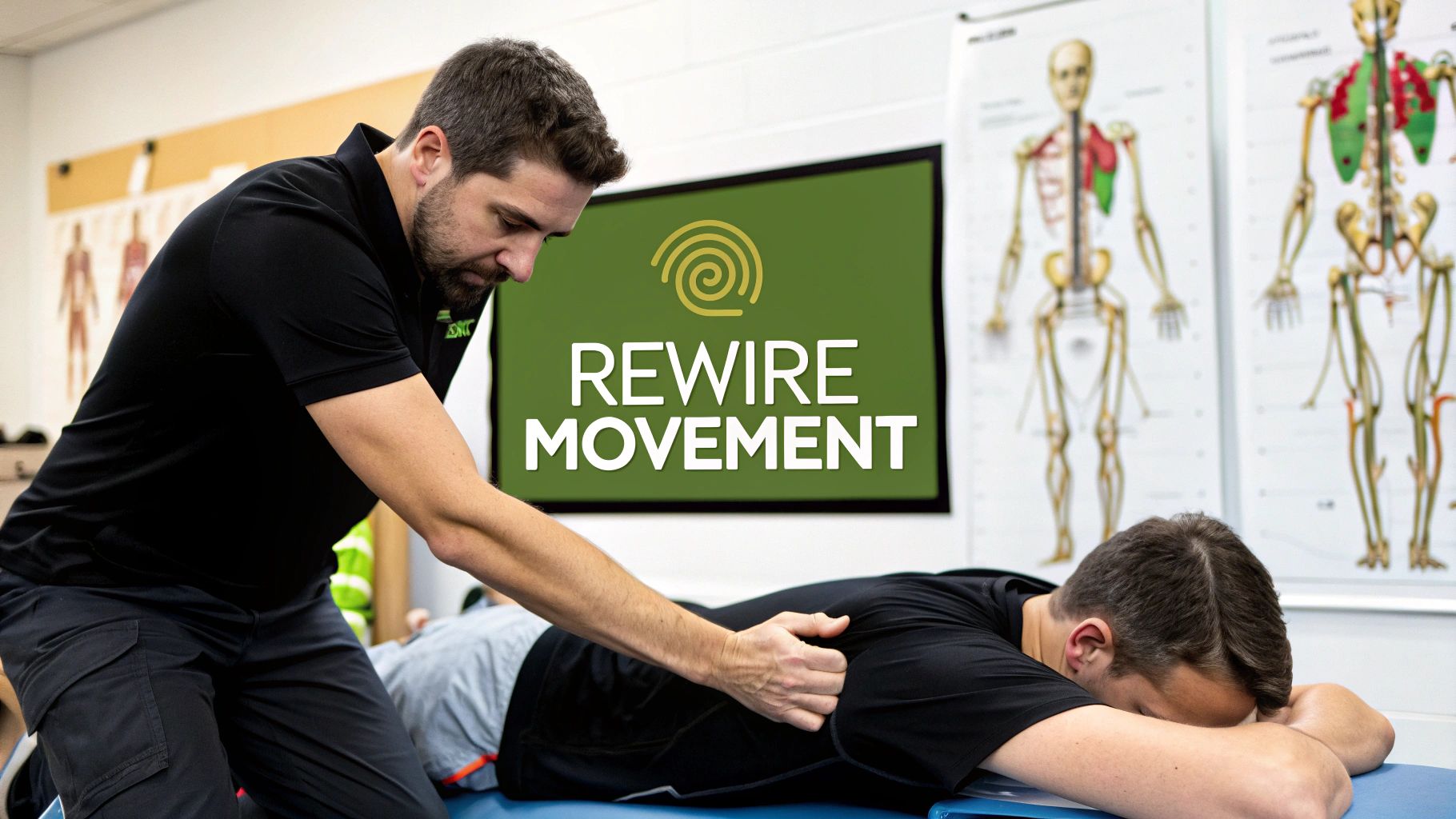
So, what in the world is neuromuscular reeducation? Think of it as a conversation between your brain and your body—and right now, they might be giving each other the silent treatment.
After an injury, surgery, or even just from long-term bad habits, the communication lines between your brain, nerves, and muscles can get fuzzy. Your body starts to develop weird "workarounds" to avoid pain, leading to wonky movement patterns that feel normal but are actually super inefficient. Neuromuscular reeducation is all about getting everyone back on speaking terms.
It's less about brute-force strengthening and more about reminding your muscles how to fire in the right order, at the right time. It’s a process of rewiring those faulty connections and restoring your body's original, intended blueprint for movement.
Ever feel like your body has a mind of its own? That wobbly ankle that never quite recovered, or the way you unconsciously lean to one side? That's your brain-body connection on the fritz.
Let me paint you a picture. Imagine a master guitarist who, after a hand injury, suddenly can't play a simple chord. Their fingers feel clumsy and uncoordinated. They haven't forgotten the music, but the lightning-fast, automatic signals from their brain to their fingers are scrambled. To get back on stage, they have to painstakingly reteach their fingers every single movement, rebuilding that lost connection note by note.
That's exactly what neuromuscular reeducation does for your body. It's a guided process to help you unlearn the clumsy, compensatory habits your body picked up to protect itself.
The real goal here isn't just to build bigger muscles. It’s about restoring the quality, timing, and coordination of every movement you make. We're teaching your body to move smarter, not just harder.
This whole process hinges on a few powerful principles that help your body relearn and heal from the inside out.
Let's break down the science behind how your brain and muscles get back in sync. This table shows the core concepts that make this therapy so effective.
These principles work together to turn clunky, conscious effort back into the fluid, unconscious movement you were born with.
So, when you boil it all down, neuromuscular reeducation is an active therapy designed to:
It's not just a set of exercises; it's a complete retraining program for your nervous system. Whether you're aiming to perfect a yoga pose or just want to walk down the street without a limp, it’s about rediscovering a more natural, efficient way to live in your body.
"Neuromuscular reeducation" might sound like something out of a sci-fi novel, but it’s actually a beautiful, intuitive process. It’s all about tapping into three core principles your body uses every single day to get your brain and muscles back on the same page. Think of it as turning clumsy, painful movements back into the smooth, confident actions they were meant to be.
Let’s dive into how the magic happens.
At the very heart of this process is neuroplasticity. This is your brain’s incredible, built-in ability to reorganize itself by forming new neural connections. Your brain isn't a fixed, hard-wired computer; it's more like a dynamic, ever-changing city map.
After an injury or because of chronic pain, your nervous system often creates clumsy "detours" or inefficient back roads to avoid the problem area. These faulty movement patterns quickly become the new normal. Neuromuscular reeducation is like a skilled city planner, helping your brain build brand-new, direct superhighways. Through specific, repeated exercises, you're literally paving over those old, dysfunctional routes. The best part? Research shows this can happen at any age.
Next up, we have proprioception. This is your body's amazing internal GPS—a kind of sixth sense that tells your brain where your limbs are in space without you even having to look. Go ahead, close your eyes and touch your finger to your nose. That’s your proprioception working flawlessly! It’s the silent hero behind your balance, coordination, and every graceful movement you make.
When this system gets fuzzy or damaged, you might feel clumsy, unstable, or like you’re constantly on the verge of re-injury. You’re essentially driving through life with a glitchy map. The exercises in neuromuscular reeducation are designed to recalibrate this internal guidance system. They challenge your balance, forcing your brain to pay laser-focused attention to the signals coming from your muscles and joints. This sharpens your body awareness and is a huge part of kinesthetic learning, where we learn best by doing and feeling.
This image below perfectly captures the communication breakdown that this therapy aims to fix.
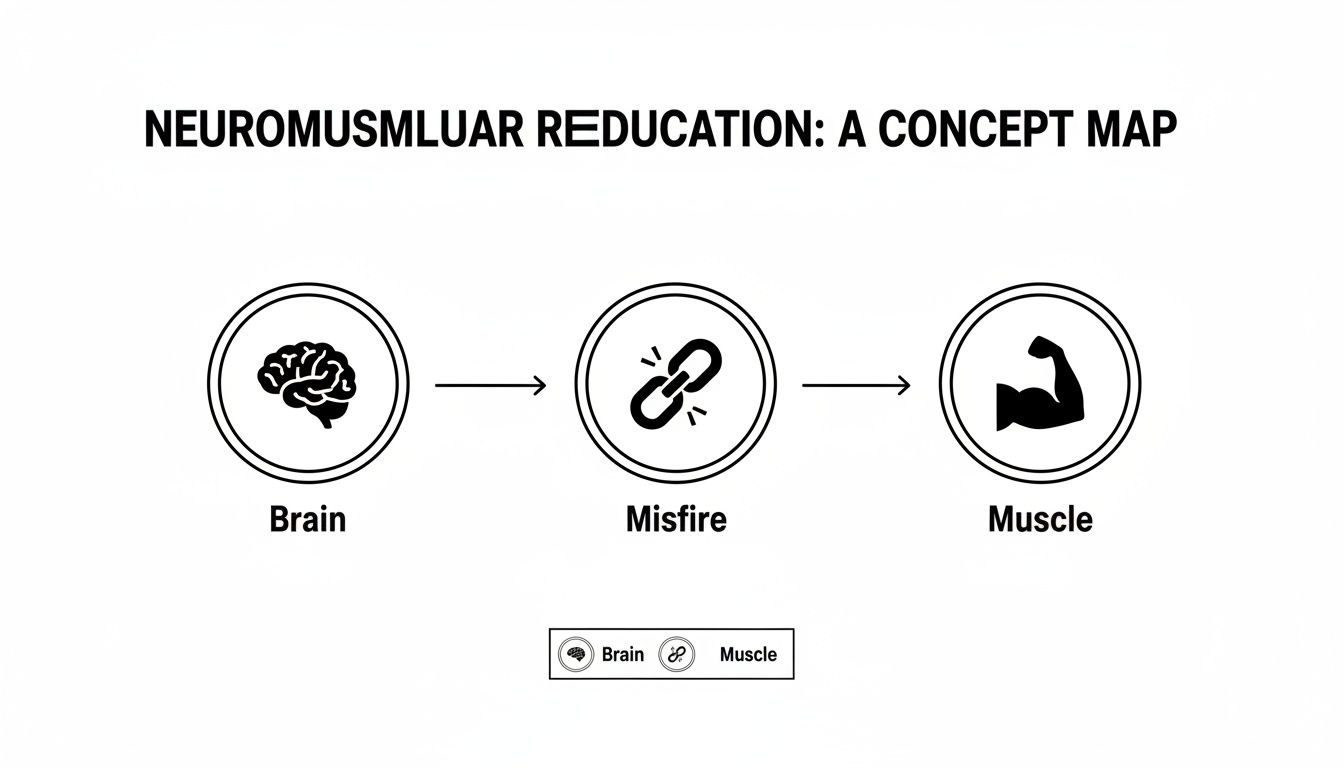
You can see how a "misfire" between the brain's command and the muscle's response can happen. That's exactly the problem neuromuscular reeducation solves.
Finally, let's talk about motor control. If neuroplasticity is building the roads and proprioception is the GPS, then motor control is the sophisticated software that plans the route and tells the car how to drive. It's the process your brain uses to coordinate all the tiny muscle contractions needed to perform any action, from taking a simple step to hitting a perfect tennis serve.
When motor control goes haywire, muscles fire out of sequence, too weakly, or not at all. This forces other muscles to jump in and overcompensate, leading to strain, chronic pain, and deeply ingrained bad habits. Neuromuscular reeducation works to refine this "software" by breaking down complex movements into smaller, more manageable pieces.
By practicing these individual components with perfect form, you're essentially debugging faulty code, one line at a time. You're teaching your body the correct sequence of muscle activation until it becomes second nature. The result? Movement that feels effortless, powerful, and—most importantly—pain-free.
Now that we've peeked behind the curtain at the science—all that cool stuff about neuroplasticity and proprioception—let's get to the fun part: the "how." How do we actually put this into practice?
Think of your physical therapist as a master craftsman with a unique set of tools, each one designed to recalibrate that delicate connection between your brain and your body. These aren't just random exercises you could find online; they're targeted moves designed to reboot your movement patterns from the ground up. This is where theory hits the gym floor.
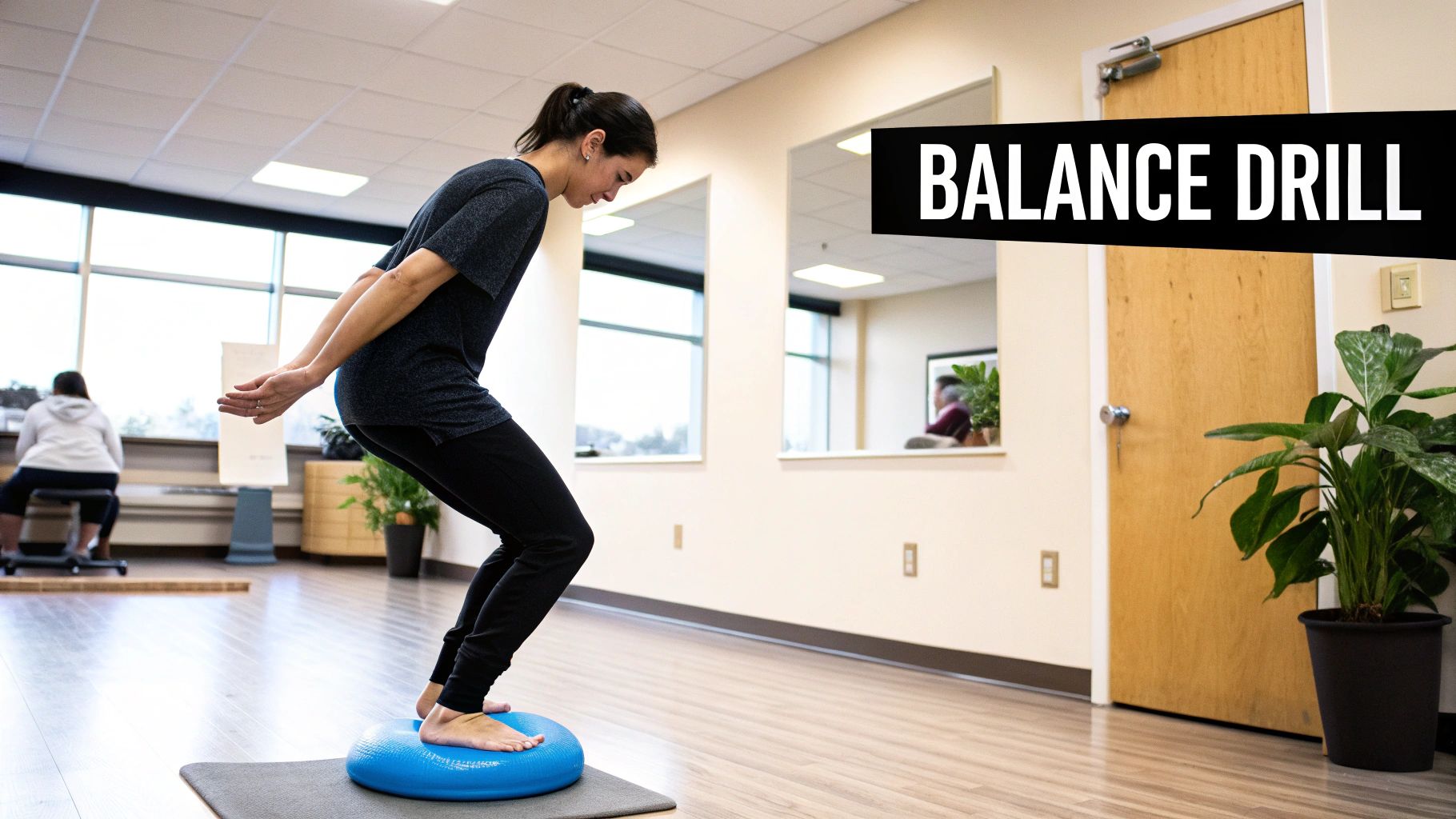
A good therapist will draw from a wide range of methods, mixing and matching to build the perfect program for you. The goal is to challenge your stability, sharpen your body awareness, and get the right muscles firing in the right order again.
Here are some of the go-to tools you'll likely see on your journey to better movement:
These foundational exercises lay the groundwork for everything else, ensuring your body has the stability and awareness it needs to progress safely.
Once you’ve nailed the basics, your therapist might pull out some more specialized techniques to really speed up the rewiring process. These methods are fantastic because they often give your nervous system direct feedback, helping it learn much faster.
One of the most powerful is Proprioceptive Neuromuscular Facilitation (PNF). It’s a hands-on approach where a therapist physically guides you through specific diagonal and spiral movements. By applying resistance and giving you tactile cues, they essentially light up the correct pathway for your brain, showing it the most efficient way to get a muscle to contract.
Another game-changer is Biofeedback. This sounds high-tech, but the concept is simple. Sensors are used to give you real-time information about what your muscles are up to. You might watch a graph on a screen that shows you exactly when a certain muscle is firing. This visual cue helps you learn to consciously control muscles your brain might have been ignoring, turning an automatic process into a skill you can master.
The real magic of these techniques is that they make you the pilot of your own recovery. You’re not just going through the motions; you are actively rebuilding the communication lines between your mind and your muscles.
Finally, Plyometrics often come into play in the later stages, especially for athletes. These are explosive exercises like jumping and hopping that train your nervous system to produce force and react in a flash. It's the ultimate test of neuromuscular efficiency, making sure your body is ready for the dynamic demands of sports and life. Getting your alignment right during these moves is critical, which is where modern posture analysis software can offer incredibly detailed insights into your form.
By layering these different tools, a therapist crafts a program that addresses your specific needs, helping you not just get over an injury but move with more confidence and precision than ever before.
Alright, let's get that section sounding like it was written by a human expert who's seen it all in the clinic.
You might be wondering if neuromuscular reeducation is some high-tech secret reserved for Olympic athletes. The truth? It’s for anyone whose brain and body aren't quite on speaking terms anymore.
Think about it this way. Ever sprain your ankle and find that even after it's "healed," you just don't trust it? You walk tentatively, constantly worried it might give out. That's not just a physical thing; it's a communication breakdown. The injury messed with your body's internal GPS, and this therapy is how we get it back online and recalibrated, so you can walk, run, and jump with confidence again.
It's also a massive deal for people coming back from surgery. Your body is a master of compensation. If something hurts, it will find a workaround. The problem is, these workarounds often become bad habits that cause a whole new set of issues down the road. Neuromuscular reeducation is like hitting the reset button, teaching your body how to move correctly from square one post-op.
The range of people who can benefit from this is huge, spanning all ages and walks of life. At its core, it's about getting back to living your life, whether that means sprinting down a soccer field or just feeling steady on your own two feet at home.
Here are just a few examples of who we see this work wonders for:
The common thread here is always a glitch in the communication line. It could be from a sudden injury, a chronic condition, or even just decades of slouching at a desk. Neuromuscular reeducation is the repair crew that gets the messages flowing clearly between your brain and your body again.
For an athlete, recovery isn't just about letting a torn muscle heal. It's about regaining that almost unconscious, split-second coordination that separates good from great. Simply hitting the weight room isn't going to cut it, and the research backs this up.
Take ACL surgery, a huge one in the sports world. A study looked at athletes six months after their operation and found that a program focused on neuromuscular training blew traditional strength training out of the water. The athletes retraining their brain-body connection reported significantly better knee function and felt more prepared to play. Why? Because that specific motor control work basically teaches the new ligament how to talk to the brain again. You can geek out on the details in the full study on post-surgery recovery.
This just goes to show that true recovery has to address the "software" that runs the movement. By zeroing in on the quality of an athlete's movement—how they land from a jump, how they cut and pivot—we can build a much more resilient system that’s far less likely to get injured again. It’s the difference between being "healed" and being truly ready to compete.
So, you’re about to start neuromuscular reeducation. What actually happens when you walk into the clinic? It’s natural to feel a little uncertain, but rest assured, this isn’t about just being told to “do some exercises.” Think of it as a collaborative mission between you and your therapist to decode your body’s unique movement language.
Your first session is all about detective work. Your therapist will watch you move—how you walk, stand up, reach for something. They’re not just looking at the obvious stuff; they're hunting for the sneaky, inefficient habits your body has picked up over the years. This initial deep dive is everything, as it allows them to pinpoint the real source of your problems, not just chase the symptoms.
Once your therapist has a solid understanding of your movement patterns, they'll draw up a game plan just for you. This isn't some cookie-cutter routine pulled from a textbook. It's a living, breathing plan that will change and grow as you get stronger and more confident.
The process usually unfolds in a pretty logical way:
This phased approach is a game-changer, especially after surgery. Take a total hip replacement, for instance. Neuromuscular reeducation is absolutely crucial for regaining the stability you need for daily life. A focused eight-week program can dramatically improve how a person walks and climbs stairs, tackling the compensatory habits that often lead to a higher risk of falling. You can dive deeper into these vital recovery findings for hip surgery patients.
Progress is a partnership. Your active participation and consistent effort are the most important ingredients for success. This therapy empowers you to take control of your recovery by truly understanding how your body is meant to move.
It's also important to be realistic. You're essentially overwriting years of ingrained movement habits, and that doesn't happen in a single session. Progress can feel slow at times, but it’s the small, steady wins that build up. With every appointment, you're methodically teaching your brain and body to work together more efficiently, paving the way for lasting, pain-free movement.
The magic of neuromuscular reeducation doesn't just happen on the therapist's table. Real, lasting change is forged in the day-to-day—it's the homework that truly rewires your brain. Think of it this way: your therapy sessions lay down the faint outlines of a new path in your nervous system. Your home practice is what turns that dusty trail into a paved superhighway.
But let's be honest, going from a supervised session to practicing on your own can feel like taking the training wheels off. How do you know if you're doing it right? Are you reinforcing good habits or accidentally falling back into the old, wonky ones? This is where a little bit of smart technology can be a game-changer.
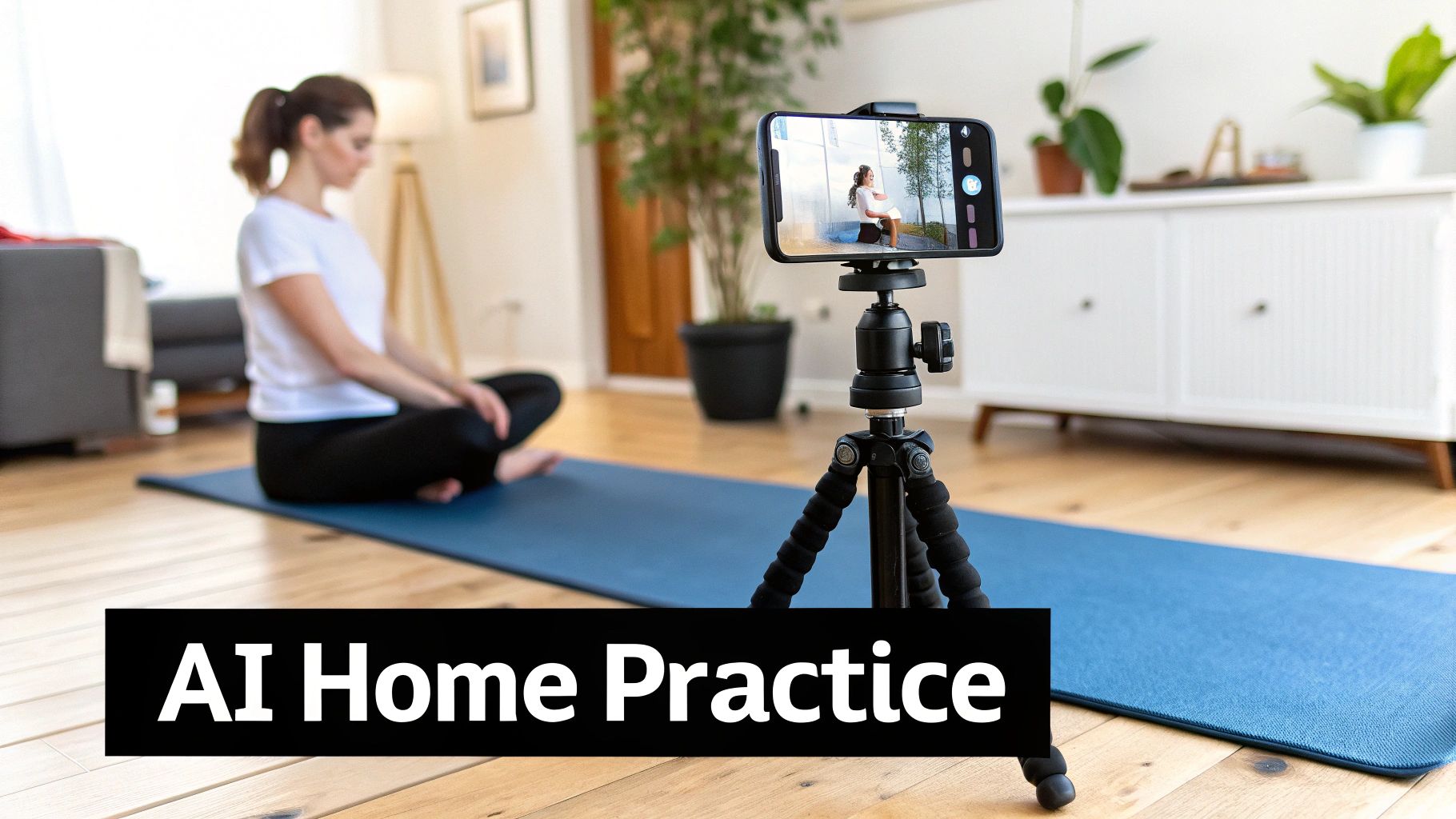
First thing's first: create your space. You don’t need a fancy home gym. All you need is a quiet corner where you won’t stub your toe on the coffee table mid-lunge.
The goal is to carve out a little sanctuary that helps you tune out the noise and tune in to your body. This is your time to listen to its whispers. And the golden rule? Never, ever push through sharp pain. We're here to challenge the system, not punish it.
Your home practice is a conversation with your body. Some days it's ready for a heart-to-heart, and other days it just needs a gentle check-in. The best skill you can build is learning to listen and respond with compassion.
This is where AI-powered tools like Dalm can really shine. Imagine having a virtual coach in your pocket, ready to give you pointers whenever you unroll your mat. Using just your phone's camera, Dalm provides real-time pose analysis and gentle voice cues while you flow through a yoga session.
Yoga is an incredible medium for this work. So many poses are natural-born challenges for your balance, core strength, and proprioception—the cornerstones of neuromuscular reeducation. With an AI guide, you get instant feedback on your form, helping you fine-tune those movement patterns with a precision that’s tough to achieve on your own.
Let’s take someone struggling with a wobbly ankle, for example. We know from research that a focused six-week program of specific balance drills can dramatically improve stability. One study highlighted how exercises like single-leg stances and controlled landings were incredibly effective at restoring dynamic balance. In fact, it's estimated that over 90% of soft tissue injuries can be improved with these kinds of precise motor control exercises. You can geek out on the details and learn how neuromuscular training impacts dynamic balance in the full study.
An AI tool like Dalm can directly support this. When you’re wobbling through Tree Pose or Warrior III, the app analyzes your stability on the fly. It might gently prompt you, "Engage your core to stop swaying," or "Try shifting your weight a tiny bit to the left." It’s like having your therapist's voice right there with you, helping you catch those tiny instabilities and sharpen your body's internal GPS.
When you pair professional therapy with smart tools for your homework, you create a powerful feedback loop. Every minute you spend practicing becomes a confident step forward, building a body that’s more resilient, coordinated, and truly your own.
Jumping into something like neuromuscular reeducation is bound to stir up a few questions. It’s a fascinating world where brain science meets physical movement, so a little curiosity is a good thing! Let’s unpack some of the most common queries that pop up.
Think of this as your quick-and-dirty guide to the practical stuff. We'll clear the air so you can feel totally confident about how this all works.
Great question, and it's probably the most common one we hear. The key difference boils down to one word: focus.
While there's definitely some overlap, traditional physical therapy often concentrates on the hardware—strengthening individual muscles, increasing flexibility, and improving your range of motion. It’s about making the parts stronger.
Neuromuscular reeducation, on the other hand, is all about upgrading the software. It’s obsessed with the quality of your movement. We’re talking about the timing, the sequence, and the subconscious coordination that makes an action smooth and efficient.
Picture yourself lifting a heavy box. A regular PT approach might focus on building up your bicep and back strength to get the job done. Neuromuscular reeducation teaches your brain the safest and most efficient way to fire those muscles, ensuring you lift with your legs and core to protect your back. It's a subtle but game-changing shift.
So, one builds the engine, and the other fine-tunes the driver. You really need both to perform your best.
Ah, the million-dollar question! The brutally honest answer? It depends. There's no magic number here, as the timeline is unique to you, your specific condition, and how consistently you stick with the program.
Some people notice small but significant changes—a little more stability, a better sense of balance—within just a few sessions. For bigger changes, especially after a serious injury or for a neurological condition, you're likely looking at several weeks or even months of dedicated work.
Think of it this way: neuroplasticity is a marathon, not a sprint. Your brain is constantly adapting, but forging strong, new pathways for movement takes time and a whole lot of repetition. Progress isn't always linear, either. You’ll have amazing days and days where things feel a bit off. The important thing is that every single session is another step toward building a better, more efficient way of moving.
While the ultimate goal is for you to confidently practice on your own, starting with a qualified professional is non-negotiable. A physical therapist, occupational therapist, or chiropractor acts like a movement detective. They have the trained eye to spot exactly where things are going wrong and build a program that’s safe and tailored just for you.
Trying to do these exercises on your own without that initial expert guidance can be a recipe for disaster. You could easily reinforce the exact dysfunctional patterns you're trying to eliminate or, even worse, get hurt. It's like trying to fix a complex engine with a blurry, photocopied manual—you're more likely to break something than fix it.
Once your therapist has helped you build that solid foundation and you truly get the "why" behind each movement, a home program becomes your superpower. This is where tools like AI-assisted apps can be incredibly valuable. They can act as your virtual coach, giving you that instant feedback to make sure your form is on point and every minute of your solo practice is productive.
Ready to take control of your home practice? Dalm uses AI-powered pose analysis to provide real-time feedback, helping you perfect your alignment and enhance your body awareness. Discover a smarter way to practice yoga by visiting https://dalm.co.