
What is postural control? A Quick Guide to Balance and Stability
Ever tried to stand on one leg and felt that little wobble in your ankle? Or maybe you've stood on a moving bus and, without thinking, your body just knew how to stay upright as it lurched and swayed. That incredible, automatic balancing act is your postural control at work. It's the silent hero of your body, working around the clock to keep you from face-planting.
Think of postural control as your body's built-in stabilization system. It’s a sophisticated, behind-the-scenes operation run by your brain, nervous system, and muscles, all collaborating to keep you stable and oriented. It’s the constant, subtle dance that keeps your center of gravity squarely over your base of support, whether you're standing still, walking, or lunging for a runaway toddler.
This isn't just one thing happening; it's a symphony of activity. Your body is a master data-gatherer, constantly pulling in information from your eyes (vision), your inner ears (vestibular system), and sensory receptors all over your body (proprioception). It crunches all that data in real-time and sends out lightning-fast commands to your muscles, telling them precisely how to adjust to keep you balanced against gravity and whatever else the world throws at you.
To really get what postural control is all about, you have to look at its three main jobs. These pillars work together seamlessly, whether you’re attempting a tricky yoga pose or just getting out of a chair.
This whole dynamic process is the foundation for pretty much every move you make. Sharpening your postural control isn't just for gymnasts or physical therapy patients—it's for everyone. When you improve this system, you move more efficiently, put less strain on your joints, and build a ton more confidence in your body. For a deeper dive, check out these powerful postural awareness exercises you can start doing right now.
Postural control is the foundation of all movement. It’s the invisible skill that allows for every step, reach, and turn we make, transforming conscious effort into effortless grace and stability.
This system might sound complex, but at its heart, it's a simple and elegant three-step process. Here’s a quick look at how it all comes together.
From feeling the ground to processing the data to making a move, these three steps happen in a fraction of a second, thousands of times a day, without you ever having to think about it. It’s your body’s brilliant, built-in autopilot for stability.
Think of your body like a high-tech car equipped with an incredible navigation system. To get you around safely, it doesn't just use a single map. It's got a GPS to see the road ahead, an internal gyroscope to feel every tilt and turn, and sensitive tire sensors reporting back on the road conditions.
Your body’s postural control system is surprisingly similar, relying on three distinct sensory streams to create its own internal GPS.
This constant flood of information lets your brain build a live, 3D map of where you are in space, moment by moment. It's the magic behind why you can weave through a crowded room without bumping into anyone or stand on one foot without immediately face-planting. Let's meet the three key players on this sensory team.
Your eyes are the most obvious and often the most dominant source of information for your balance. They give you a powerful external reference point, showing you where the horizon is and how you're positioned relative to everything around you. It's like the main satellite map on your car’s dashboard.
This gives you the big-picture view, helping you anticipate potential bumps in the road and adjust your posture before you hit them. When you spot an uneven patch of sidewalk coming up, your visual system is what tips off your brain to get ready for a change in terrain.
Deep inside your inner ear lies the vestibular system, an amazing little piece of biological engineering that acts as your body’s gyroscope. This system couldn’t care less about what you see; it’s all about motion and gravity.
It detects acceleration, deceleration, and every little tilt or turn of your head. Ever felt dizzy after spinning in a circle or a bit queasy on a boat? That's your vestibular system getting scrambled signals—a perfect example of what happens when your internal gyroscope and your visual map just can't agree.
Finally, the somatosensory system gives your brain feedback from the ground up. This is a massive network of sensory receptors embedded in your skin, muscles, and joints that report on pressure, stretch, and vibration. Think of them as the advanced sensors in your car’s tires, constantly feeding you intel on the road’s texture and grip.
This system is how you can feel the difference between standing on soft sand, a hard tile floor, or a wobbly cushion. It’s feeding your brain critical information about your base of support. This internal body awareness, a core part of the somatosensory system, is also called proprioception. We dive deep into this "sixth sense" in our guide on what is proprioception training.
When these three systems work together seamlessly, your brain gets a rich, multi-layered stream of data. This is what allows for the thousands of tiny, automatic muscle adjustments that keep you stable—the very definition of postural control.
This flowchart paints a clear picture of this powerful information loop, from your senses to your brain and right down to your muscles.
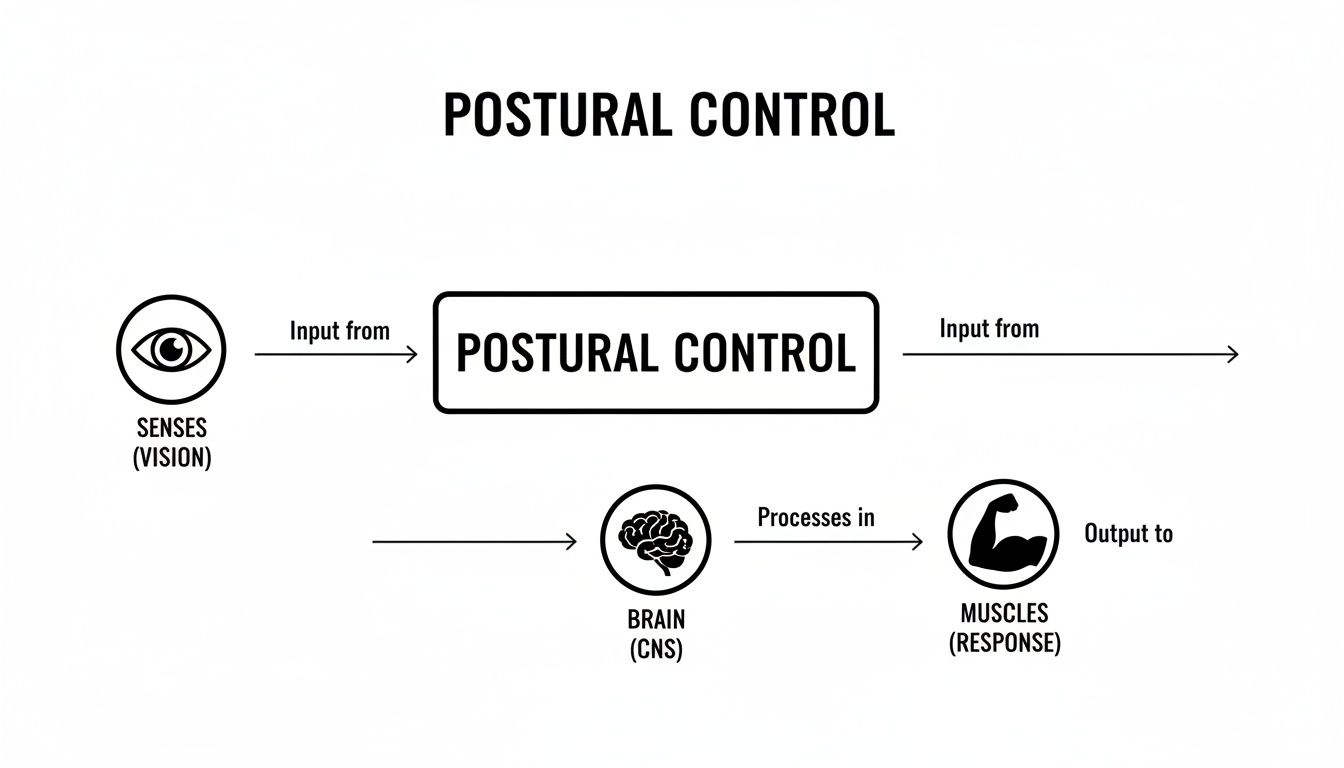
As you can see, staying upright is a continuous feedback process. Sensory input drives the precise muscle actions needed for stability. When this system starts to falter, it’s more than just a minor inconvenience. Poor postural control is a major factor in musculoskeletal disorders, which affect an estimated 21.9% of people globally.
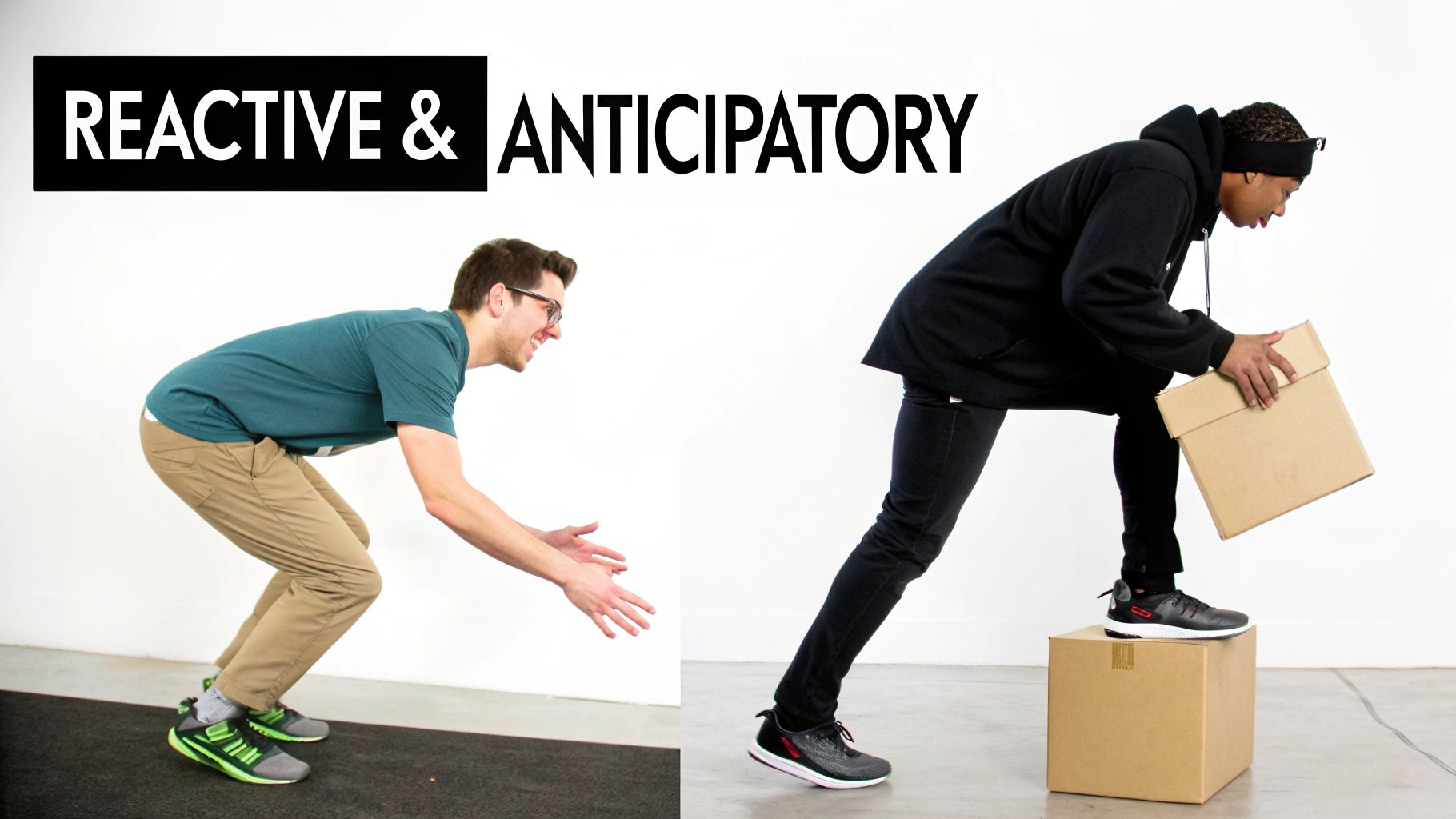
Think of your postural control system as having two highly specialized bodyguards working around the clock. One is a lightning-fast reactor, the other a brilliant strategist who spots trouble before it even begins. Both are absolutely critical for keeping you on your feet, but they go about their jobs in completely different ways. Getting to know them is the secret to mastering your balance.
These two bodyguards are your reactive control and anticipatory control systems. One is the hero that jumps in to save the day after you stumble, while the other prepares for action before you even move a muscle. Let's get to know this dynamic duo.
Ever caught your foot on a rogue paving stone? Before you can even think "whoops," your arms have flown out, your torso has twisted, and your other leg is planted firmly to prevent a face-plant. That's reactive postural control jumping into action.
It's your body's built-in emergency response system—the firefighter rushing in after the alarm has already sounded. It works through lightning-fast feedback loops. Your sensory system screams, "Ankle rolling!" and your brain instantly deploys a counter-move to stabilize you. These reactions are pure reflex, built for one thing and one thing only: getting you back to a stable position after you've lost it.
Now, picture yourself reaching for a heavy carton of milk on the top shelf. Your body knows what's coming. Long before your arm even starts to move, something amazing is happening under the surface. Your core tightens, your weight shifts ever so slightly, and the muscles around your shoulder brace for the load. That’s anticipatory postural control.
This is the fire marshal of your body—the pro who inspects the situation and sets up safeguards to stop a fire from ever starting. It’s a “feed-forward” system, where your brain uses past experiences to pre-activate muscles for a movement you intend to make. It predicts the chaos your own action is about to create and preps your body to handle it without a hitch. This is the difference between a graceful lift and a wobbly, unstable one.
Think of it this way: Reactive control is what saves you from a fall. Anticipatory control is what prevents you from losing your balance in the first place.
Truly mastering movement is all about shifting from a mostly reactive state to a more anticipatory one. This is where consistent practice, like yoga or specific balance drills, comes in—it trains your brain to become a much better psychic.
The more you repeat a movement, the better your brain gets at predicting the right postural recipe. A beginner wobbling through a new yoga pose is a classic example of reactive control working overtime, making dozens of tiny corrections. An experienced yogi, by contrast, flows into the same pose with effortless grace because their brain has already done the math and engaged the right muscles ahead of time.
You can see these two systems at play everywhere:
Improving your postural control means training both bodyguards. You need those quick reflexes for life’s unexpected bumps, but the real prize is building an anticipatory system so sharp that you rarely have to call on them. Through mindful movement, you teach your body to stop putting out fires and start preventing them altogether, giving you more efficiency, power, and confidence in everything you do.
If your sensory system is the GPS and your nervous system is the driver, then your physical body—bones, joints, and muscles—is the actual high-performance car. This is where we get into the nuts and bolts of biomechanics, the hardware that carries out every single command to keep you from face-planting.
Think of your body as a dynamic, living skyscraper. Your skeleton is the steel frame giving it structure, and your joints are the clever hinges that allow for movement. But the real heroes are your muscles—a powerful network of support cables that hold the entire structure steady against the constant pull of gravity.
Without this muscular tension, your skeleton would just be a pile of bones on the floor. Biomechanics is all about understanding how these parts work in concert to create a stable, efficient, and surprisingly resilient structure.
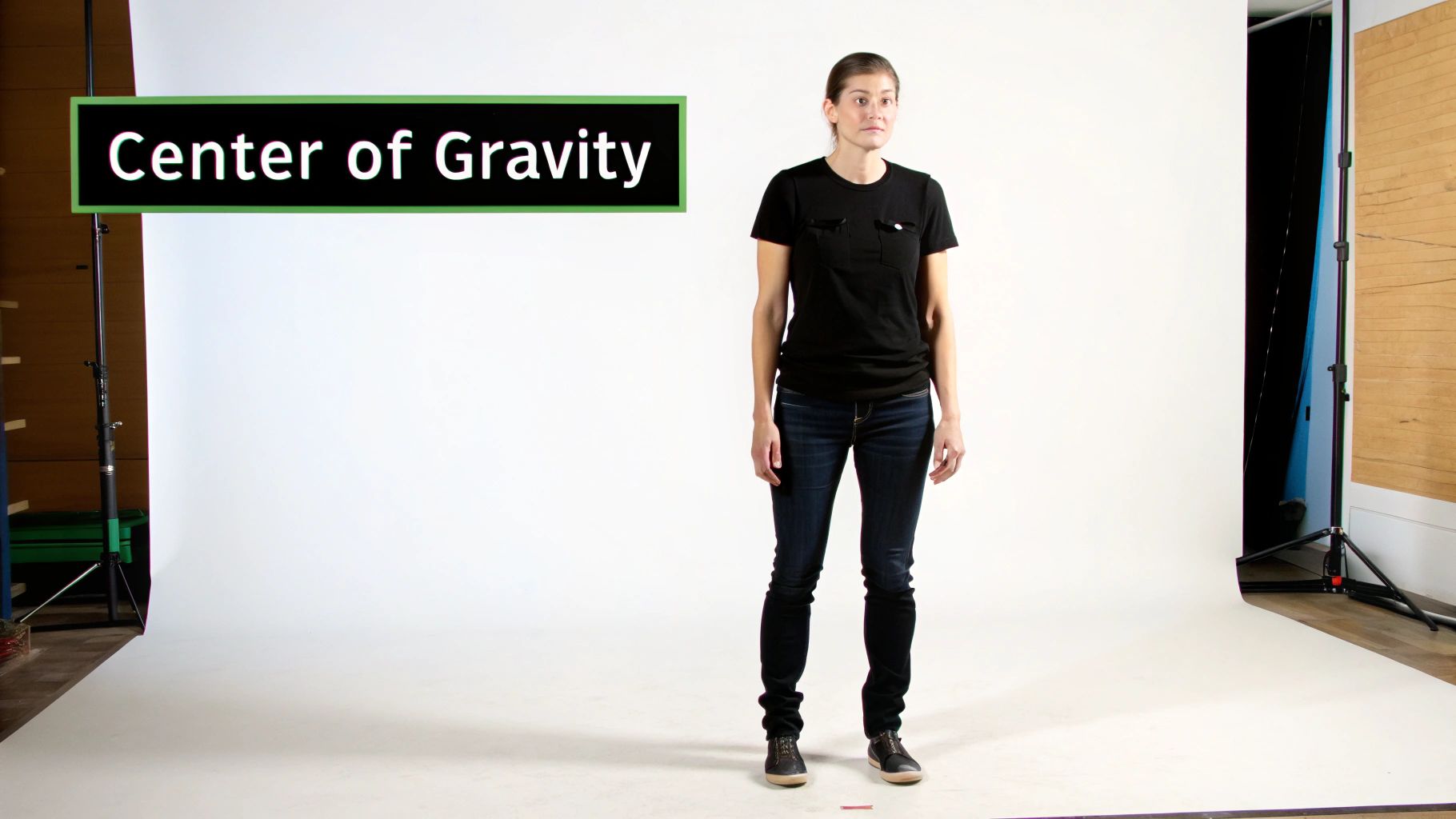
To really get the physics of staying upright, you only need to wrap your head around two key ideas: center of gravity and base of support. These two are locked in a constant dance, and their relationship is what determines whether you stand firm or topple over.
Your center of gravity (COG) is simply the imaginary point where your body's total mass is concentrated. When you're standing still, it's usually hovering somewhere around your belly button. Your base of support (BOS) is the area on the ground you're covering. Standing on two feet? It's the whole shape outlined by your feet and the space between them.
The golden rule of balance is surprisingly simple: You're stable as long as your center of gravity stays directly over your base of support. The moment your COG wanders outside that base, you start to lose your balance.
Try standing on one foot. Your base of support instantly shrinks to the size of your shoe sole. Suddenly, keeping that center of gravity perfectly aligned above it becomes a real challenge. This is precisely why a seemingly simple yoga posture like Tree Pose is such a fantastic way to train your postural control.
While pretty much every muscle has a part to play, a special team is working around the clock to maintain your alignment. Meet your postural muscles—the foundation crew that never takes a day off. These muscles are built for endurance, firing off tiny, constant contractions all day long to keep you upright without you even noticing.
The star players on this crew include:
When this crew is strong, coordinated, and firing on all cylinders, your body naturally finds its optimal alignment. And good alignment isn’t just about looking taller or more confident—it’s about pure mechanical efficiency. It spreads the load evenly across your joints, which minimizes wear and tear and slashes your risk of injury. A well-aligned body just moves better, with less effort and more power.
Think of your sense of balance like a story. It's not a skill you learn once and then file away—it's a dynamic, living system that evolves right alongside you. From those first wobbly toddler steps to the steady confidence of an athlete, our relationship with balance has distinct chapters.
Understanding this journey is the key to mastering your stability, no matter what page you're on. It’s a classic tale of development, hitting your stride, and then learning to adapt with wisdom.
Remember watching a baby learn to sit up? Their whole body is a little science experiment, a series of trial-and-error movements that slowly teach the brain how to connect what it feels with what the muscles should do. Every successful sit, crawl, and stand is a huge win for their brand-new postural control system, building the foundational wiring they’ll rely on for the rest of their lives.
This fine-tuning continues through childhood and the teen years, sharpening reaction times and boosting coordination. By the time we hit young adulthood, most of us are at our peak. Our senses are sharp, our muscle responses are snappy, and our brain is a supercomputer for processing balance data. It's the golden era of stability, a time when we can pretty much take our balance for granted while we effortlessly move through the world.
Then, as we cruise into our 30s, 40s, and beyond, things start to change. It's not like falling off a cliff; it’s more like a slow, subtle recalibration. The sensory systems that feed our brain crucial information might get a little less sensitive. We can lose some muscle mass, and those lightning-fast reflexes from our youth might slow down by a hair.
These age-related shifts simply mean our body has to work a bit harder to keep us upright. This is exactly why an unexpected crack in the sidewalk or a patch of ice can be a much bigger deal for a 65-year-old than a 19-year-old. The body’s natural back-and-forth movement to maintain balance, called postural sway, often increases.
An unsteady feeling isn't just in your head. Impaired postural control is a leading, measurable risk factor for falls in older adults and people with chronic conditions. It's a quantifiable change with serious consequences.
This isn't just a theory; the numbers tell a stark story. Population reports reveal that more than 25% of adults aged 65 and older fall at least once a year, and these incidents are often tied directly to a decline in postural control. Research using high-tech measurement tools has confirmed this, showing a clear, quantifiable increase in postural sway as we age, directly linking it to a higher risk of falling. You can learn more about the research on aging and postural sway if you want to dig into the science.
But here’s the good news: this decline isn't a life sentence. Postural control is a trainable skill, no matter your age. Just like you can build muscle or improve your heart health, you can actively train your balance system to be sharper, more responsive, and more reliable. Seeing these natural shifts isn't a reason to panic—it's a call to action. By getting proactive with practices like yoga that challenge and strengthen your stability, you can keep your balance system in top shape, ensuring you stay steady on your feet for years to come.
Okay, enough with the theory. It's time to get practical and start training your body's personal stability manager. And for that, there’s no better training ground than a yoga mat.
Yoga is so much more than stretching. It's a masterclass in mindful movement, precise alignment, and holding your ground against gravity. This makes it one of the absolute best ways to whip your postural control into shape.
Think about poses like Tree Pose (Vrikshasana) or Warrior III (Virabhadrasana III). These aren't just about looking graceful; they're intense challenges for your entire stability system. The moment you lift one foot for Tree Pose, you're putting your postural control on high alert. Your sensory system is reading the floor, your inner ear is managing every tiny wobble, and your muscles are firing like mad to keep you from toppling over.
This is where the real work gets done. You’re literally strengthening the neuromuscular pathways that keep you upright and steady in your day-to-day life.
Here’s the thing, though. While yoga is a phenomenal tool, there’s a catch: form is everything. Sloppy form doesn't just make a pose less effective; it can actually open the door to strain or injury. Are your hips really square in Warrior III, or are they cheating open? Are you leaning just a bit too far forward, throwing everything off?
It's tough to know for sure when you're on your own.
This is where a little help from technology can turn a good practice into a great one. Imagine having a biomechanics expert watching your every move, giving you instant pointers to nail your alignment. That’s exactly what an AI-driven platform like Dalm does.
Dalm is like having a personal coach in your pocket. It gives you real-time, medical-grade analysis of your poses, tracking the subtle shifts in your center of gravity and using voice cues to guide you into that sweet spot of perfect alignment.
An AI coach takes the guesswork out of the equation. Instead of just feeling like you're getting better, you can see the hard data that proves it. This is the same approach used in elite sports medicine to keep athletes on the field and off the injury list.
For example, sports science has shown time and again that poor postural control is a major predictor of injuries. Trainers use precision tools to spot athletes with wobbly balance—say, someone in the bottom 25% for their age group—and put them on a targeted training program. You can see for yourself how these data-driven benchmarks reduce injury risk in high-level athletes.
Dalm brings that same scientific rigor to your living room. It doesn't just cheer you on; it quantifies your stability, turning your yoga session into a personal balance lab. This kind of sophisticated posture analysis software lets you track your postural sway, check your alignment accuracy, and watch your stability numbers improve over time. You can finally pinpoint exactly what needs work and tackle it head-on.
By blending the ancient wisdom of yoga with the precision of modern tech, you get a clear, powerful path to mastering your balance. Every moment on the mat becomes a deliberate step toward rewiring your brain and body for unshakable stability, helping you move through life with more confidence and control.
Alright, we've unpacked what postural control is and why it's the secret sauce behind every move you make. But theory is one thing, and real life is another. Let's tackle some of the most common questions that come up when people start applying this stuff.
Not a chance! It’s true that a desk job is a direct assault on the muscles that hold you upright, but you can absolutely fight back. The first line of defense is simple: set up an ergonomic workstation and force yourself to take micro-breaks to stand and stretch. It makes a world of difference.
But for a real counter-attack? Dedicate just 15-20 minutes a day to targeted exercises. Think yoga, Pilates, or specific core workouts. You're not just stretching; you're rebuilding the very muscular scaffolding that your 9-to-5 is trying to tear down.
Patience, grasshopper. While you'll probably feel a little more stable within a few weeks, deep, lasting improvements don't happen overnight. We're talking months, not days. You're literally rewiring your brain and muscles to work together in a new way, and that takes consistent, mindful effort.
This is exactly why tracking your progress is so critical.
It's one thing to feel like you're getting better, but it's another thing entirely to see it. When you have concrete data showing your alignment is improving, it's a massive motivator to keep going. It proves the hard work is paying off.
Yes and no. You can't really "overtrain" for balance in the way you can bench press until your muscles give out. But trying to practice when you're exhausted is a recipe for disaster. When you're tired, your form gets sloppy, your focus wavers, and your risk of taking a tumble skyrockets.
Think of it this way: balance work is as much a mental game as it is a physical one. It’s all about quality, not quantity. A short, sharp session where you're fully locked in will do more for you than an hour of exhausted, mindless wobbling.
Heck no! That's like saying learning to cook is just about not starving. Sure, fall prevention is a massive benefit, especially later in life, but great postural control is the foundation for a vibrant, active life at any age.
Ultimately, mastering your postural control gives you a quiet confidence in your body. Every movement just feels smoother, stronger, and more connected.
Ready to stop guessing and start measuring? Dalm uses AI to give you a medical-grade breakdown of your yoga poses. You get instant feedback to nail your form and actually see your progress over time. Turn your practice into a personal balance lab and build stability that feels unshakeable. Discover a smarter way to practice at https://dalm.co.