
What Is Pranayama Breathing Your Guide to Breathwork

Ever feel like your mind is a web browser with way too many tabs open? That's modern life for you. But what if I told you there’s an ancient, built-in tool you can use to close those tabs and find some calm?
In simple terms, pranayama is the yogic art of consciously controlling your breath. It's about turning that automatic, background process of breathing into a powerful instrument for changing how you feel, both mentally and physically.
Think of your breath as the remote control for your nervous system. By mastering specific breathing patterns, you can literally dial down stress, crank up your focus, and hit the reset button on your energy levels.
The name itself, a gift from ancient Sanskrit, tells the whole story.
Put them together, and pranayama literally translates to the "extension of the life force." It’s the practice of using your breath to direct and expand your internal energy.
Look, we all know we need oxygen to live. But pranayama is so much more than just a fancy way of inhaling and exhaling. It’s the bridge connecting your physical body to your mind.
Imagine your mind is a kite and your breath is the string. On a normal, hectic day, that kite is probably thrashing around wildly, at the mercy of every gust of wind—every stressful email, every random worry. Pranayama is how you learn to hold the string.
With a steady hand on the string, you can guide the kite. You can let it soar gracefully instead of getting tangled in the trees. Pranayama gives you that control over your inner world.
By practicing these techniques, you're directly tapping into your autonomic nervous system. You can consciously flip the switch from the frantic "fight-or-flight" mode to the calm "rest-and-digest" state. It's a physiological game-changer. This simple shift slows your heart rate, can help lower blood pressure, and brings you back into your own body with a feeling of grounded awareness.
To help break it down, here’s a quick look at the core ideas.
As you can see, pranayama is a deep and practical skill.
So, when we ask "what is pranayama breathing," the real answer isn't just "breathwork." It's a hands-on, accessible method for taking back the reins of your own well-being, one intentional breath at a time.
Pranayama isn't some new-age wellness fad you just saw on social media. Its story is ancient, woven into the very fabric of human history. To really get what pranayama is all about, we have to rewind thousands of years to ancient India, long before yoga mats were even a thing.
This wasn't born in a trendy studio. The earliest whispers of pranayama appear in some of the oldest philosophical texts known to man, where it was held up as a powerful key to unlocking spiritual growth and mastering the mind.
Picture ancient yogis, not on fancy mats, but in quiet caves or under sprawling banyan trees. They weren't just stretching; they were using their breath like a precision instrument, seeing it as the vital link between the physical body and the untamed wilderness of the mind.
Their endgame wasn't just to chill out. It was to anchor a wandering mind, making it steady and strong enough for deep, unshakable meditation. This is where the practice gets its first official shout-out. Pranayama’s roots dig back over 2,500 years, showing up in legendary texts like the Upanishads and, most famously, the Yoga Sutras of Patanjali.
The Yoga Sutras, put together around the 2nd century BCE, lay out pranayama as the fourth of the eight "limbs" of yoga. That placement is a big deal—it shows just how critical breath control was to achieving a truly still mind. For a deeper dive, you can explore the historical evolution of pranayama in more detail.
As the centuries rolled on, the practice didn't just sit still—it evolved. A new school of thought, Hatha Yoga, took these ancient ideas and refined them into a more structured, almost scientific system.
For Hatha yogis, pranayama became the ultimate tool for purifying the body's subtle energy highways, known as nadis. The idea was that by clearing these channels, you were paving the way for higher states of awareness.
The big idea never changed: to master your breath is to master your mind and the very life force coursing through you.
The Hatha Yoga Pradipika, a classic text from around 1350 CE, is like the ultimate instruction manual. It meticulously details all sorts of breathing techniques, explaining how different patterns could cleanse the body, soothe the nervous system, and guide you into a state of deep meditative focus.
This incredible history shows us that pranayama has always been about more than just breathing. It's a timeless discipline, a legacy of wisdom passed down through generations, and it’s just as relevant in our chaotic, screen-filled lives as it was thousands of years ago. It’s a practice built on centuries of real human experience, not just theory.
So, how can something you do automatically all day long completely change how you feel? It’s not some kind of new-age magic; it’s straight-up biology. The secret is the direct hotline between your breath and your autonomic nervous system—the behind-the-scenes operator running all your body's unconscious functions.
Think of this system as having two primary channels. You've got the sympathetic nervous system, which is your body’s built-in "fight-or-flight" alarm. This is the one that kicks into high gear when you're stressed, making your heart pound and your mind race.
Then there’s the parasympathetic nervous system, the "rest-and-digest" button that brings on the calm. This is the state where your body gets down to the business of repairing itself, your mind settles, and you feel totally grounded. Pranayama is basically the remote control that lets you switch between these two channels whenever you want.
Ever notice that when you're stressed, your breathing gets shallow and quick? That’s a signal to your brain that something is wrong, and it keeps that sympathetic alarm blaring. Conscious, slow, and deep breathing—the very heart of pranayama—sends the complete opposite message.
It’s like signing a biological peace treaty with yourself. This intentional breathing pattern directly stimulates the vagus nerve, a superhighway of the parasympathetic system that travels from your brainstem all the way down into your gut.
Activating the vagus nerve is like hitting a physiological reset button. It tells your entire body that the coast is clear and it's safe to power down the stress response.
This simple act sets off a chain reaction of calm throughout your body. Your heart rate begins to slow, your blood pressure can drop, and even your digestion gets back on track. It’s a real, science-backed way to turn your breath into a powerful tool for your well-being.
But the benefits don't stop at just chilling out. Deeper, more intentional breathing makes the gas exchange in your lungs way more efficient. Put simply, you're getting a much better delivery of oxygen into your bloodstream and, crucially, to your brain.
This boost in oxygen can have a massive impact on how well you think. When your brain is properly fueled, you might notice:
When you practice pranayama, you're not just calming your nerves—you're actively creating a healthier, more supportive environment for your brain to do its best work. This kind of intentional practice is a close cousin to other forms of awareness, which you can dive into by exploring what is mindful movement. So next time you feel that wave of overwhelm, just remember: this incredible power is only one conscious breath away.
Alright, enough theory. The best way to get pranayama is to actually do it. You have to feel the shift in your own body to understand its power.
Let's dive into three foundational techniques that are both simple enough for today and powerful enough for a lifetime.
You might know this one as Belly Breathing, and honestly, it’s the bedrock of all good breathwork. Most of us, thanks to a lovely thing called stress, have fallen into the bad habit of shallow chest breathing. This technique retrains your body to use its primary breathing muscle—the diaphragm—for a much deeper, more satisfying breath.
Get comfy, either sitting up or lying down.
It’s an incredibly grounding practice and the perfect launching pad for any breathwork journey.
This simple act of paying attention is how you consciously flip the switch from a state of stress to a state of calm.
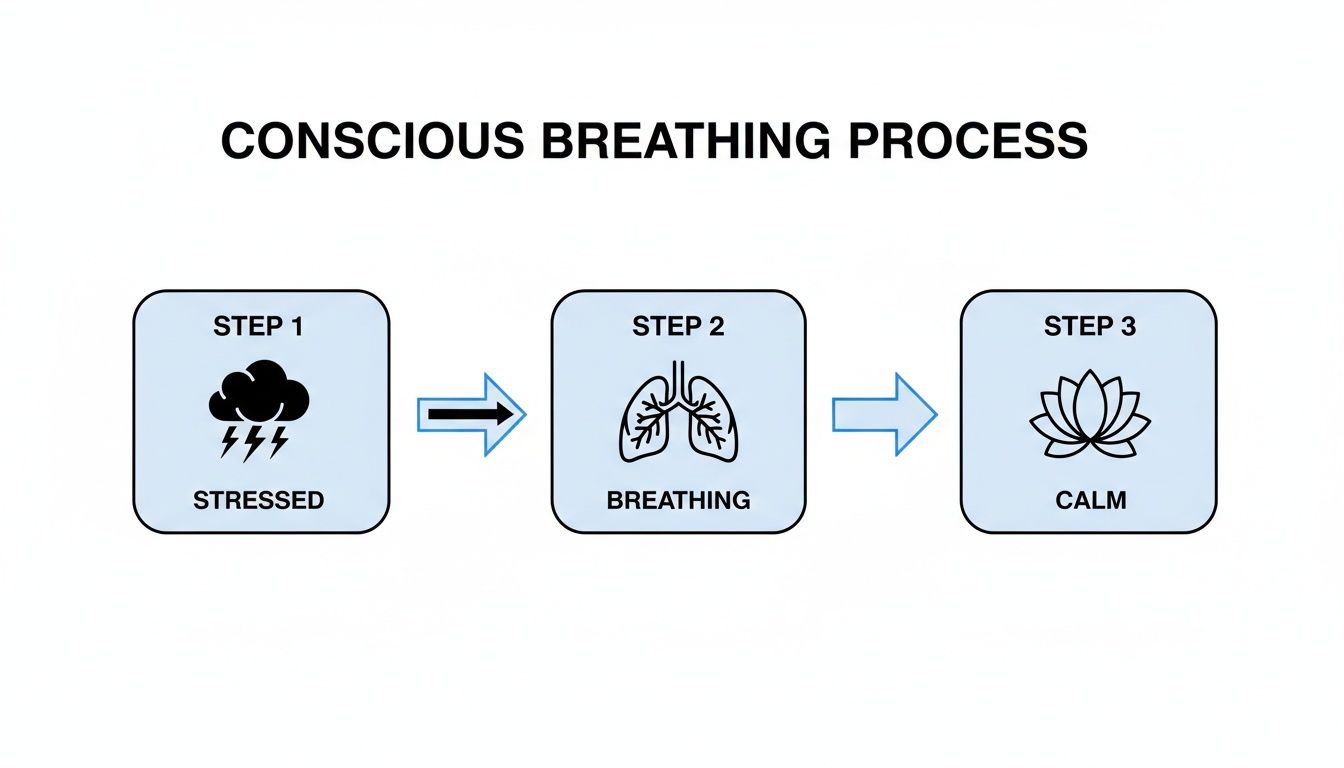
This little map shows it all: by deliberately engaging with our breath, we open up a direct line to our nervous system, guiding it back to a place of peace.
Ujjayi (pronounced oo-jai-ee) often gets called the "Victorious Breath" or "Ocean Breath," and for good reason. It has this gentle, audible whoosh that sounds just like distant waves. That sound is pure magic—it gives your busy mind a single, soothing thing to focus on.
The trick is to create a very slight constriction at the back of your throat, kind of like the feeling you get when you’re about to fog up a mirror.
Keep your mouth closed and breathe in and out through your nose, maintaining that gentle throat constriction. You’re looking for a soft, whispery sound that you can hear and feel.
That rhythmic, wave-like sound is incredibly meditative. It also helps build a little internal heat, which is why you’ll often hear it cued in yoga classes.
Meet Nadi Shodhana, or Alternate Nostril Breathing. This one is a total powerhouse for bringing your mind and body back into alignment. It’s designed to harmonize the right and left hemispheres of the brain, leaving you feeling centered, clear, and unbelievably calm. It’s no wonder it’s one of the most effective breathing exercises for anxiety.
This practice is way more than just plugging one nostril. Pranayama divides breath into three parts: Puraka (the inhale), Kumbhaka (holding the breath), and Rechaka (the exhale). Nadi Shodhana expertly plays with these phases to slow your entire system down.
By guiding your breath to 6 breaths per minute or fewer (a huge drop from our usual 12-20), you’re giving your body a masterclass in efficiency and deep relaxation. People who practice this regularly have seen up to a 30% improvement in lung capacity and focus. It’s ancient wisdom with seriously modern, measurable benefits.
Ready to give it a shot?
That’s one full round. Try for 5-10 rounds and just notice the incredible sense of balance it brings. You’ll feel it.
While pranayama breathing has some incredible perks, jumping in without knowing the ropes is a bit like trying to sail without checking the weather. To make sure your practice is safe, enjoyable, and actually helpful, you need to approach it with a little bit of common sense.
The golden rule of pranayama club? Never, ever force your breath. It’s so tempting to think you need to push it, but this isn't an ego workout. The whole point is gentle, mindful control, not huffing and puffing until you see stars. If you start feeling dizzy, lightheaded, or gasping for air, that’s your body waving a little white flag telling you to back off.
Think of it like learning to play the guitar. You don't start by shredding a crazy solo. You start with simple scales, listening to each note. Your breath is your instrument—learn to play it with care.
Your body is your best teacher, hands down. It’s constantly sending you little messages, and learning to read them is what separates a nourishing practice from a draining one.
This becomes especially important if you're dealing with specific health issues. It's always a smart move to chat with your doctor before you start, particularly if you have:
This isn’t about putting up roadblocks. It's about customizing the practice to fit your body, right here, right now.
The wisest teacher you will ever have is your own body. Learning to listen to its subtle whispers is the foundation of a safe and sustainable pranayama practice.
Besides tuning into your body, a few practical setup tips can make all the difference. Creating the right environment helps you relax and get the most out of every single breath.
First, check your posture. Slouching scrunches up your diaphragm and makes it harder to breathe properly. Sit up tall, whether you’re on a cushion or a chair. Keep that spine long and your airway open. It’s a simple fix that allows for much deeper, more satisfying breaths.
Second, try to practice on a relatively empty stomach. Doing deep breathing exercises right after a big meal is just plain uncomfortable. A good rule of thumb is to wait at least two to three hours after eating. This gives your digestive system the space it needs to do its thing.
Following these simple guidelines creates a solid foundation for your breathwork, letting you dive into its benefits with confidence.
The real magic of pranayama happens when you take it off the yoga mat and carry it with you into the beautiful chaos of your everyday life. You don’t need an hour-long, silent retreat to feel the benefits. The whole idea is to make these techniques your secret weapon for handling whatever the world throws your way.
So, let's ditch the all-or-nothing mindset. Believe it or not, even just five minutes of mindful breathing can hit the reset button on your entire nervous system. The trick is to sprinkle these little breath breaks into the moments you need them most, turning them from a chore into a superpower.
This is how you build a bridge between the practice and the real world, letting your breath become a steady anchor in the storm of stress or distraction.
To make it really stick, try linking a specific breathing exercise to a common daily trigger. Think of it like creating simple “if this, then that” recipes for feeling better. This approach takes the decision-making out of it and makes pranayama your go-to, instinctive response.
Here are a few practical ideas to get you going:
By weaving pranayama into these small but crucial moments, you're actively rewiring your nervous system. You're teaching it, breath by breath, that you have an always-on tool to find your calm, no matter what's happening around you.
This practice goes hand-in-hand with other mindfulness exercises that help connect the mind and body. If you're looking to build out your mental toolkit, exploring different meditation techniques for beginners can give you even more avenues for cultivating that inner peace. When you consistently use these simple strategies, your breath truly becomes your most reliable and portable source of resilience.
Whenever you dip your toes into something new, a few questions are bound to bubble up. It's totally normal. So, let's tackle some of the most common ones right now so you can get started with confidence.
I get this one all the time. And it's a great question! While taking a few deep breaths is definitely a good thing, pranayama is much more deliberate. It's about consciously manipulating your breath using specific rhythms, counts, and techniques—like the alternate nostril breathing we explored in Nadi Shodhana.
Think of it like this: deep breathing is like humming a tune you just thought of. Pranayama is like following sheet music to perform a symphony. Both are music, but one is a highly refined technique designed to produce a very specific effect.
The short answer? As often as you can, without it feeling like a chore. The magic of pranayama isn't in long, grueling sessions. It’s all about consistency.
Honestly, practicing for just five minutes every day will do you a world of good—way more than struggling through a 30-minute session once a week because you feel like you "should."
The whole point is to build a habit that feels supportive, not stressful. Listen to your body and find a rhythm that works for you.
Absolutely, unequivocally, no! You don't need fancy yoga pants, you don't need to be able to touch your toes, and you certainly don't need any prior experience. Pranayama is for everyone.
All you truly need is your own breath and a quiet moment to pay attention to it. It's a beautifully simple and personal tool that anyone can use to bring a little more calm and clarity into their life.
Ready to perfect your form and deepen your practice? Dalm uses AI to give you real-time feedback on your poses, guiding you toward better alignment and a more connected practice. Start your personalized yoga journey at https://dalm.co.