
What Is Range of Motion Exercises A Guide to Better Movement

Ever notice how some people move with an effortless grace, while others seem a bit… creaky? The secret often lies in something called range of motion.
Think of every joint in your body—your shoulder, hip, knee, or wrist—as a high-tech door hinge. Each one is engineered for a specific job, allowing you to swing, bend, and rotate. But just like a real hinge gets rusty and stiff without use, your joints need regular movement to stay healthy and functional.
So, what are range of motion exercises? They’re the "oil" for your body's hinges.
These exercises are essentially the user manual for your joints, guiding them through their complete, intended path to maintain smoothness and prevent stiffness. They aren't just for pro athletes or people recovering from an injury; they're for anyone who wants to move through life freely and without pain.
Whether you're reaching for that top-shelf jar, bending down to tie your shoes, or just turning your head to back out of a parking spot, a healthy range of motion makes everything easier. As you explore these movements, consider pairing them with exercises that boost your postural awareness for even greater benefits.
A good range of motion makes movement feel fluid and natural. You never really appreciate it until you start to lose it.
Getting a handle on the different types of these exercises is your first step toward building a smarter mobility routine. Each one plays a unique role in keeping your body’s hinges working perfectly.
Here’s a quick breakdown of the main categories of ROM exercises. Think of it as choosing the right tool for the right job—each one has a specific purpose.
Understanding which type to use and when is key. One helps you build strength through movement, another gently coaxes a stiff joint back to life, and the last one preps your body for action.
To really get what range of motion exercises are all about, you need to meet the three main characters in the story. Think of them as a team of mobility specialists, each with a unique skill set for improving how you move. Knowing their individual strengths helps you pick the right move for the right moment.
Let's meet the cast. First up is Active Range of Motion (AROM), the fiercely independent one of the group.
Active ROM is all you. These are the movements you do using nothing but your own muscle power to guide a joint through its full, available path. When you lift your arm overhead, bend your knee to tie your shoe, or turn your head to look behind you, you’re performing an active range of motion exercise.
Because you are the engine behind the movement, AROM is fantastic for building functional strength and control. It’s not just about flexibility; it’s about teaching your muscles to support your joints through their entire journey. This is the stuff that helps you tackle everyday tasks with confidence, from putting away groceries on a high shelf to picking a toy up off the floor.
Next, we have Passive Range of Motion (PROM), the supportive partner. With passive exercises, an outside force does all the heavy lifting for you. This "assistant" could be a physical therapist, a yoga strap, a resistance band, or even just the gentle pull of gravity.
You get to completely relax the muscles around the joint while it's moved by that external force. Imagine a therapist gently lifting your leg for you, or using a towel to pull your foot closer to stretch your hamstring. PROM is a game-changer in rehab, helping to maintain joint mobility and prevent stiffness when an injury keeps you from moving a joint on your own.
Passive ROM is the gentle nudge your body sometimes needs. It coaxes a joint to remember its potential without the stress of muscular effort, making it a cornerstone of healing and regaining mobility.
This approach is also perfect for safely exploring the true outer limits of your flexibility.
Finally, meet Dynamic Range of Motion, the fluid athlete of the trio. Forget the slow, held poses you might picture with traditional stretching. Dynamic ROM uses controlled, smooth momentum to move your joints through their full range. Think of big arm circles, gentle leg swings, or walking lunges with a torso twist.
These movements are the gold standard for warming up before a workout or a game. They get blood flowing to your muscles, wake up your nervous system, and prep your body for more intense activity. The focus here is on smooth, continuous motion, not on pushing to an extreme edge.
This concept map breaks down how these exercises benefit your joints, promote healthy movement, and lead to better overall wellness.
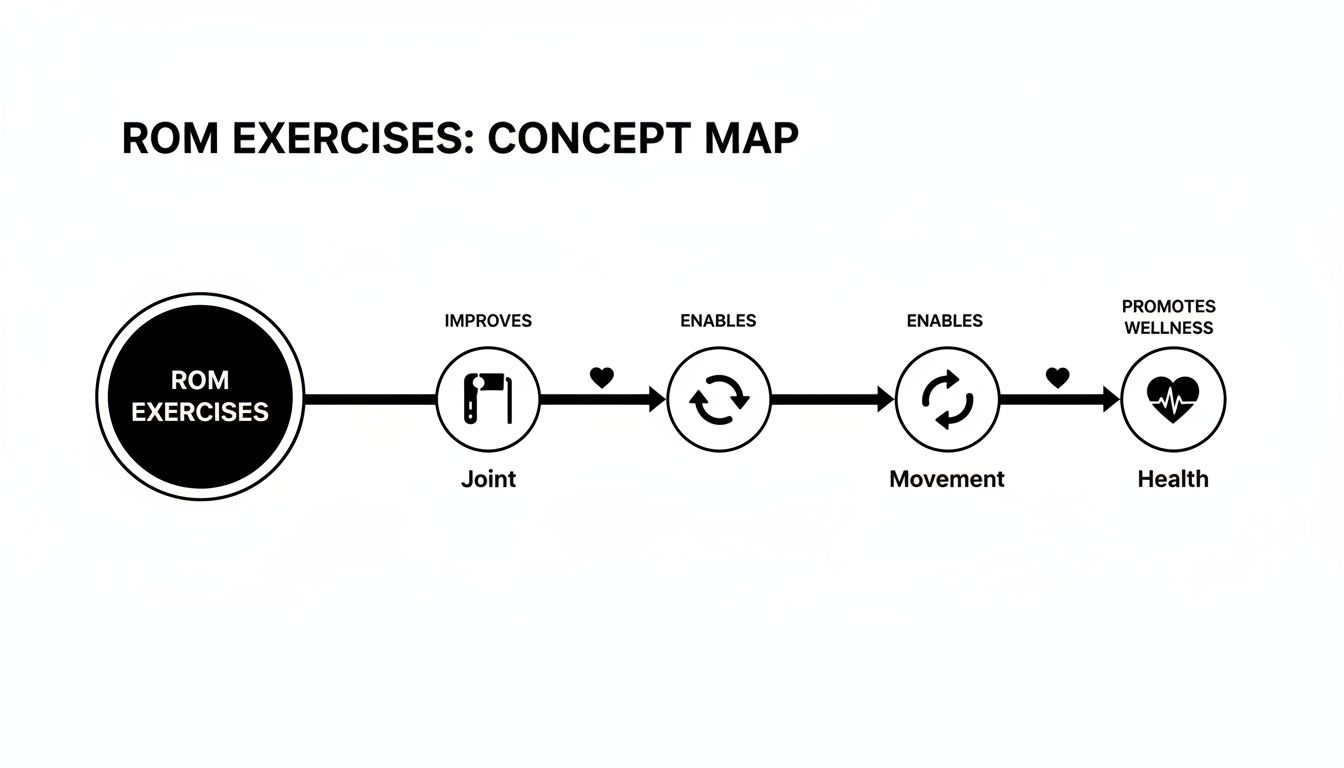
The map highlights a simple truth: healthy joints enable better movement, which is a cornerstone of a healthy life. By bringing all three types of ROM into your routine, you create a well-rounded practice that builds strength, boosts flexibility, and prepares your body for pretty much anything.
The power of these exercises is so profound that they produce incredible results in clinical settings. For example, one study found that 100% of ICU patients who performed ROM exercises avoided developing muscle weakness—a huge contrast to those who didn't. You can see the full research on muscle strength improvement here.
Let's be real: working on your range of motion is about so much more than being able to touch your toes (though that's a cool party trick). It's about fundamentally upgrading your quality of life. When you make these exercises a regular part of your routine, you start to see real, tangible benefits that you'll feel every single day.
Think about kneeling in the garden without that familiar ache in your back. Or effortlessly getting down on the floor to play with your grandkids and popping back up without a single groan. That is what true mobility feels like. It’s the freedom to move through your world with ease and confidence.

You know that nagging shoulder ache or the low-back stiffness that greets you every morning? More often than not, stiff joints and tight muscles are the villains behind the scenes. Your joints are like the hinges on a door—if you never open the door fully, the hinges get rusty and creaky.
Range of motion exercises are the WD-40 for your body. They gently coax each joint through its natural path, which helps to:
By making this a habit, you’re actively telling those daily aches and pains that they’re no longer welcome.
Whether you're a weekend warrior or a dedicated athlete, a good range of motion is your secret weapon. A joint that can move through its full, intended arc allows your muscles to fire on all cylinders, generating maximum power. On the flip side, a tight, restricted joint is like driving with the emergency brake on—it kills your performance.
And this isn't just talk. Solid research shows that improving your range of motion can lead to a whopping 15-25% increase in force production during big lifts and movements. That’s a game-changing advantage, whether you’re lifting weights, sprinting, or perfecting your golf swing. You can dig into the full research on performance enhancement to see for yourself.
Think of it this way: investing in your mobility isn’t just about avoiding pain. It’s about unlocking the strength and power your body already has. Every extra degree of movement you gain is another gear you can shift into.
One of the most profound benefits of a consistent mobility practice is building a more resilient, "life-proof" body. When your joints move freely and your muscles are pliable, you're just plain harder to injure.
Good range of motion helps your body absorb shock and distribute forces evenly. So if you trip, stumble, or have to make a sudden, awkward movement, your joints have the "give" they need to move without being pushed to their breaking point. You're essentially creating a protective buffer zone against the physical curveballs life throws your way. It’s a crucial investment in your long-term health, and if you're curious about the bigger picture, check out our guide on how to improve flexibility safely.
Okay, we've talked enough about the "what" and "why." Now for the fun part: actually moving. Think of this section as your starter pack—a few simple, effective exercises to get your major joints feeling loose and happy. We’re going to focus on the big players: the shoulders, hips, knees, and spine.
The idea isn’t to twist yourself into a pretzel on day one. It's about re-introducing your body to gentle, purposeful movement. Consider it a friendly daily check-in with your joints.

Before you jump in, there's one non-negotiable rule: listen to your body. These moves should feel like a satisfying stretch, not a sharp pain. Good form is everything when it comes to staying safe and getting real results.
Your shoulder is an incredible piece of natural engineering—a ball-and-socket joint that moves in almost every direction. Pendulum swings are a fantastic, low-stress way to remind it of that freedom.
The trick here is to let gravity be your workout partner. Don't muscle the movement; let the weight of your arm create the swing.
This one is so simple you can do it lying down, which makes it perfect for waking up your lower body without the strain of standing. It's a cornerstone exercise for anyone looking to improve mobility in their hips and knees.
Remember, the goal is smooth and controlled. This isn't a race. You're just gliding the joint through its happy place, not shoving it into a painful corner.
Your spine is the central pillar of your entire body, and keeping it mobile is a game-changer for your posture and overall comfort. Cat-Cow is a yoga classic for a reason—it gently moves the spine through its full range of flexion and extension.
Get on your hands and knees, with your wrists stacked under your shoulders and your knees right under your hips.
This move is pure magic for releasing tension in your back and neck. It’s also one of many fundamental movements that make for excellent yoga warm-up exercises, prepping your body for whatever comes next. Weaving these simple ROM exercises into your daily routine is a powerful way to keep moving freely and comfortably for years to come.
Knowing a few good range of motion exercises is one thing, but that’s only half the battle. The real secret sauce is in how you perform them, and frankly, that's where most of us stumble.
Trying to follow a generic YouTube video is a bit like trying to learn to dance from a book. You can see the pictures and mimic the steps, but you’re left wondering, "Am I actually doing this right?" That uncertainty can lead to sloppy form. Best case scenario? You're just not getting the full benefit. Worst case? You could be setting yourself up for an injury.
This is exactly where smart, guided practice steps in and changes everything. It’s the difference between just going through the motions and truly mastering them.
Picture having a personal yoga instructor right there with you, analyzing every tiny movement you make. That’s essentially what AI-driven guidance offers. It’s like having a virtual expert who uses some seriously cool tech to see and understand your body's alignment as it happens.
Instead of wondering if you’re pushing too far or not quite far enough, an AI-powered app like Dalm gives you immediate, practical feedback. We’re not talking about vague advice here; this is feedback tailored to your body's exact position, right in that moment.
This kind of detail completely transforms your practice. It helps you make those tiny micro-adjustments that seem small but have a massive impact. For instance, it can tell you to:
These are the kinds of small cues that separate a potentially harmful movement from one that’s incredibly beneficial.
Guided practice takes the guesswork out of the equation. It gives you the confidence to explore your body's limits safely, turning each session from a shot in the dark into a productive, measurable step toward better mobility.
The biggest game-changer here is that the feedback is instant. A pre-recorded video can’t pause itself and tell you that your knee is caving inward, but an AI coach absolutely can. This immediate correction loop is what really fast-tracks your progress and helps build solid muscle memory.
Think of it like learning to play the guitar. A teacher who corrects your hand position on the fretboard while you’re playing helps you learn way faster and more effectively than if you were just trying to copy a recording. The same idea applies to movement.
By getting these constant, gentle course corrections, you learn the right way to move from the get-go. This data-driven approach makes your range of motion exercises not just more effective, but fundamentally safer, ensuring every single minute you put in actually counts.
Let's dive into some of the questions that pop up most often when people start exploring range of motion exercises. Think of this as your quick-start guide to clear up any confusion and get you moving with total confidence.
Here’s the thing: consistency is king. Forget about grueling, hour-long sessions. For general mobility and keeping your joints feeling good, a short daily routine is far more effective.
Honestly, even 5-10 minutes of mindful movement can completely change the game for your body. If you're working through an injury, your physical therapist will give you a specific plan, but for the rest of us, a little bit every day works wonders.
The number one rule? Listen to your body. Some days you'll feel like moving more, and on others, you'll need to take it easy. The goal is to build a habit that feels good, not like a chore.
Let's be crystal clear: you should never feel any sharp, shooting, or stabbing pain during these exercises. The whole point is to explore your available range of motion, not to force your body into a place of pain.
You might feel a bit of muscle soreness the next day, what's often called Delayed Onset Muscle Soreness (DOMS). This is totally normal, especially if the movements are new to you—it’s the same kind of ache you’d get after trying any new workout.
But pain deep inside the joint is a huge red flag. It’s your body’s way of screaming, "Hey, you're pushing too hard or your form is off!" This is exactly where guided practice is so crucial, helping you find that perfect balance between a helpful stretch and a harmful strain.
Great question! This one comes up all the time. Here’s a simple way to think about it: all stretching is a form of ROM exercise, but not all ROM exercises are stretches. It’s the old "all squares are rectangles, but not all rectangles are squares" puzzle.
When most people say "stretching," they're talking about static stretching—holding a pose for a certain amount of time to lengthen a muscle.
"Range of motion exercises" is the big-picture term. It covers any movement of a joint through its natural path, which could be:
So, think of ROM as the entire world of joint health, and stretching is just one of the most important countries in it.
Absolutely. Both can play a major role in how freely your body moves. Research has shown pretty clearly that our spinal mobility, for example, tends to take a nosedive as we get older.
On top of that, other studies have found that people with a higher body weight can sometimes have a more limited range of motion in joints like the hips and ankles. This is exactly why building a consistent, safe mobility practice is so important at every single stage of life.
It's not about turning into a contortionist. It’s about holding onto the functional movement you need to live a full, active life, regardless of your age or your size.
Ready to move smarter, not just harder? Dalm uses AI to analyze your movements with medical-grade precision, providing real-time voice feedback to perfect your form and keep you safe. Stop guessing and start moving with confidence by exploring Dalm today.