
Discover what is reciprocal inhibition and how it boosts flexibility

Ever wonder how you can bend your elbow without your bicep and tricep getting into a full-on tug-of-war? The answer is a neat little trick your nervous system pulls off called reciprocal inhibition. It’s the secret sauce that makes your movements smooth, coordinated, and efficient every single day.
Think of your muscles as dance partners. For any graceful move to happen, one partner has to lead while the other follows. Reciprocal inhibition is the brilliant choreographer making sure they don't step on each other's toes.
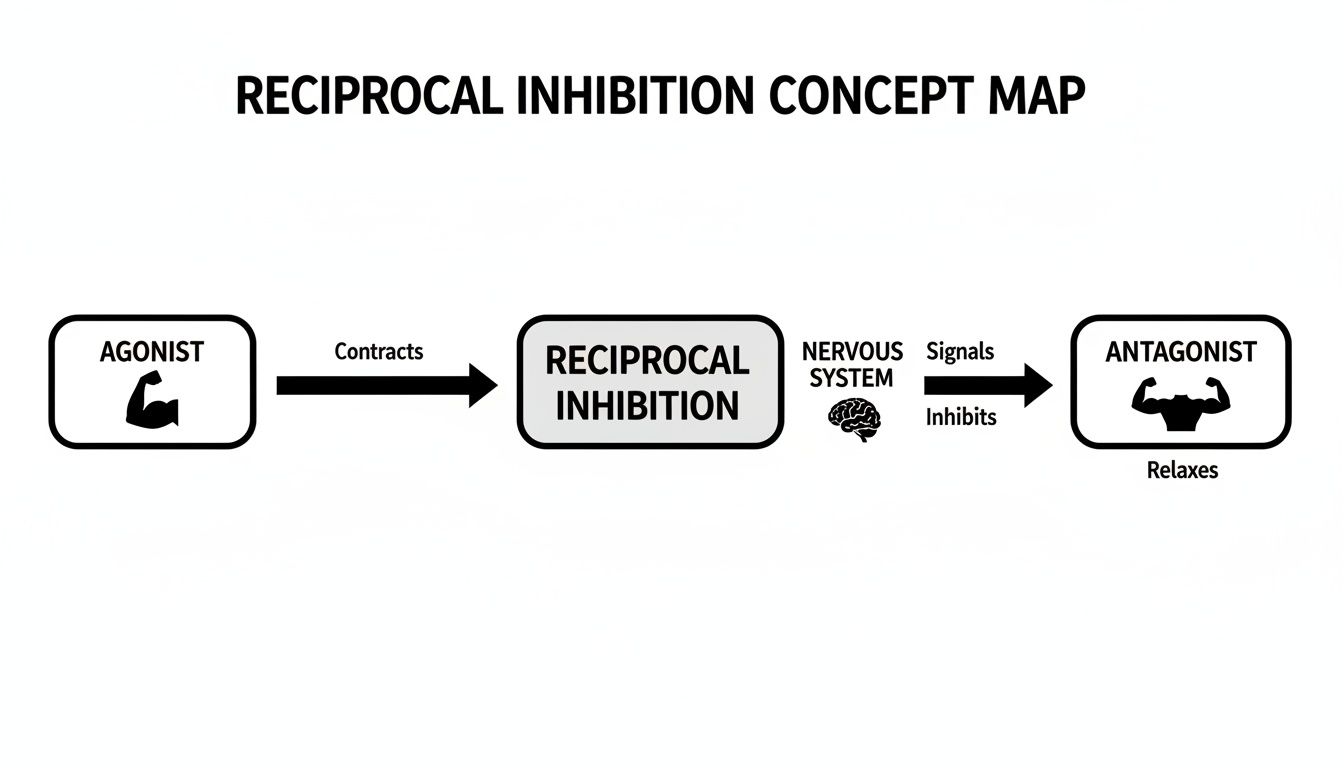
When you decide to flex a muscle—let's call it the agonist (the lead dancer)—your brain sends an automatic signal to its opposing muscle, the antagonist (the follower), telling it to chill out and lengthen. This seamless cooperation prevents your muscles from fighting each other, letting you move with purpose instead of getting stuck in a muscular standoff.
Reciprocal inhibition isn't just some cool biological factoid; it’s the fundamental reason we can move fluidly. It turns a potential muscular stalemate into a beautifully synchronized performance.
This neurological reflex is firing off constantly, whether you’re kicking a ball, lifting a grocery bag, or just walking down the street. It’s your body’s built-in shortcut to getting things done without wasting energy.
To really get what’s happening with reciprocal inhibition, it helps to meet the cast of characters involved in this neuromuscular play. They each have a crucial part to play in pulling off the final performance.
Let's break down who does what with a simple table.
This entire conversation happens lightning-fast through a pathway in your spinal cord. When one muscle contracts, sensory receptors inside it shoot a message to inhibitory interneurons, which basically tell the motor signals headed for the opposing muscle to stand down.
Interestingly, this isn't an all-or-nothing deal. The strength of this "relax" signal can vary. For instance, research on the ankle joint found that the inhibition was fourfold greater in some motor units than others. You can dive deeper into the nitty-gritty of the science behind this by checking out studies on reciprocal inhibition pathways.
Understanding this principle is your first step toward using it to your advantage. Once you learn to trigger this response on purpose, you can unlock new levels of performance and flexibility. This is especially handy for anyone wondering how to improve flexibility with smarter, more effective stretching techniques.
So, how does this whole muscular partnership actually work? It's not magic, but it’s pretty close. Think of it as a high-speed conversation happening constantly between your brain, spinal cord, and muscles—an incredibly efficient messaging system built for perfect coordination.
When you decide to move, say, to bend your arm, your brain fires off a command. This signal zips down your spinal cord, but it’s not just one simple message. It’s a brilliant two-for-one deal. The main signal, carried by a motor neuron, is the "Go!" command that tells your biceps (the agonist) to contract.
But at the exact same time, a copy of that signal splits off and heads to a special little messenger in the spinal cord called an inhibitory interneuron. This tiny neuron has one job and one job only: to hit the brakes.
This inhibitory interneuron gets the "Go!" signal intended for the biceps and immediately flips it into a "Stop!" signal. It then shoots this new command over to the motor neuron of the opposing muscle—your triceps (the antagonist)—telling it to chill out and not contract. The whole thing happens so fast it feels completely seamless.
This is the secret sauce that prevents your muscles from fighting each other. One gets the green light, while its partner gets the red light.
This entire process is deeply connected to your body's internal GPS. To dive deeper into that fascinating sense, check out our guide on what is proprioception training.
It’s an elegant system. It’s the very reason you can do a bicep curl without your triceps putting up a fight. By contracting your bicep, you are actively silencing the tricep, allowing your arm to bend without a struggle. It's neuromuscular teamwork at its finest.
Ever get into a stretch and feel like you've hit a brick wall? That frustrating feeling where your muscle just won't budge another millimeter? We've all been there. But what if I told you your nervous system has a secret override switch that can help you blow past those plateaus?
This is where understanding reciprocal inhibition goes from a neat science fact to a total game-changer for your flexibility. By intentionally triggering this reflex, you can unlock a deeper, more effective stretch almost instantly. It’s the difference between passively waiting for something to happen and having an active, intelligent conversation with your body.
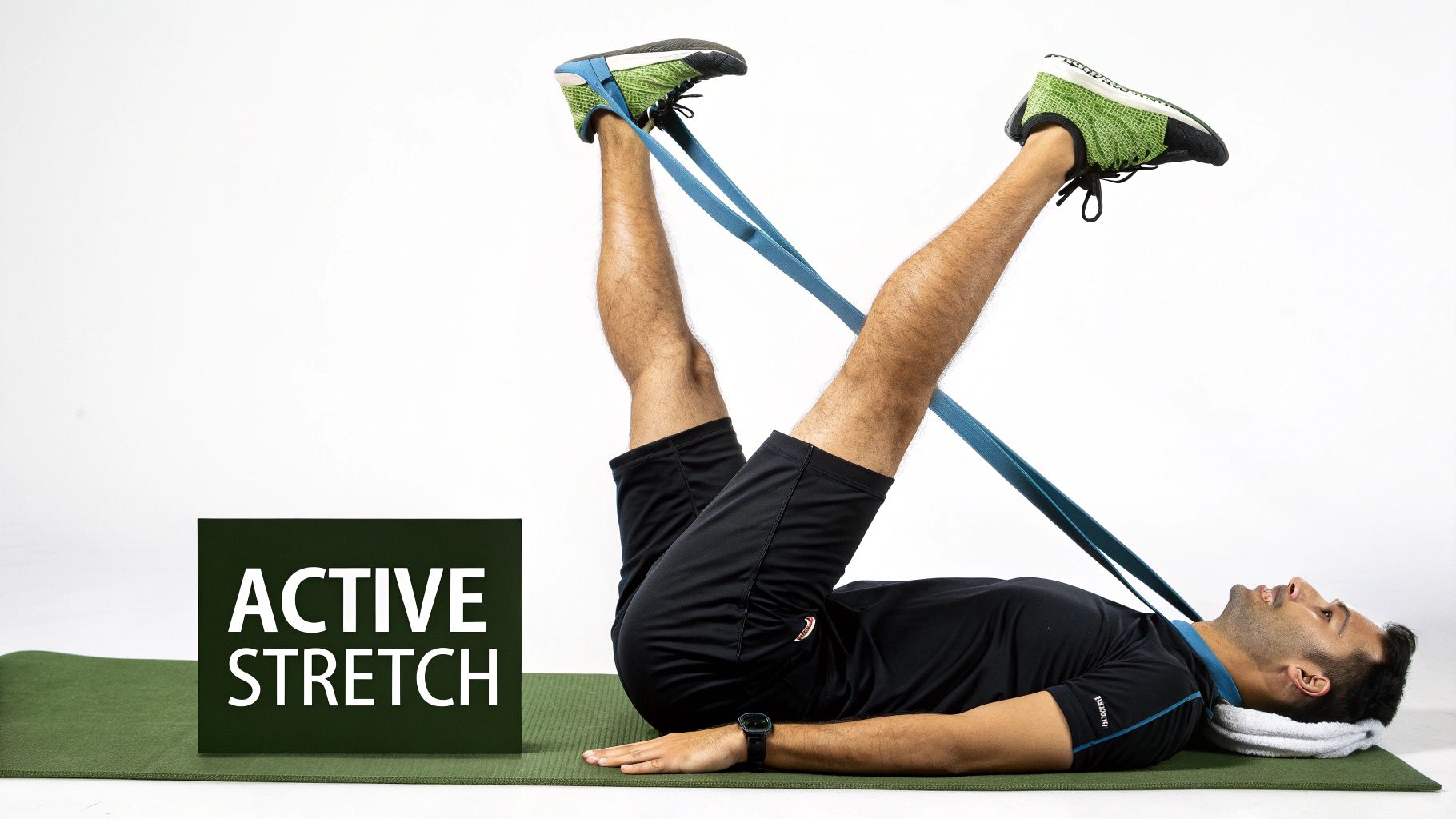
Let's break this down with a classic hamstring stretch. Your hamstrings are the "antagonist" muscles you're trying to lengthen. The muscles on the opposite side, your quadriceps, are the "agonists."
When most people stretch their hamstrings, they just passively lean forward and hang out, hoping for the best. An active stretch, however, is a whole different ballgame. Instead of just relaxing, you’re going to give your nervous system a direct order.
By actively contracting your quadriceps (the agonist), you send a powerful relaxation signal straight to your hamstrings (the antagonist). Your brain basically tells the hamstrings, "Hey, stand down—the quads are on duty right now!"
This neurological trick forces the hamstrings to relax, allowing them to lengthen way more than they would with passive stretching alone. You’re literally using your body’s own wiring to create more slack in the system.
Ready to feel it for yourself? This simple sequence is a core technique in Proprioceptive Neuromuscular Facilitation (PNF) stretching, and it puts reciprocal inhibition to work immediately.
This powerful method works for just about any muscle group. Want to stretch your chest? Actively squeeze the muscles in your upper back. Need to open up your hip flexors? Squeeze your glutes. It’s one of the safest and most efficient ways to genuinely improve your mobility.
The beauty of active stretching is that it does more than just make you more flexible. It also builds strength and stability in those opposing muscles, creating a more balanced and resilient body. If you want to explore more poses that use these principles, our guide to the best yoga poses for flexibility is the perfect next step.
This whole reciprocal inhibition thing isn't just a neat party trick for getting a deeper hamstring stretch. It's the silent, unsung hero behind pretty much every move you make, from a graceful yoga flow to a full-out sprint. It’s what makes complex movement even possible.
But here’s where it gets really interesting. Your nervous system isn't just a simple on/off switch. Think of it more like a brilliant sound engineer at a mixing board, constantly tweaking the "volume" of that "relax" signal to the opposing muscles. It masterfully dials the inhibition up or down depending on what you're asking your body to do. This is what allows you to be both a powerhouse of stability and a model of fluid grace.
Let's look at a cyclist absolutely hammering it on the downstroke. You'd think their brain would completely shut off the opposing hamstrings to let the quads go wild, right? Not exactly. For movements that require a ton of power under a heavy load, the body actually needs a little bit of co-contraction—a bit of tension from the "off" muscles—to keep the joint from flying apart.
In these high-force scenarios, the nervous system intentionally turns down the inhibitory signal. Research on intense cycling has shown that as the load gets heavier, the reciprocal inhibition gets weaker. This allows the primary movers to fire like a cannon while the opposing muscles provide just enough tension to keep everything stable and safe. If you want to get nerdy, you can read the full research on how the nervous system adapts during cycling.
By toning down that "relax" signal, your body creates controlled tension. This is a brilliant protective mechanism that braces your joints and helps channel all that explosive energy right where it needs to go.
Now, flip the script from raw power to the controlled elegance of a yoga practice. Picture yourself moving from a strong Warrior II into a long, open Triangle Pose. This isn't about muscling your way through it; it's a beautiful, seamless handoff between different muscle groups.
To make that happen, your body cranks the reciprocal inhibition dial way up, creating that buttery-smooth quality of movement.
This perfect back-and-forth, this effortless exchange of contraction and release, is what gives yoga its signature grace. It’s your nervous system's internal dance in action, giving you the precise tool for the job—whether that’s crushing a new personal record or finding total stillness on the mat.
In a perfect world, reciprocal inhibition is your body's secret weapon for smooth, efficient movement. But what happens when the wires get crossed? You end up with something called altered reciprocal inhibition, a fancy term for when chronic muscle imbalances mess with this brilliant neuromuscular conversation.

This isn't some obscure medical condition; it’s a direct result of modern life. When one muscle gets stuck in a chronically tight state, it starts constantly whispering "relax" to its opposing muscle. Over time, that opposing muscle gets so used to being told to shut off that it essentially becomes lazy, weak, and hard to wake up when you actually need it.
One of the best real-world examples of this faulty wiring is Lower Crossed Syndrome, a postural nightmare fueled by way too much sitting. Here’s how it unfolds:
In short, your body learns a bad habit. The constant command to relax the glutes becomes the new normal, creating a massive imbalance that leads to bad posture, nagging low back pain, and a much higher risk of injury when you try to be active.
This dysfunction isn't just about bad habits, either. It can also be a component of certain neurological conditions. For instance, studies show that in patients with Parkinson's disease, the normal modulation of reciprocal inhibition is severely disrupted, which is a major factor in their movement difficulties. You can dive deeper into these neurological findings and their impact on movement control.
Recognizing this common glitch is the first step toward fixing it. Once you can pinpoint which muscles are doing all the work and which ones have been put to sleep, you can start intentionally rewiring those connections. It's all about waking up the sleepy muscles to restore that smooth, coordinated partnership your body needs for powerful, pain-free movement.
Jumping into the science of how we move can feel a bit like learning a new language. Let's tackle some of the most common questions about reciprocal inhibition so you can put this amazing principle to work safely and get the most out of every stretch.
Pretty much! This little neuromuscular hack is a game-changer for almost any major muscle group you’re trying to coax into letting go—think hamstrings, quads, chest, and those stubborn hip flexors.
The technique itself, a type of PNF stretching, is beautifully simple. By gently contracting the muscle opposite the one you're stretching for about 5-10 seconds, you trick the target muscle into relaxing. This neurological sleight-of-hand allows you to sink deeper into the stretch without fighting against your own body. Just be sure to follow the golden rule: listen to what your body is telling you and never, ever push into sharp pain.
Think of reciprocal inhibition less like a command and more like a clever negotiation with your nervous system. You're simply flipping one muscle's "on" switch to gently nudge its opposite partner's "off" switch, creating space and freedom where there was once tension.
Ah, a great question! While they're both part of your body's internal safety team, they play very different roles.
The stretch reflex is your body's emergency brake. If you yank a muscle into a stretch too fast or too far, it slams on the brakes by contracting that same muscle to prevent a tear. It’s a purely protective, almost panicked reaction.
Reciprocal inhibition, on the other hand, is the traffic cop waving you through a green light. It’s what allows for smooth, coordinated movement by relaxing the opposing muscle. One is a red light for danger; the other is a green light for safe passage. They work in tandem to keep your movements efficient and injury-free.
Your body usually sends pretty clear signals. The most common sign is a persistent, nagging muscle imbalance. You might feel like one muscle group is chronically tight (hello, hip flexors and chest muscles!) while its opposing group feels weak or "sleepy" (looking at you, glutes and upper back).
Another tell-tale sign is struggling to feel a specific muscle engage during an exercise, no matter how hard you try. If you suspect something is off, your best bet is to chat with a physical therapist who can give you a proper diagnosis and a roadmap for getting things back in sync.
Curious to see how well your muscles are communicating? Dalm’s AI-powered pose analysis gives you a real-time look at your alignment, helping you spot the exact imbalances that can throw off reciprocal inhibition. It’s time to stop guessing and start training smarter. Perfect your form with personalized guidance at https://dalm.co.