
What Is Restorative Yoga A Guide to Deep Relaxation
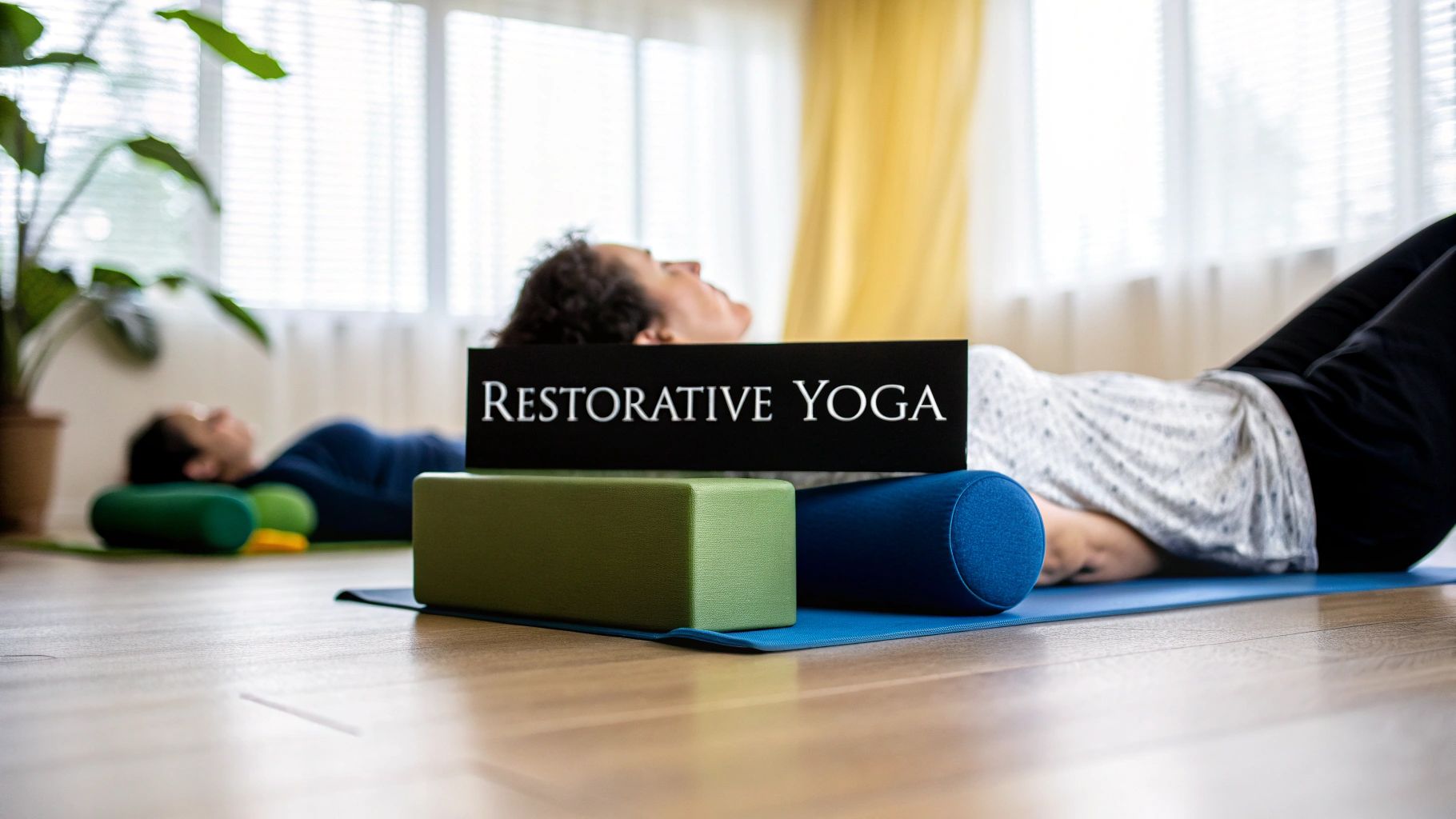
Ever feel like your "off" switch is broken? Welcome to restorative yoga, the radical art of doing absolutely nothing.
This isn't your typical power-flow, sweat-dripping yoga class. Think of it less as a workout and more as a "work-in"—a practice dedicated to deep, intentional, and glorious rest. We use a mountain of props like bolsters, blankets, and blocks to completely support the body in gentle poses, allowing you to melt into a state of pure stillness. The goal? To finally let your body's "rest and digest" system take over.

Forget everything you’ve come to expect from a yoga studio. There are no vinyasas, no chaturangas, and definitely no pressure to nail a handstand. Instead, you'll be building a cozy, supportive nest for your body.
With every curve and joint cradled by props, your muscles can finally stop firing. They don’t have to hold you up, stretch, or engage. In this cocoon of comfort, your body gets the signal that it's safe to let go of that tension you’ve been carrying for weeks (or years!), and your mind gets a much-needed permission slip to quiet down. The whole point is to activate the parasympathetic nervous system—our built-in mechanism for healing and recovery.
This practice is the ultimate system reboot. It's about moving from the chaotic "fight or flight" state that dominates modern life into a deeply healing "rest and repair" state, all by strategically doing less.
This shift from active doing to passive being is what sets restorative yoga apart. While other styles are fantastic for building strength and flexibility, this practice is all about surrendering to total relaxation.
To really get your head around what is restorative yoga, it helps to put it side-by-side with its more energetic cousins, like Vinyasa. The vibe, the goals, and the way it feels in your body are worlds apart. One is about firing you up, and the other is about letting you gently power down.
Here’s a quick look at how they stack up.
As you can see, they’re two very different paths with two very different destinations. One isn't better than the other; they just serve completely different needs.
To really get what restorative yoga is all about, we need to hop in a time machine. This practice wasn't dreamed up in some trendy, modern studio. Its roots are far more interesting, born from physical struggle and a flash of pure genius. The story starts with a man who would completely reshape the yoga world.
His name was B.K.S. Iyengar. Born in India back in 1918, he was a sickly, frail kid who turned to yoga hoping to find a path to better health. But as he dove deeper into his practice, he ran into a wall. His body simply couldn't hold many of the classic poses correctly, at least not without a ton of strain. This problem, however, lit a creative fire in him.
Instead of trying to jam his body into shapes it wasn’t ready for, Iyengar started getting creative. He grabbed whatever was lying around—scraps of wood, bricks, ropes, and rolled-up blankets—and used them to prop himself up. This simple innovation was a game-changer. It let him stay in poses for much longer without any muscle strain, which unlocked a whole new level of release and proper alignment.
This clever method was the very foundation of what we now call restorative yoga. It's all about using props to find perfect support, allowing the body to let go completely. You can read more about his personal healing journey and groundbreaking work in this deep dive into restorative yoga. This wasn't about finding a shortcut; it was about turning yoga poses into powerful instruments for deep healing.
Iyengar’s inventive use of props didn't go unnoticed. One of his students, in particular, saw the incredible potential in this supportive style and would become a champion for bringing it to the West. That student was Judith Hanson Lasater. She was so inspired that she dedicated herself to refining the method, zeroing in on its incredibly restful and therapeutic side.
In fact, it was Lasater who actually came up with the name restorative yoga and made it a global phenomenon. She built an entire system around a single core concept, one she brilliantly termed "active relaxation."
"By supporting the body with props, we alternatively stimulate and relax the body to move toward balance... [This creates] specific physiological responses that are beneficial to health and can reduce the effects of stress-related disease."
This was never about just lazing around on some pillows. Lasater taught that by strategically cradling the body with props, you could essentially send a direct message to your nervous system to chill out. The idea is to eliminate all physical effort, which tells your brain it's safe to switch off that frantic "fight or flight" mode and turn on the healing "rest and digest" system.
And that, right there, is the heart of restorative yoga today. It’s a practice born from one man's personal quest for health, and perfected by a student who recognized its power to heal us all.
It might look like you're just lounging on a pile of pillows, and well, you are. But underneath that cozy exterior, your body is undergoing a massive biological shift. Think of your nervous system as having two primary modes: the amped-up "fight or flight" and the chilled-out "rest and digest." Most of us live our lives with the gas pedal floored, stuck in that first mode.
Restorative yoga is the key that turns the ignition off. It's the master switch that flips you back into "rest and digest" mode, activating what's known as the parasympathetic nervous system. When your body is completely held and supported by props, it sends a powerful message straight to your brain: "Hey, you can relax. You're safe. Let go." This isn't just a fleeting feeling; it’s a physiological command that kicks off a chain reaction of goodness.
This deep, intentional stillness dials back the production of cortisol, our main stress hormone. Let's be honest, cortisol gets a bad rap, but when it’s constantly flooding our system, it’s linked to everything from anxiety and crummy sleep to weight gain. By turning down that cortisol faucet, you give your entire system a much-needed break to reset and repair.
The benefits don't just stay on the mat; they ripple out into your daily life. It’s not just about feeling mellow for an hour. It’s about carrying that sense of calm with you long after you’ve rolled up your mat. Many people are shocked to find their sleep quality dramatically improves, simply because the practice retrains the body how to power down and enter a truly restful state.
Here are a few of the science-backed perks:
By quieting the external "noise" and eliminating physical strain, restorative yoga creates the perfect internal environment for your body's natural healing processes to take the lead. It's a powerful reminder that sometimes, the most productive thing you can do is absolutely nothing at all.
Forget everything you think you know about props. In restorative yoga, they aren't just accessories or a crutch for beginners—they are the practice. Think of yourself as building a cozy, supportive nest, and these tools are your branches, leaves, and feathers. Instead of forcing your body into a shape, you build the shape around your body, letting it finally let go.
These props are about to become your best friends. The whole point is to get rid of every last bit of muscular effort, letting your bones feel heavy and your mind go quiet. Each prop has a job, and together they create a little sanctuary of support where you can sink into a state of deep, uninterrupted rest.
Building your cozy nest is an art, but it's one you can master quickly. Once you get a feel for what each prop does, you'll be stacking and arranging them like a seasoned pro, unlocking a level of relaxation you might not have thought possible.
If you're just getting started, having a full set of these can be a game-changer. For a rundown of what to look for, check out our guide to the best yoga equipment for beginners.
The real magic happens when you combine these props to create poses you can truly surrender to. Unlike more active yoga styles, the name of the game here is duration. A key feature of restorative yoga is holding poses for 5 to 20 minutes at a time, giving your nervous system the chance to hit the reset button. B.K.S. Iyengar pioneered this approach using whatever he had—like household furniture—before Judith Hanson Lasater helped standardize the prop-heavy practice we know today.
Here are a few classics to get you started:
Supported Child's Pose (Balasana): This is pure bliss. Place a bolster longways on your mat. Kneel with your big toes touching and knees wide, then just fold forward and melt your torso and one cheek onto the bolster. Let your arms hang loose. It’s an instant soother for a busy mind and an achy back.
Legs-Up-the-Wall (Viparita Karani): My personal favorite after a long day. Place a folded blanket or a bolster a few inches from a wall. Sit on your prop with one hip against the wall, then swing your legs straight up, scooting your butt as close to the wall as feels good. This gentle inversion is incredible for tired legs and quieting a racing mind.
The infographic below shows exactly what’s happening inside your body during this shift from "fight or flight" to "rest and digest."
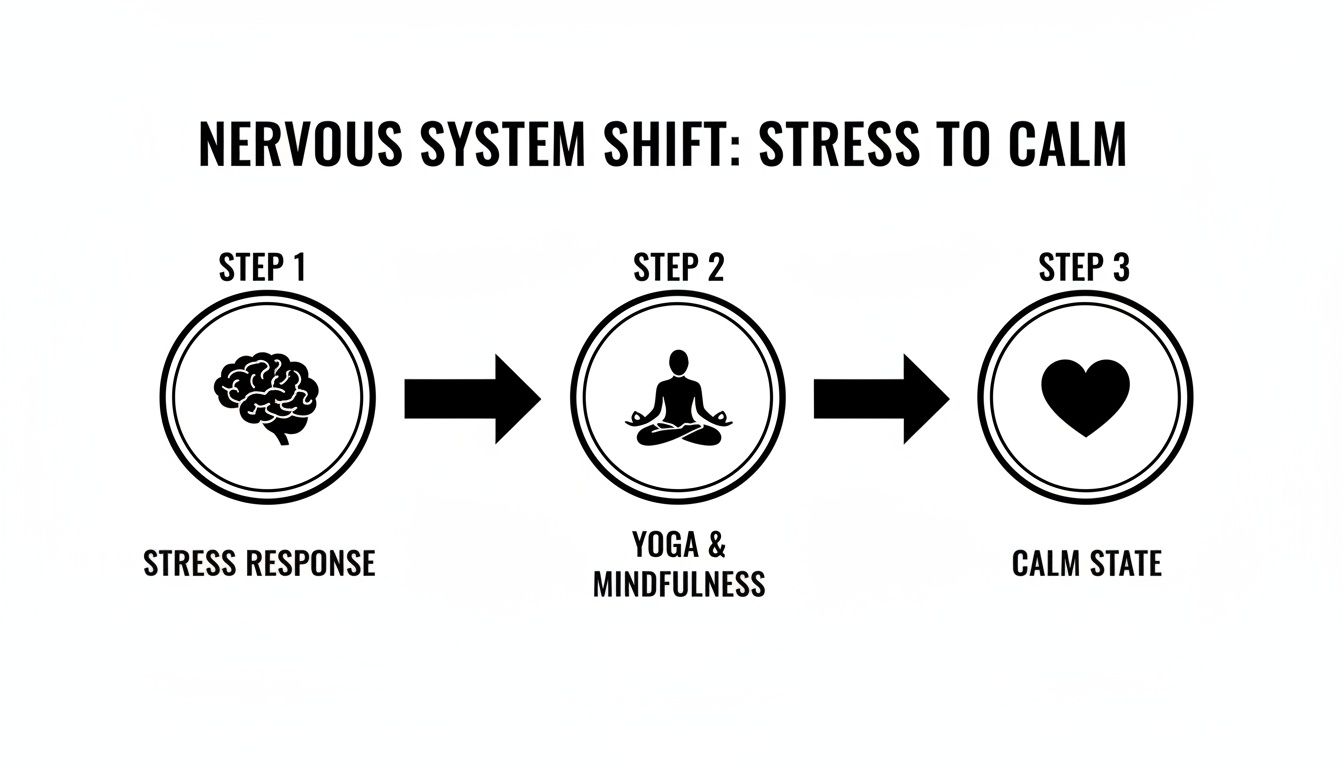
It’s a perfect visual for what restorative yoga is all about—giving your body a direct, physical pathway to its own built-in relaxation response.
Ever walked into a room and felt your shoulders instantly drop? That’s the vibe of a restorative yoga class. Forget the bright lights and thumping bass of a power vinyasa studio; this is a whole different world, one that feels hushed, safe, and incredibly calming.
The room is usually dimly lit, maybe with a few candles flickering, creating an atmosphere that practically whispers "relax." You won’t be asked to jump, flow, or sweat. The whole point is to slow waaay down.
The pace is deliciously unhurried. In a typical 60 to 90-minute class, you might only do four to six poses. Seriously. It’s not about quantity or getting a workout; it’s about how completely you can let go and allow your body to be held by the props.
Your instructor will have a calm, soothing voice, acting more like a gentle guide than a boot camp sergeant. Their job is to help you build your own personal "nest" of comfort for each shape, using a mountain of bolsters, blankets, and blocks so you don't have to exert a single ounce of muscular effort.
Think of the class structure as a gentle, guided journey from the chaos of your day into a state of deep, nourishing stillness.
Gentle Arrival: Things usually kick off with a few minutes of quiet centering. You'll be invited to connect with your breath, consciously leaving the day's to-do lists and worries at the door.
Supported Poses: This is the heart of the practice. You'll settle into a handful of key poses and stay there for a good long while—often 5 minutes or more. With your permission, the instructor might offer a gentle touch to help you release even further.
Mindful Transitions: Getting from one pose to the next is slow and almost dreamlike. There’s absolutely no rushing. The idea is to keep that peaceful, blissed-out feeling going.
Deep Relaxation (Savasana): The grand finale is a final, luxurious rest. Tucked under a cozy blanket, maybe with an eye pillow to block out the light, you simply soak it all in and let the practice work its magic.
In a world that constantly demands more, restorative yoga is a quiet rebellion. It’s your official permission slip to stop doing and simply be.
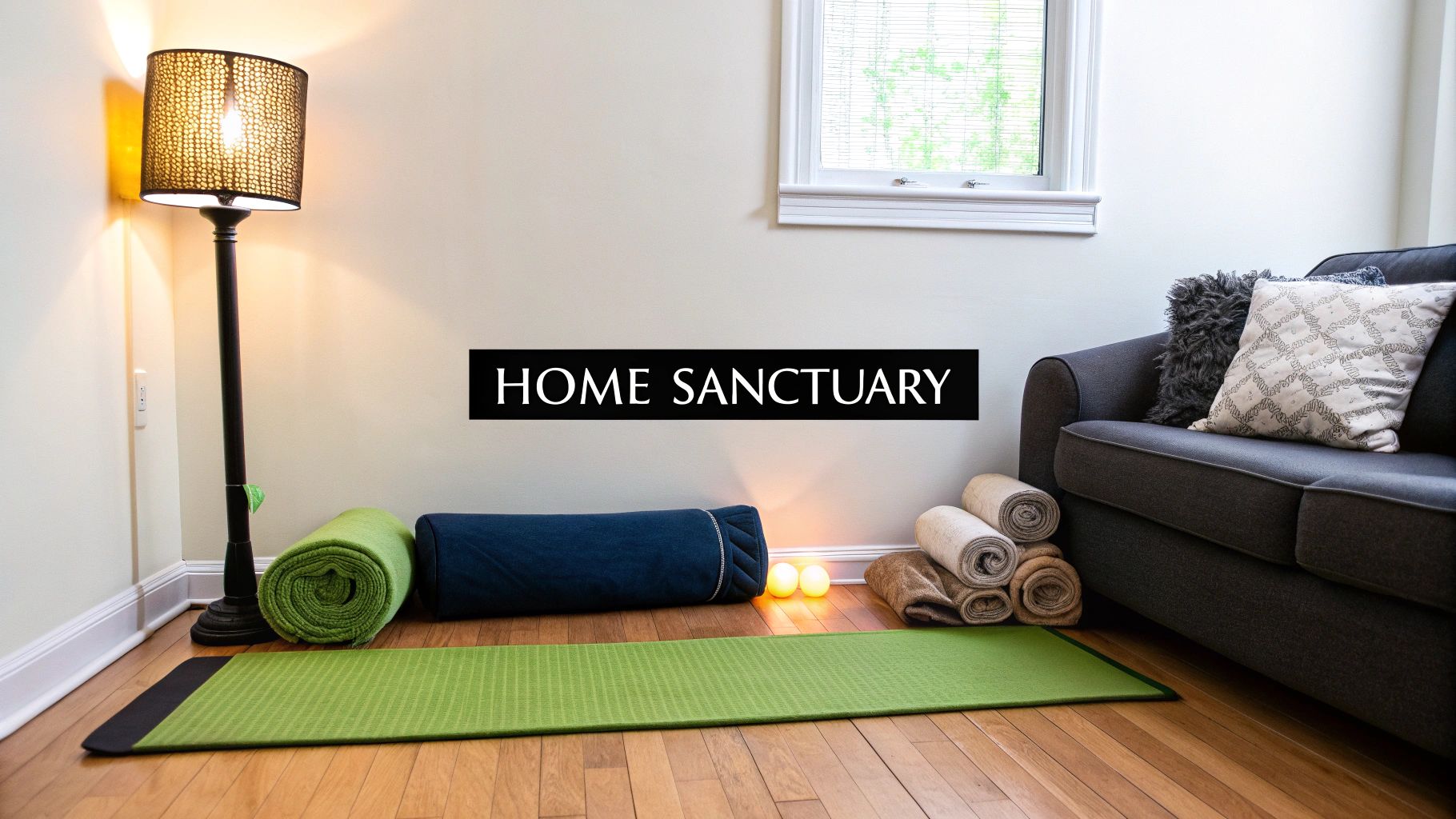
Here's the beautiful truth about restorative yoga: its incredible benefits aren’t locked away in some fancy studio. You can build your very own sanctuary of calm right in your living room, proving that deep, meaningful rest is yours for the taking, anytime you need it.
The secret? It all comes down to intention. When you carve out a dedicated space and time, you're sending a powerful signal to your brain that it’s time to shift gears from go-go-go to slow-slow-slow. You don't need a sprawling home gym; a quiet corner where you can be undisturbed for 20 minutes is more than enough.
No official props? No problem. I guarantee your home is already a treasure trove of amazing substitutes that will help you melt into stillness. All it takes is a little creativity to assemble a support system that would make any studio jealous.
Let's get resourceful with these household items:
Your goal isn't perfection; it's support. The entire point is to cradle your body so completely that every last muscle can finally sigh with relief and let go. A well-placed pillow makes all the difference between holding on to tension and truly surrendering.
Once you have your makeshift props ready, setting the atmosphere is the final, delightful step. This is your chance to engage your senses and create a peaceful environment that tells your nervous system it's safe to unwind.
Kill the harsh overhead lights and switch on a soft lamp or a few candles. Put your phone on silent—better yet, put it in another room to avoid the temptation to scroll. You might even play some soft instrumental music or nature sounds to help mask any distracting household noises. This thoughtful prep work transforms your practice from just "doing yoga" into a truly intentional act of self-care.
For a full breakdown of creating your ideal space, our complete guide on how to start yoga at home has you covered.
Bringing your practice home also opens the door to some pretty cool modern tools. While it might sound a little strange at first, technology can actually deepen your connection to this ancient practice, especially when you’re flying solo.
Platforms like Dalm, for example, use AI to give you real-time feedback on your alignment. This means you get gentle, personalized voice cues that help you subtly adjust your position for maximum comfort and benefit. It ensures you’re getting the most out of every supported pose, all without a teacher physically in the room. It’s a perfect example of how tech can support, rather than disrupt, a mindful home practice, making it safer and even more effective.
As you dip your toes into the world of restorative yoga, you're bound to have some questions. It’s a far cry from the pretzel-like poses you see on Instagram, and that's a good thing! Let's clear up some of the most common head-scratchers so you can roll out your mat with clarity and confidence.
Think of this as your personal myth-busting session, where we separate the blissful facts from the fiction.
Ha! It’s a great question. While you’ll feel more rested than you have in ages, restorative yoga is a state of conscious relaxation, which is totally different from sleep.
When you nap, your brain checks out. In restorative yoga, your mind stays gently engaged. You’re actively paying attention to your breath and the sensations in your body, which is what flips the switch on your nervous system from "fight or flight" to "rest and digest." That conscious awareness is where the magic happens.
Let’s be real: you’re not going to burn a ton of calories while blissfully supported by a mountain of blankets. But, restorative yoga can be a secret weapon in your overall wellness strategy.
The practice is a master at lowering cortisol, that pesky stress hormone that loves to tell your body to store fat, especially around your middle. By dialing down stress and promoting better sleep, you’re creating an internal environment that makes it much easier to maintain a healthy weight.
The main point is to melt away stress, not calories. Any positive effect on your weight is usually a happy side effect of having a calmer, more balanced system.
This is probably the most common mix-up, and it's easy to see why—both styles are slow and use plenty of props. The real difference is the intention behind the practice.
Think of it this way: Yin challenges your tissues to improve mobility, while Restorative cocoons you to promote healing.
Ready to bring this deep rest into your own home? Dalm uses AI-powered pose analysis to provide real-time voice feedback, ensuring you find the perfect alignment for maximum release, even without an instructor. Discover a safer, more effective home practice at https://dalm.co.