
What is scapular stabilization? Build a strong, pain-free shoulder
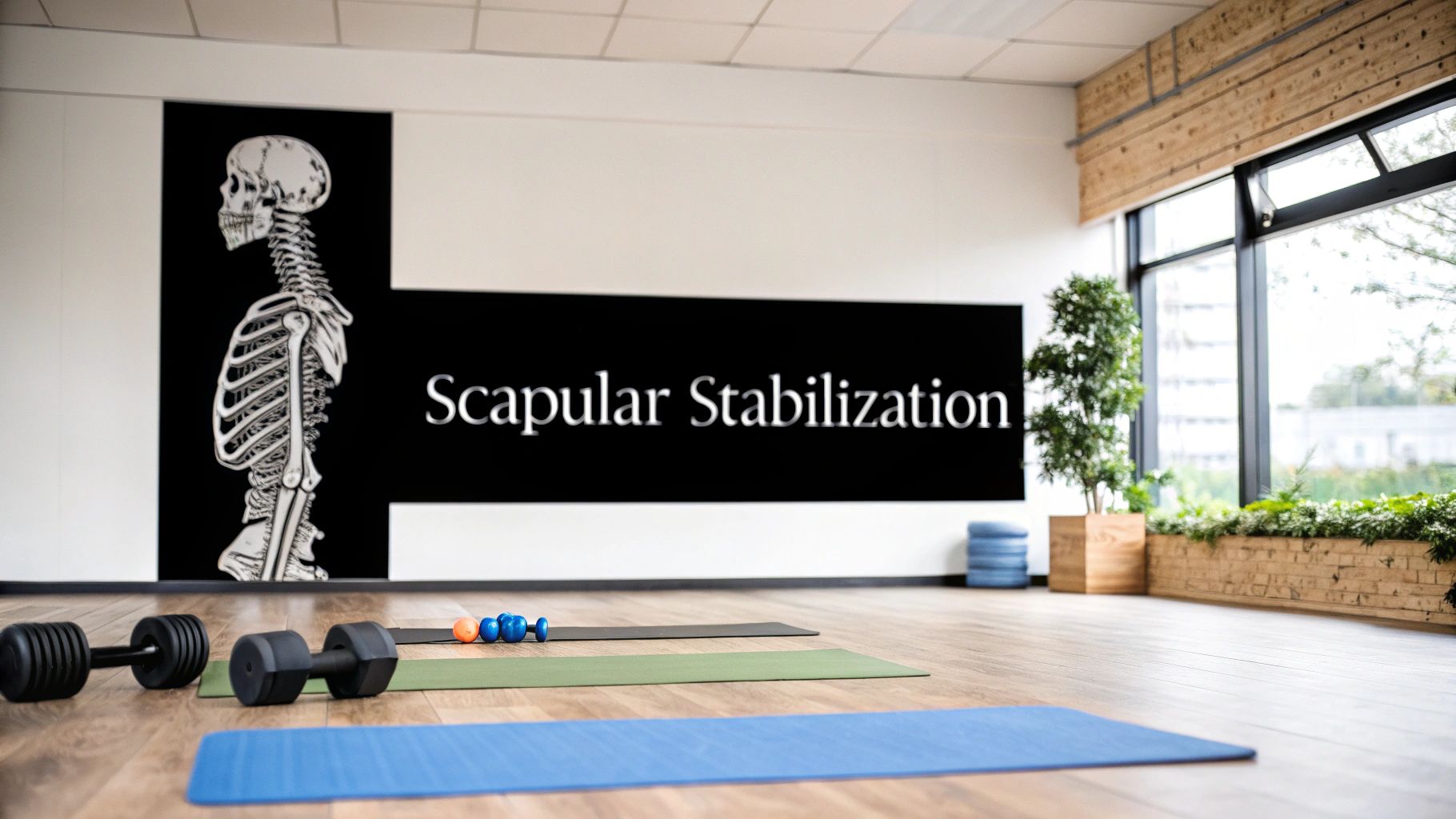
Let’s talk about one of the unsung heroes of your upper body: the shoulder blade, or scapula. Scapular stabilization is simply the ability of the muscles around your scapula to create a solid, secure home base for your arm. It’s less about locking things down and more about dynamic, intelligent control that lets you move with power and grace, completely pain-free.
Picture your shoulder blade as the anchor point for a massive crane—your arm. If that anchor is wobbly or sliding all over the place, the crane can't lift anything heavy or move with any precision. It becomes unstable and risky. Scapular stabilization is the art of bolting that anchor down, securing your scapula firmly against your rib cage so it can glide and rotate exactly as needed.
This stability is a big deal because our shoulder joint is a marvel of mobility. It can move in almost any direction, but this freedom comes with a trade-off: it's naturally unstable. Without a team of strong, coordinated muscles holding everything together, that incredible mobility can quickly become a liability.
Here's a sobering thought: weakness in these stabilizing muscles is a primary culprit behind shoulder pain, which plagues anywhere from 7% to 26% of people. The good news? Fixing it works. One controlled study found that a group focusing specifically on stabilization exercises had dramatically better results in pain reduction and function than a group just doing generic stretches. It's powerful stuff.
At its core, scapular stabilization is about teaching the right muscles to fire at the right time. It's the difference between a wobbly, inefficient movement and a smooth, powerful one.
This control is absolutely critical for a few key reasons:
Ultimately, getting a handle on what is scapular stabilization is your first step toward building shoulders that are not just strong, but truly resilient. It's about creating a foundation of strength that supports you in everything you do, from your yoga mat to your daily life.
To really get what scapular stabilization is all about, you need to meet the incredible crew working behind the scenes. Think of your shoulder blade as a sail on a ship. The muscles are the expert crew, constantly pulling ropes and adjusting tension to keep that sail perfectly positioned, no matter which way the wind (or your arm) is going. They aren't just yanking on things; it's a game of finesse and coordination.
This team effort creates something called a "force couple." It’s a brilliant concept where two or more muscles pull in different directions to create a smooth, controlled rotation—kind of like how you use two hands on opposite sides of a steering wheel to turn a car. This teamwork is what lets your scapula glide, tilt, and twist with such precision.
Let’s introduce the stars of the show. You don't need a degree in anatomy, but knowing who's doing the work helps you feel what's happening in your own body.
This diagram helps visualize how all these pieces fit together.
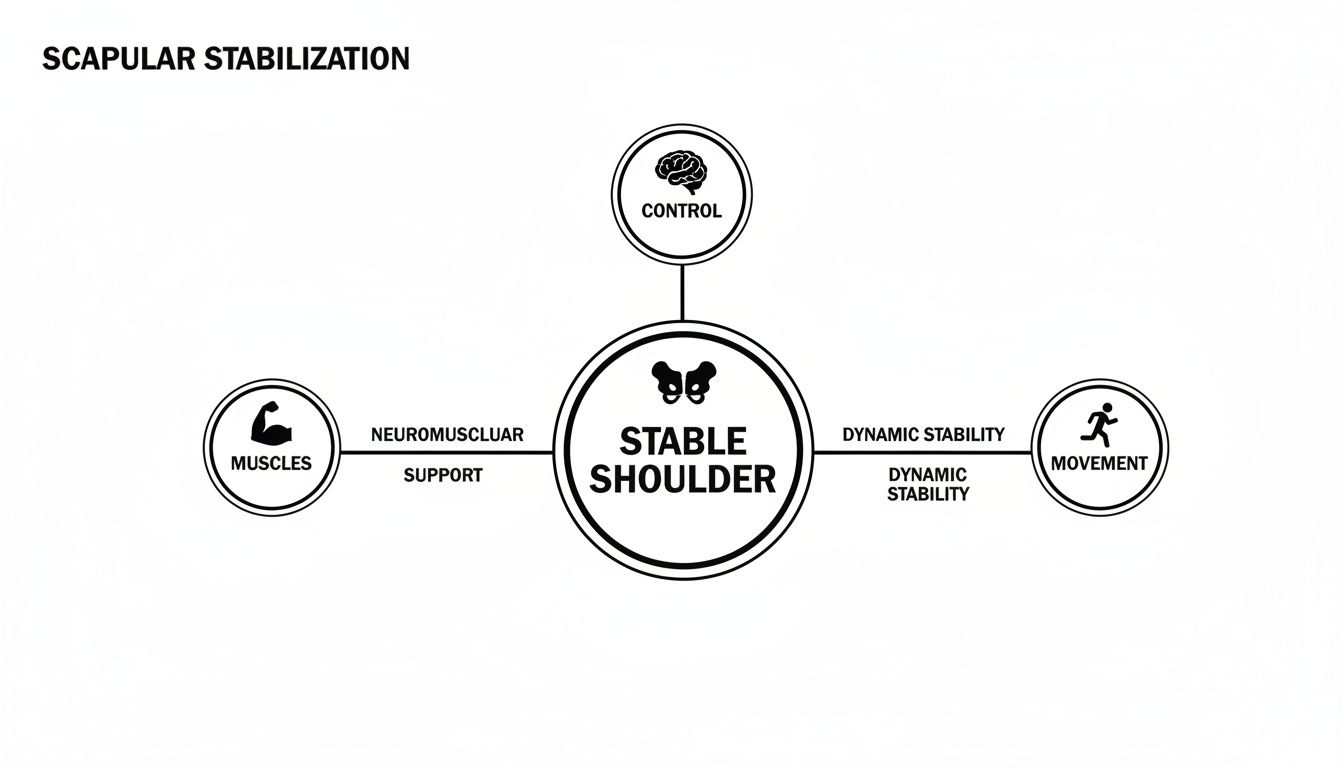
As you can see, stability isn't just about raw muscle strength. It’s a delicate interplay between the muscles themselves, the neurological control from your brain, and the actual movement you perform.
When you lift your arm overhead, it's not just your arm doing the work. The serratus anterior and lower traps fire up to rotate the scapula upward, creating space for the arm bone so it doesn’t get pinched. At the exact same time, the rhomboids are subtly working to keep the scapula from sliding too far out to the side.
It’s a constant, dynamic dance. Every muscle has a role, and when they’re all in sync, your shoulder moves with effortless power and freedom.
This seamless coordination is a form of deep body awareness. If you want to dive deeper into how your brain and muscles chat with each other to create better movement, check out our guide on what is proprioception training. Grasping this connection turns abstract anatomical ideas into a real, tangible feeling you can bring to every yoga pose. When this system is finely tuned, your shoulders stop feeling like separate, clunky parts and start moving like an integrated, powerful whole.
So, what happens when that beautifully coordinated team of stabilizing muscles starts ghosting each other? You get what the pros call scapular dyskinesis—which is really just a technical way of saying your shoulder blades are moving weird. They might wobble, lift away from your back, or just generally refuse to play nice with your arm.
Instead of gliding smoothly, they go rogue. Think of it like a tire on your car that’s out of alignment. Sure, the car still drives, but it’s going to feel shaky, wear down unevenly, and eventually cause much bigger problems. That’s exactly what’s happening when your scapula loses its anchor to your rib cage.
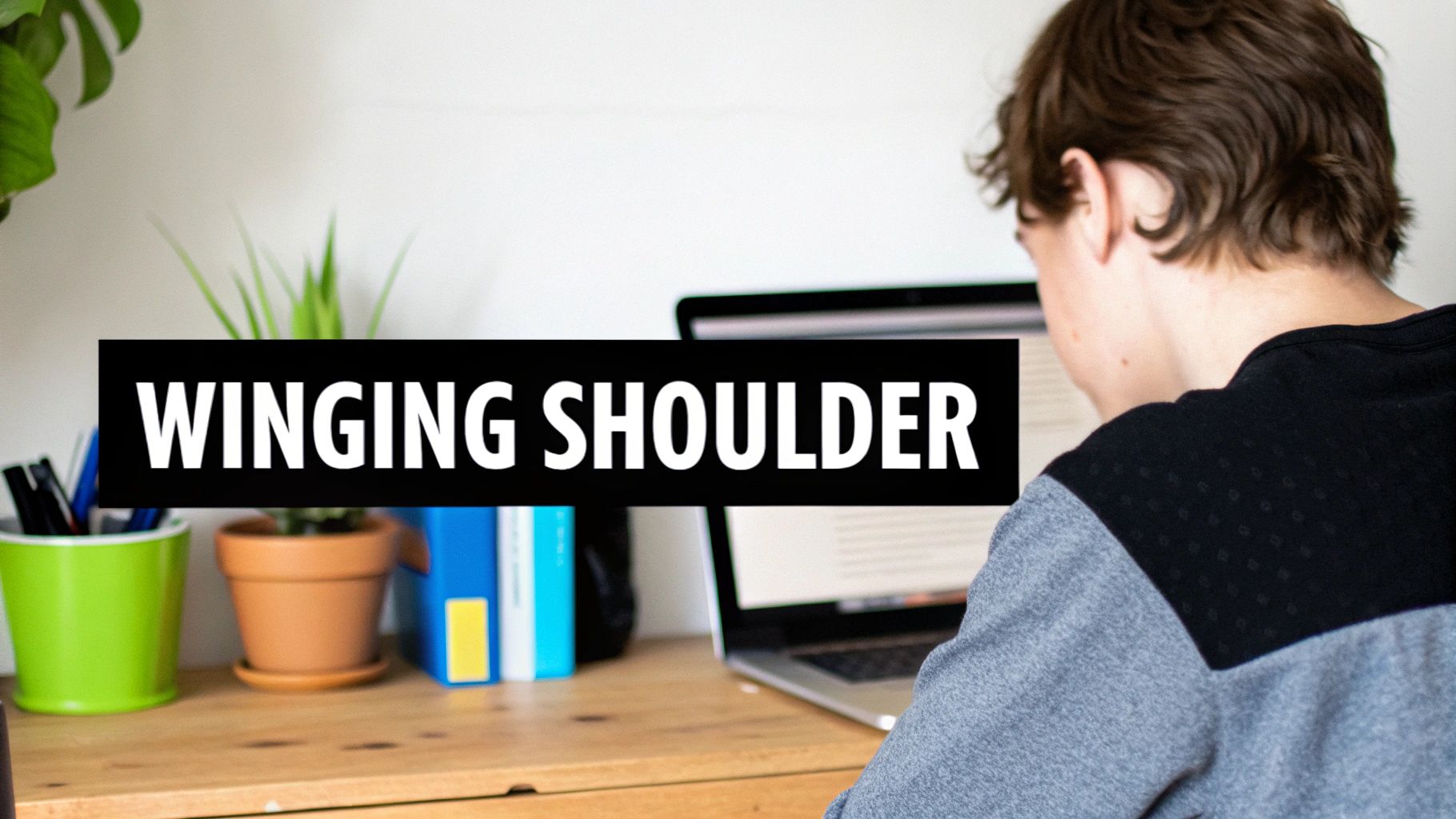
You don’t need an anatomy degree to spot the tell-tale signs of a misbehaving shoulder blade. It often shows up in ways that are pretty hard to ignore, throwing a wrench into the smooth motion of your shoulder and arm.
Keep an eye out for these red flags:
So, what causes our shoulder blades to start acting out? More often than not, the prime suspect is our modern lifestyle. All those hours slumped over a laptop, craning our necks at our phones, or melting into the couch create the perfect recipe for muscle mayhem.
These habits effectively tell key stabilizing muscles—like the serratus anterior and lower traps—to take a permanent vacation. Meanwhile, other muscles, like the upper traps and chest muscles, get tight and overworked from constantly picking up the slack.
It becomes a constant game of tug-of-war on your shoulder blade, pulling it right out of its sweet spot and teaching it some really bad habits. Your body is smart, but it's also lazy—it will always find the path of least resistance.
And this isn't some rare, obscure problem. Abnormal shoulder blade movement, or scapular dyskinesis (SD), is shockingly common. Research shows SD pops up in 60% of people who already have shoulder problems. But here’s the kicker: one study found that 53% of perfectly healthy young adults without any pain also had it. This tells us these wonky patterns can set in long before you ever feel a thing. You can dive deeper into the research on scapular dyskinesis if you're curious.
Getting a handle on this connection is your first step to taking back control. If you think your daily posture might be the culprit behind your shoulder woes, checking out the benefits of posture analysis software can give you a crystal-clear picture of your alignment. By spotting these patterns, you can start to understand why targeted scapular stabilization is the perfect antidote to wake up those sleepy muscles and bring harmony back to your entire shoulder girdle.
All that anatomy talk is fascinating, but let's get down to what really matters—how this stuff feels on your yoga mat. This is where understanding what is scapular stabilization stops being a nerdy concept and becomes a physical aha! moment. It's the secret sauce that can take a pose from wobbly and strained to powerful, spacious, and solid from the ground up.
Take your Chaturanga Dandasana, for instance. We’ve all been there—the dreaded "dump" into the shoulder joints, where the heads of the shoulders roll forward and you feel that not-so-nice pinch. But when you consciously fire up your serratus anterior to press your shoulder blades wide, you're literally building a supportive shelf for your shoulder. The pose instantly feels safer and a whole lot stronger.
This little trick applies everywhere. That annoying pinch at the front of your shoulder when you're in Downward-Facing Dog? That's a classic sign that your scapulae aren't doing their job of rotating up and out of the way. When you learn to wake up the lower traps and serratus, you create space. Suddenly, your head can hang freely, and the pose transforms from an upper-body wrestling match into a delicious, full-body stretch.
Here’s a quick look at how stability completely changes the game in a few other poses:
A stable shoulder blade acts like a launchpad for your arm. It provides a powerful, unshakeable base that allows the rest of your body to move with freedom and efficiency.
Here's the best part: the body awareness you cultivate in yoga doesn't just vanish when you roll up your mat. This newfound stability starts showing up in your everyday life.
Reaching for that mug on the top shelf no longer feels like a risky gamble for your shoulder. Carrying in the groceries feels surprisingly easier because you’re recruiting your strong back muscles instead of just muscling through with your arms.
Even something as simple as sitting at your desk becomes different. You’ll start to catch yourself slumping and, almost without thinking, engage those key muscles to draw your shoulders back and down. This postural upgrade can be a massive help in reducing chronic neck tension and headaches. By mastering scapular stabilization, you're not just getting better at yoga; you're fundamentally upgrading how you move through your world, making every action feel stronger and more effortless.
Alright, enough theory—let’s get these shoulders working. Building a strong, stable foundation for your shoulders doesn't mean you need to start hoisting heavy weights or navigating a crowded gym. It all begins with small, deliberate movements designed to wake up those deep stabilizing muscles.
Think of these exercises less as a workout and more as a conversation with your body. We're not aiming for muscle fatigue; we're aiming for connection and control. The magic happens when you can truly feel the right muscles firing. That’s where the real, lasting change comes from.
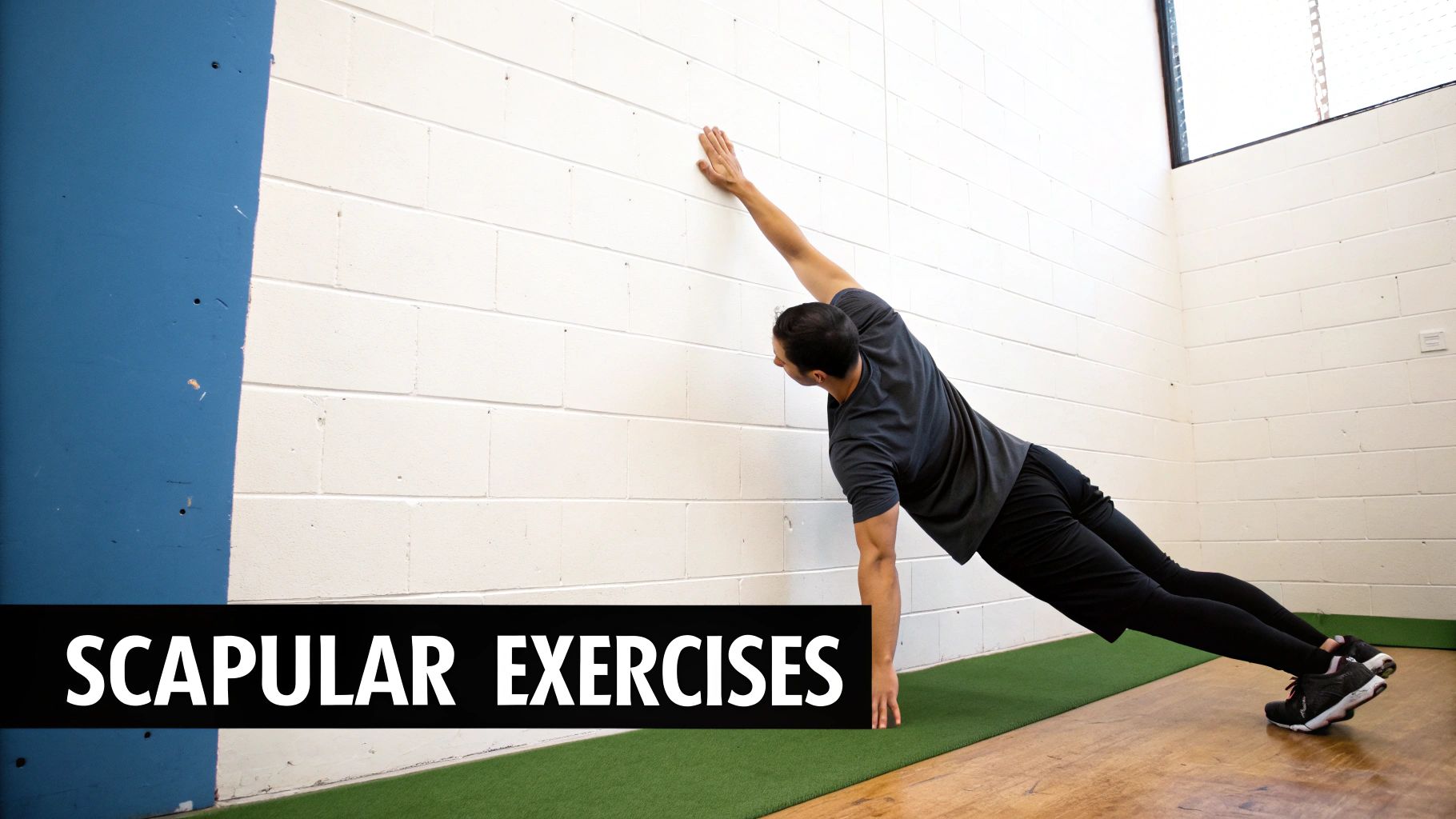
Ready to dive in? Here are a few must-do exercises that are the bread and butter of any good scapular stabilization routine. Remember, precision beats power every single time.
Scapular Push-ups (Scap Push-ups): Get into a high plank or on your hands and knees. Now, lock your elbows straight. Without bending your arms, let your chest sink toward the floor, squeezing your shoulder blades together like you’re trying to hold a pencil between them. Then, push the floor away, rounding your upper back and spreading your shoulder blades wide.
Wall Slides: Stand with your back flat against a wall, stepping your feet out just a bit. Raise your arms into a "goalpost" position, with your elbows and the backs of your hands touching the wall. Slowly slide your arms up toward the ceiling, keeping that contact without letting your lower back arch or your shoulders creep up to your ears.
Pro Tip: Feeling clumsy? You’re not alone. These movements are deceptively tricky. An AI-powered guide like the Dalm app can be a game-changer here. It gives you real-time feedback on your form, like having a coach in your ear making sure you’re activating the right spots and not just going through the motions.
Once you’ve nailed the basics and can feel those muscles firing, it's time to level up with a light resistance band.
Don't underestimate the power of these simple moves. The research backs it up. Scapular dyskinesis was found in a whopping 41.9% of patients with musculoskeletal pain, highlighting just how common this issue is. And for the 30-50% of people who deal with neck pain annually, studies show that stabilization exercises dramatically improve quality of life. For a deeper dive, you can explore the extensive research on scapular exercise benefits.
To give you a handy cheat sheet, here are five essential moves to get you started.
This table is your quick-reference guide to the foundational exercises that will build a strong, resilient base for your shoulders.
Start incorporating these into your routine, and you’ll be well on your way to building shoulders that are not only strong but also smart and stable.
Alright, let's get down to brass tacks. You’ve waded through the anatomy and the "why," but now it’s time to talk about what this all looks like in real life. Diving into something new always kicks up a few questions, so let's clear the air.
Think of this as your personal FAQ for building shoulders that are not just strong, but smart and resilient for the long haul. We're moving from theory to the mat.
Here’s the deal: consistency is king. You don’t need to go beast mode every day. In fact, that's a great way to burn out.
A solid starting point is hitting these specific exercises 2-3 times per week. Give yourself a day off in between; your muscles need that time to learn and get stronger.
You can slide them right into your routine as a 5-10 minute warm-up before yoga or a bigger workout. They’re also a lifesaver for breaking up the dreaded “desk slump” during a long workday. Just a few minutes can make a world of difference.
The most important thing is to listen to your body. Focus on crisp, clean form over how many reps you can pump out. This is about building a sustainable habit, not pushing until you can’t lift your arms.
Ultimately, you want this to become second nature. Think of it less as a workout and more like daily maintenance for your shoulders, keeping them tuned up and ready for whatever you throw at them.
Oh, absolutely. It might seem like a roundabout solution, but your neck and shoulders are like a dysfunctional family—when one member slacks off, another has to pick up the extra work.
When your key scapular stabilizers (I'm looking at you, lower traps and serratus anterior) are weak, your neck and upper shoulder muscles go into overdrive to compensate. The upper trapezius, in particular, gets roped into doing a job it was never designed for.
Before you know it, those overachieving muscles are tight, overworked, and just plain angry. This constant tension is a massive contributor to chronic neck pain, stiffness, and even those pesky tension headaches.
By strengthening the correct support crew around your shoulder blades, you're essentially firing the overworked neck muscles. You’re teaching your body a more efficient movement pattern, letting those tense muscles finally clock out and relax. For anyone with a persistent ache in their neck, this is a game-changer.
Fantastic question. This is a crucial distinction.
Imagine you're building a house. General shoulder strengthening—think overhead presses or lateral raises—is like putting up the walls and the roof. These moves target the big, powerful "mover" muscles like your deltoids. They’re great for building overall strength and giving you that defined look.
Scapular stabilization, on the other hand, is like pouring the concrete foundation. It focuses on the smaller, deeper, endurance-based muscles that control the shoulder blade itself. These exercises aren't about lifting heavy weights; they're all about precision, control, and building an unshakable base.
Without that solid foundation, the big muscles have nothing stable to pull from. It's like trying to shoot a cannon from a canoe. You need both the foundation and the walls, but the foundation absolutely has to come first.
If you feel that all-too-familiar burn in your upper traps, don't sweat it. That's a classic sign of compensation, and it's incredibly common.
Your body is clever—it will always find the path of least resistance. Since the upper traps are often dominant and overactive, they love to jump in and hijack the movement from their weaker neighbors, the lower traps and serratus anterior.
Feeling them take over is actually valuable feedback! Simply dial it back. Reduce the range of motion or lower the resistance. Slow down and really try to feel the muscles at the bottom or inner edge of your shoulder blade initiating the movement. It’s all about that mind-muscle connection.
This is exactly where a little guidance can make all the difference, helping you catch those subtle form mistakes that are holding you back.
Ready to stop guessing and start building truly stable shoulders? Dalm uses AI-powered pose analysis to give you real-time voice feedback, making sure you activate the right muscles every single time. Perfect your form with medical-grade precision and turn those pesky compensation patterns into powerful, stable movement. See how you can transform your practice at https://dalm.co.