
What Is Yin Yoga and Its Deep Restorative Benefits?

So, What Exactly Is Yin Yoga?
Ever feel like you’re running a marathon, even when you’re standing still? That’s modern life. Yin yoga is the complete opposite—it’s the art of hitting the pause button.
It’s a slow, quiet, and deeply meditative style of yoga. Instead of flowing quickly from one pose to another, you’ll settle into gentle, floor-based stretches and hold them for a good while, usually somewhere between 3 to 5 minutes, and sometimes even longer. The real magic isn't in what you do, but in what you don't do. You don't push, you don't strive, you just... soften.
Think of your body as having two distinct systems. You've got your muscles—the "yang" tissues—that love to be active, get warm, and move. They’re what power you through a run or a dynamic Vinyasa class. But underneath all that, you have a deeper, quieter network: your connective tissues. These are the ligaments, tendons, fascia, and even the joints themselves. This is your "yin" side.
Yin yoga isn't a conversation with your muscles; it's a deep, quiet dialogue with this hidden framework. It’s less about building strength and more about creating space. Think of it as a deep-tissue massage you give yourself, where gravity and time do all the work. By holding poses for longer, you allow tension to gently unravel from stubborn areas like the hips, pelvis, and lower spine, where we tend to store a lot of physical and emotional stress.
We live in a "go-go-go" world that celebrates effort and speed. Yin yoga is a beautiful rebellion against that. It invites you to find your "edge"—that first whisper of sensation, a mild stretch, but never pain—and then to simply relax into it. You’re not trying to force your way into a pretzel shape. You’re learning to breathe, to listen, and to let go.
This infographic breaks down the core concepts that make yin yoga so unique: stillness, a focus on deep tissues, and that signature slow pace.
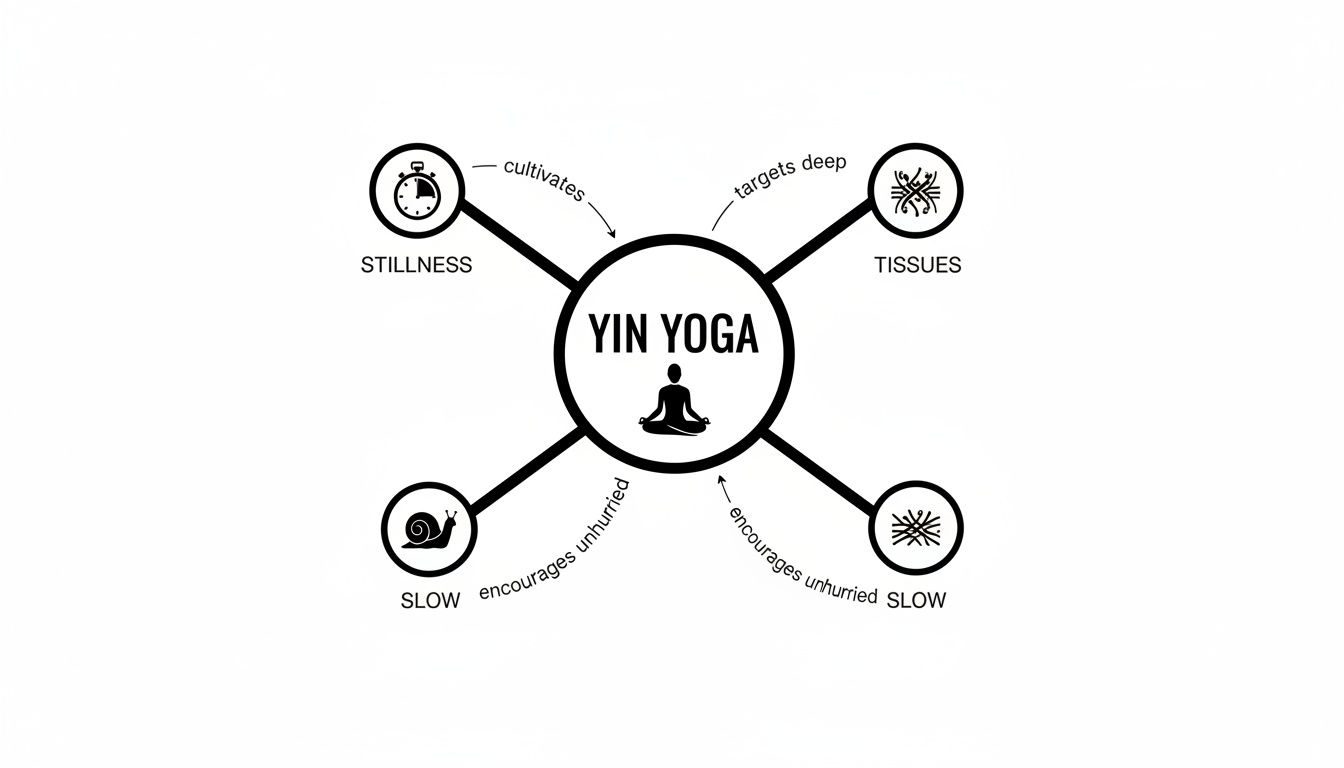
As you can see, these pillars create a practice that hits the reset button on both your body and your mind. The real transformation happens in that quiet space between the effort and the ease.
To really get what yin is all about, it helps to see it next to its more energetic cousins, the "yang" styles like Vinyasa or Ashtanga. It all comes down to the tissues they target. Yang tissues (muscles) are like rubber bands—they're elastic and respond best to rhythmic, repetitive movement. But yin tissues (connective tissues) are more like taffy—they're plastic and need slow, steady pressure to change their shape.
You wouldn't yank on a piece of taffy and expect it to stretch, right? You’d pull it slowly and gently. The same goes for your ligaments and fascia. Applying fast, forceful movements can actually be harmful. Yin's deliberate pace safely hydrates these deep tissues, boosts circulation in the joints, and seriously improves your flexibility over time.
For a closer look at the different styles, this table breaks it down nicely.
Understanding this contrast is key to appreciating what makes each practice so powerful in its own right. If you're new to yoga in general, you might find our guide on gentle yoga for beginners a great place to start exploring.
The goal of Yin Yoga is not to get better at the poses, but to use the poses to get better at being with yourself. It's a practice of profound self-inquiry, teaching patience and acceptance one long, quiet breath at a time.
Ultimately, yin yoga offers a rare opportunity to cultivate mindfulness and what experts call interoception—the ability to truly feel and understand what’s happening inside your own body. By learning to stay present, even through discomfort, you're training your mind to remain calm and focused. And that’s a skill that pays off long after you’ve rolled up your mat.
If you think Yin Yoga was cooked up in some trendy city studio, think again. Forget the curated playlists and pricey mats for a second. The story of this slow, meditative practice actually begins somewhere far more intense: the world of competitive martial arts.
Believe it or not, this quiet practice has a surprisingly fiery origin, born from a need for extreme flexibility and raw inner power.
It all started back in the late 1970s with a martial arts champion named Paulie Zink. Zink was a master of Taoist arts, and he knew something about deep flexibility that his stiff martial arts students desperately needed to learn. He started blending his hatha yoga background with ancient Taoist principles, creating something totally new that focused on long, passive holds.
This wasn't your typical yoga class. Zink's method was initially a closely guarded secret, his secret weapon for helping students unlock the range of motion they needed for their grueling discipline. He’d have them hold deep, floor-based poses for ages, getting into the stubborn connective tissues that a quick stretch just can't reach.
By the early 1980s, Zink was openly teaching what he called 'Yin and Yang Yoga.' This was a complete system that balanced those long, passive (yin) holds—often lasting 3 to 5 minutes or more—with dynamic, flowing (yang) movements inspired by animal forms. You can get the full scoop on the invention of Yin Yoga on myvinyasapractice.com.
While Zink’s original art was a holistic practice, it was the quiet, introspective "yin" side that was about to take the world by storm.
The next chapter of our story brings in two people who would essentially translate Zink’s genius for the rest of us. One of his early students was Paul Grilley, a yoga teacher obsessed with anatomy and how the human body actually works.
Grilley was completely captivated by how effective the long holds were. He dove deep, studying how the practice affected the body's tissues on a cellular level. He stripped away some of the more esoteric Taoist elements and focused on the functional anatomy, brilliantly connecting the poses to the body's meridian lines from Traditional Chinese Medicine.
It was Grilley who really refined the practice, making it more accessible to the average person. He’s also the one who gave it the name we know today to distinguish it from Zink’s broader system: Yin Yoga.
"Yin yoga is a quiet practice that encourages acceptance and relaxation... The magical element of time in the Yin practice allows us to observe and investigate deeper patterns and habits in our physical and subtle bodies."
Then came another of Grilley’s influential students, Sarah Powers, who added another crucial layer. She skillfully wove in the principles of mindfulness and Buddhist psychology, highlighting Yin Yoga’s incredible power as a tool for exploring our own minds and emotions.
Together, Grilley and Powers took a martial arts secret and turned it into a modern sanctuary. They adapted this ancient wisdom for our crazy, fast-paced lives, creating the perfect antidote to our over-stimulated, "yang-heavy" world. The yin practice you find in studios today is a beautiful blend of all of it: ancient Taoist knowledge, modern anatomical science, and profound meditative techniques.
The real magic of Yin Yoga isn't found in acrobatic poses or a heart-pounding pace. Instead, its deep, lasting power comes from three core principles. Think of them less as rigid rules and more as a simple, elegant framework for exploring your own body.
Getting a handle on these "Three Tattvas of Yin" is your ticket to a practice that's not only effective but also incredibly rewarding. They are your internal compass, helping you listen to what your body needs in any given moment.
The first step in any yin pose is to find your "appropriate edge." This is your personal sweet spot—not too much, not too little, but just right. Forget everything you know about pushing through the burn in a more active yoga class. In yin, we do the opposite.
You want to move into the shape just far enough to feel the very first whisper of a stretch. It’s a mild sensation, a gentle tugging in the target area. Once you feel it, you stop. That’s your edge.
Let’s be clear: pain is a red flag, not a goal. If you ever feel a sharp, shooting, or electric zing, you’ve gone way past your edge. We're looking for a therapeutic level of stress that coaxes tissues to open up, not a feeling of distress that makes them want to seize up.
Once you've found that gentle edge, your next job is to simply be still. This is often harder than it sounds and works on two levels: physical and mental.
First, the physical part. When you fidget, wiggle, or constantly readjust, you're asking your muscles to fire up. This pulls the tension right out of the deep connective tissues we’re trying to work with. You have to stay still to keep the focus where it belongs.
Think of your fascia like a piece of cold plastic wrap. If you try to stretch it quickly, it just rips or resists. But if you apply gentle, steady pressure over time, it slowly begins to creep and lengthen. Stillness is the key that allows this slow, deep release to happen.
Of course, the mind will have its own ideas. The urge to scratch an itch, make a to-do list, or wonder what's for dinner is totally normal. The practice isn't about silencing the mind, but about learning to watch these impulses come and go without needing to act on them.
And here’s the final ingredient: time. This is what truly sets Yin Yoga apart. We hold these simple shapes for a lot longer than you might be used to, typically anywhere from 3 to 5 minutes, and sometimes even longer for seasoned practitioners.
Why the long wait? Because we’re not targeting your muscles. We’re going after the deeper, more plastic-like tissues—your fascia, ligaments, and tendons. These tissues are stubborn. They don’t respond to a quick stretch.
Holding a pose for several minutes is like slow-cooking a tough cut of meat. A quick sear won't soften it; you need low, slow heat over a long period to break down the tough fibers and make it tender. In the same way, a sustained, gentle hold is what gives your connective tissues the time they need to respond.
This long hold is what unlocks the biggest benefits:
Put these three pillars together—finding your edge, resolving to be still, and holding for time—and you create a practice that is less about forcing and more about allowing. You're creating the space for profound change to happen all on its own.
Ever wondered how just holding a pose for five minutes can feel so incredibly transformative? It’s a fair question, especially if you’re used to more dynamic yoga styles. The secret isn't in the movement, but in the stillness. When you finally give your body and mind permission to hit the pause button, profound shifts begin to happen.
This isn’t some vague, feel-good idea. We're talking about real, measurable changes deep within your body’s architecture and nervous system. From rehydrating your connective tissues to literally retraining your brain's response to stress, the benefits of embracing the slow lane are as real as they are lasting.
Yin Yoga’s main target isn’t your muscles; it’s the deeper, tougher stuff—your fascia, ligaments, and tendons. Unlike muscles, which love a good, quick stretch, these connective tissues are dense and far less pliable. They don’t respond to a few seconds of pulling, but they absolutely transform under slow, sustained pressure.
Think of your fascia like a kitchen sponge. When it’s dry and compressed from sitting all day or from repetitive movements, it gets stiff and brittle. The long, gentle holds in Yin Yoga act like a slow, deliberate squeeze-and-release. You’re wringing out old, stagnant fluid and inviting fresh hydration back in. This simple process kicks off some amazing physical perks:
This isn’t just talk. When pioneers like Paul Grilley brought Yin Yoga to the forefront in the 1990s, they were driven by these tangible results. Grilley saw students achieve mind-blowing gains—we're talking up to 40% improvements in hamstring and hip mobility within months. Some studies have even shown that holding poses for 3-8 minutes can reduce chronic lower back pain by 20-30% after just eight weeks. If you want to dive deeper into the history, you can explore more about Yin Yoga's therapeutic roots on with-yinyoga.com.
Let's face it, the modern world has most of us perpetually stuck in "fight or flight" mode. That’s your sympathetic nervous system running the show. Yin Yoga is the ultimate antidote; it’s a powerful tool for flipping the switch and activating its much calmer counterpart.
The parasympathetic nervous system—often called the "rest and digest" system—is what allows your body to heal, recover, and truly chill out. The slow pace, deep breathing, and quiet focus of a Yin practice are all clear signals to your brain that you're safe and sound.
This deliberate slowdown drops your heart rate, lowers your blood pressure, and dials back cortisol, the body's main stress hormone. It’s a practice of learning to simply be, not just do—an essential skill for navigating the chaos of modern life.
Beyond the anatomy we know in the West, Yin Yoga is deeply rooted in the principles of Traditional Chinese Medicine (TCM). In this system, the body is seen as a network of energy, with life force, or Qi, flowing through specific pathways called meridians.
Every Yin pose is intentionally designed to gently compress or stretch certain areas of the body, stimulating these energetic superhighways. According to TCM, when Qi flows freely, we feel healthy and vibrant. But when it gets blocked or stuck, it can show up as physical pain, emotional turmoil, or even illness.
The long, quiet holds in Yin Yoga work to:
This is what makes Yin Yoga so uniquely powerful. It’s a multi-layered practice that works on your physical body, calms your frazzled nerves, and helps restore your energetic balance, all at the same time.
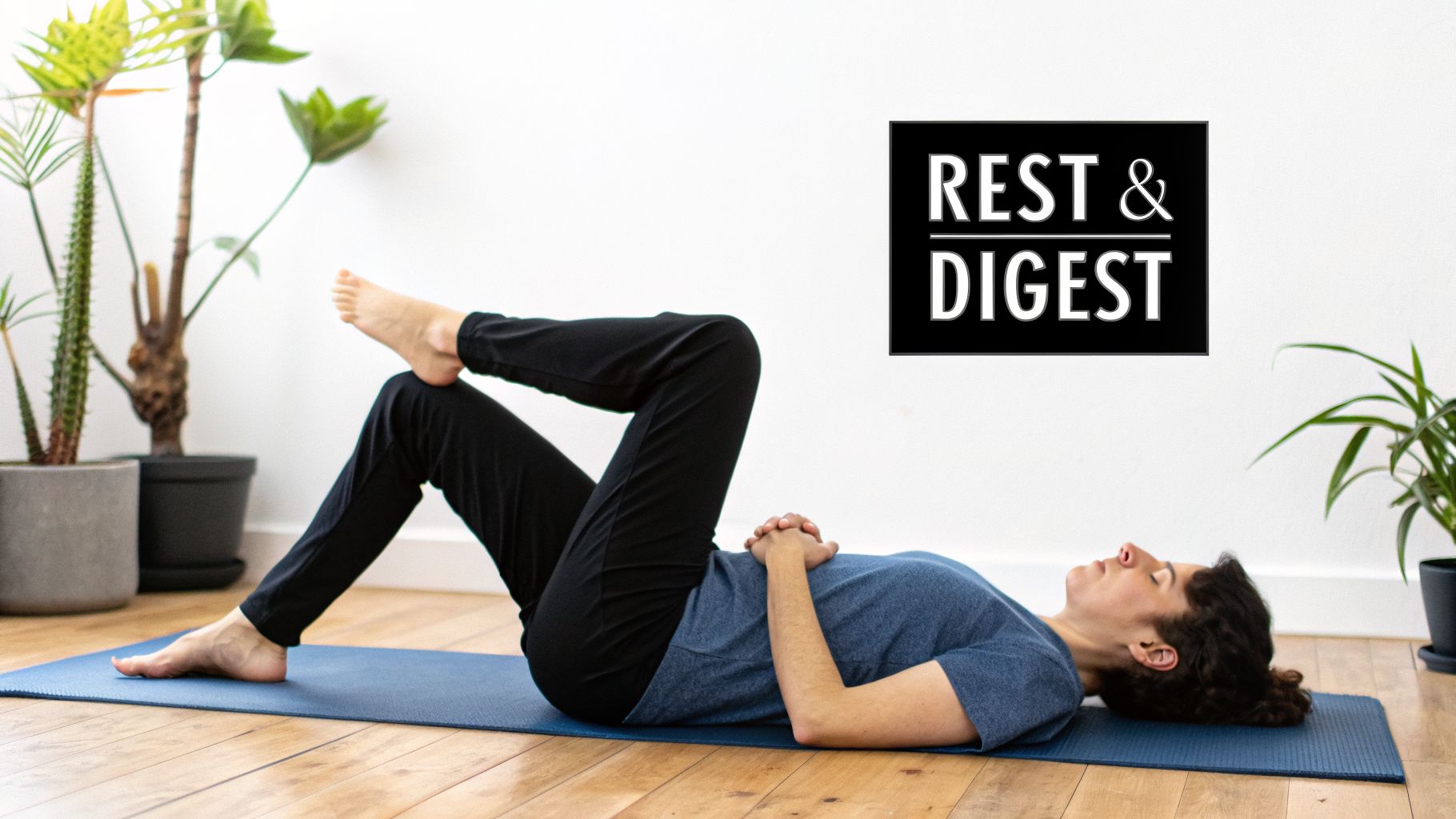
Alright, enough with the theory. The only way to truly get Yin Yoga is to feel it in your own body. And trust me, getting started is way simpler than you might think.
You don’t need to be a human pretzel or even touch your toes. You just have to be willing to slow down, get quiet, and listen.
This is your practical playbook. We’re going to walk through a few foundational poses, breaking down what they do and, more importantly, how to make them feel good for your unique body. In the world of yin, we throw out the idea of what a pose is “supposed” to look like. It’s all about what it feels like.
Here are five simple but incredibly powerful poses perfect for dipping your toes into the yin waters. Just keep those core principles in mind: find that gentle edge, commit to stillness, and then let time work its magic.
For your first few sessions, aiming for 2-3 minutes per side is a fantastic starting point.
Butterfly Pose (Baddha Konasana): This is a classic for a reason. It’s a wonderful hip opener that also gives some love to the inner thighs and lower back.
Melting Heart Pose (Anahatasana): Think of this as the perfect antidote to a day spent hunched over a keyboard. It’s a beautiful way to open up the shoulders, chest, and that often-neglected upper back.
Sphinx Pose (Salamba Bhujangasana): This gentle backbend is pure gold for the lower spine. It creates a mild, healthy compression that can help stimulate the kidneys and give your adrenal glands a little reset.
Ready to connect the dots? A great sequence doesn't have to be long or complicated to be deeply effective. The real goal is to create a flow that feels balanced and lets you move from one shape to the next with ease.
A sequence isn't just a to-do list of poses. It's about creating a container for quiet observation. Each shape is just another chance to check in with yourself.
Here’s a simple, 30-minute sequence designed to give you a full-body yin experience. It's a fantastic routine for winding down in the evening or for a lazy weekend morning.
And remember, these timings are just friendly suggestions. You can learn more about finding your own sweet spot in our guide on how long to hold yoga poses. The most important instruction is to listen to your body. It always knows best. Welcome to the practice.
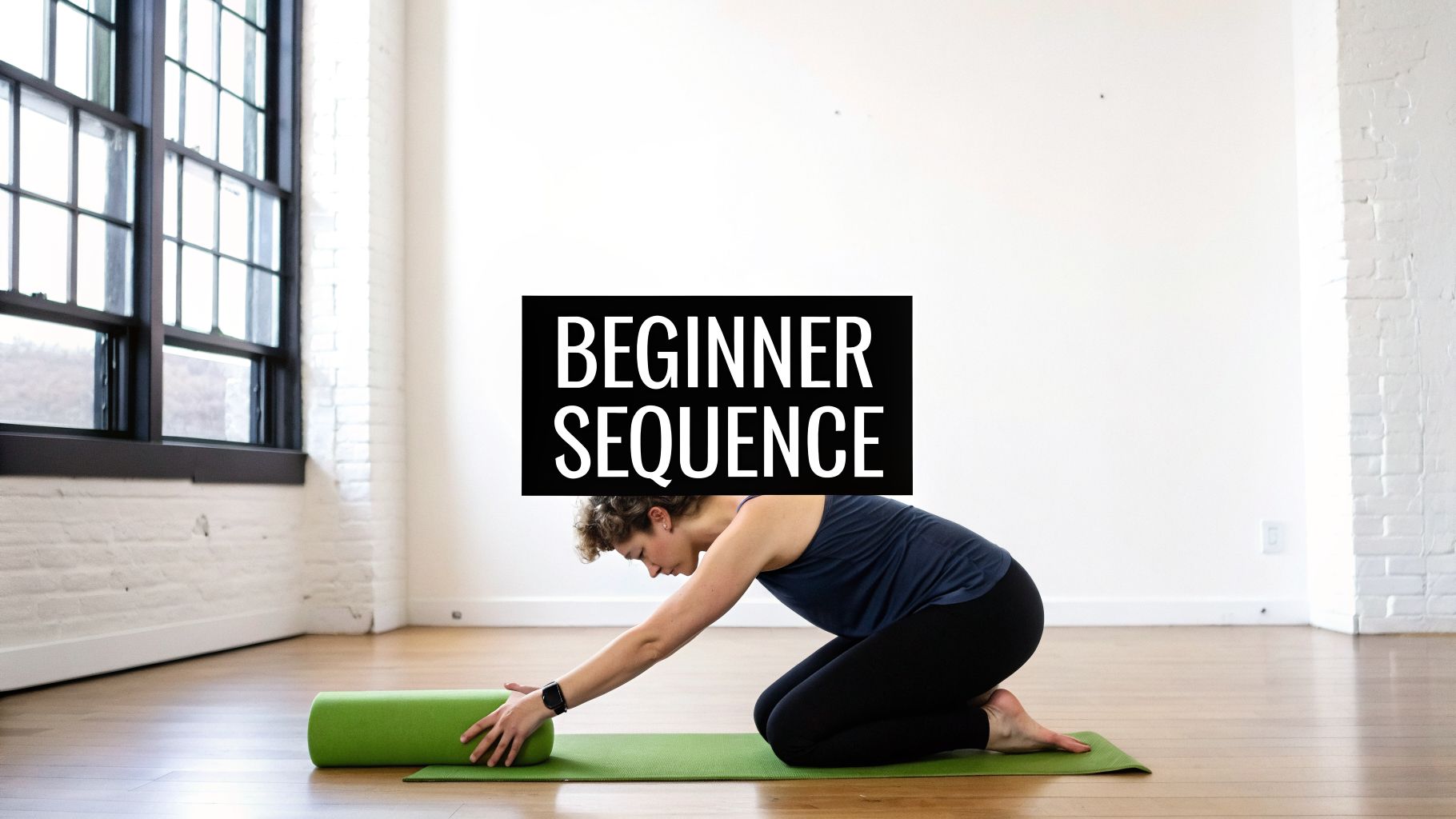
Yin yoga is all about stillness, deep listening, and connecting with yourself. It's an ancient practice. But just because it's old doesn't mean it can't get a little help from a modern-day companion.
When you're practicing at home, it can be tough to know if you're holding a pose safely. Are you finding your true "edge," or are you pushing just a bit too far? This is where technology can step in, acting as your personal guide right there on the mat.
Imagine having a quiet partner during your practice, one that knows exactly what you need during a long, intense hold in Dragon Pose. That's what smart apps like Dalm are built for. Instead of just guessing, you get clear, real-time feedback based on your body’s actual position.
The long, quiet holds in yin yoga are the perfect setting for AI-powered pose analysis. Using your device's camera, the technology can observe your alignment and offer gentle voice feedback to help you settle into the safest and most effective version of each pose.
This isn’t about chasing some "perfect" shape. It’s about making sure that gentle, healthy stress is reaching the right target tissues. The AI can notice if you’re collapsing in a way that might strain a joint and suggest a tiny shift, making sure your stillness is both safe and deeply healing.
Platforms are completely changing the home practice game with this kind of precise pose analysis. They can deliver voice-guided corrections with up to 98% alignment precision, helping you get the most out of every single minute.
One of the best parts of any practice is seeing how far you’ve come. But with a slow, subtle practice like yin, progress can be hard to spot day-to-day. This is another spot where a smart guide makes a world of difference.
The real beauty of smart guidance is that it honors the core of yin yoga—personal exploration—while adding a layer of safety and insight that was once only available in a studio setting.
By tracking your sessions, AI can show you tangible proof of your journey. It can map your flexibility gains over time, showing you exactly how your consistency is paying off. Seeing data that shows a 20% improvement in your forward fold over a month is incredibly motivating. It keeps you coming back to the mat.
This kind of smart assistance also connects you to a wider community. Sharing your progress and celebrating milestones with others turns a solitary practice into a shared global journey.
If you're curious about how this all comes together, our guide on the benefits of a smart yoga mat explains more. When used thoughtfully, technology can make your personal yin yoga experience safer, smarter, and more connected than ever before.
Diving into any new practice can feel like the first day of school. You're excited, maybe a little nervous, and you've got a ton of questions bubbling up. That's a good thing! It means you're already paying attention.
Let's demystify things a bit. We'll walk through some of the most common questions that come up when people first encounter the quiet, powerful world of Yin Yoga. Getting these cleared up will help you hit the mat with confidence, ready to settle in.
Yes, and honestly, it’s one of the best places to start. Yin Yoga is incredibly welcoming because the whole point is to listen to your body, not to force it into a pretzel shape you saw on Instagram.
Unlike more dynamic yoga styles that demand a certain amount of strength or balance right out of the gate, yin meets you exactly where you are today. You’ll see a lot of props—blankets, pillows, blocks—and they aren't for "cheating." They are essential tools of the practice, there to support your body so you can release into a pose without any strain.
Here’s the secret: The "look" of the pose doesn't matter. It’s all about what you feel. A beginner who finds that sweet spot of a gentle stretch with the help of three pillows is having a more authentic yin experience than a flexible person pushing themselves into pain just to look a certain way.
With yin, a little goes a long way. Consistency is far more important than intensity. You really don't need to practice every single day to feel a major shift.
For most people, hopping on the mat for a yin session 2-3 times per week is the sweet spot.
This rhythm gives your deep connective tissues enough time to respond to the gentle stress, then recover and rebuild stronger. Think of it as the perfect antidote to all the "yang" in your life—things like running, lifting weights, or even a fast-paced vinyasa class. While those activities build muscle, yin restores your range of motion and melts away that deep-seated tension.
This is a brilliant question, because at a glance, they can look almost identical. Both styles use lots of props and move at a snail's pace. The real difference lies in their purpose.
A simple way to tell the difference? In a pose, ask yourself: am I feeling a mild, interesting stretch (that’s Yin), or am I floating on a cloud of support with zero sensation (that’s Restorative)?
First thing's first: for any acute or serious injury, please talk to your doctor or physical therapist. Their advice is gold. That said, for more general stiffness, chronic aches, or the later stages of healing, Yin Yoga can be a wonderfully gentle tool.
The number one rule is that you are your own best teacher. This practice is about nurturing your body, not pushing through pain.
Keep these guidelines in your back pocket:
By listening closely and respecting your body's messages, you can make your yin practice a powerful ally in your recovery and long-term health.
Ready to put this into practice? With Dalm, you can bring the intelligence of Yin Yoga right into your living room, with a guide that understands your body. Our AI-powered analysis gives you real-time feedback, making sure you’re practicing safely and finding that perfect edge every single time. Start your personalized journey at https://dalm.co today.