
Yoga for hamstring flexibility: Safe, Effective Poses
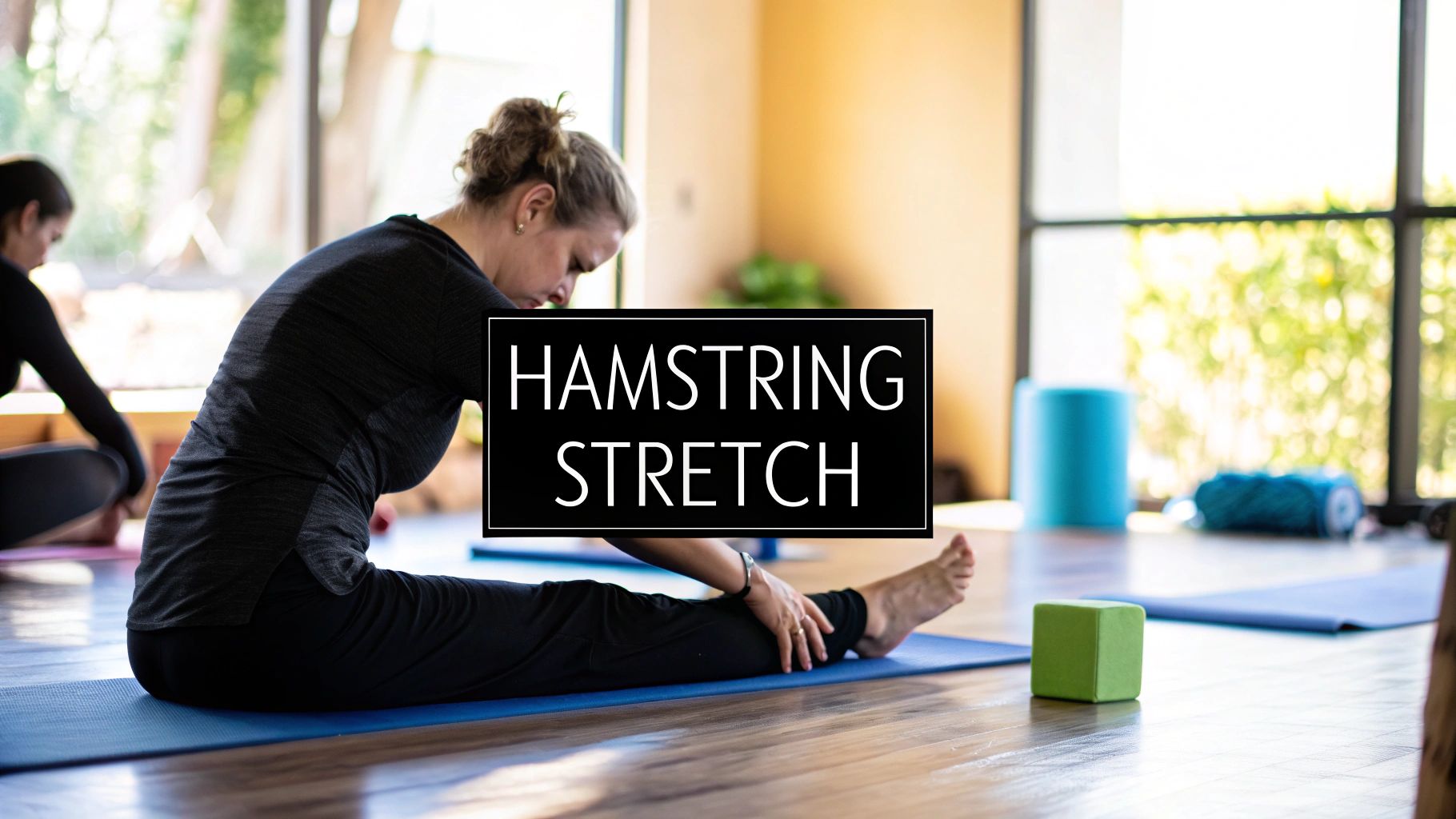
Yoga is one of the best tools out there for unlocking tight hamstrings. It’s not about forcing a stretch; it's about a series of gentle, sustained poses that actually convince your nervous system to let go. With a little consistency, you can safely lengthen those stubborn muscles, ease up on your lower back, and even stand a little taller.
Ever try to bend over and feel like the backs of your legs are about to snap? You're definitely not alone. That nagging, sometimes painful tightness is a super common complaint, but it's usually about more than just needing a good stretch. To really get some relief, we need to peek behind the curtain.
First off, your "hamstrings" aren't just one big muscle. They're a powerful trio—the semitendinosus, semimembranosus, and biceps femoris—that run all the way from your "sit bones" (the ischial tuberosity) down to your lower leg. Because they cross both your hip and knee joints, they're responsible for two key jobs: extending your leg backward and bending your knee.
Okay, so why do they get so wound up? The biggest offender, hands down, is modern life. All those hours spent sitting—at a desk, in the car, on the couch—keep your hamstrings stuck in a shortened position. After a while, your body just adapts, and the muscles essentially forget what it feels like to be fully long.
But sitting isn't the only villain in this story. Let's look at a few other sneaky culprits that might be contributing to your tightness.
Here's a quick look at the common lifestyle and biomechanical factors that secretly contribute to hamstring tightness, helping you identify your personal triggers.
Identifying your own patterns from this table is a huge first step toward finding real, lasting relief.
This is where a smart yoga practice shines. We're not just yanking on a muscle and hoping for the best. Yoga gets to the root of the problem by addressing the why—the neurological and biomechanical reasons your body is holding on so tight.
The real lightbulb moment for most people is realizing that hamstring tightness is often a symptom, not the root cause. It's your body's response to imbalances elsewhere, like weak core muscles or sedentary habits.
For example, a fascinating study looked at tailors, who are notorious for having tight hamstrings from sitting all day. After just a 7-week Hatha yoga program, their sit-and-reach test scores improved by an average of 2.2 cm. That's a significant jump! It shows how yoga methodically teaches the neuromuscular system that it's safe to release and lengthen.
Ultimately, understanding why your hamstrings are tight changes everything. Instead of fighting your body, you start a conversation with it, using each pose to gently coax these crucial muscles back to a happy, relaxed state. For a wider view on this, you might find our general guide on how to improve flexibility really helpful.
Alright, let's get down to business. It's time to gently coax those stubborn hamstrings into relaxing. We're moving from the theory into the practical, starting with a handful of beginner-friendly poses that are all about safety and immediate relief.
Forget about trying to fold yourself in half on day one. That's not the goal. Our focus is on accessible moves that meet your body exactly where it is right now. This is about starting a friendly conversation with your muscles, not winning a flexibility competition.
And let me tell you, props like blocks and straps aren't cheating—they're your secret weapons. They allow you to find that sweet spot in a stretch without messing up your alignment or straining your back. They turn a potentially painful moment into a supported, feel-good release.
Ah, Downward-Facing Dog (Adho Mukha Svanasana). It's supposed to be a "resting" pose, but if you have tight hammies, it can feel more like a form of torture. The secret? Bend your knees. A lot!
Seriously, don't be shy. Bend them as much as you need. This little trick takes the pressure right off your hamstrings and lets you focus on what really matters in this pose: creating a long, straight line from your hands all the way to your tailbone. A happy spine is way more important than straight legs.
This one simple change transforms Downward Dog from a frustrating fight into a super effective way to lengthen your hamstrings and your spine. It sets you up for a safe and successful practice.
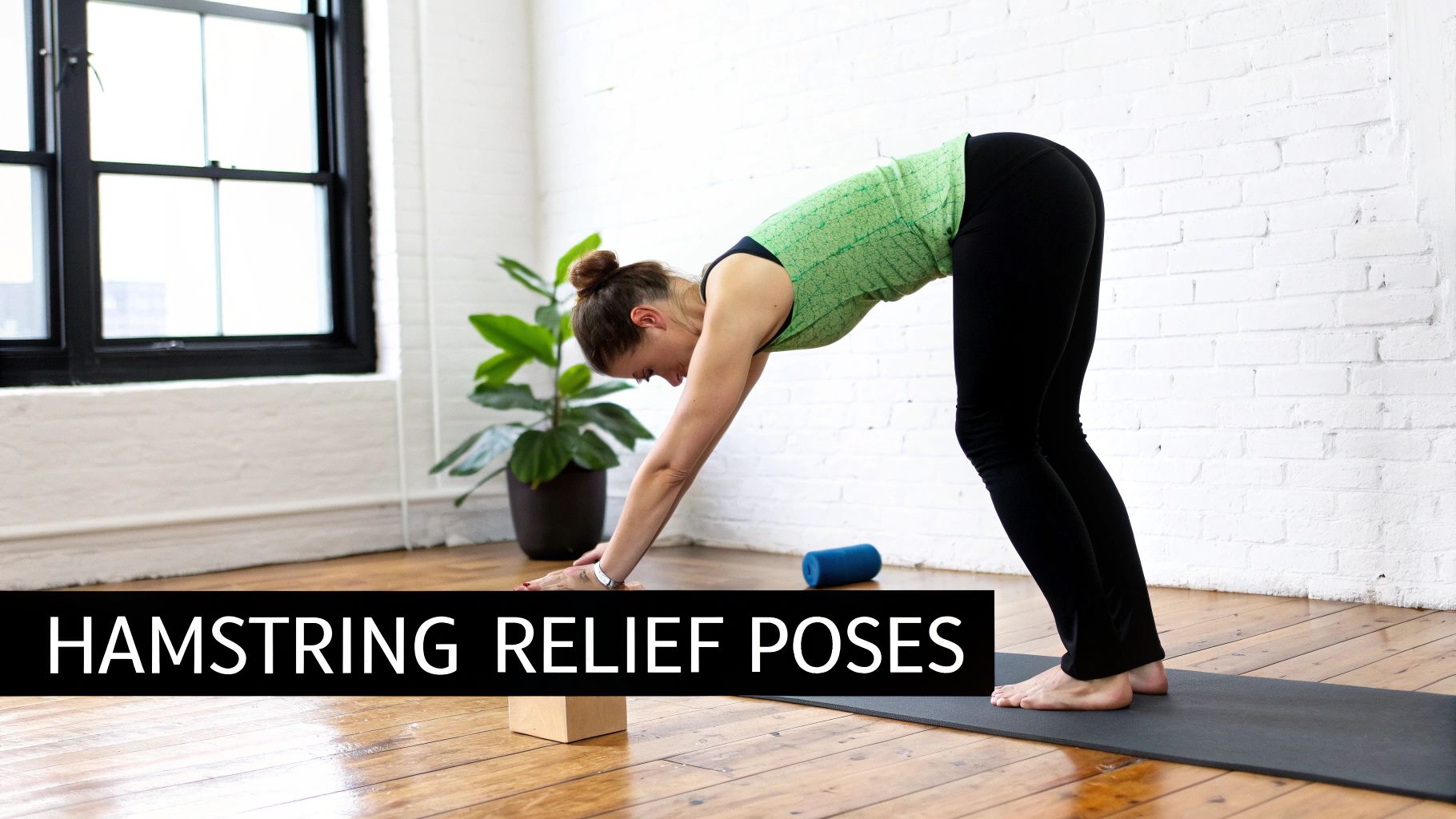
The Standing Forward Fold (Uttanasana) is a classic for a reason, but diving in headfirst is a one-way ticket to ouch-town. This is where your yoga blocks become your best friends.
By placing blocks under your hands, you're essentially bringing the floor up to meet you. This support is crucial because it helps you keep your back flat as you hinge from your hips. It prevents that all-too-common mistake of rounding your lower back, which just puts stress on your spine and completely misses the point of the hamstring stretch.
What to Feel: You're looking for a gentle, even stretch all the way down the back of your legs. If you feel a sharp, zinging sensation behind your knee or way up by your butt, you've pushed it too far. Ease up and bend your knees more.
This supported version ensures you're actually stretching the muscles you intend to, teaching your body the correct way to fold forward from the hips, not the waist.
Let's make gravity our ally, shall we? Lying on your back for Reclining Hand-to-Big-Toe Pose (Supta Padangusthasana) gives your spine all the support it needs, which lets you zero in on the hamstring stretch with laser focus.
For beginners, using a yoga strap (or a belt, a dog leash, a towel—get creative!) is basically non-negotiable here. It gives you the extra reach you need so you can control the stretch without craning your neck or hiking your shoulders up to your ears trying to grab your foot.
This pose is, hands down, one of the safest and most effective ways to open up your hamstrings. The floor has your back (literally), and the strap puts you in the driver's seat. It's a perfect foundational pose. And if you're looking to build out your toolkit, exploring other core movements can make a huge difference. You can find more in our guide on the best yoga poses for beginners.
So, you've been putting in the work. Those foundational poses are starting to feel familiar, maybe even… comfortable. The screaming sensation in your hamstrings has quieted to a more manageable conversation. Perfect. That means you’re ready to see what’s next.
Ready to dial it up a notch? We’re about to introduce some poses that ask for a little more, but the reward is a much deeper, more satisfying sense of release. This isn't about jamming yourself into a pretzel shape. It's about intelligently nudging your boundaries to see what’s possible. The goal is always smart progress, not picture-perfect poses.
Pyramid Pose, or Parsvottanasana, is where the real work begins. It’s a laser-focused stretch that hones in on the hamstring of your front leg. But to get the goods without hurting yourself, you have to be a stickler for alignment.
First, let's sort out your foundation—your feet. This isn't a lunge. Both feet are flat on the floor, about three feet apart. Your front foot points straight ahead, but your back foot angles out just a bit, maybe 45 degrees, which is crucial for keeping your balance. From there, the name of the game is squaring your hips to the front of your mat.
Here’s the secret sauce: fire up the quad on your front leg. I know, it sounds backward. Why would you tense a muscle to stretch its opposite? It's a neat little neurological trick called reciprocal inhibition. When you engage your quadriceps, it sends a signal to your hamstring to chill out and lengthen. Trust me, it’s a game-changer.
The most common mistake I see in Pyramid Pose is people rounding their spine into a "C" shape just to get their nose to their knee. Big mistake. Your hamstrings attach to your sit bones (the bony parts of your butt), not your spine. A rounded back just strains your lumbar spine and you completely miss the hamstring stretch.
The goal is not to touch the floor. The goal is to feel a meaningful stretch in the belly of your hamstring. A flat back with a generously bent front knee is a million times better than locked legs and a rounded spine.
This little mental flip is everything. It takes the ego out of the equation and turns the pose into a curious exploration of what your body can do today. Wondering how long you should hang out in this exploration? We've got some great insights in our article on how long you should hold yoga poses.
Alright, let's talk about the pose that often feels like the final frontier of flexibility: The Splits, or Hanumanasana. It's the ultimate benchmark for open hamstrings, but diving in too fast is a one-way ticket to a pulled muscle. The key is a patient, intelligent approach, using other poses to pave the way.
A fantastic starting point is a simple Low Lunge with your back knee down. From this stable base, you can begin to straighten your front leg, flex your foot back towards your shin, and hinge forward over it. This is Half Splits (Ardha Hanumanasana), and it gives you all the hamstring-lengthening goodness of the full pose with way more control.
This methodical build-up isn't just about playing it safe; it's genuinely more effective. Research even backs this up, showing that yoga's holistic approach kicks the butt of traditional static stretching. One groundbreaking 10-week study on male college athletes found that a regular yoga practice massively improved hamstring flexibility and balance far more than a standard stretching routine did. The athletes in the yoga group showed a significantly greater ability to extend their hips and knees—proof that yoga’s mindful approach creates a more functional, integrated flexibility. You can geek out on the full study on yoga's impact on athletic performance.
What if you had a top-tier yoga instructor watching over your shoulder, correcting your form in every single pose, right in your own living room? Sounds a bit like sci-fi, but that’s exactly what you get with the Dalm app. This is where ancient practice gets a serious tech upgrade, giving you a personal alignment coach for your entire yoga for hamstring flexibility journey.
Let's be honest. When you’re deep in a hamstring stretch, feeling that intense pull, it's nearly impossible to self-diagnose your form. Are my hips actually square? Is my spine rounding? Am I just yanking on my low back instead of actually lengthening my leg muscles? These are the little details that make the difference between a game-changing stretch and a potential injury.
The Dalm app uses some seriously smart AI to be your eyes on the mat. It analyzes your body's position with incredible precision, especially in those key hamstring-opening poses. We’re talking about poses like Triangle Pose or a tricky Seated Forward Bend, where one tiny shift changes the entire experience.
Picture this: you're easing into Pyramid Pose. All your focus is on that screaming sensation in your front hamstring. You probably have no idea your back has started to curve like a turtle shell. But Dalm sees it.
This screenshot gives you a peek at how the Dalm app delivers real-time analysis, using skeletal tracking to pinpoint your exact joint angles and body alignment.
This kind of visual feedback immediately shows you where your form is solid and where you need a little tweak. It turns those abstract alignment cues you hear in class into concrete, visual data you can actually use. This is how you start to truly feel the difference between a good stretch and a risky one.
This isn't just about getting a report card after you're done. Dalm gives you immediate, actionable audio feedback while you're in the pose. It’s like having a teacher right there, whispering the exact correction you need at the exact moment you need it.
You might hear a gentle reminder like:
This kind of personalized instruction is a massive advantage. It helps you build correct muscle memory, ensuring that every time you practice, you're reinforcing good habits, not repeating the same old mistakes.
The most powerful part of this AI feedback is how it teaches you to listen to your own body. The app’s cues connect what you're feeling on the inside with what's happening on the outside, fast-tracking your body awareness.
This intelligent guidance helps you dodge the common injuries that pop up when people push for hamstring flexibility too fast. Instead of just blindly forcing a stretch, you learn to work with your body's unique structure and its limits on any given day.
Every single person who practices yoga hits a plateau. It's that frustrating point where your progress just grinds to a halt, and your hamstrings refuse to give another millimeter. More often than not, the problem isn't a lack of effort—it's a subtle, recurring mistake in your form that’s holding you back.
Dalm's precision analysis can spot these hidden roadblocks. For example, it might notice that you consistently tilt your pelvis in a forward fold, which completely shuts down any real hamstring release. Once you get that specific feedback, you can make the tiny but crucial adjustment needed to finally unlock a new level of flexibility.
By refining your technique with AI-driven insights, you can speed up your progress safely and smartly. You’re no longer just guessing; you’re practicing with a clear, mechanical understanding of your own body, turning every session into a targeted step toward more open, happy hamstrings.
Let's be real: flexibility isn't something you "achieve" and then check off a list. It’s a conversation you're constantly having with your body. If you want to see real, lasting change in your hamstrings, you need a plan that actually fits into your life, not the other way around.
The biggest mistake I see people make is falling into the "all-or-nothing" trap. They think if they can't block out a full hour for yoga, why bother? That couldn't be more wrong. A focused 15-minute practice, done four times a week, will do more for your hamstrings than one heroic 90-minute session on a Sunday. I guarantee it.
Why? It’s all about teaching your body a new normal. Short, frequent sessions send gentle, consistent signals to your muscles and nervous system. You're telling them, "Hey, this range of motion is safe." This slowly coaxes your stretch reflex to chill out, building trust between your mind and your muscles to create real, sustainable openness.
The magic recipe is simple: consistency over intensity. Aim for shorter, more frequent practices. This approach keeps you from burning out and gives your body the time it needs to recover and actually adapt.
Not sure where to start? Here are a few real-world examples of what this could look like:
The best practice is the one you actually do. Don’t let the idea of a "perfect" schedule stop you from starting an imperfect but consistent one. Seriously, even five minutes of mindful stretching before bed is a win.
This isn't just theory; it's science. One fascinating study watched how six months of regular yoga changed the very structure of hamstrings. The yoga group showed major drops in passive muscle stiffness, which is just a fancy way of saying their muscles became more elastic. This shift proves that long-term yoga builds more adaptable, less rigid hamstrings—key for preventing injuries and just moving better. You can nerd out on the full findings on how yoga changes hamstring physiology.
It’s so tempting to push it, thinking more stretching means more flexibility. But the real gains happen when you're resting. Every time you stretch, you create tiny micro-tears in your muscle fibers. It's during your downtime that your body gets to work repairing those fibers, making them a little longer and stronger than before.
If you skip rest days, you're just breaking down tissue without giving it a chance to rebuild. This is a surefire way to stall your progress and can even lead to inflammation, more tightness, or an injury. Listening to your body and scheduling rest is non-negotiable.
This is also where smart tech can give you an edge. Tools like Dalm provide real-time feedback, ensuring every stretch is both safe and effective. It's like having a spotter for your flexibility work.
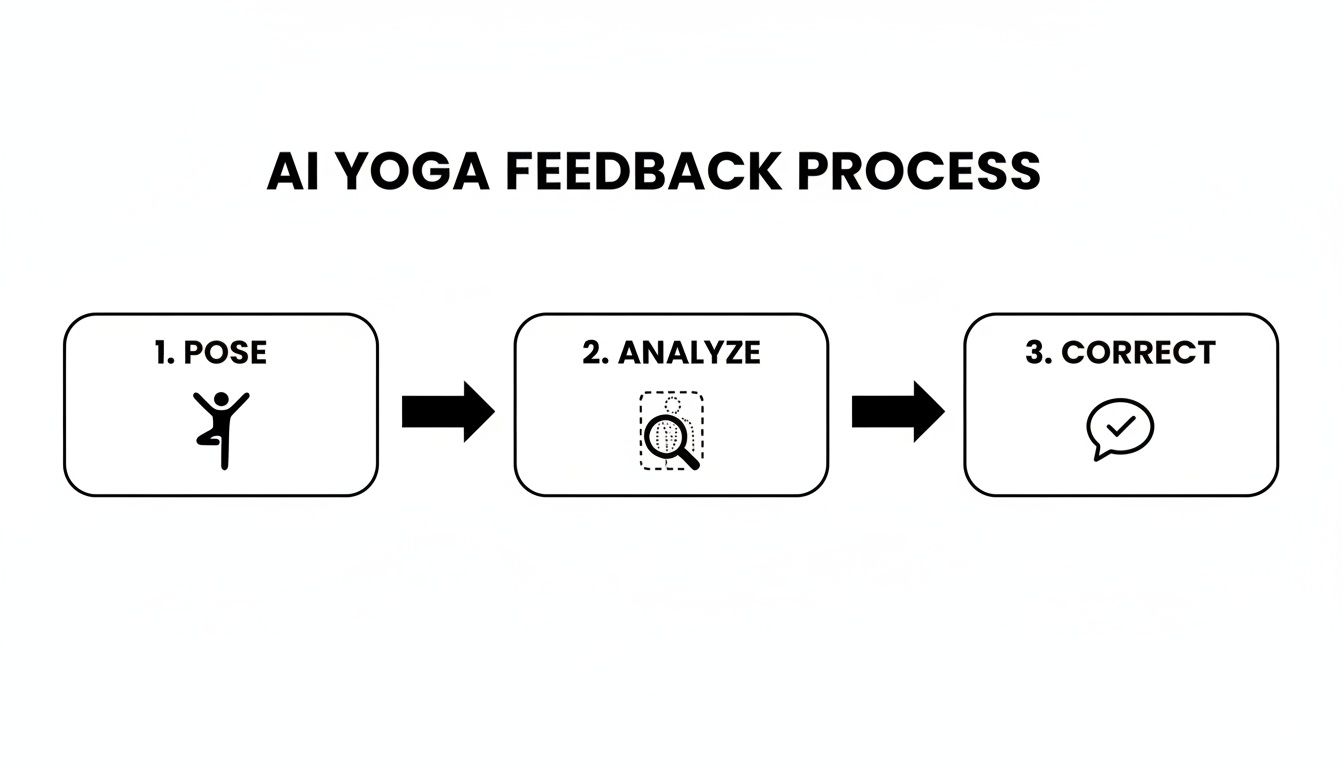
The process is a simple but powerful loop: you do the pose, the AI analyzes your form with crazy precision, and you get an instant correction. It’s an amazing way to refine your alignment and stay safe.
As you start this journey to happier hamstrings, a few questions are bound to bubble up. It happens to everyone! Let's cut through the noise and tackle some of the most common things people wonder about. I'll give you the straight-up, no-fluff answers so you can get back on your mat with confidence.
Ah, the million-dollar question. The answer is a bit of a "yes and no," but the "yes" part is what really counts. Yoga isn't going to physically lengthen your muscle fibers like you're stretching a rubber band. That’s a myth.
What it actually does is much cooler—it rewires your nervous system.
Your body has this brilliant, built-in safety mechanism called the stretch reflex. When it thinks a muscle is stretching too far or too fast, it hits the emergency brake to prevent you from getting hurt. Consistent yoga practice is like a friendly negotiation with this reflex. You're gently teaching your brain that a deeper range of motion is safe.
Over time, your nervous system chills out and loosens its protective grip, allowing the muscle to release and lengthen more freely. So while the muscle’s physical resting length doesn't change, its functional flexibility—how far it can comfortably go without freaking out—improves in a massive way.
A little trembling? Totally normal. In fact, it often means you've found your sweet spot—that perfect edge where your muscles are working hard to adapt. It's just a neuromuscular response to fatigue and a sign that you're challenging yourself.
But if the shaking feels more like a seismic event—intense, uncontrollable, or unstable—that's your cue to ease up. Pushing through major shakes is a fast track to overstretching or injury.
When the shakes get a little too shaky, try this:
This one messes with people's heads, but it’s surprisingly common and usually points to one of two culprits. First, you might have gone a little too hard. Being over-eager and pushing too deep can cause tiny micro-tears in the muscle. The body's response is inflammation and a protective tightening as it tries to heal itself.
The second reason—and this is a big one—is that your hamstrings might be crying out for strengthening, not just more stretching. Healthy, happy muscles are both flexible and strong. If you only ever pull on them, they can become weak and unstable, which makes them tighten up to protect themselves.
The real secret is balance. You need to mix in poses that build strength, like Bridge Pose or Locust Pose. Even adding some dynamic single-leg deadlifts can work wonders. This creates resilient, capable muscles that learn to relax because they feel strong and secure.
Okay, let's talk timelines. Patience is your best friend here. There is no magic number, because everyone's body, history, and daily habits are different.
Some people feel a real shift in just a few weeks of consistent practice. For others, it can take a couple of months to notice a big change. Just remember, one study found a measurable improvement in hamstring flexibility in only seven weeks. Progress is happening, even when it's slow.
The best advice I can give you is to stop focusing on the destination (like touching your toes) and start enjoying the journey. Celebrate the small victories—like feeling just a little bit more ease in a forward fold today than you did last week. That's where the real magic is.
Ready to stop guessing and start seeing real, measurable progress? The Dalm app uses AI to analyze your form with medical-grade precision, giving you real-time feedback to ensure every stretch is safe and effective. Track your journey and unlock your true flexibility potential. Perfect your practice at https://dalm.co.