
Yoga for Joint Health Your Guide to Pain-Free Movement

Yoga for joint health isn't just about stretching. It's a smart, gentle way to get your joints lubricated, strengthen the muscles that hold everything together, and dial down inflammation. Think of it as a low-impact solution to improve your mobility and kick stiffness to the curb, making everyday movements feel smoother and way more comfortable.
You know that little twinge in your knee when you get up from a chair? Or that morning stiffness in your shoulders that takes a while to shake off? That’s not just a random annoyance. It's your body's way of asking for some mindful movement.
So many of us make the mistake of thinking that when a joint aches, we should stop moving it altogether. But actually, the opposite is true—gentle, controlled motion is precisely what your creaky spots need.
Picture your joints as the gears on a bike. If you let them sit, they get rusty and stiff. Yoga is the oil that gets them moving again. The practice encourages your body to produce more synovial fluid, which is basically nature's WD-40 for your joints. It’s a cushiony substance that lets your bones glide past each other without grinding. More movement equals more lubrication, which means less pain.

But yoga is more than just a lube job for your joints. It actually builds a natural support system from the inside out.
When you strengthen the muscles around your knees, hips, and spine, you’re essentially creating a living, breathing brace. This muscular network absorbs shock and takes the direct pressure off your joints. For long-term joint health and stability, this is an absolute game-changer.
This is huge, especially when you consider how common joint pain is. Arthritis alone affects nearly one in three adults in the US, with many finding their daily lives severely limited by pain.
The good news? The science backs this up. One study found that after just eight weeks of yoga, patients with ankylosing spondylitis saw a major drop in pain and a big boost in mobility in their shoulders, hips, knees, and spine. And it's not just for specific conditions—the benefits pop up everywhere, with even kids and cancer survivors reporting less joint pain after only a few sessions. You can dive deeper into the scientific connection between yoga and joint strength.
Chronic inflammation is a huge culprit behind joint pain and stiffness, especially for those with conditions like rheumatoid arthritis. Yoga tackles this head-on in two clever ways:
Yoga offers a powerful one-two punch: it works on the physical mechanics of your joints while simultaneously soothing the systemic inflammation that keeps the pain cycle going. It's a fantastic way to proactively take back control and feel more comfortable in your own body.
Alright, let's get you moving with a few powerhouse yoga poses that are true superstars for joint health. Think of this less like a workout and more like a conversation with your body. We’ll focus on mindful alignment and what you should be feeling, making these poses work for you, not the other way around.
Let’s talk about your spine. It’s a chain of tiny joints, and desk jobs or just sitting a lot can make it feel like a rusty gate. Cat-Cow is the perfect oil for those hinges, gently waking up each vertebra.
Get on your hands and knees in a tabletop position—wrists under shoulders, knees under hips. As you inhale, let your belly drop, lift your gaze and tailbone, and create a nice dip in your back (Cow Pose). When you exhale, do the opposite: round your spine up like an angry cat, tuck your chin, and press the mat away (Cat Pose).
The mission here is simple: move with your breath. Aim for a smooth, flowing motion, not a jerky one. Imagine your spine is a wave. This beautiful, simple flow is a godsend for lubricating the spinal joints and melting away back tension.
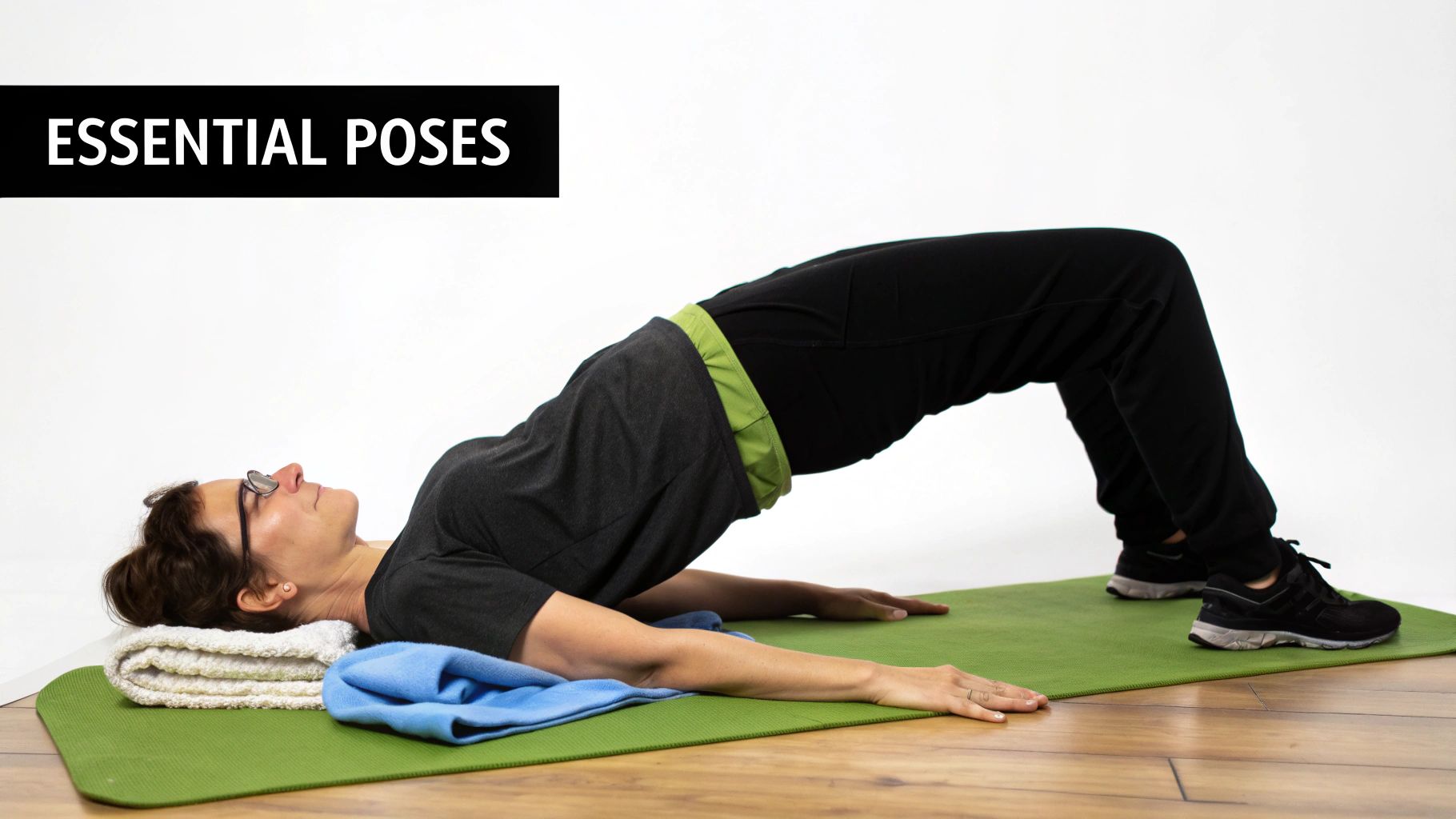
Your hips need a good support system, and strong glutes and hamstrings are their best friends. When these muscles are firing properly, they take a ton of pressure off the hip joints themselves. Bridge Pose is a gentle backbend that wakes up this entire support crew.
Lie on your back, bend your knees, and plant your feet flat on the floor, about hip-width apart. Your arms can just rest alongside your body, palms down. Now, press into your feet and lift your hips off the floor.
Pro Tip: Watch those knees! The natural tendency is to let them flop out to the sides, which totally defeats the purpose. Imagine you’re squeezing a yoga block between your thighs. This little mental cue keeps your alignment on point and makes the pose way more effective.
Hang out here for a few breaths, then slowly roll back down, one vertebra at a time. Not only does this build strength in your backside, but it also gives a lovely, gentle stretch to the front of your hips (your hip flexors), which get notoriously tight from sitting.
This classic seated pose is an absolute gem for gently opening the inner thighs and coaxing more flexibility out of your hip joints. Best of all, it’s a passive stretch, so you can just relax into it without a ton of effort.
Sit down and bring the soles of your feet to touch, letting your knees fall out to the sides. You can hang onto your ankles or feet. Now, if your knees are hovering way up high, please don't try to force them down! That's a one-way ticket to ouch-town. Instead, grab a folded blanket or a cushion and sit on it to elevate your hips.
It's amazing what a little lift can do. This small adjustment lets gravity do the work for you. Just focus on sitting tall and breathing into any tight spots. If you're really on a mission to improve your range of motion, exploring some of the best yoga poses for flexibility is a great next step.
Remember, these foundational poses aren't about twisting yourself into a pretzel. They're about creating space and building strength exactly where your body craves it most. Gentle, consistent practice is the real secret to building resilient, happy joints for the long haul.
Alright, let's get into the nitty-gritty. Now that you've got a handle on some foundational poses, it's time to zero in on what’s actually bugging you. Generic advice only gets you so far; real, lasting relief comes from targeting the specific joints that are screaming for attention.
Think of these as your personal "recipes for relief." We're not just throwing random poses at the wall to see what sticks. Instead, we'll build smart, focused mini-sequences designed to soothe, strengthen, and bring back mobility right where you need it most. This is about being precise and intentional with your practice.
Spend your days hunched over a desk, a steering wheel, or your phone? Yeah, me too. It’s no wonder our shoulders often feel like they're carrying the weight of the world, cinched up tight around our ears.
This little routine is designed to gently peel them open and melt away that tension. It's not just about a quick stretch; it's about reclaiming your natural range of motion. So much of that shoulder-and-neck ache comes from tightness in the chest, which pulls everything forward into that classic slump. Let's undo that.
Let's be honest, our hips have become the body's emotional junk drawer. And modern life, with its endless hours of sitting, is the main culprit for locking them up tight. This isn't just a hip problem; that tightness can domino into your lower back and even your knees.
For anyone who works at a desk, tight hips are practically a job requirement. Think of this routine as your antidote. By lengthening the hip flexors and releasing the glutes, you can dramatically improve your overall comfort, both on and off the mat.
Kick things off with a few gentle rounds of Cat-Cow to warm up your spine, then flow into these:
Knee pain is one of the most common complaints I hear, but here's the secret: the solution often isn't in the knee itself. It's in strengthening the muscles that support it—your quads, hamstrings, and glutes. This routine builds that support network while gently improving flexibility, all without putting nasty pressure on the joint.
This isn't just wishful thinking; there's real science here. A fascinating study on patients with knee osteoarthritis found that after just one week of integrated yoga therapy, they saw significant boosts in mobility, flexibility, and—most importantly—pain reduction. Participants could get up and move more easily, with dramatic improvements in both bending and straightening their knees. You can read more about the research on yoga therapy for knee pain for yourself.
This sequence is built with that evidence in mind.
To make it even easier to find the right move for what ails you, here’s a quick-reference table. Think of it as your cheat sheet for happy joints.
This table is a great starting point. If your shoulders are killing you after a long day, a few rounds of Thread the Needle might be just what you need before dinner. Use it to build your own mini-sessions based on how you feel each day.
It's one thing to feel the difference in your own body after a good stretch, but it's pretty validating to know that science has your back, too. That soothing sensation you get from a gentle yoga session isn't just in your head—it’s backed by some seriously compelling research showing real, measurable changes in joint health.
Yoga works its magic through a simple but powerful combination: gentle movement, muscle strengthening, and mindful breathing. This trio is a knockout punch for joint pain. It helps cool down inflammation, boosts circulation to your cartilage and soft tissues, and builds the muscular "scaffolding" your joints desperately need to operate smoothly. Think of it this way: when your muscles are strong, they act like a natural brace, taking the pressure off the joints themselves.
The proof is in the data. Time and again, researchers have found that yoga delivers significant relief for people struggling with chronic joint issues, especially osteoarthritis. And we're not talking about a temporary fix. The benefits are often on par with—and sometimes more sustainable than—traditional physical therapy.
One major systematic review looking at knee osteoarthritis found that yoga consistently crushes pain levels. A standout study from that review showed that after just eight weeks, people in the yoga group saw their pain scores plummet by a staggering 56.83%. That completely blew the control group out of the water, proving a direct and powerful benefit. You can dig into the specifics of these findings on yoga and knee pain yourself to see the numbers.
This infographic gives you a quick snapshot of the kinds of improvements researchers have seen for knee osteoarthritis.
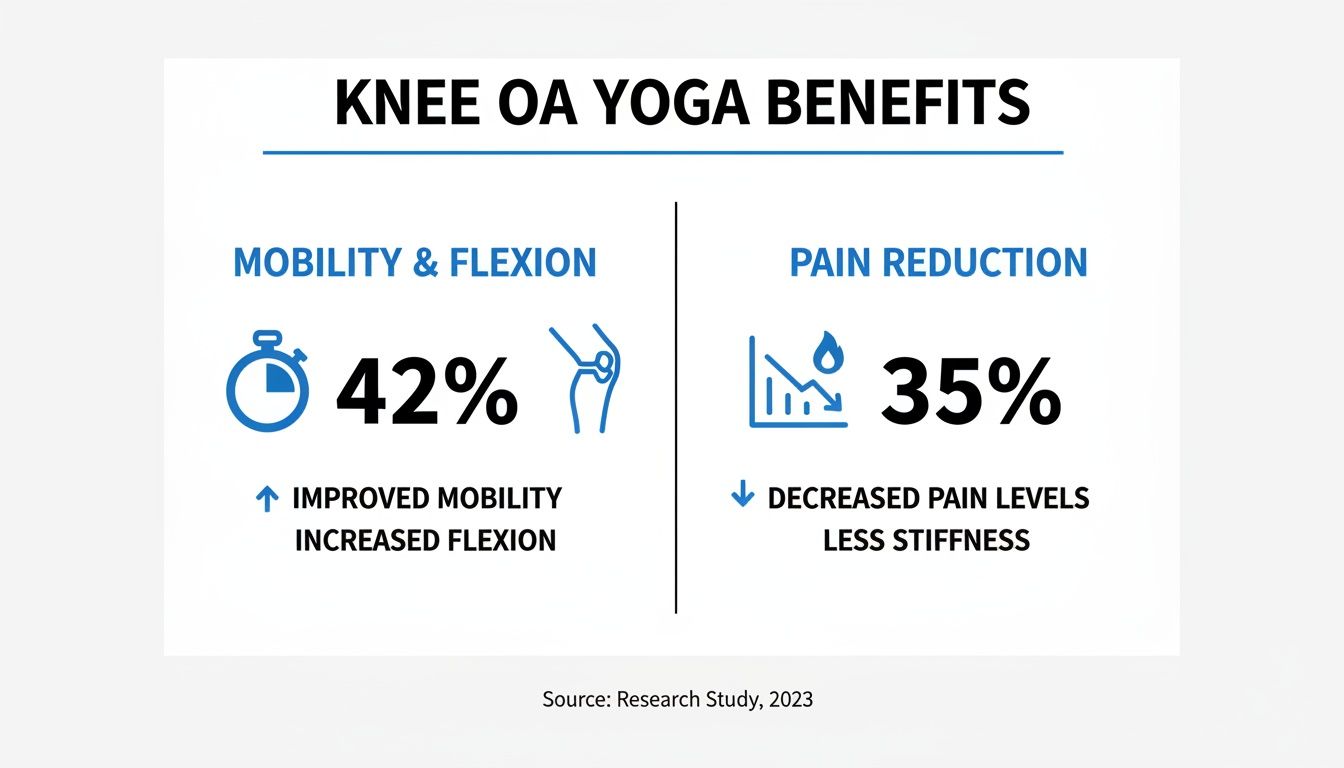
As you can see, a consistent practice doesn't just feel good; it leads to huge gains in how well the joint actually moves and how much pain you feel day-to-day.
Now, here’s where it gets really interesting. How does yoga stack up against standard strengthening exercises? One trial found it was just as effective at reducing pain. But here's the kicker: the yoga group was way better at sticking with it long-term. A full 63.1% of the yoga folks kept up their home practice, compared to just 60.3% in the traditional exercise group.
That little difference tells a big story. Because yoga is more than just a workout—it brings in mindfulness and breathwork—people seem to enjoy it more and are far more likely to make it a real, lasting habit. And consistency is the secret sauce for long-term joint health.
This mind-body connection is a cornerstone of therapeutic yoga. If you're curious to learn more about this specialized approach, you can take a deeper dive into what is therapeutic yoga and how it’s designed specifically for healing.
At the end of the day, the best exercise for your joints is the one you’ll actually do. And for a whole lot of people, the evidence points straight to yoga.
Let's be real: turning the idea of doing yoga for your joints into an actual, lasting habit is where the real work—and the real reward—lies. It’s easy to get caught up in the fantasy of a perfect, hour-long, super-bendy practice. But that's not the goal here.
Forget about intensity. The secret sauce is consistency.
A great place to start? Just 15 minutes, three times a week. Seriously, that's it. This isn't about crushing a workout; it's about showing up for yourself in a small, manageable way. You're far better off with three short, feel-good sessions than one monster session that leaves you so sore you avoid your mat for a week.

If there's one golden rule for practicing yoga with sensitive joints, it's this: ditch the "no pain, no gain" garbage. That whole philosophy is a one-way ticket to getting hurt, and it has absolutely no place here. Your practice should feel like a warm hug for your joints, not a wrestling match.
Your biggest job is learning the difference between a good stretch and a bad signal.
Your body is your ultimate teacher. Pushing through sharp pain doesn’t make you tougher; it just makes you injured. The entire point is to move within a range that feels safe and pain-free.
This approach is what makes yoga healing instead of harmful. And before you jump into any poses, it's always a good idea to get the blood flowing. A few minutes of gentle movement makes a huge difference. For some great ideas, check out these super-effective yoga warm-up exercises.
You don't need a professional studio or a perfectly curated, Instagram-worthy space. A quiet corner in your bedroom or living room is more than enough. The only thing that matters is creating a spot that feels inviting and distraction-free.
A few tips to make your space work for you:
When you create a simple routine and a welcoming space, yoga stops feeling like a chore. It becomes your go-to source for relief and a little bit of peace.
Even with the best intentions, it's natural to have a few questions buzzing around before you unroll your mat. I hear these all the time, so let's get them answered right now so you can move forward with total confidence.
Yes, you absolutely can. The trick is to shift your mindset from "I can't do that" to "How can I adapt that for me?"
This is where gentle, supportive styles like restorative yoga or chair yoga really shine. These practices are designed from the ground up to be incredibly kind to your body. Think of props as your best friends—a chair, a stack of books, or a rolled-up towel can bring the floor closer to you, meaning you never have to push into a painful position. The goal is simply to find a range of motion that feels good, not to force anything.
Of course, always have a chat with your doctor first. But for many, gentle and consistent movement is the key to unlocking relief.
While everyone's body tells a different story, you might be surprised. Many people notice a little less creakiness and a bit more freedom of movement after just their first few sessions. That initial "Oh, wow, that feels better" moment is often all the motivation you need to keep going.
For those more profound, lasting changes in joint health and mobility, studies often point to the 8 to 12-week mark, assuming you're practicing a couple of times a week. But don't forget to celebrate the small wins! The day you realize getting out of bed felt just a tiny bit easier? That's a huge victory.
The secret ingredient isn't how long you practice in any single session. It's how consistently you show up for yourself. Think of it as making small, regular deposits into your joint health savings account—they really add up over time.
This is such an important question, and learning to listen to your body's signals is a skill you'll develop over time. There's a world of difference between the satisfying ache of a muscle stretching and the sharp, angry signal of a joint that's unhappy.
A gentle, deep pulling sensation in the belly of a muscle? That's the good stuff—that's your flexibility improving. But any sharp, pinching, or grinding sensation located directly in the joint is your body screaming "STOP!"
Yoga for your joints should feel therapeutic, not painful. Your job is to gently explore the edges of your pain-free range of motion. Over time, you'll find that range starts to get bigger and bigger.
Ah, the classic question! It feels like a trick question because the answer is, unequivocally, both. And that’s the magic of a well-rounded yoga practice—you get both in one efficient package.
Stretching is what gives you that glorious feeling of openness and helps melt away stiffness, improving your range of motion. But strengthening the muscles around the joints is your long-term insurance policy.
When those supporting muscles are strong, they act like a natural brace, taking the pressure and daily load off the joint cartilage itself. This "muscle armor" is an absolute game-changer for stability and lasting comfort.
Ready to stop guessing and start moving with confidence? The Dalm app provides AI-powered pose analysis and real-time voice feedback to ensure your form is safe and effective. Get personalized guidance that adapts to your body's unique needs and start your journey to healthier joints today. Find out more at the official Dalm website.