
Yoga for Muscle Tone And A Sculpted Physique
Let's get one thing straight right from the start. If you think yoga is just about gentle stretching and finding your inner peace, you're missing half the story. When you practice with intention, yoga is an absolute powerhouse for building lean, defined muscle. It’s a smart, low-impact way to sculpt real strength, using nothing more than your own body weight.
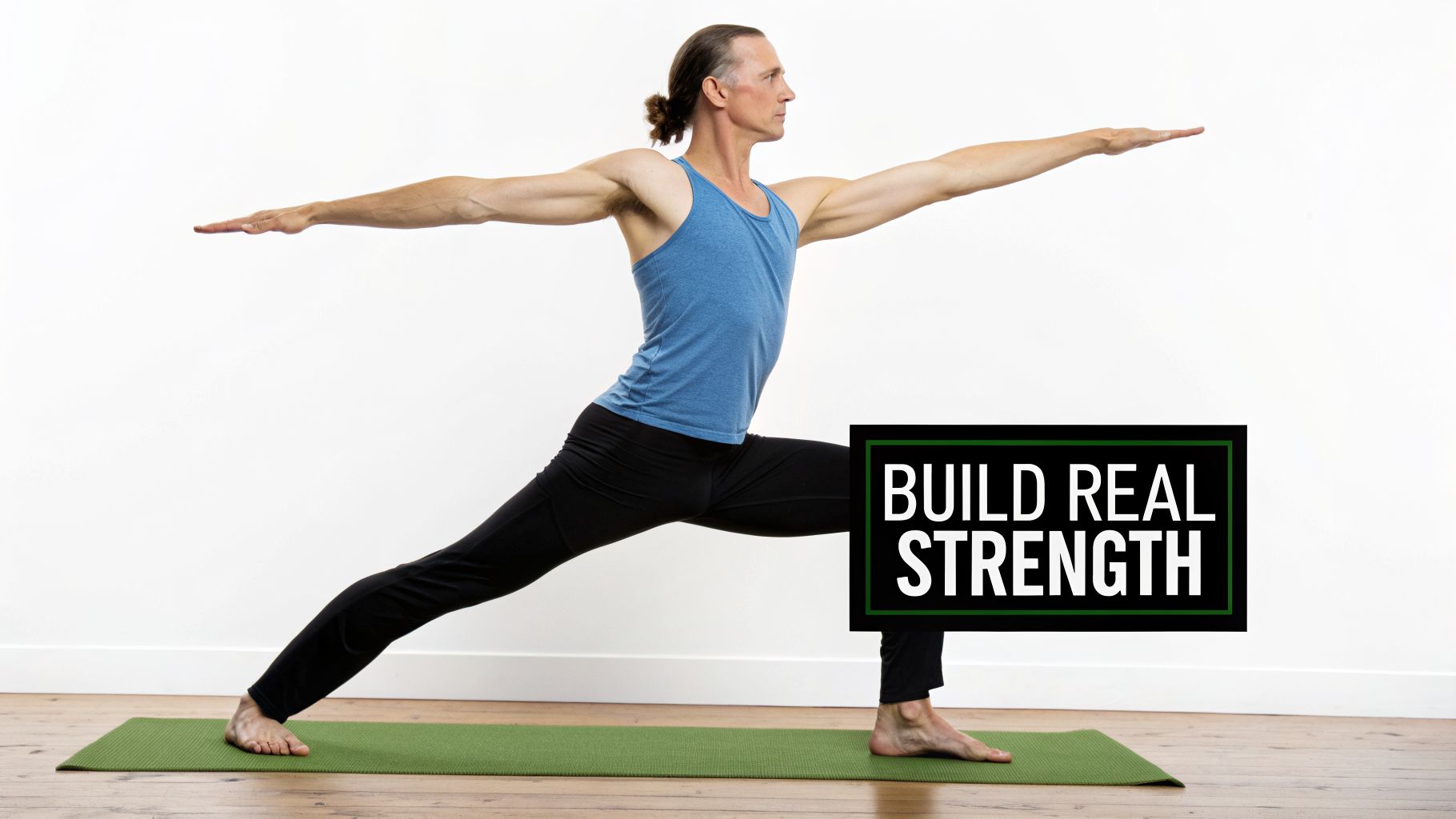
Still skeptical that holding a yoga pose can get you the same results as lifting weights? Let’s break it down. The magic happens through two core principles that every good strength coach obsesses over: isometric contractions and time under tension. These are the very same forces that make weightlifting effective, but yoga puts its own unique, dynamic spin on them.
When you’re holding a challenging pose like Warrior II or a solid Plank, your muscles aren’t just chilling out. They are firing on all cylinders to keep you stable and aligned. This constant, sustained squeeze is what’s known as an isometric hold, and it puts just the right amount of stress on your muscle fibers to tell them, "Hey, time to get stronger!"
This isn't just a feeling; it's physiology at work. The longer you can hold a pose with good, active engagement, the more you increase the time under tension. This is simply the total duration your muscles are actively fighting against resistance—in yoga's case, gravity and your own body.
It’s this sustained effort that kicks off muscle protein synthesis. That’s the fancy term for the repair-and-rebuild process that makes your muscles stronger and more visible. In fact, one 12-week study of Hatha yoga showed that practitioners made significant gains in muscular strength, absolutely crushing it in curl-ups and push-ups compared to those who didn't practice.
While both yoga and hitting the weight room can get you a toned physique, they take very different roads to get there. Take a look at this quick comparison:
The biggest difference? Yoga builds functional strength by training entire muscle chains to work together as a single, coordinated unit. It’s not about isolating your bicep for a curl; it’s about teaching your core, legs, and arms to cooperate to hold you steady in a tough pose.
Key Takeaway: Yoga builds strength by making lots of muscle groups stabilize and work in unison. This creates a balanced, practical strength that shows up in your daily life as better posture, improved coordination, and moving with more ease.
A dedicated practice focused on muscle engagement can produce fantastic toning results. For instance, focusing on core activation during your flows can dramatically improve your stability and build a strong midsection. To get started on that, check out our guide on yoga for core strength for beginners.
The real beauty of using yoga for muscle tone is how accessible it is. You don't need a clunky weight rack or an expensive gym membership. All you need is your mat and a mindset of moving with purpose. When you focus on deep engagement instead of just mindlessly going through the motions, every single pose becomes a strength-building machine.
This is where a tool like Dalm can be a total game-changer. The AI-powered feedback makes sure you’re firing up the right muscles, maximizing that all-important time under tension. No more guessing if your form is right. You get real-time pointers to fine-tune your alignment, turning a simple Plank into a full-body power move and fast-tracking your journey to a stronger, more sculpted you.
Alright, let's get down to business. If you want to sculpt some serious muscle on the mat, you need to know which poses pack the biggest punch. While any yoga flow is good for you, a few key asanas are absolute superstars for building that lean, toned look.
Think of these as the heavy lifters of the yoga world. Mastering them will fire up muscles you didn't even know you had.
If you've ever held a Plank for more than 30 seconds, you know it's a full-body affair. It's so much more than an arm workout. A proper Plank lights up your entire core, glutes, quads, and back. The trick is to think of your body as one long, solid line of energy.
Don't let your hips sag toward the floor or pike them up to the ceiling—that’s just cheating yourself. Instead, actively press the ground away and feel your belly button pull in toward your spine. It's a fantastic diagnostic tool; if something feels shaky, that's where you need to build strength!
In fact, one study on Hatha yoga found that even beginners saw significant gains in core muscle strength from regularly holding poses like Plank. You can check out the full details of this yoga and core strength research on ncbi.nlm.nih.gov.
From Plank, we flow into the real furnace: Chaturanga Dandasana. This is where you forge upper-body and core definition. People often blow right through it, but the magic is in moving slowly and with intention.
There's a good reason the Warrior poses (Virabhadrasana I, II, and III) are cornerstones of yoga for muscle tone. They are absolute monsters for building lower-body power while challenging your balance and grit.
Take Warrior II. You should feel your quads and glutes burning to hold that deep lunge, your inner thighs engage to guide your front knee, and your core switch on to keep your torso stacked perfectly over your hips. It’s a total-body effort disguised as a static hold.
And then there's Chair Pose (Utkatasana). Looks innocent, right? Wrong. It's gloriously brutal.
Picture this: You're trying to sit in an imaginary chair that's just a little too far behind you. Your weight sinks into your heels, your glutes and quads are on fire, and your core is working overtime to keep you from folding in half. That's the sweet spot.
Hold it for five deep breaths, and you'll know exactly what I'm talking about. To level up, try lifting your heels to torch your calves, or add a twist to engage your obliques. The secret is to sink low and breathe through the burn, even when your legs start to shake.
Often overlooked as just a prep pose for a forearm stand, Dolphin Pose is a strength-building powerhouse all on its own. It's my go-to for building incredible shoulder, back, and arm strength without putting any strain on the wrists.
Imagine a Downward-Facing Dog, but on your forearms. From your hands and knees, just lower your forearms to the mat, press your palms down, and lift your hips to the sky. You’ll immediately feel that intense heat build in your shoulders and upper back.
Want to really turn up the dial? Try these "Dolphin Push-ups":
These poses are fantastic on their own, but they truly shine when woven into sequences like Sun Salutations. If you're curious about how it all fits together, you'll love our step-by-step guide to Sun Salutations. Making these power poses a regular part of your practice is the fastest way to build the strength and stability that create real, visible muscle tone.
Alright, so you know the poses. But knowing how to string them together into a weekly routine that actually sculpts your body? That’s the real game-changer.
Consistency is everything here. A smart weekly plan takes all the guesswork out of the equation. It ensures you’re pushing your muscles just enough to see real change, while also giving them the downtime they need to repair and grow stronger.
This isn't about just winging it and hoping for the best. We're talking about strategic sequencing that leans into a core fitness principle: progressive overload. In the gym, that means adding more weight. On the mat, it means holding poses longer, tackling tougher variations, or flowing through more demanding transitions.
To get that toned look, every single pose needs to be an active event. It’s a simple, three-part process.
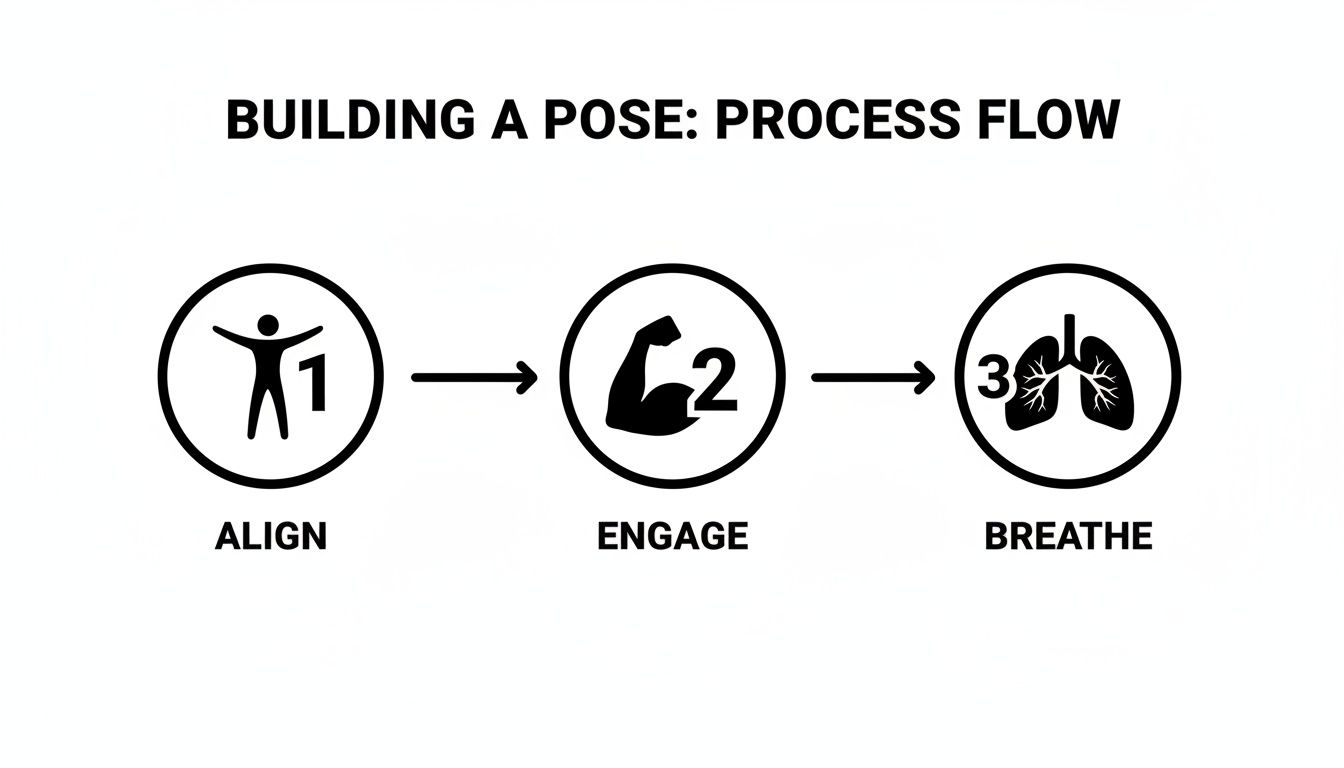
Never forget that last part. Your breath and muscle engagement are what turn a pretty shape into a powerhouse for toning.
Let's put this into action with three different weekly schedules, so you can jump in right where you are.
Just getting started with a strength-focused yoga practice? This is your blueprint. The name of the game is consistency and learning what it feels like to fire up your muscles in the foundational poses.
Feeling confident and ready to dial it up? This plan introduces more complex movements and longer holds to seriously challenge your muscular endurance and carve out that definition.
You'll notice we’re upping the frequency and intensity here. This is where the magic happens. Once your body gets used to a certain level of effort, you have to give it a new puzzle to solve to keep making progress.
This one’s for the seasoned yogis ready to push their limits. We're talking advanced poses, powerful flows synced to breath, and a serious focus on endurance and strength.
Research consistently shows that yoga has impressively high adherence rates—people stick with it. It’s a sustainable, long-term alternative to the gym for toning up. This is partly thanks to physiological perks, like improved control over your intercostal muscles, which gives you the endurance to nail those tough, long holds in Plank and Warrior. If you want to geek out on the science, check out the research on yoga's sustained benefits on pmc.ncbi.nlm.nih.gov.
Stick with one of these plans, and you will see and feel the results.

Let's be real for a second. The biggest snag with practicing yoga at home? No one’s there to call you out. You might feel like you're absolutely slaying Warrior II, but in reality, your back arm has given up and your core checked out ten minutes ago. This is where things get interesting.
Imagine having a top-tier yoga coach whispering personalized pointers in your ear during every single session. That's no longer a fantasy—it's what AI-powered platforms like Dalm bring to your mat. We’re not talking about just following a video; we're talking about a digital partner that analyzes your every move, helping you sculpt muscle faster and safer than you ever thought possible.
So, how does this actually work? It's way more intuitive than it sounds. Picture this: you're balancing in Warrior III, and the wobble sets in. Your entire focus is on not face-planting, but you're probably losing the very muscle engagement that builds strength in the first place.
Then, a calm voice from your Dalm app gently cues, "Engage your core and level your hips toward the floor." You make that tiny adjustment, and—BAM! You instantly feel your standing leg's glute and hamstring light up. That, my friends, is precision toning. You just turned a wobbly balancing act into a laser-focused muscle-sculpting exercise.
This is the magic of real-time feedback. It bridges the gap between what you think you’re doing and what your body is actually doing.
Key Takeaway: Small, AI-guided tweaks lead to massive muscle activation. You learn to fire up the right muscles at the right time, squeezing every last drop of toning potential from each pose.
These little corrections accumulate. By consistently refining your alignment, you ensure the load of each pose goes exactly where it's meant to, which is the secret sauce for stimulating muscle growth and avoiding nagging injuries from sloppy form. Your yoga-for-toning practice just became ridiculously efficient.
Building muscle tone isn't just about the grind; it's about seeing the results of your hard work. A huge challenge in home yoga is trying to objectively measure your progress. Did you hold that Plank longer? Was your Chaturanga really better this week?
AI platforms like Dalm take the guesswork out of it, turning your practice into data you can actually use.
Let’s be honest, data is a powerful motivator. Seeing hard proof that you held a Plank for 15 seconds longer than last week or finally nailed that tricky Chaturanga alignment gives you the validation you need to keep showing up. And this isn't just fluff; the benefits are real. Beginners using these systems have seen noticeable improvements in balance and flexibility—both crucial for building a strong, toned physique.
To get a feel for how Dalm's features translate directly to a more toned body, check out this quick breakdown:
This blend of in-the-moment correction and long-term tracking transforms your mat into a personal strength-training lab. If you want to dive deeper into the tech, you can learn more about Dalm's posture analysis software. Ultimately, it gives you the tools and the confidence to push your limits safely, making your journey to a more toned you not just effective, but genuinely fun.

All those fiery Chaturangas and shaky-legged Chair Poses? That’s only half the story. The stunning muscle tone you’re working toward is sculpted just as much in the kitchen as it is on the mat.
Don’t worry, this isn't about complicated diets. It’s about giving your body the right tools to repair and grow stronger after you’ve put in the work. Think of your muscles as a construction crew that just finished a tough job. If you don't give them the supplies to rebuild, all that effort was for nothing.
Let's get right to it. The two most important players in muscle recovery are protein and carbohydrates. For anyone serious about using yoga for muscle tone, this power couple is non-negotiable.
Protein is the absolute hero of muscle repair. When you stress your muscles during a dynamic flow, you create tiny micro-tears. Protein swoops in with amino acids—the building blocks—to patch up these tears, making the muscle fibers stronger and more defined than before.
Carbohydrates, on the other hand, are your energy source. They're what refill the glycogen stores in your muscles that you burned through during your practice. Without carbs, you’ll feel sluggish, and your body won't have the fuel it needs to actually use that protein for rebuilding.
Pro-Tip: Your body is primed to absorb nutrients within 30-60 minutes after your practice. I call this the "golden window." A simple smoothie with a scoop of protein powder and a banana is a perfect, no-fuss way to nail it.
There's no need to overcomplicate things. A bowl of Greek yogurt (protein) with some fresh berries and a sprinkle of granola (carbs) does the trick beautifully.
You can nail your post-yoga meal, but if you’re dehydrated or sleep-deprived, you’re slamming the brakes on your progress. It’s that simple.
Water is essential for nearly every metabolic function, including protein synthesis. Even being a little dehydrated can seriously slow down muscle repair.
And sleep? It's the most powerful (and free!) performance enhancer you have. This is when your body does the heavy lifting, releasing growth hormone and getting to work on rebuilding those fibers you challenged in Warrior III. Getting a solid 7-9 hours of quality sleep every night is a game-changer.
This holistic approach is what truly creates change. It's not just theory; the science backs it up. One 12-week study on hatha yoga found that men who practiced for an hour, six days a week, not only improved strength but also significantly lowered their body fat. You can read the full details in the research on yoga's effect on body composition at pmc.ncbi.nlm.nih.gov.
Let's make this super practical. Here are a few dead-simple ways to fuel your muscles off the mat:
When you treat your off-the-mat habits with the same intention you bring to your practice, you create an environment where your muscles have no choice but to adapt, grow, and become beautifully toned.
Jumping into any new fitness routine kicks up a cloud of questions. And when you're specifically looking to use yoga to build muscle tone, you're probably wondering what to expect, how the heck it actually works, and if it's even the right move for you.
Let's cut through the chatter and tackle the most common questions head-on. My goal is to give you the clarity and confidence you need to start sculpting a stronger, more defined body, right on your yoga mat.
Ah, this is the big one, isn't it? While every single body is on its own unique timeline, having a general idea can help you set realistic goals. Most people start to feel a difference—more stability, a little more power in their poses—within just a couple of weeks. It’s that first "aha!" moment.
But for those visible changes, the kind you can see in the mirror? Consistency is the secret sauce. If you can commit to practicing 3-5 times a week, you’ll likely start seeing some real definition and sculpting in about 4 to 8 weeks. It’s worth noting that formal studies often point to significant strength gains cropping up around the 12-week mark, which just confirms that lasting change takes a bit of time and effort.
A pro tip to speed things up: focus on the quality of your poses, not just the quantity. Actively squeezing and engaging your muscles, rather than just passively hanging out in a shape, is what tells your body it’s time to build.
You bet it can. This is one of the most stubborn myths out there, and it's time we put it to rest. Yoga is a brilliant form of calisthenics—a fancy word for strength training that uses your own body weight for resistance.
Just think about a tough pose like Crow or even a simple, well-held Plank. Your muscles are under a constant load, fighting against gravity to keep you strong and steady. This creates something called time under tension, which is a fundamental principle for sparking muscle growth and creating that toned look.
Let's be real: you're not going to build the massive bulk of a competitive bodybuilder, but that's not the goal here. Yoga is phenomenal for creating that lean, sculpted, and functionally powerful physique. It builds a kind of strength that looks just as good as it feels.
Every time you push the floor away in Chaturanga or hold your ground in Warrior II, you're sending a direct message to your muscles: "get stronger." The resistance is you, and trust me, you're more than enough to get incredible results.
While pretty much any yoga will make you stronger, some styles are definitely built to sculpt. If toning is your main goal, you’ll want to gravitate towards the more dynamic and physically demanding classes.
Here are a few styles to look for:
Even a well-taught Hatha class can be fantastic for toning if the instructor emphasizes long, active holds in strengthening postures. In the end, though, the best style is the one you actually enjoy and will show up for consistently.
I hear this all the time, and it's probably the biggest misconception in the yoga world. Saying you’re "not flexible enough for yoga" is like saying you're "too dirty to take a shower." It completely misses the point!
You don't start yoga because you're already a human pretzel; you start yoga to become more flexible. It’s a result of the practice, never a requirement to begin.
In fact, building muscle tone through a strength-focused practice is one of the smartest ways to support your body as it opens up. Strong, engaged muscles provide the stability you need to explore deeper stretches safely and effectively over time.
This is a fantastic question. While both paths can lead you to a toned body, the "how" and the final result are quite different. Gym workouts often zero in on isotonic contractions—think lifting and lowering a dumbbell—to isolate specific muscles.
Yoga, on the other hand, leans heavily on isometric contractions, where you engage your muscles and hold them steady under tension without changing their length. This builds incredible endurance and rock-solid stability.
Here’s a simple way to think about it:
This integrated, whole-body approach is why yoga creates such a unique physique. It tones your body as one coordinated system, naturally improving your posture and how you move through the world. You don’t just look strong; you learn to move with more grace and power in everything you do.
Ready to stop guessing and start seeing real results? The Dalm app uses advanced AI to give you real-time feedback on your form, ensuring you engage the right muscles in every pose. Transform your practice and accelerate your toning journey by getting personalized guidance right on your mat. Try it today and feel the difference.