
Yoga for Sciatica Pain Relief That Actually Works
When that zinging, searing pain of sciatica lights up your leg, the last thing you probably want to do is move. I get it. The instinct is to freeze, but that's often the worst thing you can do. Gentle, mindful movement is actually one of the most powerful tools you have for calming that angry nerve.
The secret isn't about pretzel-like poses or forcing a stretch. It's about intelligent movement—creating just enough space in your lower back and hips to give that sciatic nerve room to breathe. We're aiming to gently coax tight muscles, especially the piriformis, to let go and to build subtle strength that supports your spine and helps prevent future flare-ups.

If you’re stuck in a sciatica cycle, you've likely heard the advice to "just rest." But lying on the couch for days on end can actually make the stiffness and pain spiral. This is where a targeted, gentle yoga practice can feel like a miracle. It’s the polar opposite of high-impact exercises that can jolt and irritate an already sensitive nerve.
It’s important to remember that sciatica isn't really a condition itself—it's a symptom. It’s your body's fire alarm telling you something is pressing on the nerve, usually a herniated disc or spinal stenosis.
Imagine the sciatic nerve is a superhighway running from your lower back down your leg. A bulging disc or a rock-hard piriformis muscle creates a massive roadblock, causing a painful traffic jam. Yoga acts like a gentle traffic cop, slowly and carefully clearing the congestion.
The real magic of yoga for sciatica lies in its ability to create space. Poses that carefully lengthen the spine help take the pressure off the nerve right at its source. Something as simple as a Cat-Cow flow can gently mobilize the spine, improve blood flow, and reduce that pinching sensation.
Yoga is also fantastic at getting into those deep hip muscles, particularly the piriformis. This sneaky little muscle sits deep in your glutes, and the sciatic nerve often passes right under it (or, for some unlucky folks, through it). When the piriformis gets tight, it can literally strangle the nerve, causing a condition called piriformis syndrome that feels identical to classic sciatica.
A targeted yoga practice isn't about forcing flexibility; it's about giving your muscles permission to release. This mindful approach helps calm the nervous system, which is crucial because stress and tension are known to amplify pain signals.
Stretching feels good in the moment, but the long-term fix is all about building a stronger, more stable core and back. When your core is weak, your lower back muscles are forced to work overtime, which can lead to instability and a greater risk of nerve compression.
Poses like a modified Bridge Pose are brilliant for this. They strengthen your glutes and hamstrings, which essentially form a support system for your lower back. By mixing gentle stretches with these foundational strengthening moves, you’re not just chasing the pain—you’re addressing the root cause. And the science backs this up; studies have shown that structured yoga can lead to major reductions in pain for people with chronic back issues. You can even dig into the research behind yoga for sciatic relief to see the data for yourself.
Before you jump into any poses, it's wise to have a clear set of safety guidelines in mind. This isn't about being restrictive; it's about being smart so you can get the maximum benefit without any setbacks.
This table breaks down the core principles to keep in mind. Think of it as your pre-flight checklist before starting your practice.
Sticking to these principles will help you build a practice that heals rather than harms, giving your body the gentle encouragement it needs to find relief.
Starting any new movement when you're in pain can feel intimidating. If you're totally new to this, it's crucial to begin with the basics to make sure you're helping, not hurting. Our guide on gentle yoga for beginners is the perfect place to build a safe and effective foundation for your practice, giving you the confidence to move toward healing.
When a sciatica flare-up hits, your world can shrink to the size of that searing pain radiating down your leg. The last thing you want is a complicated, intense yoga routine. What you need is an emergency toolkit—a few gentle, reliable poses that whisper, "It's okay, we're just creating a little space here."
Think of this sequence as your sanctuary on the worst days. It’s all about decompressing your spine and gently persuading those tight hip and glute muscles to relax their death grip on your sciatic nerve. The goal here isn't a deep, dramatic stretch, but a deep, satisfying sigh of relief.
Let's get things started on all fours. This isn't about dramatic backbends; it's about subtle, healing movement. Cat-Cow is hands down one of the safest and most effective ways to gently mobilize your lumbar spine, encouraging blood flow and easing stiffness without a single risky forward fold.
My Two Cents: The real magic of Cat-Cow is in the fluid movement. Don't just hold the poses. Focus on that smooth transition between them. This is what helps hydrate the spinal discs and tells your nervous system it's time to chill out.
Child's Pose is famous as a resting posture, but with one tiny tweak, it becomes an absolute powerhouse for sciatica pain. By simply widening your knees, you create more space for your torso and get a deeper, more targeted release for your lower back and hips.
From your tabletop position, bring your big toes together to touch and then walk your knees out as wide as feels good—maybe even as wide as your yoga mat.
Gently sit your hips back toward your heels. You can walk your hands forward and rest your forehead right on the mat. If your hips don't quite reach your heels, don't sweat it! Just place a folded blanket or a cushion between your heels and glutes for support. Hang out here for 30 seconds to a full minute, breathing deeply into your back body.
If there’s one culprit that often gets overlooked in back pain, it’s tight hamstrings. They can put a ton of extra tension on your lower back and, you guessed it, the sciatic nerve. But trying to stretch them out with a classic forward fold when you're in pain? That's a recipe for disaster. This supported, reclining version is the absolute safest way to get the job done.
You'll want a yoga strap, a belt, or even a towel for this one.
This pose is brilliant because it completely isolates the hamstring without putting any compressive force on your lumbar spine, making it a true MVP in your yoga toolkit for sciatica pain relief.
Pain creates stress, and stress makes pain worse. It’s a vicious cycle. Throughout this whole sequence, your breath is your most powerful ally. It’s what flips the switch in your nervous system from "fight-or-flight" to "rest-and-digest," which immediately helps dial down muscle tension.
Try focusing on this simple breathing pattern:
That slightly longer exhale is scientifically proven to have a calming effect on the nervous system. As you move through each pose, let this breath be your anchor. You're sending a direct signal of safety and relaxation to every tight, grumpy muscle in your body. This combo of gentle movement and mindful breathing is your most effective first-aid response to a sciatica flare-up.
Getting through an acute sciatica attack is a massive relief, but let’s be real—the last thing you want is a repeat performance. This is where we shift gears from simply soothing the pain to building a body that’s resilient against future flare-ups. Long-term freedom from sciatica isn't just about gentle stretching; it's about forging a strong, supportive foundation around your spine and hips.
Think of your core and glutes as your body's own built-in back brace. When these muscles are weak or lazy, your lower back gets stuck picking up the slack, bearing loads it was never meant to handle. By strengthening this natural corset, you create stability, take the strain off your lumbar spine, and promote the kind of alignment that keeps that pesky sciatic nerve happy.
This isn't just managing pain anymore. This is prevention.
Bridge Pose is an absolute rockstar for sciatica prevention. It zeroes in on the glutes and hamstrings—the primary muscles that have your lower back's… well, back. When your glutes are strong and firing on all cylinders, they absorb a huge amount of pressure during everyday movements, from walking the dog to picking up groceries.
Here’s how to do a sciatica-safe Bridge Pose:
The magic is in the squeeze! This is all about glute activation, not just hoisting your hips as high as they can go.
Downward-Facing Dog is incredible for creating a sense of length through the entire back of your body, from your heels all the way up to your hands. It provides a gentle, necessary stretch for the hamstrings and calves. When these muscles get tight, they can pull on your pelvis and contribute to the kind of lower back tension that invites sciatica flare-ups.
But here’s a critical tweak for anyone with a sensitive sciatic nerve: keep a generous bend in your knees. Forcing your legs straight can easily overstretch the nerve and do more harm than good. Instead, focus on lengthening your spine by pressing your chest back towards your thighs. You’re prioritizing spinal decompression over a super-intense hamstring stretch.
This simple infographic shows a gentle flow to get your body warmed up and ready before you jump into these strengthening poses.
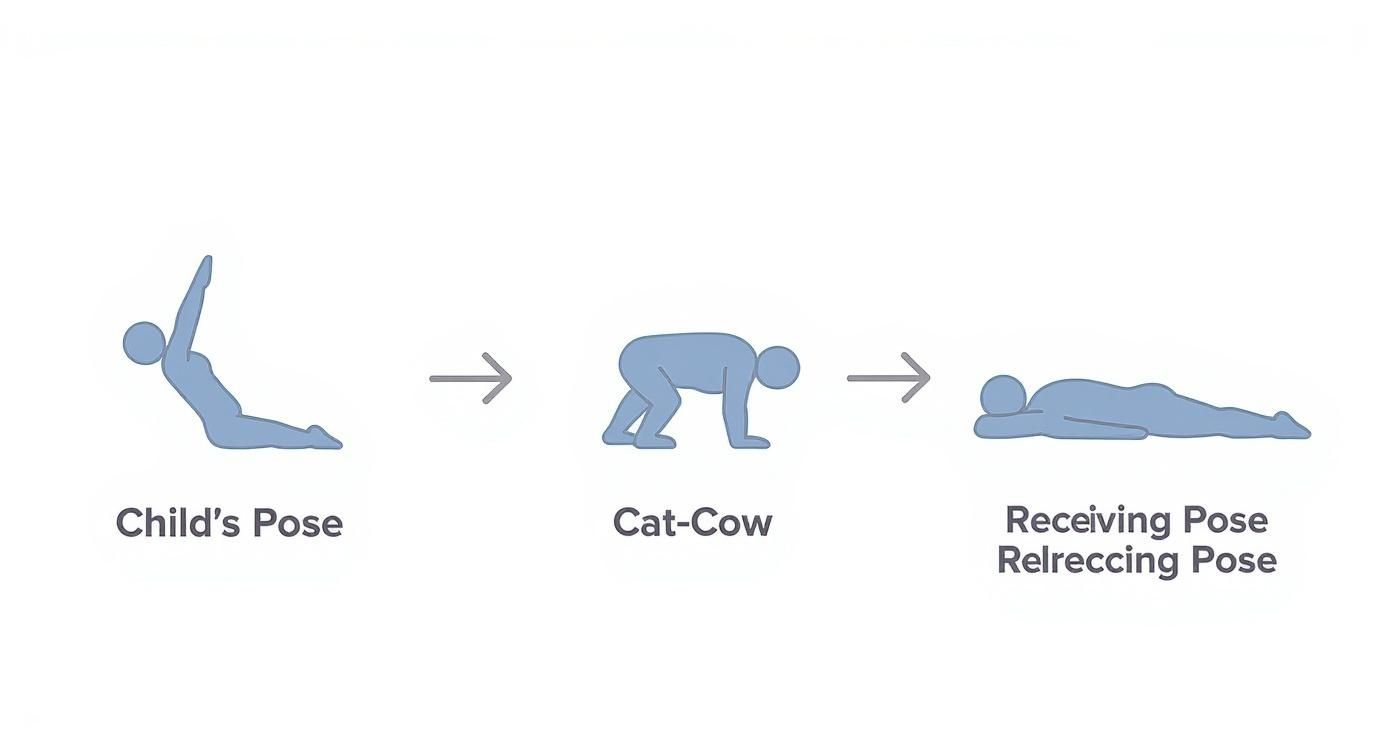
This visual guide walks you through moving from a restful Child's Pose, into a mobilizing Cat-Cow, and finally to a gentle Reclining Pose. It's the perfect way to prep your body for deeper work.
Ah, the piriformis. This deep hip rotator is a notorious troublemaker when it comes to sciatica. If it gets tight, it can literally clamp down on the sciatic nerve. Pigeon Pose is famous for getting right into that spot, but the full-on version can be way too intense—and even dangerous—during a flare-up.
So, let's work smarter, not harder, with some safer variations:
The goal is always a deep, satisfying stretch in your glute and hip—never a sharp, shooting pain. If you feel any pinching in your low back or that familiar zinging nerve sensation, you've gone too far. Back off immediately.
The proof is in the practice. Research consistently shows that a regular yoga routine can be a game-changer for pain relief. In one study, a group doing intensive yoga had significantly better outcomes in pain-related disability and spinal flexibility than a group doing standard exercises. Another study on neck and nerve pain found the yoga group reported a jaw-dropping 95.5% reduction in pain. You can read the full research on yoga's therapeutic effects if you want to nerd out on the science.
Ultimately, building a strong core is the glue that holds all of this together. A stable midsection is the ultimate protective shield for your spine. To build that crucial stability from the ground up, your next step should be our guide on yoga for core strength for beginners. This is how you build a truly resilient body that can tell sciatica to take a hike—for good.
When you're dealing with that notorious zing of sciatica, it's tempting to think any stretch is a good stretch. I mean, if it's tight, you should stretch it, right? Not so fast. The truth is, some of the most common yoga poses are pure kryptonite for an angry sciatic nerve, and they can turn your well-meaning practice into a one-way ticket to a major flare-up.
Here's the thing: there's a world of difference between stretching a muscle and yanking on a nerve. Your hamstrings might love a good, long stretch, but an irritated nerve? It absolutely despises it. Pushing into the wrong poses can either clamp down on your lower spine or overstretch the sciatic nerve itself. This is sometimes called nerve flossing, and it’s a terrible idea when a nerve is already inflamed. Imagine pulling on a frayed electrical cord—it just makes the problem worse.
So, learning what not to do is every bit as crucial as knowing which poses bring sweet relief. This isn't about being scared of movement. It's about moving smarter.
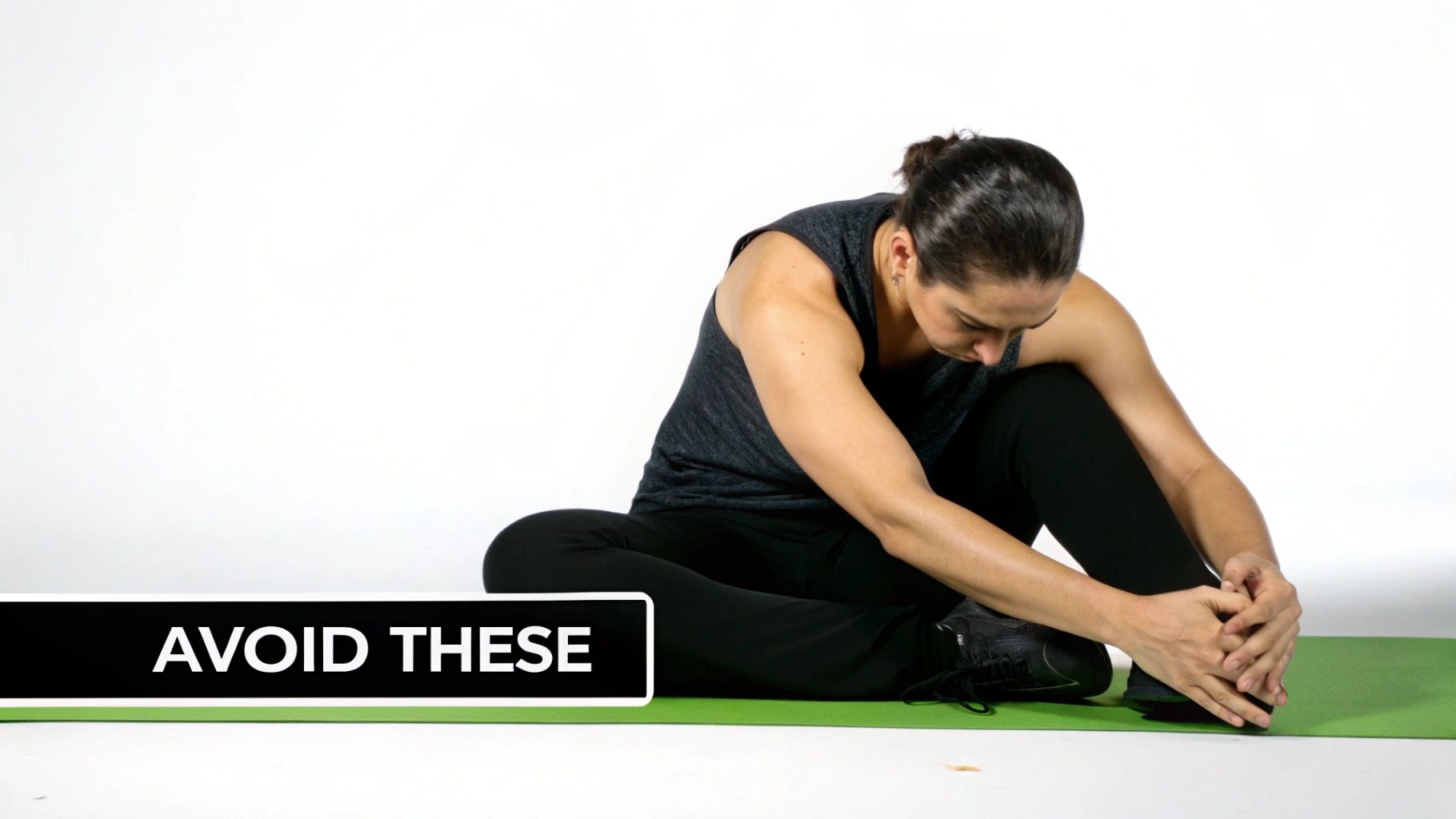
Let's talk about the usual suspects: Seated Forward Fold (Paschimottanasana) or a Standing Forward Fold with poker-straight legs. Yoga teachers often praise these for opening up the hamstrings, but for someone with sciatica from, say, a herniated disc, these are a huge red flag.
When you slump forward with a rounded low back, you’re not just getting a hamstring stretch. You’re putting the entire sciatic nerve on maximum tension, from your spine all the way down to your heel. It’s the anatomical equivalent of stepping on a garden hose. This move can also put a ton of pressure directly on your lumbar discs, which is the last thing you want if one is already bulging.
You might feel a deep "stretch" down your leg and think you're hitting the spot. But if that sensation is sharp, tingly, or electric, that's not your muscle letting go—that's your nerve begging you to stop.
Spinal twists like Ardha Matsyendrasana (Half Lord of the Fishes Pose) can feel fantastic for wringing out a stiff back. But when done too aggressively, they can spell trouble for sciatica. Combining that deep forward rounding with a powerful twist can squeeze your discs and narrow the very channels your nerve roots need to pass through.
If your sciatica is coming from something like spinal stenosis (a narrowing of the spinal canal), these compressive twists can directly poke the bear. You’re essentially putting pressure on the exact spots that need more space.
Your body is your best guru. Any pose that brings on that familiar, sharp, shooting, or burning pain down your leg is a hard no. A good stretch should feel like a sigh of relief, not a threat.
Building a smarter practice means knowing how to get the good stuff from a pose without the risk. You don't have to abandon stretching; you just have to make some clever swaps. This is where modifications become your secret weapon, helping you build a practice that actually heals instead of harms.
Here’s a quick cheat sheet comparing some common culprits with much safer alternatives. These give you the same benefits without putting your nerve in the danger zone.
Think of these swaps as your go-to toolkit. They ensure you’re always working with your body, gently coaxing muscles to release while giving that sensitive sciatic nerve the space and peace it needs to calm down.
Let’s be honest, practicing yoga at home to soothe sciatica can feel like walking a tightrope. Are your hips truly square in Pigeon Pose? Is your spine actually neutral, or just feeling neutral? When you’re trying to calm down a fiery sciatic nerve, these aren't small details. They’re everything.
Without an experienced teacher there to offer a gentle nudge, it’s easy to do more harm than good. This is where a bit of smart tech can completely change the game for your solo practice.
Picture this: an expert yoga instructor, right there in the room with you, whispering corrections for every single pose. That’s essentially what AI-powered yoga apps like Dalm bring to your mat. Using your phone or tablet's camera, these tools analyze your form with surprising accuracy, acting as a virtual spotter to keep you safe and honest.
You're not just mindlessly following a video anymore. You're getting live, personalized feedback. The app might cue you to "Engage your core a bit more" in Bridge Pose, or "Gently draw your right hip back" to fix a subtle twist. It’s not about replacing a human teacher, but about making your time on the mat so much safer and more effective.
When your alignment is off by just a few degrees, you risk compressing the very nerve you're trying to help. AI guidance helps make sure every movement is a step toward healing, not a step back.
This kind of granular feedback is a godsend for a condition like sciatica. It helps you tune into your own body, correcting those tiny postural habits that might be feeding the problem in the first place. You can finally be confident that your yoga for sciatica is actually providing relief.
One of the most maddening parts of recovery is that feeling of being stuck. Did that hamstring stretch go a little deeper today? Is your balance getting steadier? It’s often too subtle to notice on your own.
AI-powered apps take out the guesswork. They can meticulously track your alignment, balance, and flexibility over time, giving you concrete proof that your hard work is paying off. Seeing those small wins charted out is a massive motivator, especially on days when the pain makes you want to skip your practice altogether.
This tech is also great at spotting your unique patterns. Maybe the app notices you always favor your left side or that your hips hike up whenever you’re in a lunge. These little insights are pure gold, helping you understand your body’s quirks and address them with focused intention.
Here's how this tech builds a smarter, safer practice:
This brings a whole new level of intelligence to your home routine. While apps are one piece of the puzzle, other accessories like the newest smart yoga mats are also changing how we practice at home. By blending mindful movement with smart feedback, you can build a practice that’s not just powerful, but genuinely healing.
When you're dealing with the sharp, zinging pain of sciatica, it's natural to have a ton of questions. Let's be honest, it’s a tricky condition, and the last thing you want is to do something on your yoga mat that makes it worse. We've heard all the common concerns, so let's clear the air and get you moving with confidence.
This is the big one, right? The key here is to forget the "no pain, no gain" mentality. When you're in the middle of a flare-up, less is definitely more.
A short, super-gentle session of just 10-15 minutes once a day can work wonders. The goal isn't to sweat or push your limits; it's to gently mobilize the area and, just as importantly, calm your frazzled nervous system.
Once that intense, acute pain starts to fade, you can think about building a preventative practice. Aiming for 20-30 minutes, maybe 3-4 times a week, is a fantastic target. It's this consistency that really builds the core strength and hip flexibility needed to tell sciatica it's not welcome back.
Consistency will always beat intensity. A little mindful movement every day is worlds better than one epic weekend session that leaves you feeling sore and sorry.
Getting this right is probably the most crucial part of your practice. You absolutely have to learn the difference between a productive muscle stretch and a nerve-related warning shot.
Your yoga practice should never, ever replicate the pain you're trying to heal. The second you feel that nerve-y sensation, ease out of the pose until it vanishes completely.
In a word: yes. And that's why knowing what not to do is just as important as knowing the right poses.
As we've talked about, certain movements can be disastrous for an angry sciatic nerve. Think aggressive, straight-legged forward folds or deep, forceful twists. These can put direct pressure on your lumbar discs or yank on an already inflamed nerve.
Here's an analogy: if you have a cut on your finger, you wouldn't keep pulling the skin apart and expect it to heal. It’s the same idea. Forcing a sensitive nerve into a deep stretch just makes it angrier. This is precisely why we focus on gentle, modified poses—it’s the safest, and ultimately, the most effective path to relief.
Patience, my friend. Sciatica recovery is rarely a straight line. You’ll have good days and bad days, and that's completely normal.
Some people, especially if their pain is from a tight piriformis muscle, might feel a bit of relief after just a few gentle sessions. If your sciatica is rooted in a disc issue, the journey can be a bit slower. You might notice small wins at first—like being able to sit for a few more minutes without pain, or feeling less like the Tin Man when you get out of bed.
These little improvements are huge signs you’re on the right track. Generally, with a consistent and mindful practice, most people start feeling a real, meaningful difference within two to six weeks. It’s about playing the long game and creating lasting change, not just chasing a quick fix.
Ready to bring some intelligence to your home practice? Dalm uses AI to give you real-time feedback on your form, making sure every pose is a step toward healing. You can perfect your alignment and track your progress with personalized guidance by visiting the Dalm website.