
Your Guide to Yoga Studio Membership Cost
So, you're ready to roll out your mat and find your flow, but there's that one little question hanging in the air: what's this going to cost me? Let's cut right to the chase. In the U.S., you'll find that most unlimited monthly memberships land somewhere between $100 and $200.
But that's just the headline. The full story has a lot more interesting details.
Trying to pin down the exact cost of a yoga membership can feel like wobbling through a new balance pose—it takes a bit of focus! While that $100 to $200 monthly range is a great starting point, prices can swing dramatically depending on where you live, what the studio offers, and the kind of package you're looking at.
Yoga is bigger than ever, and that's a good thing. The global yoga market hit about $107.1 billion in 2023, and here in the U.S., the studio scene alone is a $14.7 billion industry. For you, this means tons of options, but it also means you've got to sort through a lot of different pricing setups. You can dive deeper into these yoga market trends to see just how much the industry has grown.
To really get a feel for what you're spending, you need to think in terms of cost-per-class. This is the secret number that tells you if you're getting a great deal. A spendy unlimited membership can actually be a total bargain if you're hitting the mat four times a week, while a "cheaper" class pack might end up costing you more if you only go once in a blue moon.
Here’s a quick-and-dirty breakdown of the usual suspects you'll see on a studio's pricing page. This is your cheat sheet to figuring out what's what.
This guide will break down all the little things that go into these prices, turning you into a super-savvy yogi who knows exactly what you’re paying for and why.

Walking into a yoga studio and trying to pick a membership can feel like staring at a giant menu in a foreign language. It's not a one-size-fits-all situation. The key is figuring out which plan speaks to your lifestyle, your budget, and how often you actually plan to hit the mat.
Let's demystify the typical options you'll encounter, from the casual "just visiting" plans to the "I basically live here" memberships.
Think of the drop-in as the "first date" of yoga plans. It's your zero-commitment way to feel out a studio's vibe, check out the instructors, and see if you click. No strings attached.
This is the perfect route if your schedule is a beautiful mess, you travel a lot, or you're on a mission to sample every studio in town before you settle down. It gives you ultimate freedom, but that freedom comes at a price—it's almost always the most expensive way to pay per class, usually running between $20 and $35 a pop.
Meet the happy medium: the class pack. It’s the yoga equivalent of a coffee shop punch card. You buy a bundle of classes upfront—usually 5, 10, or 20—and get a nice little discount for your loyalty.
This is a fantastic choice for anyone who practices regularly, say once or twice a week, but not quite enough to make an unlimited plan worth it. You get a better price per class than a drop-in, but still have the flexibility to pop in when you can. Just keep an eye on the expiration date! Most packs are good for three to twelve months.
The logic here is simple: commitment gets rewarded. When you buy in bulk, you’re signaling you’ll be back, and studios love that. So, they give you a better deal for it.
For the true devotee, the unlimited monthly membership is the promised land. This is the all-you-can-eat buffet of the yoga world. You pay one flat fee, typically between $100 and $200 per month, and can flow through as many vinyasas as your heart desires.
If you’re practicing at least twice a week, this is where you start saving serious money. For example, on a $150 monthly plan, hitting the mat three times a week drops your per-class cost to a mere $12.50. Plus, these memberships are often sweetened with some very tempting perks.
And for the truly committed, some studios offer annual memberships. It’s the ultimate long-term relationship, offering the absolute best per-class rate if you’re willing to pay for the whole year upfront. In the end, taking an honest look at your own habits is the first step to making a smart investment in your practice.
Ever get sticker shock looking at yoga studio prices? You see two studios that look pretty similar, but one wants $120 a month while the other is asking for a cool $220. It’s not just a random number they pulled out of a hat. That price tag is a carefully mixed cocktail of three key ingredients: where the studio is, who’s teaching, and what perks they offer.
It’s a bit like buying coffee. You can grab a decent cup of joe from the corner diner and it gets the job done. But that handcrafted, single-origin pour-over from the hip cafe on the trendiest block in town? That’s a whole different price point. You’re not just paying for coffee; you’re paying for prime real estate, the barista's years of practice, and the whole vibe. Yoga studios work the same way.
It's the oldest rule in real estate because it's true. A studio in a prime downtown spot in San Francisco or Manhattan is paying a small fortune in rent, and that cost inevitably trickles down to your membership fee. Meanwhile, a studio tucked away in a quiet suburban strip mall has much lower overhead, and you'll often see that reflected in their prices.
But it’s more than just rent. You're also paying for convenience. Is the studio right next to a major train station? Does it have a giant, free parking lot that saves you from the nightmare of circling the block for 20 minutes? That kind of easy access is a premium feature, and it's baked right into the price.
Let's be real: not all yoga teachers are the same. An instructor who just finished their 200-hour training is wonderful, but they simply don't have the same drawing power as a seasoned pro with 15+ years of experience, a wall of advanced certifications, and a cult following that sells out every single class.
Think of these big-name instructors as the headliners at a festival. People will happily pay more to learn from a master. Their deep expertise, their ability to command a room, and their profound understanding of the practice add a ton of value, which directly bumps up the studio's membership costs.
Okay, this is where the experience part really comes into play. One studio might just be a clean, simple room with some mats. Another might be a full-on wellness sanctuary that makes you want to move in.
You're paying for the entire atmosphere, which can include things like:
At the end of the day, a higher price often gets you more than just a class—it gets you an environment. It’s an investment in a clean, beautiful, and hassle-free space that helps your practice feel like a true escape from the daily grind.
Once you know what drives the price, you can figure out what really matters to you. Are you a no-frills yogi who just wants a great class, or is that post-flow sauna session an absolute must? Answering that question is the key to finding a studio that fits both your budget and your bliss.
Not too long ago, your yoga mat had one home: the studio. These days? It’s just as likely to be unrolled next to your coffee table. This is the big question for today’s yogi—do you stick with the sacred space of an in-person class or embrace the sheer convenience of a digital practice?
It's a classic head-vs-heart debate. On one hand, a traditional studio offers that incredible, almost electric energy of a shared practice. You get a real sense of community and the priceless benefit of a teacher’s hands-on adjustment to nudge you into the perfect alignment. But on the other side, digital platforms give you ultimate freedom and are way easier on your wallet. You can flow whenever and wherever you want, often for less than the cost of a single drop-in class.
The world of digital yoga has absolutely exploded. It’s no longer just a few pre-recorded videos on YouTube. Now we have live-streamed classes that make you feel like you’re right there, massive on-demand libraries, and even AI-powered apps that act as your personal coach. This digital boom has smashed the old barriers of price and location, making yoga accessible to pretty much everyone.
For a lot of people, the money-saving aspect is the real game-changer. An entire month's digital subscription often costs less than one trip to a brick-and-mortar studio. This has created a whole new kind of practitioner—the hybrid yogi who might hit up a few studio classes a month but keeps their daily practice consistent at home.
This quick visual guide breaks down the core factors that drive up studio membership costs, showing exactly why in-person yoga comes at a premium.
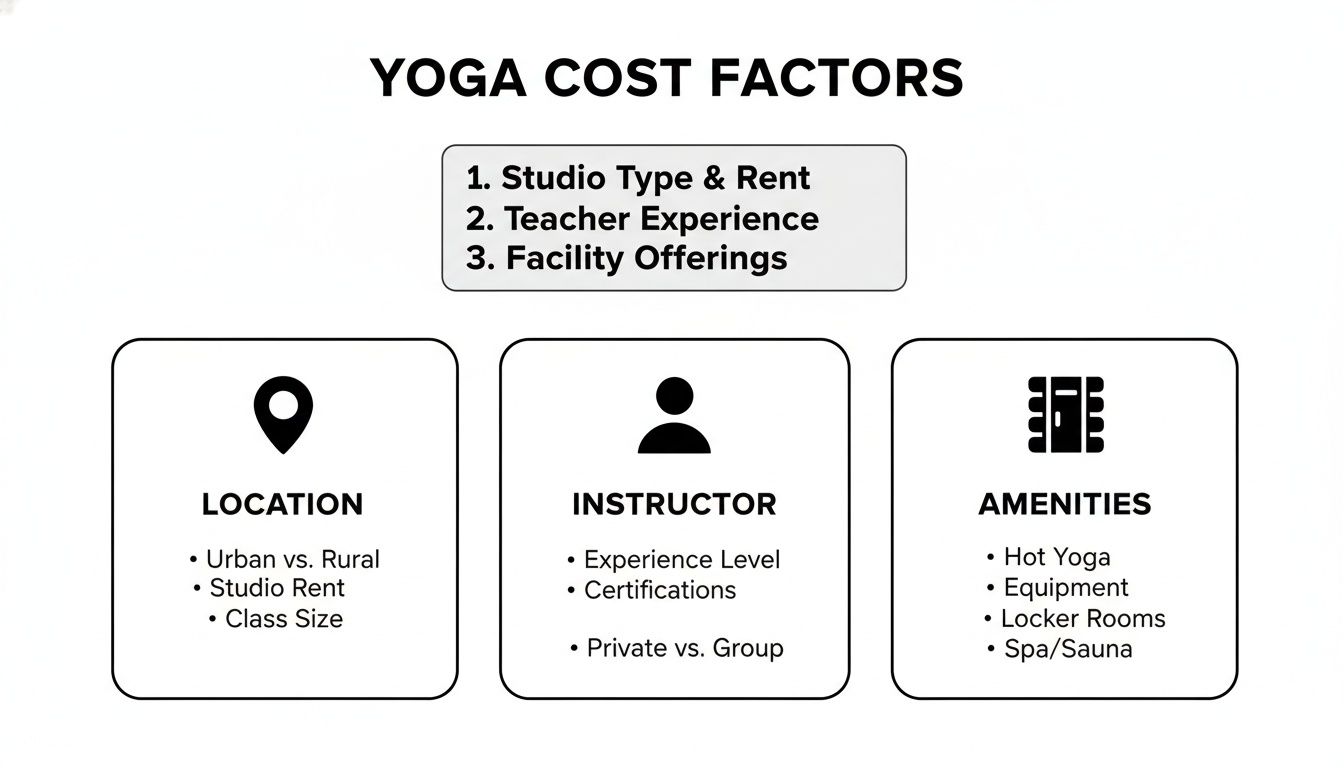
As you can see, you’re not just paying for the 60 minutes of instruction. You’re investing in the prime real estate, the deeply experienced teacher, and all the lovely amenities that make the studio experience feel like a mini-retreat.
Let’s be honest: the biggest drawback of practicing at home has always been the lack of feedback. How do you really know if your Warrior II is powerful or just a bit wobbly? This is where AI apps are making a huge splash. Using your phone or tablet's camera, they watch your form in real-time and give you gentle verbal cues to correct your alignment.
It’s like bridging the gap between a lonely online video and a pricey private lesson. You get the personalized guidance that used to be exclusive to in-person classes, making your home practice safer, stronger, and way more effective.
These AI-driven platforms offer a fantastic middle ground. They give you the affordability of digital yoga but with the kind of personalized feedback that actually helps you improve. Curious about the tech behind it? You can learn more about what a virtual yoga instructor actually does and see how it's reshaping modern yoga.
So, what's the right choice for you? It all boils down to what you value most. Are you craving that human connection and hands-on guidance? Or do you put a premium on flexibility and keeping your budget in check?
To make it easier, let’s put them head-to-head.
Here’s a no-nonsense comparison to help you weigh the pros and cons of traditional studios, free online classes, and the new wave of AI-powered yoga apps.
Ultimately, there’s no single "best" option—only what’s best for you. Whether you’re a studio devotee, a digital nomad, or a mix of both, the goal is the same: to get on your mat and find what feels good.

Ready to stretch your dollars as well as your hamstrings? Finding a yoga membership that fits your budget doesn't have to mean sacrificing quality. With a little bit of savvy, you can find your zen without sending your bank account into a tailspin.
Think of it as becoming a yoga bargain hunter. Your mission is to find the sweet spot between value and cost, and trust me, there are plenty of ways to make your practice more affordable. Let's dig into some of the best strategies.
Almost every single studio dangles a juicy carrot to attract new students, and you should absolutely take a bite. The "New Student Intro Offer" is often the single best deal you will ever find.
We're talking a week of unlimited classes for $25 or maybe even a whole month for $50. It's the perfect low-risk way to test-drive a studio—you can check out different instructors, get a feel for the community, and see if the vibe is right before you commit to a pricier plan. Don't be shy about studio-hopping with these deals until you find your home away from home.
Got more time on your hands than cash in your wallet? A work-study or karma yoga program could be your golden ticket. Many studios offer these programs, letting you work a few hours a week in exchange for free or heavily discounted classes.
The tasks are usually pretty straightforward and can include:
This is a fantastic way to become a real part of the studio community. You'll get to know everyone on a deeper level, and your membership cost could drop all the way to zero.
Think of a work-study program as a true energy exchange. You give the studio your time and positive energy, and in return, they give you unlimited access to the practice you love.
A little patience can go a long way, especially when it comes to saving money. Studios frequently run big promotions around key times of the year when people are naturally thinking about new routines and fitness goals.
Keep your eyes peeled for major sales during:
Lining up your purchase with one of these sales events can slash the price of a long-term commitment.
Don't forget to look for other ways to bring the cost down. Many employers and health insurance companies now offer wellness stipends or reimbursement programs for fitness activities, including yoga. A quick call to your HR department or insurance provider might reveal you have money just waiting to be claimed.
Also, ask if your studio offers off-peak memberships. These often come at a lower rate if you’re able to practice during quieter, less popular hours. And if you want to supplement your studio time on a shoestring budget, exploring the world of free yoga apps for beginners can give you extra practice without costing a dime.
Alright, you've found your yoga home. The incense smells just right, the light is perfect, and you’re ready to roll out your mat for good. But before you whip out your wallet, let's take a beat and talk about the not-so-zen part: the contract.
Think of it less as a stuffy legal document and more like the studio's playbook. It’s packed with crucial details that go way beyond your monthly membership cost. Skipping the fine print is like jumping into a headstand cold—a recipe for a nasty surprise. So, let’s break it down together.
Life is unpredictable. You might move, land a new job with a crazy schedule, or just decide to take a break. That’s why understanding the cancellation policy is an absolute must.
Most studios have a 30-day written notice policy. This means that after you give your notice, you should expect one more payment to come out. Some spots lock you into a minimum term, like three months, before you can cancel without getting hit with a penalty fee. Don't be shy—ask the front desk point-blank: "What's the exact process for canceling, and will it cost me anything?"
A studio with a clear, reasonable cancellation policy is a studio that respects its students. If the rules seem intentionally confusing or super strict, that’s a big red flag.
Heading off on a month-long adventure? Dealing with an injury that's keeping you off the mat? This is where the freeze or pause option becomes your saving grace.
Most places will happily let you put your membership on ice for a small fee, usually somewhere in the $15-$25 per month range. It's a brilliant little feature that keeps you from paying full price for a membership you can't even use.
Before you count on it, get the specifics:
And one last thing—keep an eye out for the auto-renewal clause. This is pretty standard; nearly every membership is designed to roll over automatically each month. Knowing your cancellation notice period is the key to making sure you don't get dinged for another month you didn't plan for. A few simple questions upfront will keep your yoga journey serene, both in the studio and on your bank statement.
Still a little fuzzy on the finances of finding your flow? Let's clear things up. The world of yoga pricing can feel a bit like a twisted pretzel pose at first, so here are the straight-up answers to the questions we hear all the time.
If you're just dipping your toes in the water with a single drop-in class, expect to pay somewhere between $20 to $35 in most major cities. In a smaller town or a more rural area, you might find that price closer to $15 to $25.
This is hands-down the priciest way to pay on a per-class basis, but it's the perfect no-strings-attached way to check out a studio's vibe, teachers, and community before you even think about committing.
For the dedicated yogi, absolutely. If you hit the mat at least twice a week, an unlimited membership is almost always a steal.
Pull out your calculator and do some simple "yoga math." Divide the monthly membership fee by the number of classes you realistically plan to attend. If a monthly pass is $150 and a single class is $25, you only need to show up six times that month to make it worth your while. Every class after that is basically free!
Your "breakeven point" is the magic number. If you can consistently hit that number of classes each month, the unlimited plan is your golden ticket to zen-on-a-budget.
You'd be surprised! While the big chain studios usually have set-in-stone pricing, you might find some flexibility at smaller, independent spots.
You’re not likely to get a discount on the standard monthly rate just by asking. But, you could try offering to pay for a full year upfront in exchange for a better deal. It also never hurts to politely ask if they have any unadvertised discounts for students, teachers, or even local business employees. The worst they can do is say no!
Ready to see what your home practice is truly capable of? Dalm uses AI to give you real-time feedback on your form, helping you master poses for a tiny fraction of what a studio costs. Unlock your potential at https://dalm.co.